
Most people following retatrutide are focused on one thing:
How much weight are people losing?
Fair enough. The results are getting a lot of attention.
But buried inside Lilly’s latest retatrutide announcement was something that could be just as important as the weight-loss numbers.
Lilly plans to submit retatrutide through something called a Biologics License Application, or BLA.
I know. That sounds like painfully boring FDA paperwork.
But stay with me, because this could decide who controls retatrutide, how hard it will be for competitors to copy it and whether compounding pharmacies ever get access to it.
The whole fight comes down to one strange question:
Is retatrutide legally a peptide—or is it close enough to a protein to be treated like a biologic?
First, what exactly is retatrutide?
Retatrutide is Lilly’s experimental once-weekly weight-loss drug.
It activates three different receptors:
- GLP-1
- GIP
- Glucagon
Semaglutide only targets GLP-1.
Tirzepatide targets GLP-1 and GIP.
Retatrutide adds glucagon to the mix, which is why people sometimes call it a triple agonist.
You may also see people online calling it “GLP-3,” but that is really just a nickname. There is no official GLP-3 drug class.
Retatrutide has not been approved yet.
But Lilly is already preparing for how it wants the FDA to regulate it once the clinical trials are finished.
That is where things get interesting.
The two roads
There are basically two different approval roads Lilly could take.
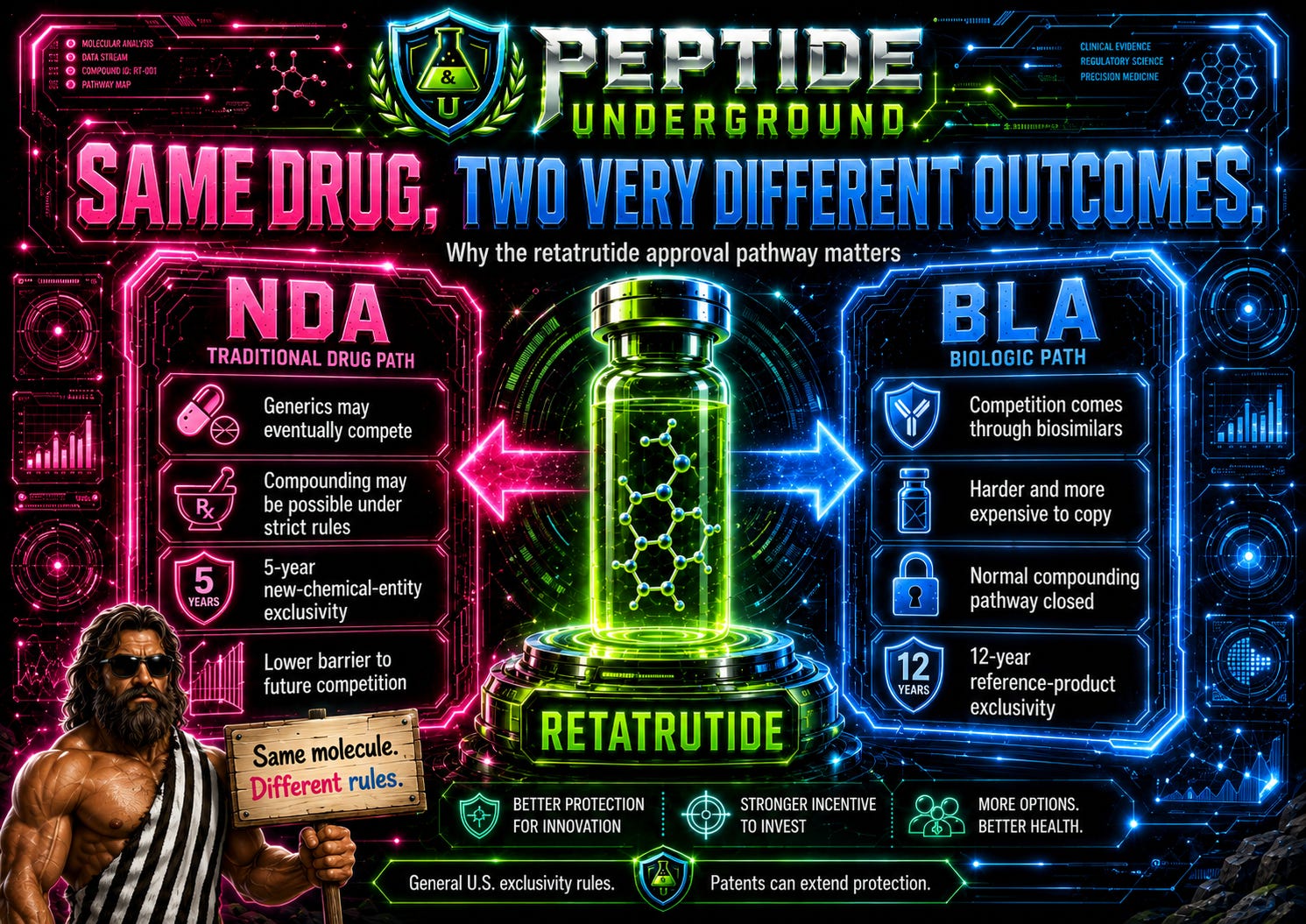
The first is the normal drug pathway, called an NDA.
That is the road used for drugs such as semaglutide and tirzepatide.
The second is the biologic pathway, called a BLA.
Why does that matter?
Because the biologic road may give Lilly stronger protection, make future competition more difficult and keep retatrutide outside the normal pharmacy-compounding system.
Same molecule.
Very different business outcome.
Why are they arguing about peptides and proteins?
Peptides and proteins are both chains of amino acids.
Think of amino acids like individual Lego pieces.
A shorter chain is usually called a peptide.
A longer and more complicated chain may be called a protein.
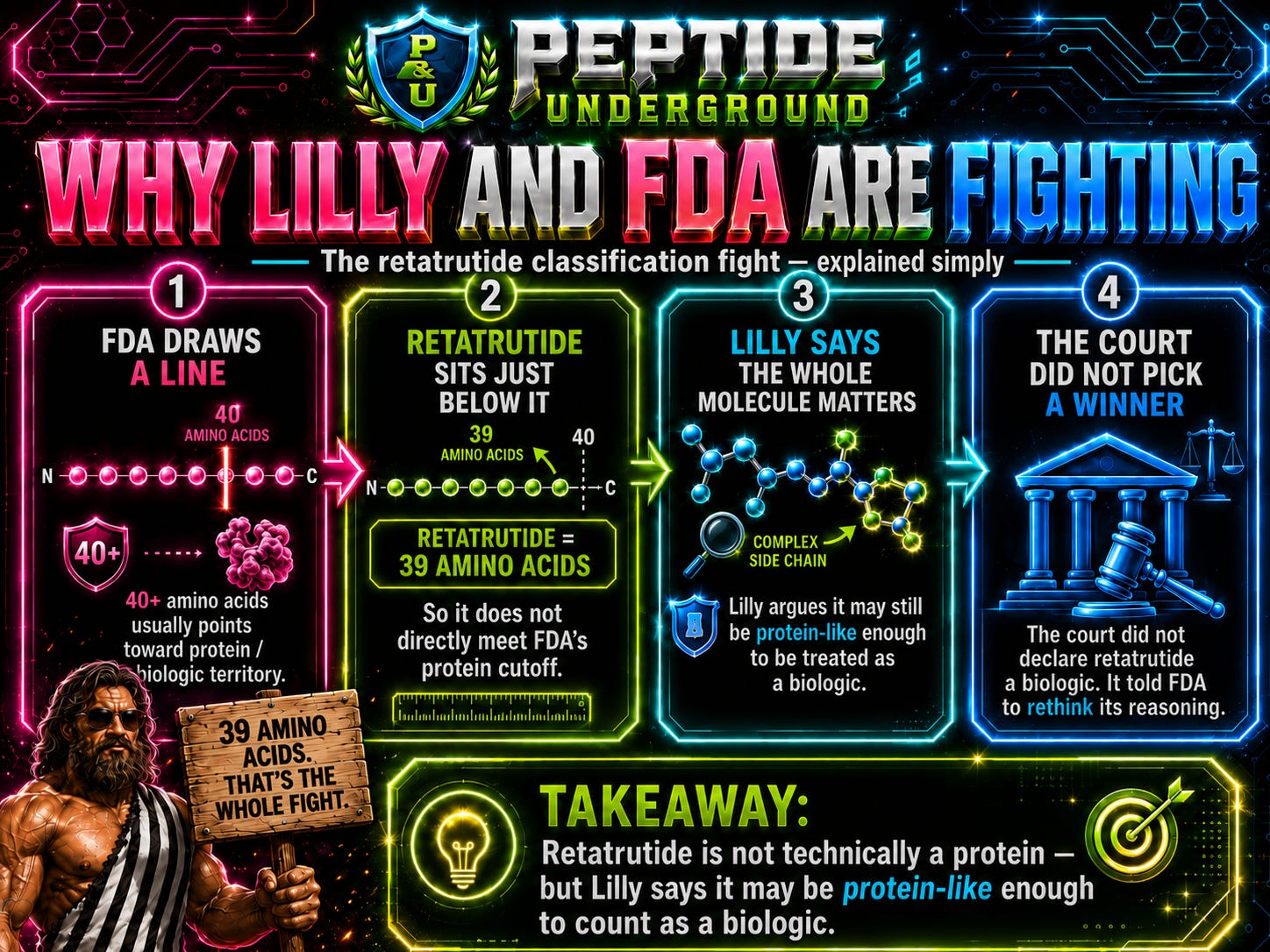
For FDA purposes, the agency generally considers a specifically ordered chain of more than 40 alpha amino acids to be a protein.
Retatrutide falls below that direct cutoff.
So at first glance, this seems simple:
Retatrutide is a peptide.
Case closed.
Except Lilly says the FDA should not only look at the number of amino acids.
Retatrutide also has other structural features that make the complete molecule more complicated than a plain peptide chain.
Lilly’s argument is basically:
“Maybe it does not technically fit your definition of a protein, but it is similar enough to one that it should still be treated like a biological product.”
That phrase—analogous to a protein—is what this entire legal battle is built around.
Caveman Explains
Lilly has new powerful drug.
Lilly wants big wall around drug.
FDA has two roads.
Normal drug road
Generics may eventually compete.
Compounding can sometimes happen under strict rules.
Biologic road
Competition is harder.
Copies are called biosimilars, not generics.
Normal compounding door is closed.
FDA looked at retatrutide and said:
“Not protein.”
Lilly said:
“Maybe not exact protein. But close enough. Biologic road.”
FDA said no.
Lilly sued.
Judge said FDA did not explain its answer well enough.
Now FDA has to look again.
If Lilly wins:
Bigger wall.
Harder competition.
Compounders stay outside.
Lilly already took the FDA to court
This is not just a theory.
Lilly previously asked the FDA to classify retatrutide as a biological product.
FDA refused.
So Lilly sued.
The court agreed with FDA on one point: retatrutide does not directly meet the agency’s definition of a protein.
But the judge also said FDA’s reasoning was too narrow when it rejected Lilly’s argument that retatrutide could be analogous to a protein.
In other words, FDA could not simply say:
“It is not technically a protein, therefore it cannot be similar to one.”
The judge sent that part of the decision back to FDA.
That was a real win for Lilly.
But it was not the final win.
The judge did not declare retatrutide a biologic.
FDA still has to reconsider the question—and it could still say no.
So this fight is not over.
Why Lilly wants the biologic road
The first reason is protection from competition.
A qualifying new biologic can generally receive 12 years of reference-product exclusivity.
A qualifying new conventional drug generally receives five years of new-chemical-entity exclusivity.
That does not mean competitors automatically arrive the day those periods end.
Patents and lawsuits can keep competition away for much longer.
But biologics are usually harder to copy.
With a conventional drug, competitors may eventually produce generics.
With a biologic, competitors have to develop something called a biosimilar.
A biosimilar is a product shown to be highly similar to the original biologic, without meaningful differences in safety or effectiveness.
That process is generally more difficult and expensive than making an ordinary generic.
For Lilly, that could mean fewer competitors and more control.
Now we get to the real bombshell: compounding
This is the part the peptide community should pay close attention to.
A compounded drug is not the same thing as an FDA-approved generic.
A compounding pharmacy prepares medication under special legal rules, often for a particular patient or clinical need.
Those rules apply to conventional drugs.
They do not normally apply to biological products.
So if FDA approves retatrutide as a biologic, traditional compounding pharmacies may not be able to make retatrutide copies through the same system used for other compounded drugs.
Even a shortage would not automatically open that door.
That means we may never see a legitimate compounded-retatrutide market like the one that developed around semaglutide and tirzepatide.
And that could completely change how people get access.
What about the retatrutide already being sold online?
This is where we need to be very clear.
Retatrutide is still experimental.
There is currently no FDA-approved Lilly retatrutide product on the market.
So anything being sold online today as:
- Reta
- GLP-3
- Research retatrutide
- Generic retatrutide
- Compounded retatrutide
is not an approved Lilly product.
It is not an FDA-approved generic.
It is not an approved biosimilar.
And calling something “research use only” does not magically turn it into an approved medication.
There may be real retatrutide circulating in the research market.
There may also be underdosed products, contaminated products or products containing something completely different.
The problem is that the buyer usually has no reliable way to know.
The unintended consequence
Here is the part I do not think regulators should ignore.
Blocking traditional compounding does not necessarily make demand disappear.
People will still want the drug.
Some will still look for cheaper access.
If licensed pharmacies cannot provide it, more people may move toward underground vendors.
So Lilly could gain tighter control over the legal market while the unregulated market grows underneath it.
That is not guaranteed.
But it is a very real possibility.
And it could create the opposite of the clean safety outcome regulators want.
This could go far beyond retatrutide
If Lilly succeeds, other drug companies will notice.
Future developers may not only ask:
Does this molecule work?
Is it safe?
Can we manufacture it?
They may also ask:
Can we design it so FDA treats it as a biologic?
Can we make generic competition more difficult?
Can we keep it outside the traditional compounding system?
There is no proof that retatrutide was originally designed for that purpose.
We should not claim that without evidence.
But companies now have a powerful incentive to think about regulatory protection while they design the molecule—not only after the drug is finished.
That could change the way future peptide-like drugs are built.
The bottom line
This sounds like an argument over amino-acid counting.
It is much bigger than that.
The real questions are:
Who controls retatrutide?
How long can they control it?
Who gets to compete?
And will compounding pharmacies ever be allowed inside the market?
FDA has not made the final decision.
Lilly may win.
Lilly may lose.
But if retatrutide is accepted as a biologic, it could become more than the next major weight-loss drug.
It could become the blueprint for locking down the next generation of peptide drugs before the public ever gets access.
Caveman Closing
Lilly made powerful molecule.
Now Lilly wants powerful wall.
FDA still deciding which road molecule belongs on.
Normal drug road leaves some doors open.
Biologic road closes more doors and builds bigger gate.
Fight not finished.
But whoever wins may decide more than future of retatrutide.
They may decide future of peptide market.
© 2026 Peptide Underground. All rights reserved.
This article is for educational and informational purposes only. It is not medical, legal or investment advice.
No posts
Comments
Nothing yet. Say the first thing.
Sign in to join the conversation.