
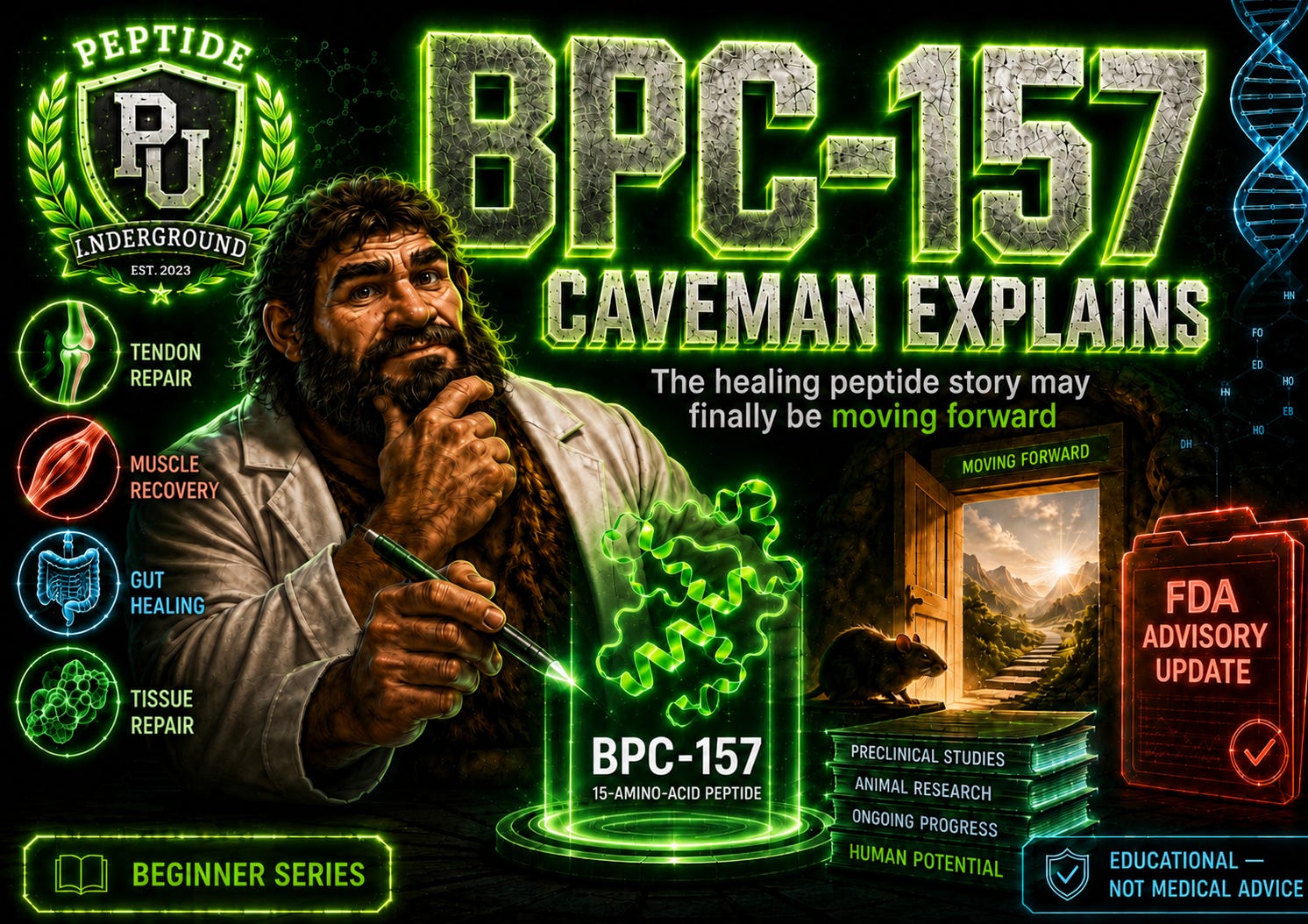
THE 30-SECOND VERDICT
What it may do: Help the body organize some of its natural repair signals.
Why people are excited: Animal studies have reported encouraging results involving tendons, muscles, the gut, nerves, and other damaged tissue.
What is still missing: Strong human trial results.
Bottom line: BPC-157 is one of the most promising—and most debated—peptides in the recovery world.
---
THE HOOK
BPC-157 has become one of the biggest names in peptides.
Athletes talk about it.
Bodybuilders talk about it.
People dealing with stubborn injuries and gut problems talk about it.
The excitement did not appear from nowhere.
Animal studies have reported better healing across tendon, muscle, gut, nerve, and soft-tissue injury models. Many people using it also report faster recovery, less discomfort, and calmer gut symptoms.
That makes BPC-157 worth understanding.
So what is it—and why has it gained such a massive following?
---
🦴 CAVEMAN EXPLAINS
Body get hurt.
Tendon angry. Muscle damaged. Gut irritated.
Body send repair crew.
Repair crew need directions:
“Go here.”
“Bring supplies.”
“Fix damage.”
BPC-157 may help those repair messages.
Rat get BPC-157.
Many rat studies show better healing.
People try it too.
Many say:
“Pain better.”
“Recovery faster.”
“Gut feel better.”
Caveman interested.
Now Caveman look closer.
---
WHAT IS BPC-157?
BPC-157 is a small chain of 15 amino acids—the tiny building blocks the body uses to make proteins and peptides.
Researchers became interested in it because animal studies suggested it may influence how damaged tissue responds to injury.
It is often called a healing peptide.
That nickname describes why people use it.
It does not mean every healing claim has been proven.
---
HOW MAY IT WORK?
When tissue gets hurt, the body has several jobs:
- bring blood and nutrients;
- send repair cells;
- build new tissue;
- organize collagen;
- control inflammation;
- protect nearby cells.
Animal and laboratory studies suggest BPC-157 may influence several parts of that process.
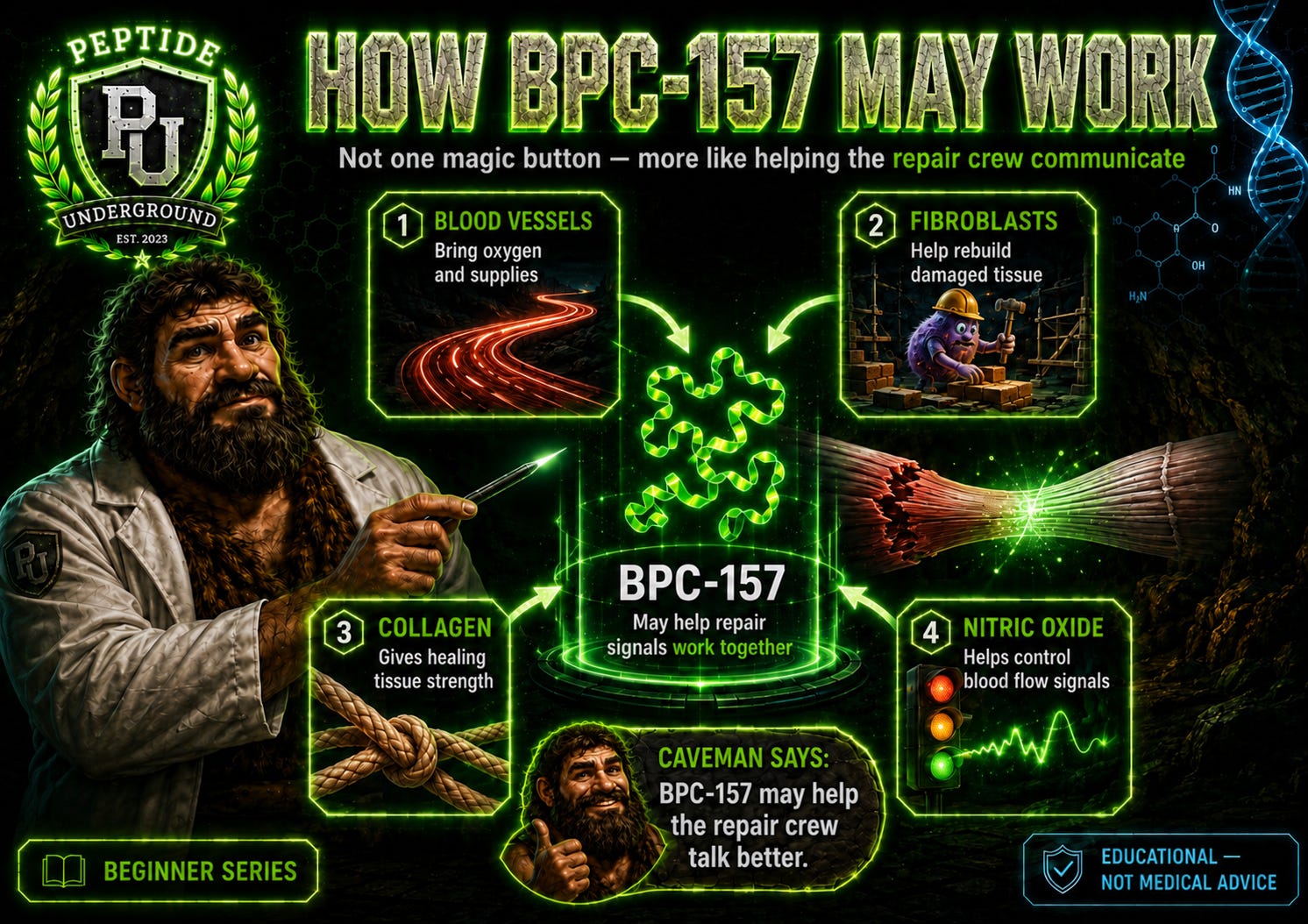
Think of it like a construction site:
Blood vessels are the roads bringing oxygen and supplies.
Fibroblasts are the workers helping rebuild damaged tissue.
Collagen is the rope and framework that gives the repair strength.
Nitric oxide is one of the signals helping control blood vessels and blood flow.
BPC-157 may help parts of this repair crew communicate and organize.
It is not one magic healing switch.
It may influence several repair signals at the same time.
---
WHAT DOES THE RESEARCH ACTUALLY SHOW?
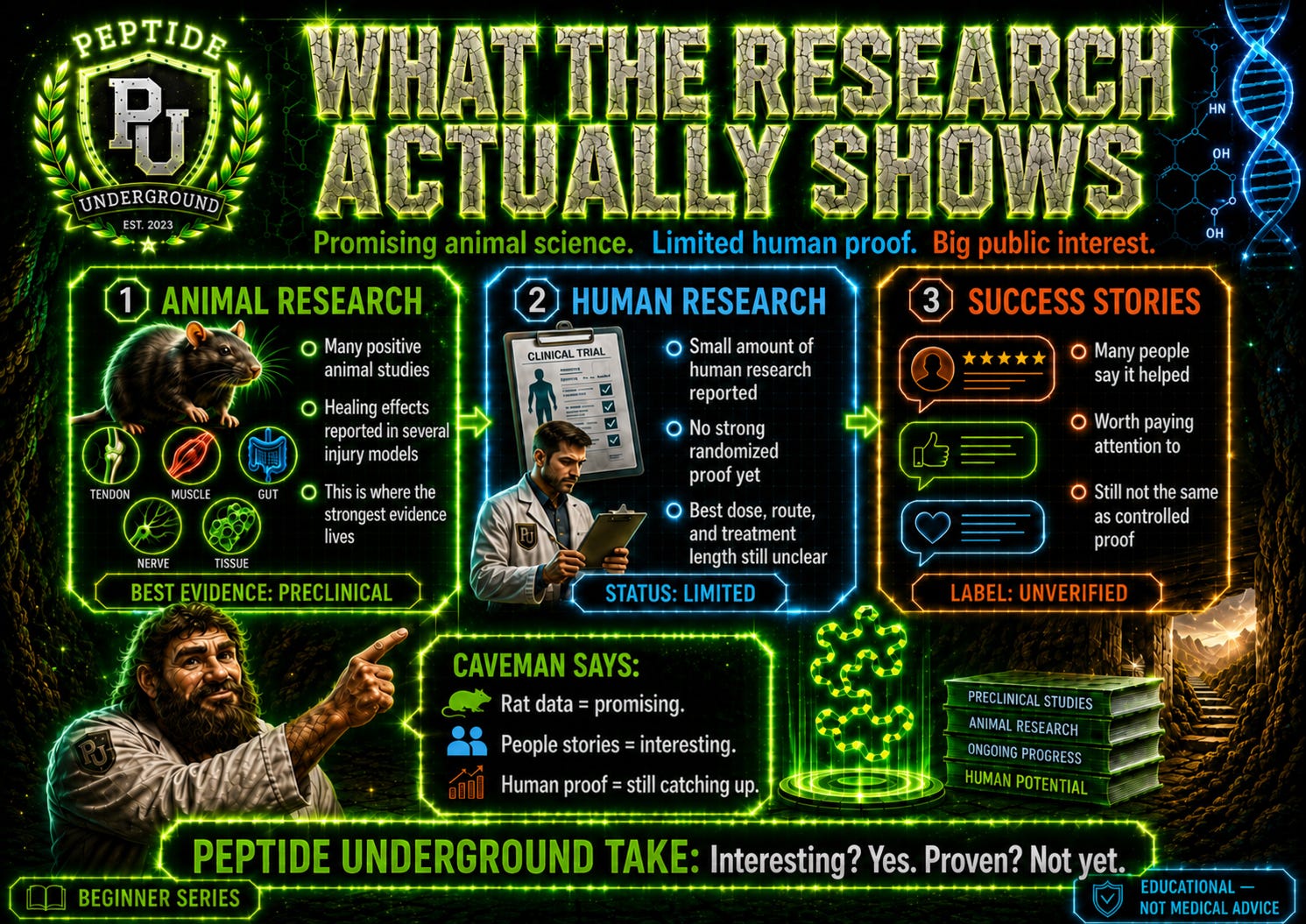
Animal studies have reported possible benefits involving:
- tendons, ligaments, and muscles;
- the stomach and intestines;
- ulcers;
- nerves;
- bones and soft tissue.
That is why BPC-157 has earned serious attention.
But animal studies are the beginning of the story—not the final answer.
The injuries, doses, and routes used in experiments may not match how people use BPC-157 in the real world. Some of the research also comes from overlapping research groups, so broader independent confirmation would strengthen the case.
A small amount of human research has been reported. One published safety pilot involved only two healthy adults, while other human reports have also been small and uncontrolled. A randomized Phase 2 hamstring-injury trial has now been registered, but it has not yet produced results.
So far, there are no convincing randomized human trial results showing that BPC-157 reliably heals tendons, muscles, gut injuries, surgical wounds, or chronic pain.
We also do not have a proven best dose, route, or treatment length.
The fairest conclusion is:
The animal research is promising enough to justify serious human trials.
The human proof is not here yet.
---
WHAT ABOUT THE SUCCESS STORIES?
Many people genuinely believe BPC-157 helped them.
Those stories should not be mocked or ignored. When large numbers of people report similar experiences, researchers should pay attention.
But a personal story cannot prove exactly why someone improved.
The injury may have healed naturally. Rest, physical therapy, nutrition, medication, or another treatment may have contributed.
People who get no result may also be less likely to talk about it.
TESTIMONIAL LABEL: UNVERIFIED
The experience may be real.
The exact cause remains uncertain.
---
A MEANINGFUL FDA UPDATE
On July 23, 2026, an FDA advisory committee voted 8–6, with one abstention, to recommend adding BPC-157-related substances to the federal 503A Bulks List. The committee had been asked to consider both BPC-157 free base and BPC-157 acetate.
That is meaningful progress.
It is not FDA drug approval.
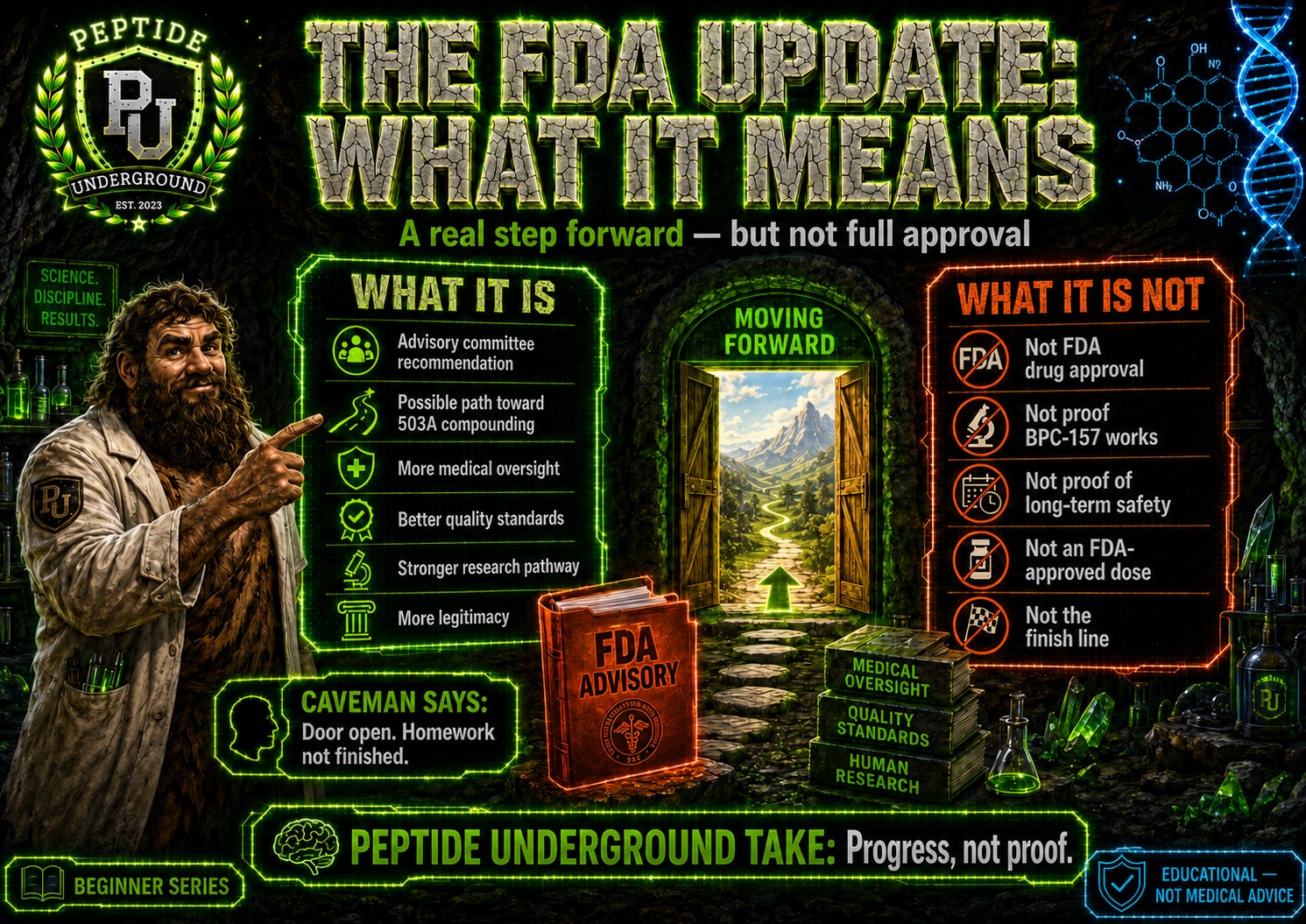
The recommendation is advisory, and the FDA must still decide whether to accept it and complete the required regulatory process. Even when a substance may be used in legal pharmacy compounding, the finished compounded drug is not FDA-approved or reviewed in advance for safety, effectiveness, and quality the way an approved drug is.
Still, the vote could eventually move BPC-157 closer to:
- regulated pharmacy compounding;
- physician involvement;
- stronger manufacturing standards;
- better product testing;
- more serious human research.
That matters because BPC-157 has spent years being obtained largely through an uneven research and gray market, where identity, concentration, purity, and sterility may vary.
Human safety information also remains limited. Better oversight and stronger trials are still needed to answer questions about repeated exposure, interactions, immune reactions, and long-term effects.
The vote does not prove BPC-157 works.
It does not establish an FDA-approved dose.
But it may create a safer and more legitimate path toward finding those answers.
This was not the finish line.
It was a door opening.
---
COMMON BEGINNER MISTAKES
“There are many studies, so it is proven.”
Most are animal or laboratory studies.
“It worked for someone online, so it will work for me.”
One person’s experience cannot predict everyone’s.
“It comes from the body, so it must be safe.”
Natural does not automatically mean harmless.
“The FDA approved it.”
No. An advisory committee recommended a possible compounding pathway.
That is progress—not drug approval.
---
🎓 PEPTIDE UNIVERSITY VERDICT
BPC-157 is not an empty internet myth.
It has a real and encouraging animal-research library behind it.
It also has years of enthusiastic reports from people who believe it helped their injuries, recovery, or gut symptoms.
That combination makes it worth taking seriously.
But it is not proven human medicine.
The FDA advisory vote gives the story real momentum. Combined with the newly registered Phase 2 trial, it could help move BPC-157 toward better-quality products, stronger medical oversight, and the human evidence it has needed for years.
Keep these three statements separate:
1. Animal studies look promising.
2. Many users report benefits.
3. Human effectiveness has been proven.
Only the first two are currently fair.
Promising science.
Strong public interest.
Limited human proof.
Real progress—and a reason to keep watching.
---
🦴 CAVEMAN FINAL WORD
Rat data look good.
People stories sound strong.
Human proof still small.
FDA panel open door.
Caveman no say:
“Proven.”
Caveman say:
“Progress.”
“Now do real human studies.”
Science homework still due.
But classroom door finally open.
Class dismissed. 🎓
---
SOURCES
- U.S. Food and Drug Administration — July 23–24, 2026 Pharmacy Compounding Advisory Committee meeting materials and 503A Bulks List information.
- Reuters — FDA advisory committee vote on BPC-157, July 23, 2026.
- ClinicalTrials.gov — Randomized Phase 2 study of BPC-157 for acute hamstring muscle-strain repair.
- Lee et al. — Safety of Intravenous Infusion of BPC157 in Humans.
- McGuire et al. — Review of BPC-157’s preclinical evidence and limited human research.
- FDA — Compounded drugs are not FDA-approved and are not reviewed before marketing in the same way as approved drugs.
---
© 2026 Peptide Underground. All rights reserved.
Educational content only. This material is not medical advice and is not a substitute for evaluation, diagnosis, or treatment by a qualified healthcare professional.
No posts
Comments
Nothing yet. Say the first thing.
Sign in to join the conversation.