
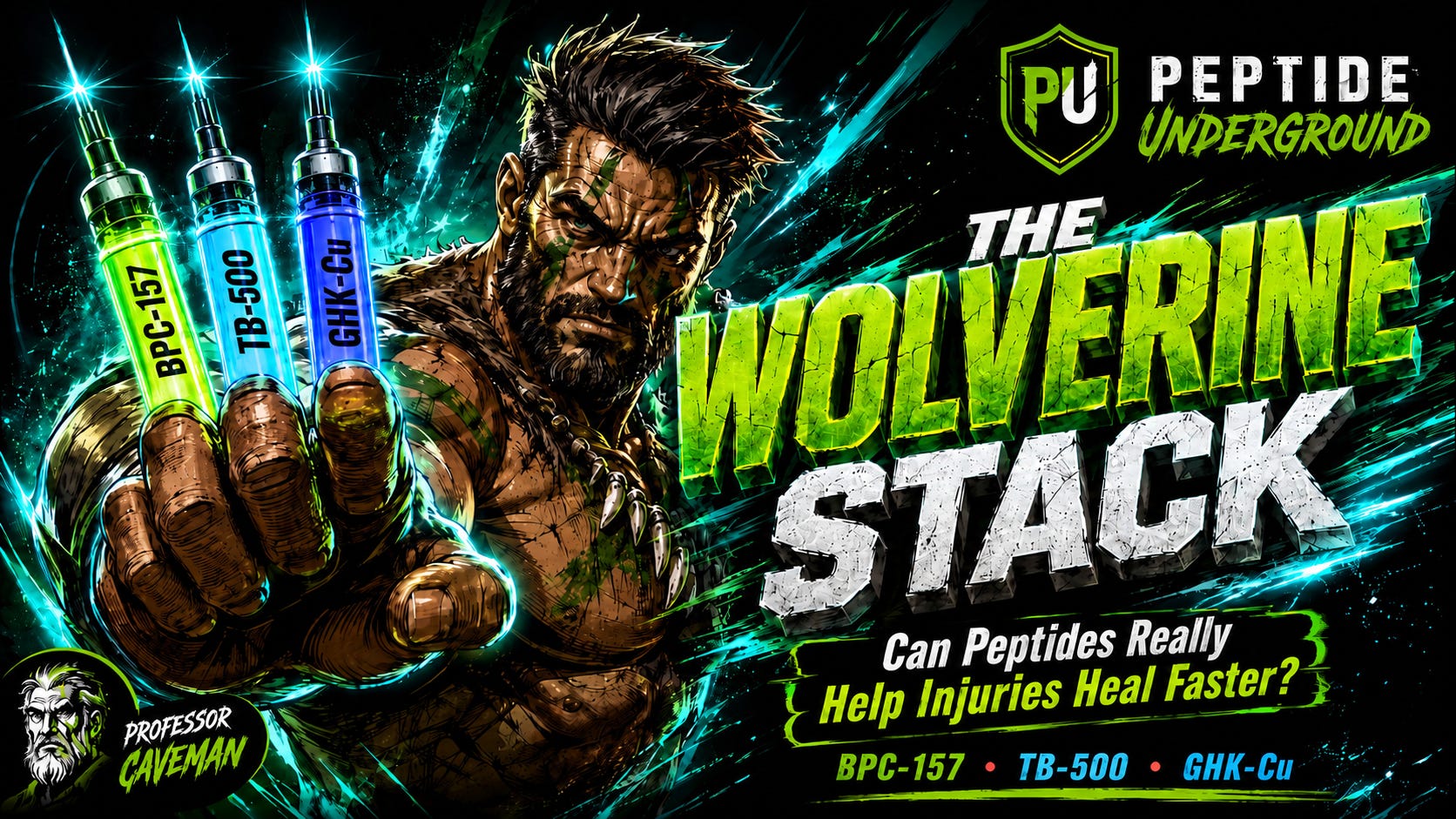
After the recent FDA panel hearing brought peptides back into the spotlight, a lot of people are hearing names like BPC-157, TB-500, and GHK-Cu for the first time.
Once you start looking into recovery peptides, one name appears everywhere:
The Wolverine Stack
Supporters claim it may help with stubborn injuries, sore joints, damaged tendons, torn muscles, inflammation, and recovery after hard training.
The name sounds powerful.
But what is it—and how much of the hype is actually supported?
Let’s keep it simple.
---
THE 30-SECOND ANSWER
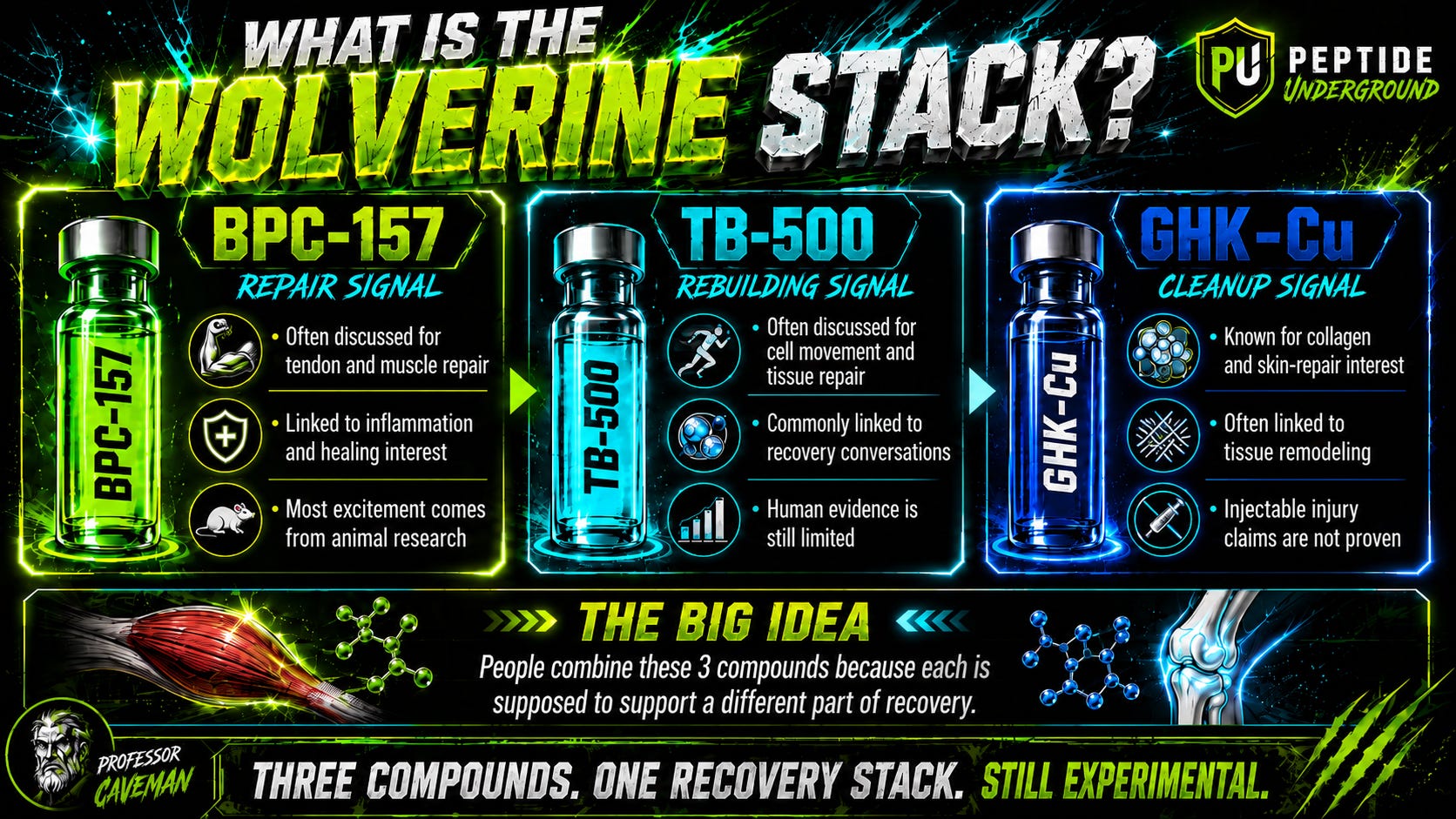
The Wolverine Stack usually combines:
- BPC-157
- TB-500
- GHK-Cu
The idea is that each compound supports a different part of the repair process.
The biology is interesting.
Animal and laboratory research is promising.
But the complete stack has not been proven in strong human injury trials.
Bottom line:
Promising enough to study. Not proven enough to guarantee results.
---
CAVEMAN EXPLAINS
Body gets injured.
Body sends repair crew.
As we get older, that crew may move slower.
The Wolverine Stack is supposed to give the crew better instructions:
- BPC-157 says, “Start fixing the damage.”
- TB-500 says, “Move the workers into position.”
- GHK-Cu says, “Rebuild and clean up the area.”
Good plan on paper.
But a good plan is not the same as proven results.
---
WHAT IS A PEPTIDE?
Peptides are small chains of amino acids that can act like biological messages.
Those messages may tell cells to:
- Repair tissue
- Reduce inflammation
- Build collagen
- Release hormones
- Move toward damaged areas
That is why researchers are interested in them.
But it does not mean every peptide works, every dose is safe, or every vial sold online is legitimate.
---
BPC-157
The repair signal
BPC-157 is the best-known compound in the stack.
It has been studied for possible effects on:
- Tendons
- Muscles
- Blood-vessel growth
- Inflammation
- Digestive tissue
The exciting part is that BPC-157 has shown strong-looking results in several animal studies.
The problem is that we still do not have strong human trials proving that injected BPC-157 heals torn tendons, ligaments, or muscles.
The science is interesting.
The certainty is not there yet.
---
TB-500
The rebuilding signal
TB-500 is commonly described as a compound that may help cells move toward damaged tissue and support repair.
This is also where the science gets confusing.
TB-500 is often treated as though it is exactly the same as thymosin beta-4.
That is not always accurate.
Full-length thymosin beta-4 has been studied in wound healing, skin repair, and eye conditions.
But that does not automatically prove that every vial sold as TB-500 will repair a damaged shoulder, knee, or muscle.
The names are often mixed together.
The research should not be.
---
GHK-CU
The cleanup signal
GHK-Cu is a copper-binding peptide best known for its possible effects on:
- Collagen
- Skin repair
- Wound healing
- Blood vessels
- Oxidative stress
It has some legitimate human research behind it, but much of that research involves skin products and topical use.
That distinction matters.
A peptide helping skin does not automatically prove that injecting it will rebuild a tendon, ligament, nerve, or muscle.
The injectable injury claims are still ahead of the evidence.
---
WHY PEOPLE COMBINE THEM
The stack sounds logical because each compound is supposed to handle a different part of recovery.
Compound| Simple role
BPC-157| Starts the repair response
TB-500| Supports cell movement and rebuilding
GHK-Cu| Supports collagen and cleanup
The theory is that combining them creates a stronger effect.
Maybe it does.
But the complete Wolverine Stack has not been properly tested in controlled human injury trials.
We do not know whether the compounds:
- Work better together
- Add little to each other
- Need different doses
- Work differently depending on the injury
- Create unexpected risks when combined
The stack is a practitioner and community protocol.
It is not an established medical treatment.
---
WHAT ABOUT THE FAST RECOVERY CLAIMS?
You may hear claims like:
- Pain drops in the first week
- Movement returns in two weeks
- Training resumes by Week Four
- Full recovery happens by Week Six
Those are not established clinical timelines.
Some people may improve quickly.
Others may notice little or nothing.
There is also a major difference between feeling better and being fully healed.
Pain may drop before the tissue is strong enough for heavy loading.
Less pain does not always mean the injury is gone.
---
ARE THESE COMPOUNDS SAFE?
We do not have enough human research to say that long-term injectable use is safe.
Possible risks include:
- Injection-site reactions
- Infection
- Contaminated products
- Incorrect concentrations
- Mislabeling
- Immune reactions
- Unknown long-term effects
The words “research use only” do not guarantee that a vial is pure, sterile, correctly dosed, or even contains what the label says.
Peptides are biological signals.
Biological signals can still cause problems.
---
COMMON BEGINNER MISTAKES
Believing animal research equals human proof
Animal studies are useful.
They are not a guarantee.
Assuming pain relief means the injury is healed
Pain and structural repair are not the same thing.
Treating TB-500 and thymosin beta-4 as identical
The names are often blended together, but the evidence may not match.
Believing three compounds automatically create synergy
A logical combination is not automatically a proven one.
Skipping the diagnosis
A painful shoulder could be a strain, tendon injury, full tear, nerve problem, joint issue, or pain coming from the neck.
Knowing what is actually damaged still matters.
---
THE HONEST READ
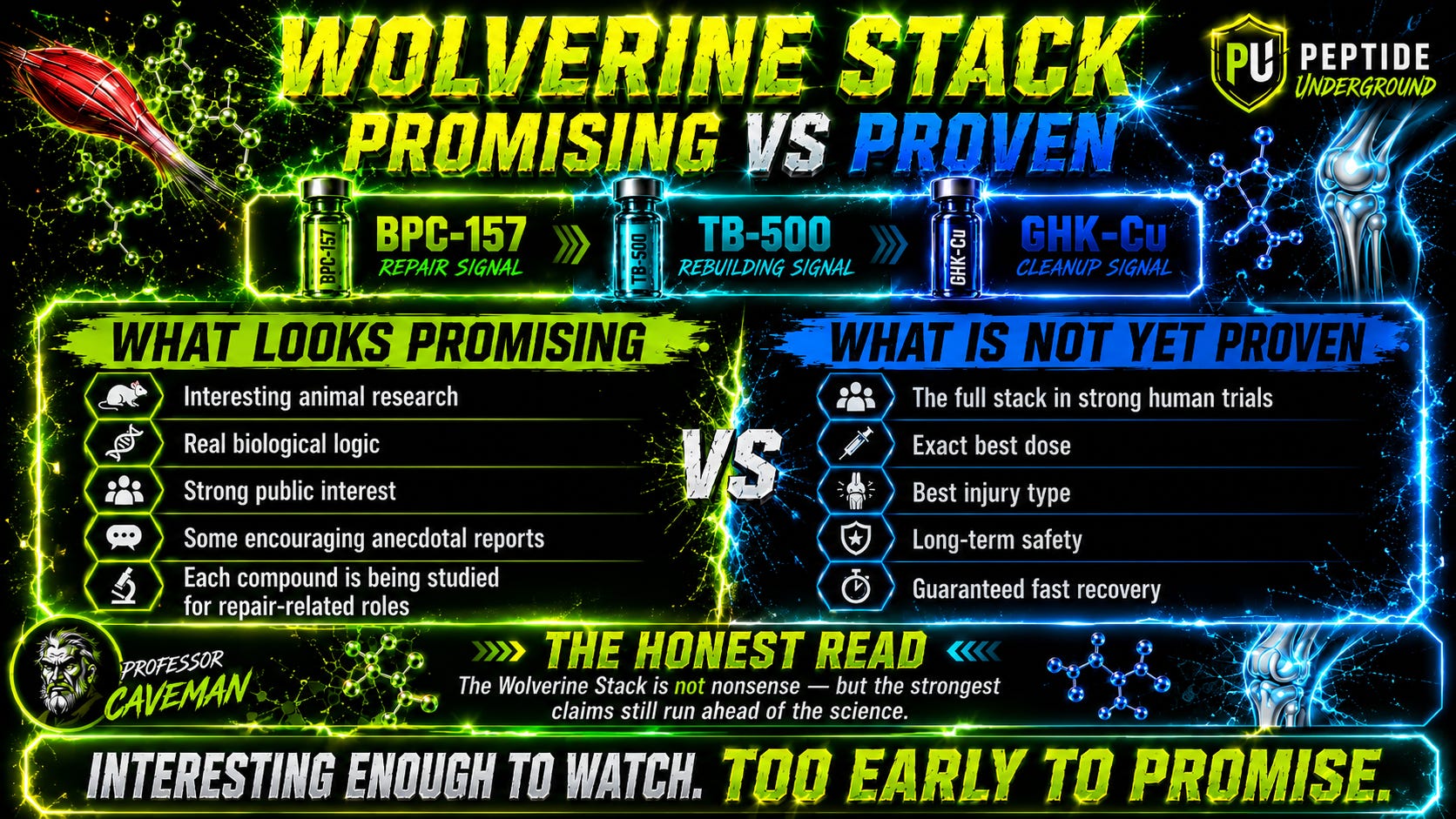
The Wolverine Stack is not nonsense.
Each compound has a real scientific reason for being studied.
BPC-157 has interesting animal research.
Thymosin beta-4 has legitimate wound-healing research, although it should not automatically be treated as identical to TB-500.
GHK-Cu has credible research involving skin and tissue remodeling.
The problem begins when early research turns into certainty.
We cannot honestly say the Wolverine Stack:
- Completely regenerates damaged tissue
- Works for every injury
- Restores everyone to 100%
- Has no downsides
- Is fully proven
Those claims are stronger than the evidence.
---
FINAL CAVEMAN SUMMARY
Three compounds.
Three interesting science stories.
Internet ties them together and calls it Wolverine.
Maybe the stack helps.
Maybe one compound helps more than the others.
Maybe recovery also comes from rehab, better training, sleep, and time.
Right now, we do not know enough to separate those things with confidence.
Stay interested.
Stay skeptical.
Do not confuse a strong story with proven medicine.
---
FINAL EVIDENCE STRENGTH: WEAK
That does not mean useless.
It means the human evidence is still limited, the complete stack has not been properly tested, and the strongest claims are running ahead of the science.
PEPTIDE UNDERGROUND VERDICT
Worth watching. Worth researching. Too early to promise.
Educational content only. This article does not diagnose injuries, recommend self-injection, or replace qualified medical care.
© 2026 Peptide Underground — No hype. Just the honest evidence.
No posts
Comments
Nothing yet. Say the first thing.
Sign in to join the conversation.