
0:00
-9:58
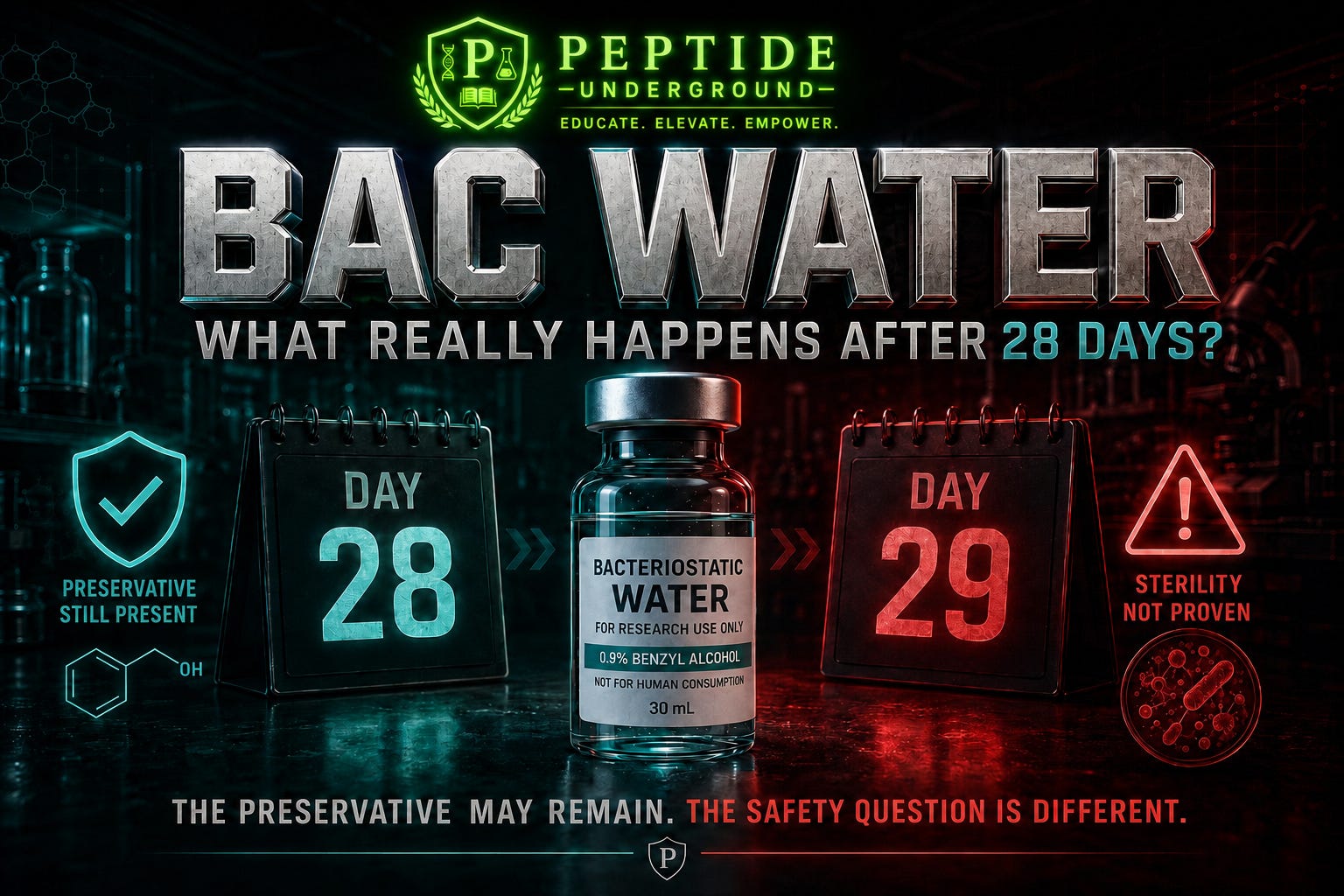
Spend enough time around peptides and you will hear the same rule repeated:
«Once bacteriostatic water has been punctured, you have 28 days to use it. After that, throw it away.»
Most people accept that rule without asking what actually changes after four weeks.
Does the benzyl alcohol stop working?
Does the water suddenly become contaminated?
Does the vial somehow become unsafe the moment Day 28 turns into Day 29?
A laboratory infographic that has been circulating through peptide circles appeared to offer part of the answer. It showed reported benzyl-alcohol measurements from bacteriostatic water over 120 days.
That caught my attention and pushed me to look deeper.
According to the results shown in that infographic, the preservative remained present well beyond the 28-day cutoff. However, I have not independently verified the complete original laboratory report, so the figures should be treated as preliminary.
The infographic may challenge one popular explanation for the rule.
It does not prove that an opened vial stays sterile or safe for months.
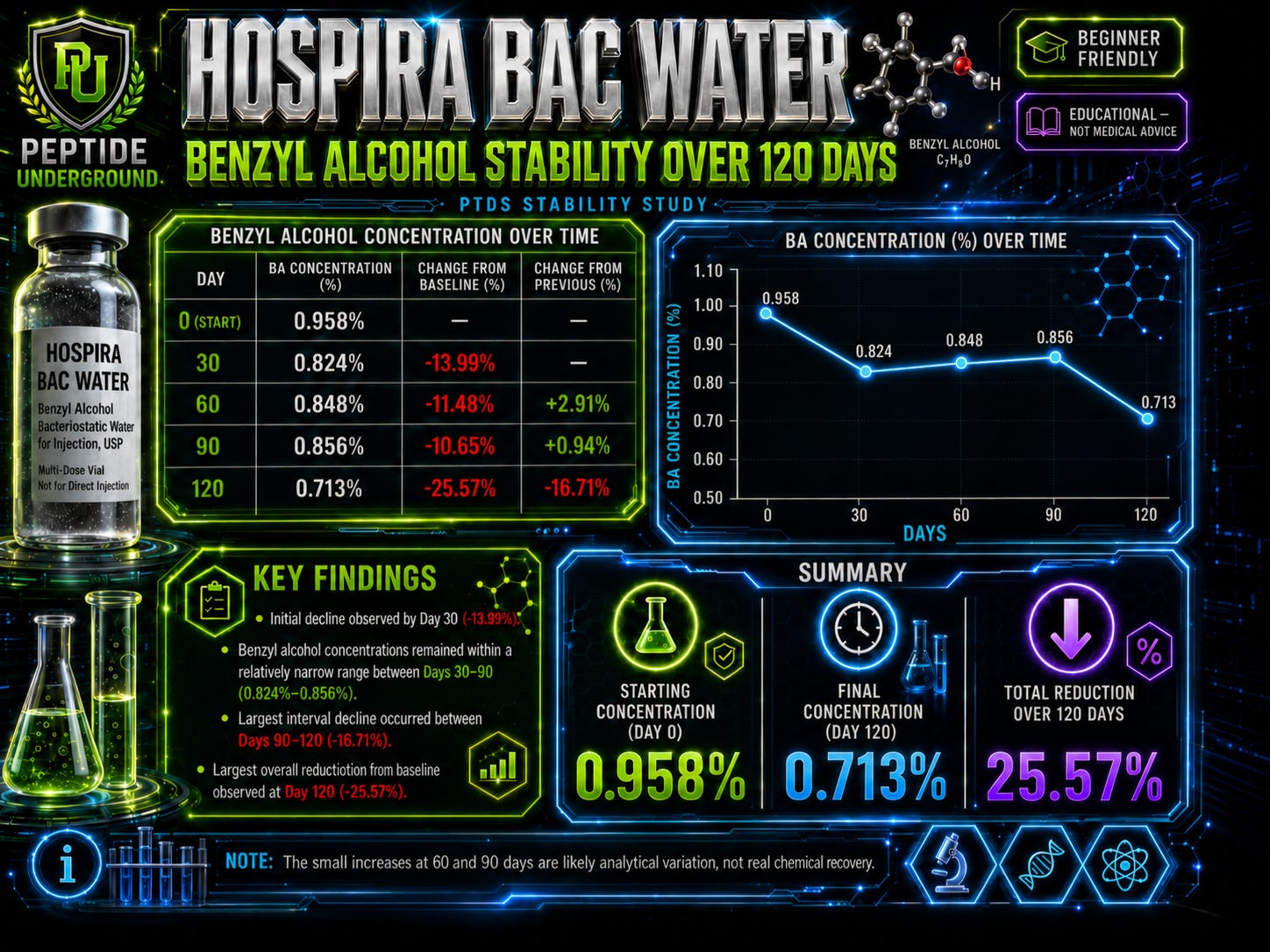
[Chemical concentration findings only. This test did not establish sterility or validate use beyond 28 days.]
That distinction is the entire point of this article.
Let’s break it down.
---
What the Test Reportedly Found
The reported results were:
- Starting concentration: 0.958%
- Day 30: 0.824%
- Day 60: 0.848%
- Day 90: 0.856%
- Day 120: 0.713%
From the beginning of the test to Day 120, the measured concentration dropped by roughly 25%.
The small increases between some dates probably do not mean the benzyl alcohol rebuilt itself. They are more likely normal variation in the testing or sampling process.
The main point is simple:
The benzyl alcohol did not appear to disappear after 28 days.
Even at Day 120, the sample reportedly still contained a meaningful amount of preservative.
That matters because bacteriostatic water is sterile water with benzyl alcohol added, usually at a concentration of 0.9%, or 9 mg/mL.
The benzyl alcohol helps slow bacterial growth after the vial has been entered multiple times.
So this test challenges one common claim:
«“BAC water has to be thrown away after 28 days because the benzyl alcohol is gone.”»
Based on the reported numbers, that explanation does not appear to hold up.
But that does not settle the whole issue.
---
Preservative Remaining Does Not Prove Sterility
This is the part that matters most.
The test appears to have measured how much benzyl alcohol remained.
It did not prove that the vial was still sterile.
Those are not the same thing.
Think of benzyl alcohol like a guard at the door.
The guard may still be there—but that does not prove nobody got inside.
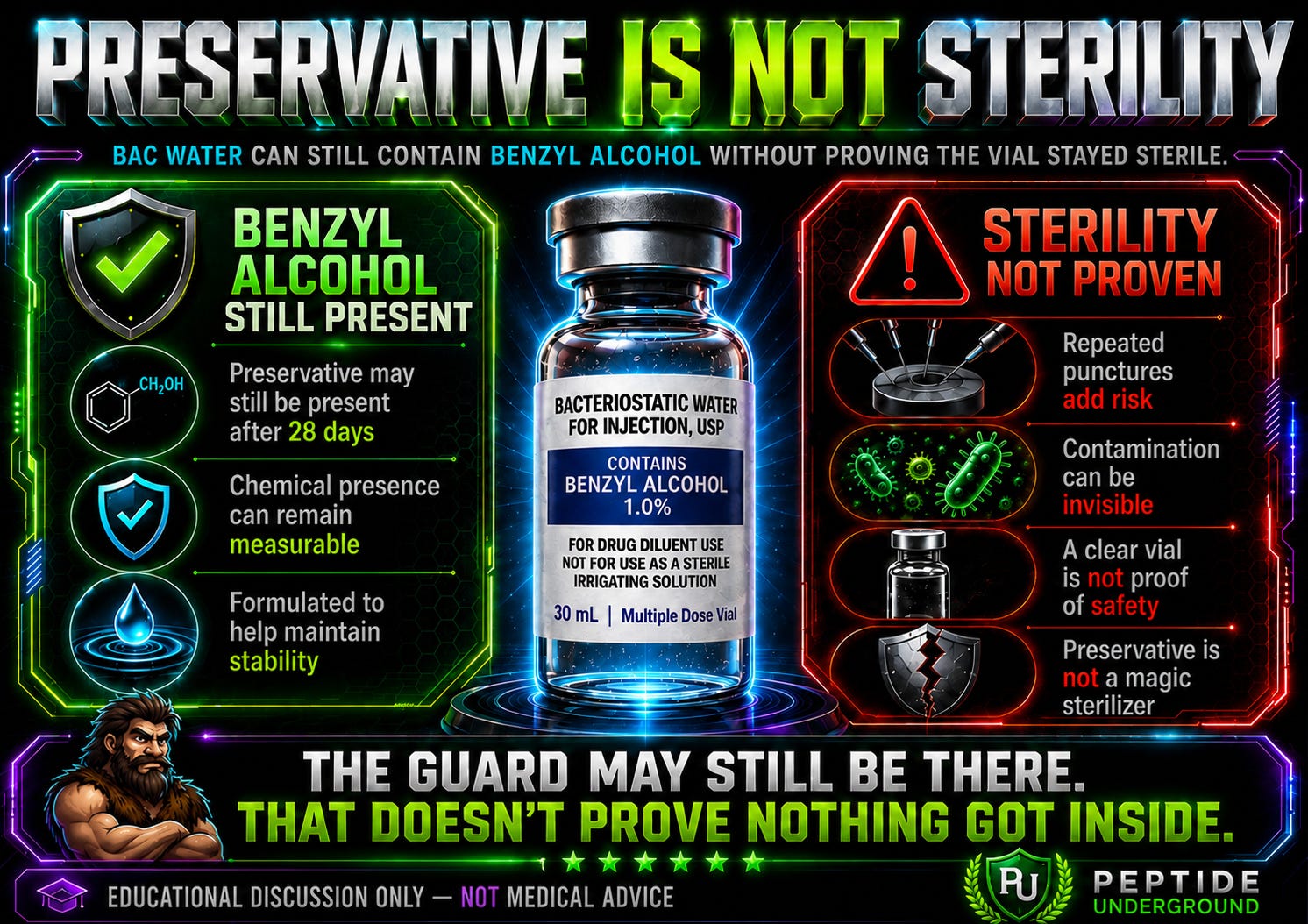
Every time a needle enters the vial, there is another chance for contamination.
The stopper may not be cleaned properly.
The needle may touch something before entering.
The vial may be stored poorly.
The rubber stopper may weaken after repeated punctures.
Contamination may also be completely invisible.
The water can still look clear and normal while no longer meeting the standards expected for injection.
Benzyl alcohol is bacteriostatic. That means it helps hold bacterial growth back.
It is not a magic sterilizer.
It cannot cancel out poor technique, dirty handling or unlimited reuse.
---
So Why 28 Days?
The 28-day recommendation is mainly an infection-control rule for opened multi-dose vials.
It gives everyone one clear stopping point.
Without that limit, people are left making judgment calls:
- “It still looks clear.”
- “I always clean the stopper.”
- “It stayed refrigerated.”
- “I used one longer before and nothing happened.”
- “The preservative should still be working.”
The problem is that contamination is not always visible.
A vial can look fine and still be unsafe.
The 28-day limit gives hospitals, clinics and individual users a consistent safety boundary instead of asking each person to guess whether their own vial stayed clean.
That does not mean the vial suddenly becomes dangerous on Day 29.
It means the risk becomes harder to verify and control after repeated use over time.
---
Did This Test Debunk the 28-Day Rule?
No.
But it may debunk a bad explanation of the rule.
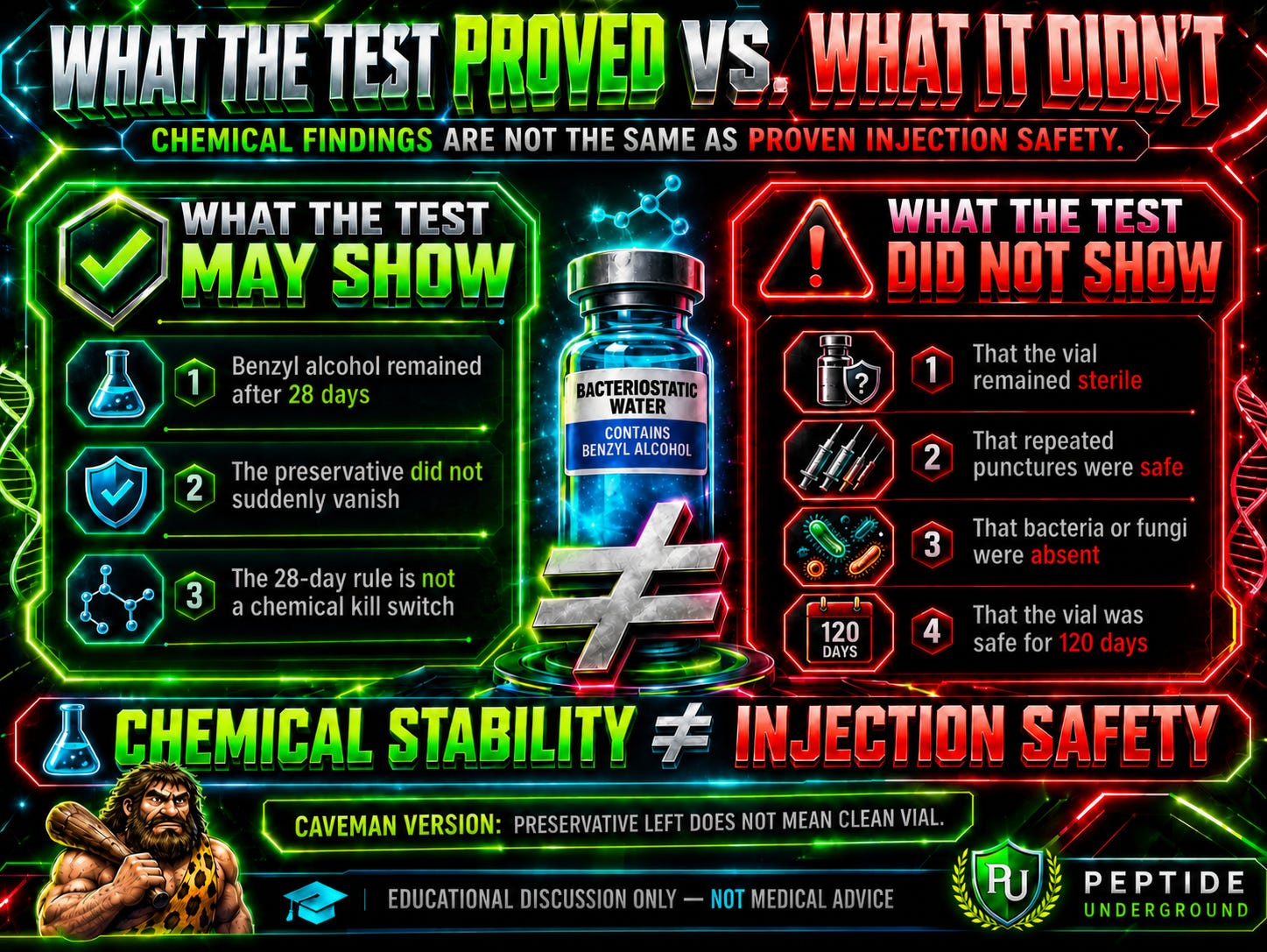
The test suggests that benzyl alcohol can remain in the vial beyond 28 days.
That is useful information.
It does not prove that a repeatedly punctured vial stays sterile for 60, 90 or 120 days.
To prove that, researchers would need to examine much more than preservative concentration.
They would need to look at:
- Bacteria and fungi
- Preservative effectiveness
- Repeated punctures
- Stopper damage
- Container and seal integrity
- Storage conditions
- Endotoxins
- Real-world handling
We would also need the complete laboratory report, including the testing method, number of samples, lot numbers, storage temperature, handling conditions and repeat measurements.
Without that information, the infographic gives us an interesting clue.
It does not give us a new expiration date.
---
Caveman Explanation
Caveman hears:
«“Day 28 good. Day 29 bad.”»
Caveman confused.
Vial no own calendar.
Benzyl alcohol no vanish at midnight.
But preservative still there does not mean vial still clean.
Every needle poke gives germs another chance to get inside.
Preservative slow germs down.
Preservative not magic.
Clear water can still be dirty water.
Caveman bottom line:
Day 29 not chemical explosion.
But old, repeatedly punctured vial not proven safe either.
---
What This Means for Peptide Users
This matters because peptide users often withdraw very small amounts.
One vial of bacteriostatic water may last much longer than 28 days, so throwing it away can feel wasteful.
The test may show that the benzyl alcohol is still present.
But injectable safety is about more than preservative concentration.
It also depends on how the vial was handled, stored, cleaned and punctured.
That is why this test cannot answer the entire safety question.
---
The Honest Takeaway
The 28-day guideline is probably not based on benzyl alcohol suddenly disappearing.
The preservative may remain present much longer.
But:
Preservative remaining is not the same as proven sterility.
The test challenges the claim that BAC water expires because its preservative suddenly disappears.
It does not challenge the fact that repeated punctures create contamination risk.
Until sterility—not just benzyl-alcohol concentration—is properly tested, the 28-day guidance still stands.
---
Bottom Line
What the test may show:
Benzyl alcohol can remain present beyond 28 days.
What the test does not show:
That an opened and repeatedly punctured vial stayed sterile.
What beginners should remember:
Clear water is not proof of clean water.
Final verdict:
The infographic raises a fair question, but it does not prove a longer safe-use period.
---
Sources and Evidence Notes
1. Centers for Disease Control and Prevention. “Preventing Unsafe Injection Practices.” Injection Safety. Updated March 26, 2024. The CDC states that once a multi-dose vial has been opened or needle-punctured, it should generally be dated and discarded within 28 days unless the manufacturer specifies a different opened-vial date. Accessed July 22, 2026.
2. Hospira, Inc./Pfizer Medical Information. “Bacteriostatic Water for Injection, USP—Description.” The manufacturer describes bacteriostatic water as sterile, nonpyrogenic water containing benzyl alcohol as a preservative. Common presentations contain 0.9% benzyl alcohol, equal to 9 mg/mL, and are supplied in multi-dose containers for repeated withdrawals. Accessed July 22, 2026.
3. Circulating BAC-water stability infographic. The infographic reports benzyl-alcohol concentration measurements over 120 days. The complete original laboratory report—including the laboratory identity, analytical method, number of vials, replicates, lot information, storage conditions and sterility testing—has not been independently verified. Its figures are discussed as preliminary chemical-concentration findings, not proof of sterility or authorization for extended use.
---
Educational discussion only. This article does not establish a new beyond-use date or recommend using an injectable product beyond its manufacturer’s instructions.
© 2026 Peptide Underground. All rights reserved. No portion of this publication may be reproduced or distributed without permission.
No posts
Comments
Nothing yet. Say the first thing.
Sign in to join the conversation.