
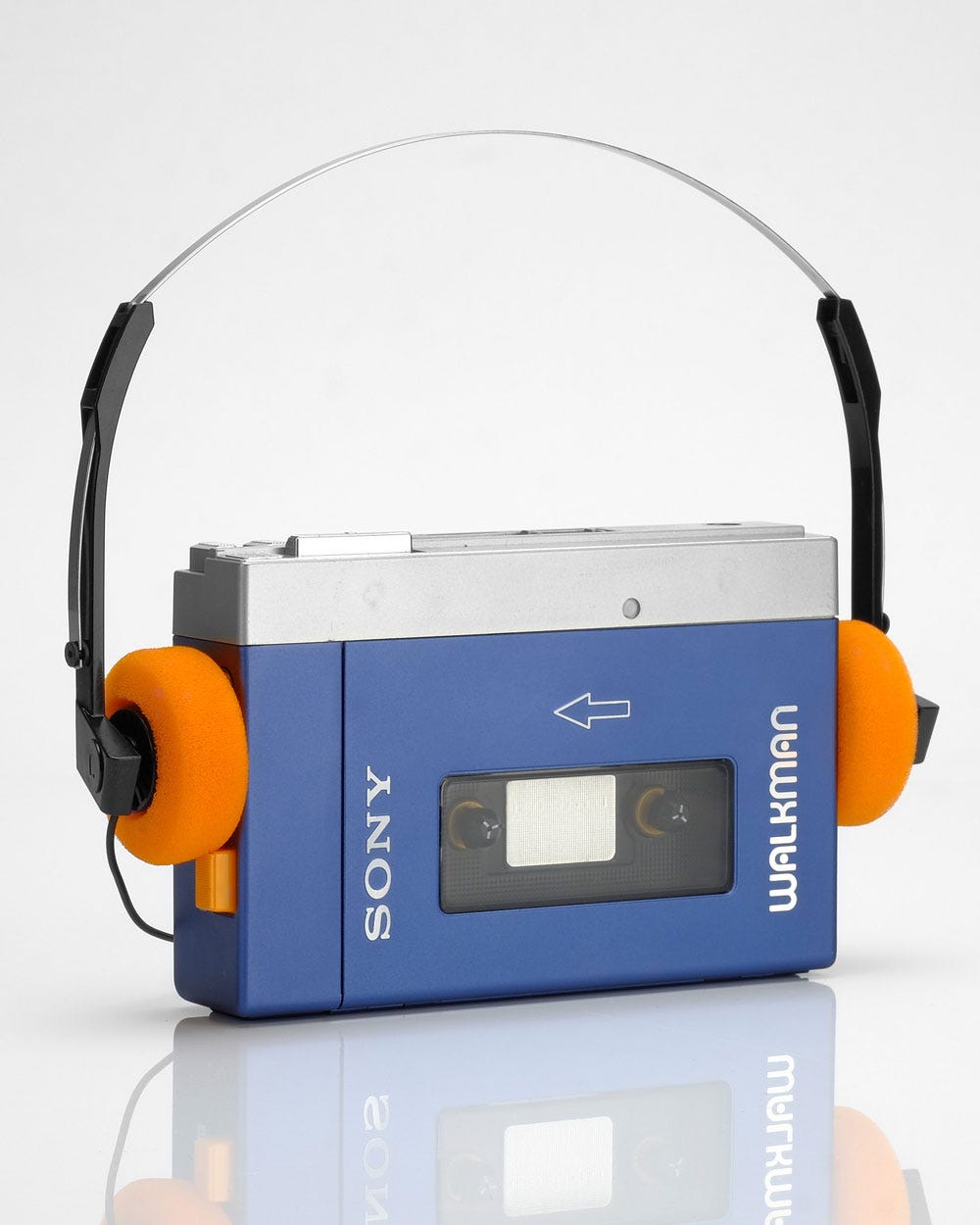
There was a time when walking down the street listening to your own music seemed almost antisocial, strange and even slightly dangerous. Today, it is difficult to imagine a city without people wearing headphones, but in the late 1970s music still belonged mainly to rooms, cars, stereo systems and radios. If you wanted to listen to your favourite album, you usually had to be somewhere.
The Walkman changed that. On July 1, 1979, the Sony TPS-L2 appeared in shops in Tokyo, a small blue-and-silver portable cassette player powered by batteries and sold with lightweight headphones. It could not record, it had no built-in speaker and, seen today, it is difficult to understand why such a simple machine was considered revolutionary. But it did one thing that mattered enormously: it allowed you to take your music with you.
Until then, portable listening usually meant a small transistor radio, which meant hearing whatever a radio station had chosen for you. The Walkman gave the listener something far more personal. You chose the cassette, the album, the order of the songs and the moment when you wanted to hear them. You were no longer simply carrying music around. You were carrying your music.
The origins of the Walkman were closely connected with the people running Sony. Masaru Ibuka travelled frequently and wanted a way to listen to stereo music during flights without carrying a heavy machine. Akio Morita quickly realised that what looked like one executive’s personal convenience might become something much larger.
Sony engineers took an existing small portable cassette recorder, removed the functions they did not need and created a machine devoted entirely to listening.
Even inside the company, there were doubts. Who would buy a cassette player that could not record? Why would anyone want to wear headphones while walking through the street? Would people really accept cutting themselves off from the sounds around them?
The answer came quickly. The first model sold around 15,000 units in its first month with relatively little advertising. Sony had created not merely a successful product, but a new human habit.
In the early 1980s, someone walking through the street with headphones could still attract curious looks. There was something peculiar about seeing a person surrounded by everyone else while listening to something nobody around them could hear.
For the first time, you could walk through the same city as everyone else while living inside an entirely different world of sound. The street remained exactly the same, but you could change its music.
A bus journey suddenly had a soundtrack. The walk to work could last exactly one album. A train ride could be accompanied by the cassette you had recorded the night before, calculating with almost scientific precision which final song might fit before Side A ran out.
The Walkman created a tiny private room inside public space, and not everybody welcomed the idea. Some found it amusing, others ridiculous and many considered it dangerous. Someone wearing headphones might fail to hear a car, a horn or a warning shouted from behind.
Others saw something deeper and more troubling in the new habit: people deliberately withdrawing from those around them and shutting out the real world.
Perhaps they were partly right.
But that was also part of the attraction.
In Greece during the early 1980s, the Walkman was not yet an everyday object. The first models were expensive, largely because of import duties, and could cost sums far beyond what most households would spend casually on a music player.
A model designed in Japan as a small personal device could approach 22,000 drachmas in Greece, while other portable stereos on the market ranged roughly from 15,000 to 30,000 drachmas.
As a result, the first people carrying them became part of the Walkman’s image. Younger and often more affluent Athenians appeared in Syntagma, Kolonaki, on the beaches of the Saronic Gulf, on motorcycles or in open-top cars with headphones over their ears.
For a while, owning a Walkman was also a statement.
Then it became ordinary life.
Prices gradually fell, more manufacturers entered the market and the device moved from “look what he’s got” to the much more familiar “where did I leave my Walkman?”
The machine itself was only half the story. What you put inside it mattered just as much.
The cassette became personal.
The Walkman gave even greater importance to the mixtape. You no longer had to listen only to an album arranged by somebody else. You could create your own cassette for a journey, a beach holiday, a late night, the girl you liked, the breakup you were trying to survive, or simply the challenge of squeezing as many favourite songs as possible onto ninety minutes of tape.
The order mattered. The opening track mattered. The last song before you had to flip the cassette mattered. Whether a track would fit completely or be brutally cut off in its final seconds sometimes mattered far more than it reasonably should have.
Music had become portable, but so had a small version of yourself.
As the years passed, Walkman models became smaller, lighter and more sophisticated. Radio tuners appeared, followed by auto-reverse, better headphones, digital displays and functions that would have seemed luxurious on the earliest machines.
By the late 1980s and throughout the 1990s, the Discman carried the same basic philosophy into the age of the compact disc. Sound quality improved, although it introduced a new form of physical discipline: learning how to walk while holding the player steady enough to stop the music from skipping.
Cassette players remained everywhere too. Some became cheaper, others more durable, and some were designed specifically for exercise or the beach.
By the end of the 1990s, the Walkman was no longer a fashion.
It was part of everyday life.
You took it on the bus, the train, the beach and the plane. You wore it while jogging, walking alone, avoiding conversation or simply trying to make a dull journey more bearable.
Then came MiniDisc players, MP3 players, the iPod, smartphones and eventually streaming. The cassette disappeared from most pockets, taking with it the pencil used to rewind loose tape and that small moment of horror when your Walkman suddenly decided to eat the cassette you loved.
Technologically, the original TPS-L2 now looks almost prehistoric.
Its central idea, however, never disappeared.
Every time we leave home, put on headphones and choose which song will accompany the journey, we are essentially repeating what somebody first did on the streets of Tokyo in the summer of 1979.
The Walkman did not invent portable music. Portable radios had existed long before it. What it transformed was something more intimate: personal listening inside public space.
It gave us the ability to stand among hundreds of people while hearing something that belonged only to us. A city street, a beach, a crowded bus or an aircraft cabin could suddenly become the setting for music we had chosen ourselves.
Once, that seemed strange.
Now it feels so natural that we barely notice it.
And perhaps that is the clearest sign of a technology that truly changed everyday life: eventually, we forget there was ever a world before it.
Comments
Nothing yet. Say the first thing.
Sign in to join the conversation.