
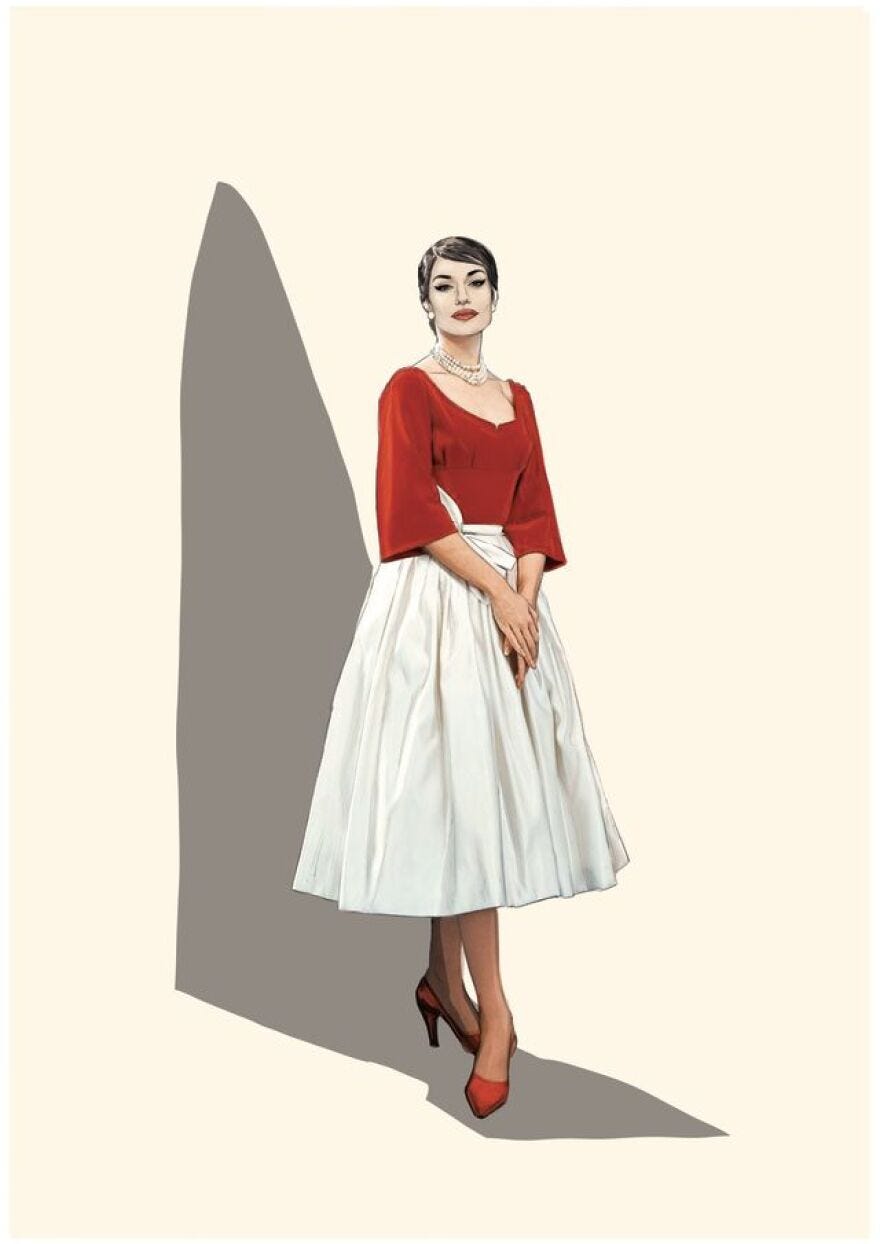
Maria Callas could stand before thousands of people, take possession of an entire theatre and make it breathe at her rhythm, yet away from the stage she spent much of her life trying to convince the people she loved that she was worthy of being loved. That may be the strangest contradiction in the story of the woman who became opera’s ultimate diva. Her voice transformed lyric theatre, her stage presence changed the way singers approached a role, and her interpretations helped restore an entire tradition of Italian bel canto to the centre of the repertoire. Yet beneath all of that achievement lived an insecurity that neither La Scala nor the roar of an audience ever managed to silence.
She was born Maria Sophia Anna Cecilia Kalogeropoulou on December 2, 1923, in New York, the daughter of pharmacist George Kalogeropoulos and Evangelia “Litsa” Dimitriadis. Her parents had moved to America looking for a better life, but the family environment in which Maria grew up was anything but secure.
According to later biographical accounts, her mother had wanted a boy and was bitterly disappointed when Maria was born. It has been written that for several days she even refused to look at the newborn child. We cannot know with certainty everything that happened inside that household, and it would be irresponsible to diagnose her mother retrospectively. Callas herself, however, believed that Litsa suffered from serious mental-health problems and described a woman given to extreme mood swings, narcissistic behaviour and abrupt changes of character.
Her father was different, though not necessarily more emotionally available. Maria learned while still young about his affairs, but apparently never turned against him because of them. She remembered instead the Greek records he played on the family phonograph, until Litsa would enter the room and replace them with opera arias. Her parents quarrelled frequently, and Maria looked to her older sister Jackie for the sense of safety neither parent seemed able to provide. Jackie, however, carried wounds of her own.
After returning to New York from Florida, Maria was struck by a car while crossing the street to greet her sister. Later family stories claimed that the concussion changed her personality, making her moodier and more competitive toward Jackie. That cannot really be proved. What seems clearer is that the relationship between the sisters became increasingly strained and that their mother encouraged the rivalry by comparing their looks and abilities.
Maria grew up believing that Jackie was the beautiful daughter while she was the difficult one. As she gained weight, the comments became harsher. At home, and later at the conservatory, her appearance became a target for ridicule. The woman who would one day become an international symbol of elegance spent her adolescence being told she was fat, awkward and less attractive than her sister.
In 1937, after her parents separated, she moved to Athens with her mother and Jackie. At the National Conservatory and later the Athens Conservatoire, it quickly became clear that this awkward, insecure girl possessed something extraordinary. She studied first with Maria Trivella and later, crucially, with Elvira de Hidalgo, under whom she mastered the technique and repertoire that would shape her career.
She was not, however, a comfortable student living inside a protected world of art. Maria was painfully conscious of poverty. Around her were girls in elegant clothes, backed by prosperous families, studying opera almost as a cultivated pursuit. Maria understood that for her it was different. She had to succeed, and eventually she did.
In 1940 she joined the Greek National Opera, then part of the Royal Theatre, and the following year appeared as Beatrice in Boccaccio. Tosca, Cavalleria Rusticana, Kalomiris’s The Master Builder and Beethoven’s Fidelio followed. By the end of the occupation years, the young Maria had already built a substantial career in Athens.
In September 1945 she returned to New York, where her father was living, and began using the name Callas. For almost two years the international breakthrough she wanted failed to appear. Then, in 1947, a successful audition led her to the Arena di Verona for Ponchielli’s La Gioconda. She slipped during the dress rehearsal and injured her ankle, but on August 2 she went on stage and took the first major step toward becoming a legend.
In Verona she met two men who would shape very different parts of her life. Conductor Tullio Serafin immediately recognised what her voice could become and emerged as one of her most important artistic mentors. Industrialist Giovanni Battista “Titta” Meneghini fell in love with her and became her companion, manager and eventually her husband.
Maria believed that in Meneghini she had found what she had been searching for since childhood: protection. Later accounts of their marriage, however, paint a far more complicated picture. Friends and several members of Meneghini’s family initially treated her with contempt, describing her as awkward, overweight and even a gold digger. According to biographical testimony, Meneghini himself once told her that he had slept with her out of pity rather than love, while Maria desperately wanted their relationship formalised through marriage and dreamed of creating the family she felt she had never truly possessed.
They married on April 21, 1949. Meneghini became increasingly involved in managing her career and finances, while Callas’s professional life exploded. In 1951 she conquered La Scala in Milan with Verdi’s I Vespri Siciliani, and within a few years she had become the singer everyone in opera was talking about.
Simply singing the roles was no longer enough for her. She wanted to embody them.
The transformation of her appearance was dramatic. During the early 1950s she lost a large amount of weight and changed from the woman mocked for her body into an icon of style. Myths have long surrounded exactly how she lost that weight. Biographical sources describe treatments at a Swiss clinic, hormonal interventions and iodine therapy, while there are also reports that she underwent cosmetic procedures, including work on her eyelids and upper arms. Some of these claims are better documented than others and deserve the caution appropriate to later biographical testimony.
What is beyond dispute is the result. Callas lost weight, rebuilt her wardrobe, studied fashion almost as intensely as she studied a libretto and created a visual presence that became inseparable from her voice. Yet the physical transformation did not erase the old wounds. Insults could still cut through her. Luchino Visconti, despite becoming one of her most important collaborators, could speak to her with extraordinary harshness, and the press soon discovered that Callas was not merely a great singer but irresistible material for scandal.
Every cancellation, dispute or outburst could be turned into evidence of the supposedly “hysterical diva.” In 1956 came the Metropolitan Opera in New York, and her return to the city of her birth was triumphant. By then the myth was at its height, and Callas could demand fees and conditions that very few performers had ever dared to ask for.
The voice, however, was beginning to pay a price. Her extreme weight loss, relentless workload and a repertoire that forced her between very different vocal demands began to leave traces. The upper register became less secure, and the weaknesses could increasingly be heard.
The year 1958 was especially brutal. In Rome she withdrew from Norma after the first act, creating a public scandal, and later came the definitive rupture with La Scala. Callas always insisted that she had not been dismissed but had left in defence of her dignity. By then the atmosphere around her had turned poisonous. According to accounts, someone placed a dead dog inside her car, vandals covered the walls of her home with graffiti and smeared excrement around the entrance, while anonymous callers abused her late at night and threatening letters arrived at the house.
For all the power she projected onstage, fame frightened her. She once said that fame intoxicated other people, but terrified her. At roughly the same time, she also began seeing her marriage differently. Meneghini, once the protector she believed she needed, had become in her eyes a man excessively interested in her money and capable of damaging her professional relationships. She reportedly complained to a close associate that her husband would search even her pockets looking for cash.
Something else hurt more deeply. Maria wanted a child. Why she never had one became the subject of contradictory accounts. Meneghini later claimed that she suffered fertility problems and produced medical documentation that was itself questioned. Other testimony described a marriage with a severely limited sex life. The precise truth is difficult to reconstruct, but what appears beyond doubt is that Callas’s desire for motherhood remained unfulfilled.
Then Aristotle Onassis entered her life.
Their relationship began at the end of the 1950s. For Callas, Onassis was not simply another powerful man. He was Greek, cosmopolitan, enormously wealthy and, crucially, independent of the opera world. He seemed to offer her a life beyond the suffocating identity of “La Divina.”
The relationship, however, became something much darker. Testimony from people around them and from later biographers describes an Onassis who was unfaithful, manipulative and frequently humiliating. He boasted about sexual conquests, disappeared for long periods and maintained relationships with other women. Maria suspected his infidelity, while he often responded by treating her jealousy as irrational.
Even apparently small incidents reveal the degree of control he exercised over her. He reportedly told her not to wear her glasses on his yacht because he thought they made her unattractive. Callas had poor eyesight, yet obeyed and moved around the deck barely able to see clearly.
The image is almost too perfect as a metaphor. Maria Callas, a woman powerful enough to impose her conditions on the greatest opera houses in the world, accepted that a man could decide whether she was even allowed to see properly.
Accounts of their relationship grow darker still. There are testimonies describing verbal and physical violence, humiliations in front of others and blows allegedly delivered in ways designed not to leave visible marks the next morning. Some of these details come from later witnesses and must be treated as such, but there are enough overlapping accounts to suggest a relationship in which love, dependence, humiliation and violence existed side by side.
In one particularly cruel episode attributed to Onassis, Callas raised the subject of marriage in front of friends, expecting perhaps a joke in response. He is said instead to have answered in a way deliberately designed to humiliate her. Later, when her voice was deteriorating, he reportedly told her that she was “nothing,” that all she had was a whistle in her throat and even that no longer worked.
It struck precisely where Callas was most vulnerable: her voice.
Around the same period, she began abusing sleeping pills. There were times when she slept heavily for hours, detached from everything around her. According to one account, a small fire broke out aboard Onassis’s yacht while she was so heavily sedated that she did not even hear the alarm.
By then Callas was already retreating from the stage. In 1960 she sang Norma at Epidaurus and returned the following year for Medea. In 1962, London critics were openly harsh about the state of her voice, though audiences continued to adore her.
Then, in the summer of 1964, came a small moment on the island of Lefkada that feels almost written for film. Callas was attending a musical event with Onassis when she spontaneously said she wanted to sing. A piano was found, along with a young pianist, the future composer Kyriakos Sfetsas. Without rehearsal, she sang Santuzza’s aria from Cavalleria Rusticana.
It was the role with which she had begun as a student. Without knowing it, she seemed to be closing a circle.
The real end of her major operatic career came in 1965. On May 29, during Norma in Paris, she collapsed onstage and was carried unconscious to her dressing room. The woman who had once seemed capable of making her voice obey any demand was now confronting the fact that the instrument itself no longer responded as it once had.
In her private life, she still hoped that Onassis would marry her. In 1966 she renounced her American citizenship and took Greek nationality, a move that helped bring her marriage to Meneghini formally to an end. She waited, but Onassis never proposed.
Then, in October 1968, he married Jacqueline Kennedy.
For Callas it was another rejection, but this time one played out before the entire world.
She tried to return to work. In 1969 she starred, without singing, in Pier Paolo Pasolini’s film version of Medea. She taught at Juilliard, made recordings, tried to recover her voice and later toured with the tenor Giuseppe Di Stefano, himself struggling with vocal problems. Her final public appearance as a singer took place in Sapporo, Japan, on December 11, 1974.
After that came silence.
Maria Callas withdrew into her Paris apartment. The world continued to talk about her, listen to her recordings and debate whether her voice had declined because she lost too much weight, sang the wrong roles, worked too hard or simply lived a life too heavy to remain contained inside one throat.
The truth probably lies in no single explanation, just as Maria Callas herself cannot be contained inside a single explanation.
She was not simply the woman abandoned by Onassis. She was not the “hysterical diva” of the headlines, the wounded daughter of a rejecting mother, the girl mocked for her weight or the wife of a man who controlled her money. And she was certainly not only a magnificent voice.
She was all of those things, and far more.
Callas inherited an operatic world in which a singer could sometimes stand onstage and simply sing beautifully. She forced that world to remember that there was also a character, a body, a drama and a theatre taking place before the audience. Norma, Tosca and Medea were not merely roles she performed. At her greatest, they seemed to pass through the same wounds she carried herself.
Perhaps part of her power came from precisely there. The girl who had been taught that she was not beautiful enough, thin enough or lovable enough became the woman nobody could ignore when she stepped onto a stage. The woman who desperately sought security from people who often hurt her could open her mouth and make thousands of strangers feel rage, jealousy, loss, desire and grief without needing to explain any of it.
During one violent episode attributed to her relationship with Onassis, Callas is said to have told him, “You can kill me, but you cannot break me.” We cannot know with certainty whether she said those exact words. Yet they fit with unsettling precision the life we know she lived.
Many things wounded her: her mother, the insults about her body, poverty, the cruelty of the operatic world, Meneghini, the press, the loss of her voice, Onassis, her unfulfilled desire for a child and, finally, loneliness. Yet none of them managed to reduce Maria Callas to the story they tried to write for her.
On the morning of September 16, 1977, Maria Callas died in Paris at the age of 53 after suffering a heart attack. She had spent her final years largely withdrawn from public life, far from the stages where her appearance had once been enough to create near hysteria.
By then, however, the voice had already escaped the body.
And it no longer needed that body in order to be heard.
Comments
Nothing yet. Say the first thing.
Sign in to join the conversation.