
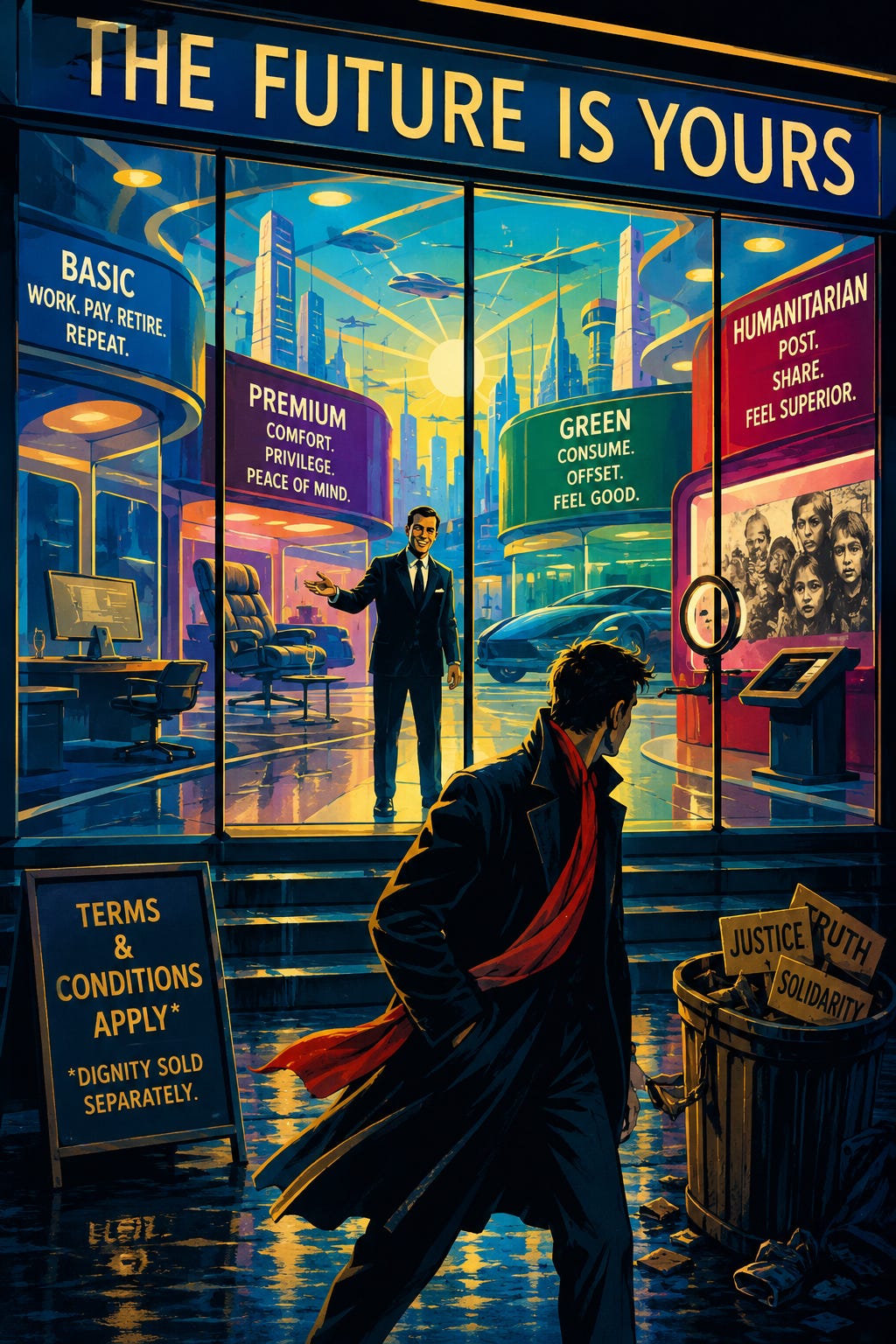
I walked into the store because everyone kept telling me that sooner or later I had to invest in my future. The showroom stood on one of those streets where buildings contain more glass than strictly necessary and the people going in and out carry coffees that cost roughly the same as a family meal.
Above the entrance, a glowing sign declared:
THE FUTURE IS YOURS.
Directly underneath, in letters small enough not to interfere with the optimism, it said that terms and conditions applied.
As soon as I entered, a man in his early forties approached me. His teeth looked as though they had their own insurance plan. He wore a suit without a tie, because ties are apparently authoritarian while two-thousand-euro suits are not.
“Welcome to the Future Experience Center,” he said. “Have you thought about what kind of tomorrow suits you?”
I told him I had not realised there were different kinds.
He smiled with the patience of a man trained to deal with the financially illiterate.
“Of course. The future is no longer one-size-fits-all.”
He led me to the first model.
This was the affordable package.
It included forty-five years of work, two midlife crises, an uncertain pension and a free mindfulness app for those periods when I might begin wondering why exactly I had done any of it.
“Very popular with young people,” he told me.
I asked whether young people actually chose it.
“Not exactly. But they get it.”
There was also a family package. For a small additional charge, you could add a child, provided you first managed to find a home, time, money and another person optimistic enough to do it with you.
I asked whether hope was included.
The salesman laughed.
“Hope is an optional extra.”
We moved on.
This one was genuinely impressive.
It came with private healthcare, private education, private insurance, a private pension and a system designed to help you forget that the word “society” once meant something more than people using the same motorway.
“With this package,” he explained, “you drastically reduce your exposure to the unpleasant sides of reality.”
I asked which sides those were.
He paused briefly.
“Other people.”
Premium also came with special glass. From the inside, you could see the world perfectly clearly, but nobody outside could disturb you.
“Excellent for social awareness from a safe distance,” he added.
There was even an app that notified you whenever a major tragedy occurred, allowing you to post the correct image before everyone moved on to the next subject.
“Does the system suggest captions too?”
“With Premium Plus.”
I was beginning to understand why it had so many customers.
The next model was full of plants.
An entire wall was covered in moss, and in the middle stood an electric SUV large enough to transport your entire ecological conscience personally.
The salesman handed me a paper straw.
“The Green Edition allows you to continue living more or less exactly as before, but with better aesthetics.”
I asked whether it actually reduced consumption.
“There’s no need to become extreme.”
He explained that I could keep buying more things, provided the packaging had leaves printed on it. I could also throw away my clothes every six months as long as the company stated that it was “working toward a more sustainable value chain.”
A screen on the wall showed a forest.
I asked where it was.
“I don’t know,” he said. “But it’s carbon neutral.”
Then he lowered his voice.
“We also have the Humanitarian Edition.”
That sounded interesting.
The room was white and exceptionally clean. Black-and-white photographs of children from different parts of the world covered the walls, all carefully beautiful enough not to make anyone genuinely uncomfortable.
“With this package,” he said, “you can take an active role in the major humanitarian crises of our time.”
I asked how.
“One flag on your profile, two shares per week and up to three days of intense outrage at no extra charge.”
I asked what happened on the fourth day.
“Usually there’s a new issue.”
You could choose between war, natural disaster or refugee crisis. The system tracked trends and recommended whichever tragedy offered the best return in social recognition.
“And the people?” I asked.
“What people?”
“The ones in the photographs.”
The salesman looked at the wall as though he were seeing them for the first time.
“They’re not exactly customers.”
“What are they?”
He smiled again.
“Operating costs.”
By then I was getting tired.
I told him I could not see any future for the people who could not afford any of the packages.
He explained that of course there was one.
“It simply isn’t available for direct purchase.”
For the poor, there was the Resilience Package. For the unemployed, there was Personal Reinvention. For people who had lost their homes, there was an online seminar called Reframing Home. For workers who could not afford their electricity bill, there was a podcast about gratitude.
“And what if somebody gets angry?”
“We have excellent anger management.”
“What if they don’t want to manage their anger? What if they want to change the thing making them angry?”
For the first time, the salesman stopped smiling.
“That is not one of our products.”
I told him I probably would not be buying anything.
He looked genuinely disappointed.
“We can arrange financing. Your future in one hundred and twenty interest-free instalments.”
I looked at him.
“Do you sell souls in instalments?”
The smile returned immediately.
“Not yet. But our development team is working on it.”
Before I left, he handed me a brochure. On the cover, a family laughed inside a house with enormous windows, two children, one dog and no visible debt.
The terms of use were printed on the final page.
The future, it said, may differ from the photographs. The company accepts no responsibility for war, unemployment, poverty, social collapse, extreme weather, loss of rights or undesirable consequences resulting from decisions made in the interests of shareholders.
And underneath, in even smaller print:
Dignity sold separately.
I walked back onto the street without a future.
Strangely, I felt lighter.
Across the road, an elderly man was helping a woman lift her shopping trolley onto the pavement. A delivery rider had stopped to give water to a dog. Two children were sharing a sesame bread ring and arguing over the larger piece with the seriousness of international negotiators.
None of these things had appeared in the showroom.
Perhaps because none of them could be priced.
So I kept my present. It is second-hand, scratched and comes without a warranty. It contains people in pain, people who are afraid, people who need help and a few who still insist, despite all expert advice, on helping one another without a business model.
They can keep the future.
At least until they find a way to sell the final breath by subscription.
Comments
Nothing yet. Say the first thing.
Sign in to join the conversation.