
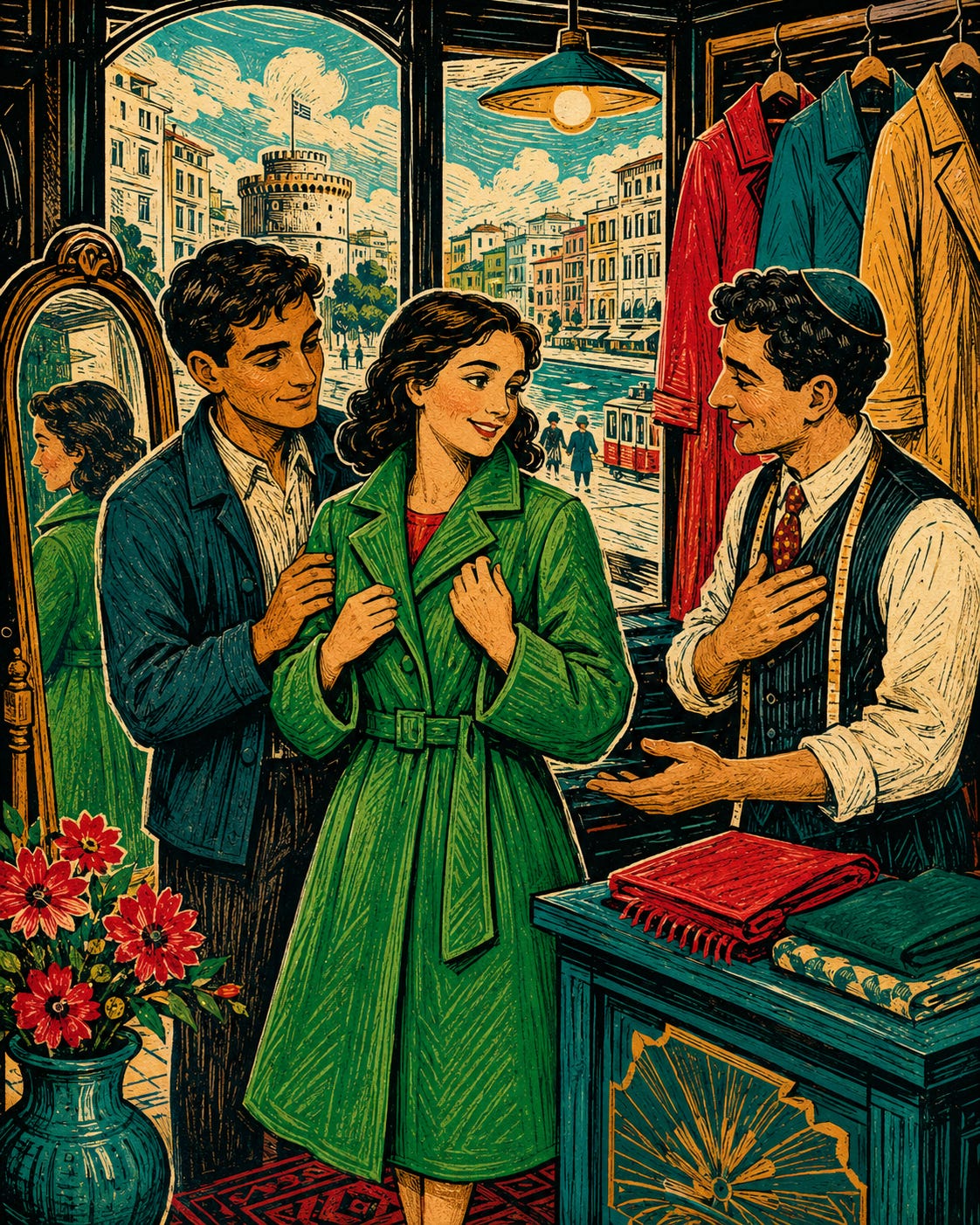
In postwar Thessaloniki, in a city still trying to remember how life was supposed to continue after occupation and war, a brother and sister walked into a newly opened clothing shop to buy a coat and came out having shared something far greater. The little store stood somewhere in the city centre, its sign announcing something along the lines of “Ladies’ Ready-to-Wear Clothing.” Today, that sounds completely ordinary. Back then, it was almost revolutionary.
Most people still made their own clothes. Those with more money went to a tailor or dressmaker. The idea that you could simply walk into a shop, try on a finished garment and leave wearing it felt like evidence that something was finally changing. The city had endured war, hunger, persecution and death, yet in its shop windows the promise of ordinary life was beginning to appear again.
The brother and sister had gone into town that winter day specifically to buy something. The young man had come to Thessaloniki from the mountains of Arcadia, leaving behind poverty and a life with few possibilities. He had found a job with a private company, in a position that seemed almost cosmopolitan to him at the time, and had decided that he would work as hard as necessary to make something of himself.
The salary was not much, but at first that hardly mattered. What mattered was that he had left, stood on his own feet and begun building a life of his own. Once he felt reasonably established, he invited one of his sisters, then around twenty, to come and live with him.
He wanted his sisters to see another kind of world. He wanted them to get as far away as possible from the deprivation they had known, to live with dignity and, as people said quite openly in those days, to have the chance to “marry well.”
But he had also made another promise, this one to himself. With the first money he could genuinely spare, he would buy his sister something beautiful. It was not about showing off. It was his way of proving that life had started to change, that the first money he earned could become something more than food, rent and necessity.
That was how they found themselves standing in front of the new shop that winter afternoon. The young woman hesitated almost as soon as they went inside. She looked at the clothes, the mirrors, the unfamiliar elegance of the place and told her brother they should leave. There was no reason to spend so much.
He refused. He had made a promise, and he had no intention of breaking it.
What he could not possibly have known was that the young man behind the counter had made a promise of his own.
The owner greeted them with barely contained excitement. The shop had opened only the day before, and they were his first real customers. A courteous young man wanting to buy a gift for his sister, and a young woman almost embarrassed to try on the clothes. For someone beginning a new business, it was difficult to imagine a better first sale.
He began taking down coats, suggesting colours and styles, helping her try different ones. She looked at herself in the mirror, turned toward her brother for his opinion, listened to the shopkeeper, then disappeared into the fitting room again.
And then they found the green coat.
It was heavy, elegant and rather striking by the standards of the time. More importantly, it suited her beautifully. She put it on and stood before the mirror, looking for a few seconds at a version of herself she may never have seen before.
Her brother smiled and told her that was the one. Only one problem remained, and it was the obvious one: the price.
When he asked how much it cost, the shopkeeper hesitated. Then he smiled and told them the price did not matter because he wanted them to have it as a gift.
The young Arcadian thought he had misunderstood.
A gift?
The owner insisted. They were his first customers, and he had promised himself that the first thing sold from his new shop would be given away.
The brother refused immediately. He explained that he had saved money from his first earnings for the specific purpose of buying his sister this gift. If he accepted the coat for free, his own promise would lose its meaning.
The shopkeeper listened and then asked him for only a few minutes. If he heard why the promise had been made, he said, perhaps he would think differently.
The young man behind the counter was a Jew from Thessaloniki.
A few years earlier, when the city had become a place of terror for its Jewish population, his life had been in immediate danger. An elderly Christian couple had first hidden him and later helped him escape.
They were no longer alive.
They had been prosperous, deeply religious and socially conservative, exactly the kind of people someone might not automatically imagine risking everything for a Jewish boy. Yet they had done precisely that.
They gave him shelter, food and protection at a time when a single word to the authorities could mean death.
The boy had promised himself that if he survived, he would return to Thessaloniki. He would work, build a life and find ways to give something back in honour of the people who had saved him.
Not because a life could ever truly be repaid, but because he never wanted to forget how his own had been preserved.
When he decided to open the shop, he gave himself one rule for its first day: whatever the first customer asked to buy would be given away. Not for luck, and not because he believed it would bring prosperity.
He wanted to remember that money came second, and that before money came the human being.
By the time he finished telling the story, none of the three had much left to say. The young woman was crying. Her brother was crying too. The shopkeeper, who had started the day smiling because he had finally made his first sale, was now crying with them.
Two Christians from Arcadia and one Jew from Thessaloniki found themselves embracing inside a tiny women’s clothing shop, in a city that only a few years earlier had seen human beings separated according to religion, origin and whether they were considered worthy of continuing to exist.
Now their only problem was that there were two promises and only one coat.
The Arcadian brother proved stubborn. He refused to accept for free the gift he had promised himself he would buy with his first earnings. The Jewish shopkeeper was equally stubborn. He refused to make a profit from his first sale.
Eventually they found a solution that allowed both men to keep their word. The green coat was sold at cost price.
One man had bought his sister the gift he had promised her. The other had completed his first sale without earning a single drachma in profit, just as he had promised himself he would.
And the young woman left the shop wearing a green coat that had already become worth far more than whatever number had once been written on its tag.
I do not know what happened to the three of them afterwards. Perhaps the shopkeeper became a successful businessman, or perhaps the little store closed only a few years later. Perhaps the young woman wore the coat until the fabric faded and it no longer kept out the cold. Perhaps her brother eventually built the life he had imagined when he left Arcadia for Thessaloniki.
None of that matters quite as much as what happened inside that shop.
Only a few years after an age in which religion and origin had been turned into reasons to kill people, three young strangers stood in a small store arguing over who should be allowed to do something kind for the other.
The green coat would eventually wear out, as all clothes do. But both promises had already been kept, and perhaps that is what survives from stories like this: not who was Christian and who was Jewish, not who had more money and who had less, but the rare moment when three people decided that no difference between them mattered more than the human being standing in front of them.
Comments
Nothing yet. Say the first thing.
Sign in to join the conversation.