
I thought I’d landed on the perfect idea for the outdoorsy women on my holiday gift list – unique, practical, and bound to be the most talked-about present under their trees. Hardly able to contain my excitement, I showed one of the yet-to-be-wrapped gifts to my Army veteran, avid outdoorsman cousin who was in town for a pre-Christmas visit. “A she-wee!” Peter proclaimed with the boisterous enthusiasm usually reserved for reunions with long-lost friends.
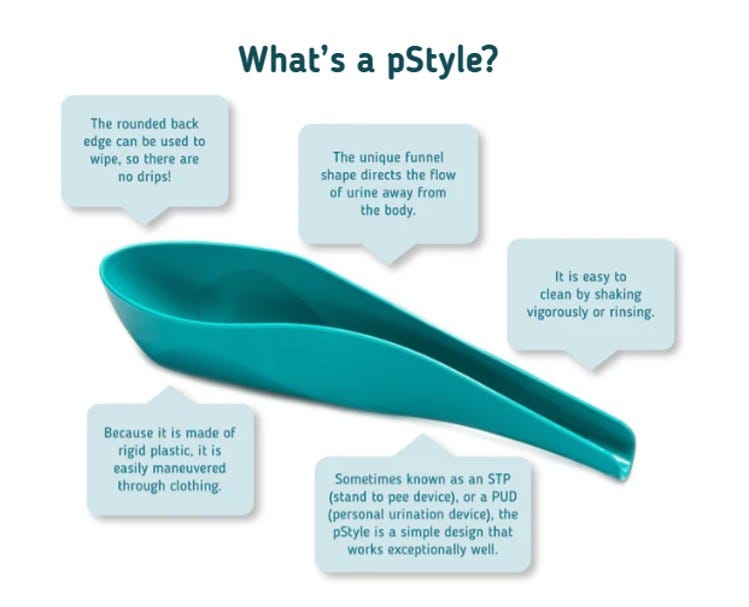
The Christmas gift I cradled was a pStyle, not whatever it was that Peter was so excited about. The 7 ½- inch molded plastic device reminded me of the antique ceramic gravy boat we use at Thanksgiving, but without a handle or pedestal. I’d first seen one a year earlier while attending an on-line conference of researchers and practitioners from the obscure world of people who capture urine. Its unique contours allow a woman, or anyone without a penis, to urinate while standing and – most importantly – without dropping their drawers. Folks who camp, work on construction sites, or just need to pee on the side of the road during a long trip will appreciate its utility. It’s also terrific if you want to pee into a jug – it’s aim, as I learned when I tried it myself, is surprisingly accurate.
Peter’s excitement was my first clue that there was an entire category of “personal urination devices”, and that I had some catching up to do. I asked for the back story on his familiarity and shouldn’t have been surprised that it dated from his days as a U.S. Army officer. “On my second or third tour in Afghanistan, we’d be on long convoys, and some of those convoys were looong, and in hostile territory. The guys could pee in an empty Gatorade or water bottle inside the vehicle, but the female soldiers were forced to hold it. They weren’t too happy.”
Combat roles for women were new at the time, and peeing in an enclosed vehicle was but one of the many kinks still to be worked out. Enter the Shewee, pronounced with long E’s the way Peter said it. The brainchild of Samantha Fountain, a British woman pissed off about filthy public toilet seats, it was approved for use by NATO troops shortly after its invention in 1999. Now women could pee standing up, or within the confines of their vehicle and direct their wee into a bottle, if not exactly like their male counterparts, then close enough. While I was glad to know that our servicewomen had this option, it meant that my holiday gift idea wasn’t as new-fangled as I’d thought. But since none of the women on my gift list were military veterans, maybe I’d still be able to impress them.
Not my sister. Sally pointed out that privacy while peeing wasn’t a selling point for her. You don’t make it as a professional dancer – which she once was – if you’re hung up about nakedness. Taking me down a notch further, she let me know that she used something similar more than thirty years ago, in 1995, when she took a two-week wilderness kayaking trip with NOLS. The device she used was more of a pee-in-a-cup contraption that allowed users to do their thing while sitting in a kayak or canoe. “I don’t know if it was something that NOLS had fashioned themselves or if you could buy it off the shelf,” but she wasn’t impressed then, and she wasn’t impressed now. At least not yet.
Women haven’t always needed help with this most basic of functions. Skirts and robes, if they’re long enough, can hide a lot of anatomy and allow wearers to pee standing up with just slight adjustments to posture. But as women’s styles began to drift toward pants in the early 1900s, the search for urination upgrades was on.
The first such patent, for the “Sanitary Protector”, came along in 1922. Essentially a paper funnel that fit snuggly up against a woman’s underparts, the idea was that the “Protectors” could be stacked and sold in coin-operated dispensers to women who didn’t want to place their bare bottom on questionable toilet seats in public restrooms. In the 1950’s a foldable version, also made of paper, was introduced. Since both patents expired, I assume that neither was much of a money maker.
While hygiene has been an important rationale for any of the stand-to-pee inventions, the social revolutions of the 1970s, with more pants-wearing women pursuing the rugged outdoors, brought new needs. Combine that with technological revolutions – rigid, molded plastics became available at the same time - and the patent applications started picking up. But I don’t think the sales did much better, which is probably why I never encountered them, even during my backpacking heyday of 1975-85.
Fortunately, not all recipients had the same reaction as my sister. Upon opening the small package, Mary, my younger son’s girlfriend, erupted with “A stand-to-pee!” She had never seen this brand, but she was elated at the gift. A wetlands scientist who is often surveying people’s property, taking soil samples and making note of vegetation, she confided, “My bum is probably on critter cams everywhere,” a sacrifice her male colleagues haven’t had to make. I was glad to have leveled the playing field for her, even if just a little.
But my niece Callie was in a league of her own. I wasn’t with her when she opened presents, but she seemed to be familiar with the entire panoply of peeing tools and told me “They’re the frickin’ bomb. The pStyle is the best by far.” Callie, who spends a good portion of each year leading biological expeditions in the wilds of South America’s tropical forests, had been using another model that, after six or seven years of heavy-duty use, was showing its age. It will be happily retired now that she has a replacement.
But Callie had more to say. Never one to hold back, she added detail. “There’s a bit of technique to it. The ones with funnel designs don’t work as well. [The pStyle] is so narrow that you can really wedge it in and not take your pants off – it lets you pee like you have a [rhymes with tick]. After you’re done, you kind of scrape it forward so it mimics the action of toilet paper. No weird dribbles.” She also lauded the safety advantages. In the tropics, grabbing hold of a tree trunk can have unpleasant or even deadly consequences. Even in the relatively tame environments I frequent, my tush has had some close encounters with poison ivy that could have been avoided by standing.
Maybe my gifts weren’t as novel as I expected – it seemed that everyone knew about the women’s elimination revolution but me. Nonetheless, I met my goals. The gifts were unique – certainly there were no duplicates. And they were talked about, even if it was my teen niece commenting, “What a typical Lynn present.”
pStyles and other “stand-to-pee” innovations aren’t just for wilderness, or for those trying to avoid communal toilet seats. They have a big following among transgender men who want, or for safety reasons need, to stand while peeing. As I discovered, they are also a valuable health aid in the early days after hip replacement surgery when quad muscles aren’t yet ready for getting up and down fro
m a toilet. I presume the same holds true for anyone with hip mobility challenges.
In a post-Christmas conversation, my daughter-in-law relayed that she’s heard that stand-to-pee devices are a great relief to people who’ve had C-sections whose abdominal muscles scream with every attempt to stand. I presume the same would be true for anyone recovering from abdominal surgery.
No posts
Comments
Nothing yet. Say the first thing.
Sign in to join the conversation.