
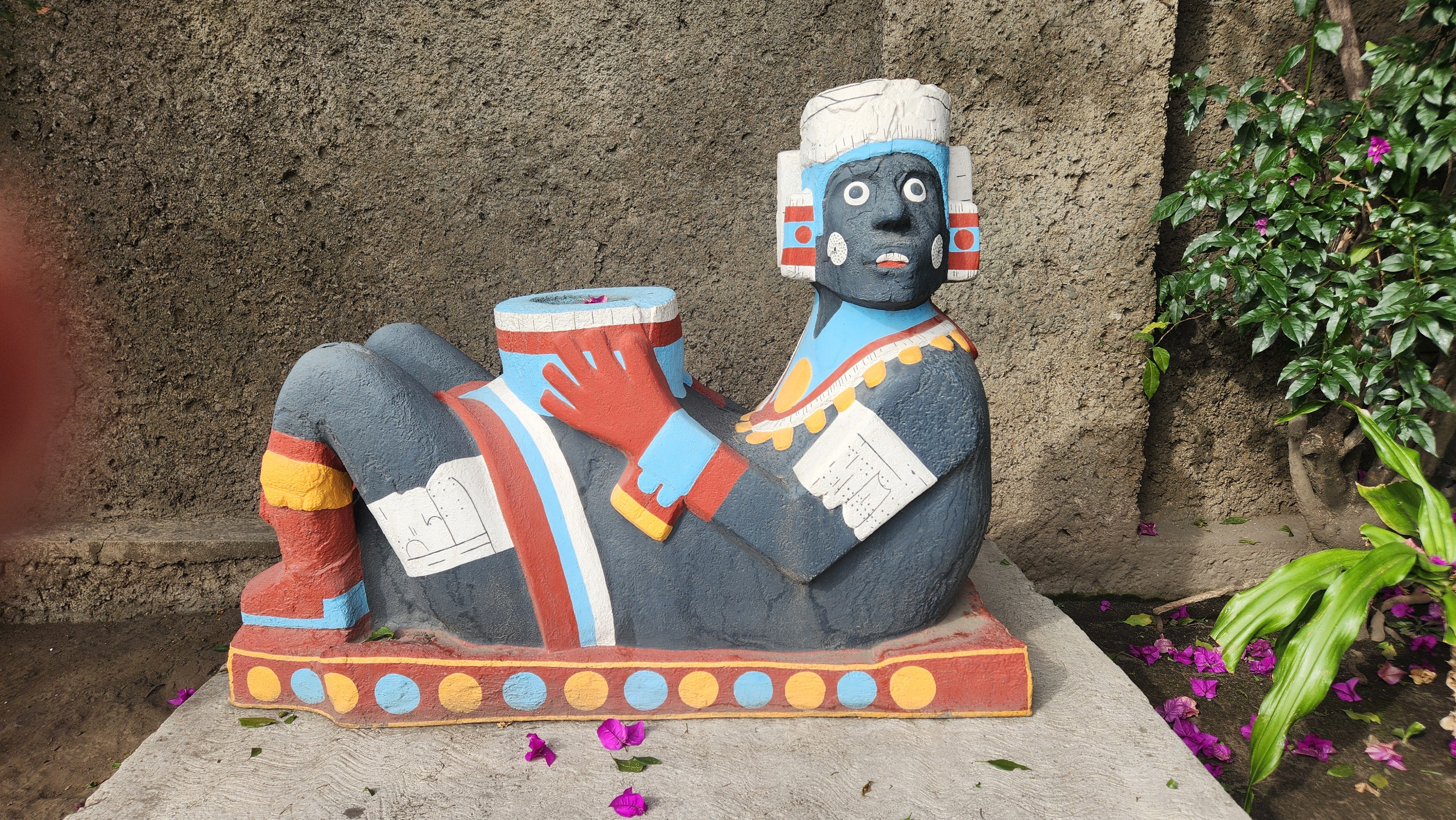
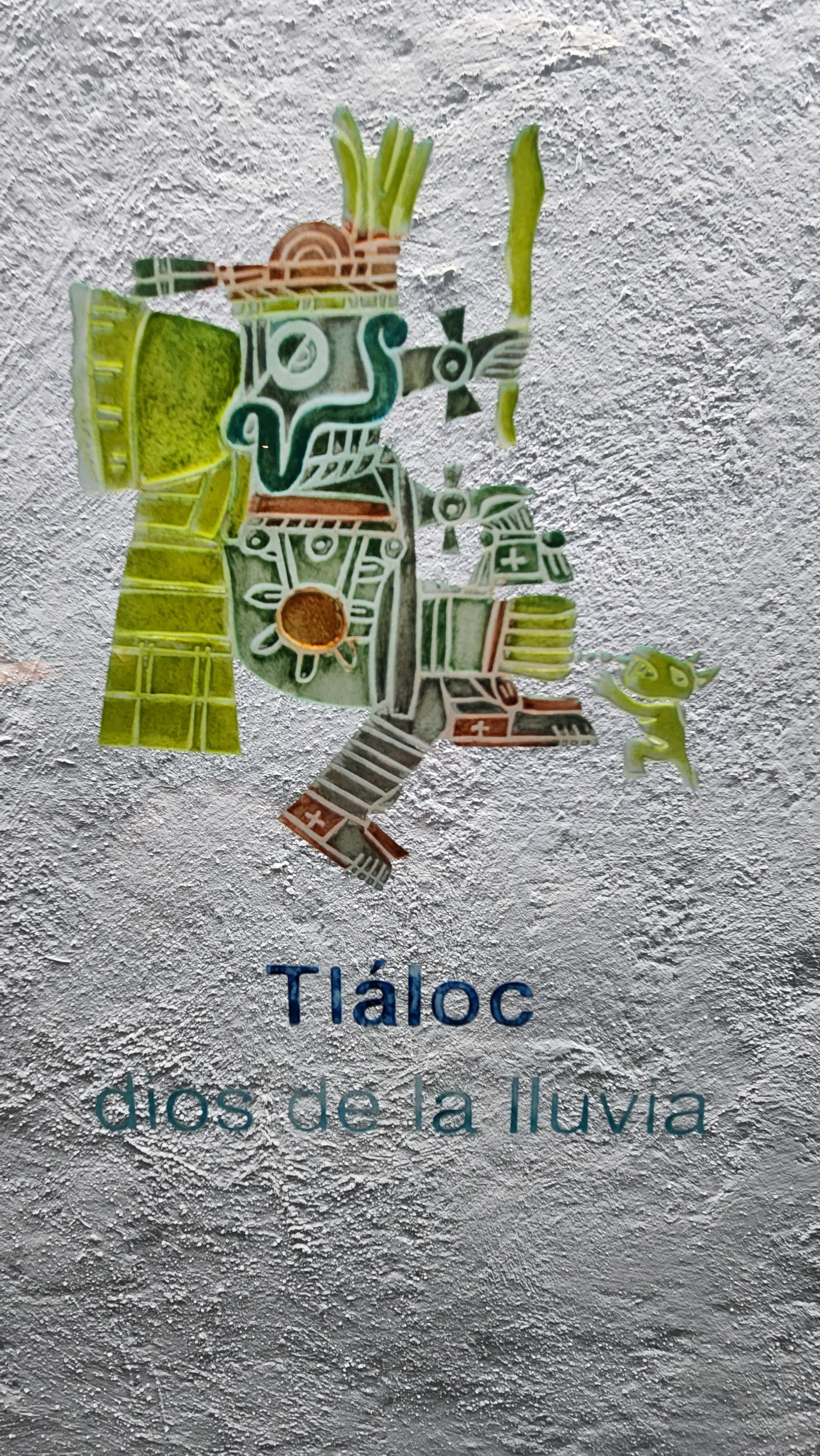
Tlaloc was ever-present during our week in Mexico City, particularly the central part of today’s modern city built atop Tenochtitlan, the ancient Aztec capital that Cortes stumbled upon more than 500 years ago. Through excavated monoliths and plastic tourist trinkets, the god’s perfectly round eyes penetrated our every tourist move. I’m a water geek, but Tlaloc of the circular eyes, the Aztec god of rain, was new to me, and I to him. But the more time I spent in his territory, the more I understood why he was everywhere.
Most visitors to twenty-first century Mexico City are there to soak up the art and auras of painters Frida Kahlo and Diego Rivera, to trace disinterred Aztec history with visits to the National Anthropology Museum and Templo Mayor, the remains of what was once the center of Aztec civilization, and of course to eat “real” Mexican food. They give little thought to the role that water played for this ancient city and its remaking after Spanish colonization. Most have little idea that they’re walking atop what was once a vast lake, or why its geologic origins still matter to the hemisphere’s largest city.
When Hernan Cortes arrived at Tenochtitlan in 1519, looking for gold that didn’t exist, the city sat on a modestly sized island in the middle of a vast, shallow lake. The shores of the lake were dotted with smaller communities, most of which had been in place long before the Aztecs appeared on its shores. In fact that’s probably why the Aztecs, after years of searching, selected the island for their new home – everything else was taken. Two hundred or so years later, when the Spaniards vanquished the last Aztec ruler, Cortes launched what became a 400-year effort to drain the lake and, on its remains, build what we now know as Mexico City.
For Cortes, as much as he admired Tenochtitlan, whose size and cultural richness rivaled that of the largest cities he knew in Europe, destroying Aztec power meant dismantling their city and rebuilding it to his own specifications. It took the better part of four centuries to engineer a way to fully – or almost fully - drain the lakes whose beds Mexico City now stands on. The Aztecs and surrounding communities got all the freshwater they needed from the lakes as well as from streams and springs that fed into the lakes. Because Tenochtitlan was far from shore, and lake water levels and water quality fluctuated with the seasons, the Aztecs built an elaborate system of aqueducts and conveyances to bring clean, fresh water into the city center. They never had to drill wells.
Fast forward to the present era, and you’ll find a very different setup. Like any modern metropolis, Mexico City has a complex water distribution system. Roughly 25% of the region’s water supply is taken from rivers 75 or more miles distant, most of it having to be pushed up and over a mountain range. But three quarters of the city’s water supply is groundwater pumped from an array of more than 1,000 dispersed wells. The mechanics of these operations are daunting, but that’s not the biggest challenge. It’s that the city is running out of water.
It shouldn’t be surprising that providing groundwater to a metropolitan area of – in rough numbers – 20 million people is not sustainable. If you remove more water than can be naturally replenished – which is what’s been happening for decades – then groundwater levels will drop.
As groundwater tables drop, it becomes harder to get the remaining water to the surface, to the place where people need it, which in turn means higher energy costs and more greenhouse gas emissions, more contaminants in the water, and possibly deeper, more expensive wells.
You’d think that a metropolis with a dwindling water supply would do everything it could to conserve what they have. And maybe its leaders are doing everything that they can. After all, water isn’t the only problem on their hands. But meanwhile, I kept reading about how leaky the water distribution system is. Multiple sources bandied the astounding figure of 40% water loss for the distribution system though I’ll cut them some slack and go with the 35% claimed in a 2024 piece from the New York Times. Before we rag too hard on Mexico City, keep in mind that a typical “very large” public water system in the U.S. loses 16% of its water, while 20% is not at all unusual for more modestly sized systems. Both countries have room for improvement.
In both countries the water “loss” is from true leaks and pipe breaks, but generally “nonrevenue” numbers include water that is distributed for use but not billed. This can be intentional, like water supplied to public fountains or fire hydrants. But in Mexico City’s case, it’s estimated that there are as many as 900,000 illegal connections, i.e. homes and businesses that surreptitiously tap into the distribution system but don’t get a water bill, and don’t pay. Even among the 2.5 million legal connections, an estimated 60% of them don’t pay their bills meaning that altogether only about a quarter of the water that exits the treatment plant is actually paid for. I was explaining this to a friend who runs a public service organization with a nine-figure budget. He shook his head and said simply, “That can’t work.” No, it can’t. Which is probably why so many people have only intermittent supply.
Ironically, this city which almost ran out of water as recently as 2024 also floods. On the first morning of our January visit I struck up a conversation with an expat American who works for a world-renowned agricultural network with a research station an hour or so south of where we were staying. “It’s a good thing you’re not here during the summer,” she told me. “During the [summer] rainy season this city becomes impassable.”
Virtually all of Mexico City’s annual rainfall – 27 or so inches – comes between the months of June and September, not unlike the American southwest. Like cities everywhere, pavement, sidewalks, and roofs have displaced natural vegetation and healthy soils, making it nearly impossible for water to soak into the ground. But because Mexico’s capital city is built upon the former Lake Texcoco – which, like the Great Salt Lake, had no natural outlets other than evaporation - there is no escape route for rainwater. And so, the accumulated rain pools as if the landscape “remembers” its past and each summer tries to become a lake again. Like a sturgeon or salmon that keeps trying to swim upstream to its ancestral spawning ground despite the dam in its way, the lake remembers.
How can a city be faced with dialectically opposing challenges, dire water shortages on the one hand and chronic flooding on the other? Tightening up the distribution system will certainly help shore up the supply but would do nothing to counter the annual flooding. Similarly, constructing expensive drainage tunnels to alleviate flooding would do nothing to bolster water supply. What if there were a way to solve both problems at once? Could there be a way to alleviate flooding while also bolstering water supply? The answer is a resounding “yes”.
Since 2009 Isla Urbana, a Mexico-based non-profit organization, has been delivering rainwater harvesting systems first to residents of Mexico City and, now, more broadly to other parts of the country facing similar water stresses, and even into some areas of the U.S. To date nearly 45,000 systems have been installed, annually collecting and repurposing 1.75 billion gallons of water that would otherwise be a nuisance. They’ve also trained countless individuals in how to build and maintain rainwater collection and purification systems for people who are otherwise overlooked by their municipal distribution systems.
Through it all, Tlaloc, the god of rain, is there. He answers prayers by bringing the gift of summer rains to this otherwise parched region of the world. I’ll take it one step further by suggesting that Tlaloc may be behind another significant gift – Isla Urbana and its rain harvesting wherewithal. We all have much to learn from Isla Urbana’s innovative example. There’s still a long way to go, but the organization’s leadership provides hope and a concrete path forward.
If you like Water-philic, why not share?
Want to know more about the how-to of rainwater harvest, particularly for potable water? ARCSA (formerly American Rainwater Catchment Systems Association) has a wealth of resources on building and maintaining rainwater harvest systems, certification, etc. If you live in Virginia, check out their relatively new permitting system for potable rainwater systems.
No posts
Comments
Nothing yet. Say the first thing.
Sign in to join the conversation.