
Newfangled ways to treat bodily excretions don’t usually make it into mainstream news. There are plenty of scientists and inventors out there trying to tackle what is arguably one of humanity’s biggest challenges, but they tend to work in obscurity and news of their work struggles to circulate beyond a select sphere of colleagues. Case in point, Lina Zeldovich’s captivating and superbly researched 2021 book “The Other Dark Matter” struggled to find the light of day because agents and publishers were squeamish about her subject, human excrement. Thankfully the University of Chicago Press saw her topic’s value, but her challenges illustrate the larger point. Even though, to quote the popular children’s book title, “Everyone Poops”, not everyone wants to be reminded of it.
That obscurity makes it especially sweet when my in-box brings off-beat news about advances in this matter that is near and dear to me. The instances are infrequent enough that I always appreciate them. But as a real-life example of “grace happens”, last week not one, not two, but four friends independently sent me news of the weird. Knowing that many of you relish these tidbits as much as I, I’m paying it forward to you.
My friend Rob sent me a link to a Swiss invention that turns a urinal into a fertilizer factory. We all need food, and farmers need fertilizer to grow that food. But fertilizer production and transport is a major source of greenhouse gas emissions. Meanwhile, wastewater is chock full of nutrients, which become pollutants unless they are removed. But removing them requires energy, which also creates greenhouse gas emissions. What if there were a way to efficiently capture nutrients from wastewater and shuttle them directly to plants, thus reducing greenhouse gas emissions on both ends? Hello urine recovery.
It just so happens that, even though our pee makes up only a tiny sliver of wastewater’s volume, it carries the majority of the nutrient load – about 75% of its nitrogen, and nearly two-thirds of its phosphorus - yet virtually none of the pathogens. Once mixed in with the rest of a building’s waste stream it becomes energy intensive to filter out the nutrients, but collecting undiluted urine separately from wastewater keeps the nutrients concentrated. Concentrated nutrients are exactly what farmers need. Here’s where Rob’s link to the Swiss Nutrient Harvester comes in.
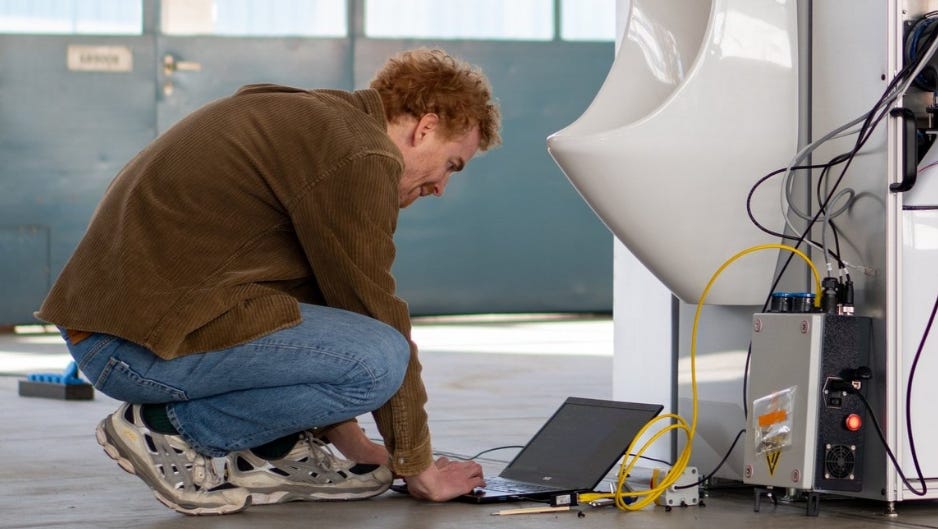
Behind what looks like a stylish urinal sits a micro factory that stabilizes and concentrates urine into a powdered plant fertilizer that can be easily packaged and transported. Lest you think this only solves half the problem given that only half the population can use urinals, go back and read my earlier piece about an easy-to-use $12 device that lets the rest of us pee, and aim, while standing.
The second news item came from my recently retired husband Marc. As a Minnesotan of a certain age, he is eligible to audit classes at “the U” (i.e., University of Minnesota). For free. This semester he’s taking “The Social Life of Soils”. Initially I was sitting in on the video lectures with him. After all, there was no “social life”, or life of any sort, in the soil science course I took in 1979, and I thought I’d enjoy learning along with him. However, it turns out that I know more about the ecosystem beneath our feet than I realized, so I ditched him.
But he didn’t ditch me. Marc is a diligent student, so when he was assigned a reading on the role of soil nitrogen in soils, he made it all the way to the references where his eyes landed on something he knew I’d like: a research paper titled “Urine luck”. This time it was Spanish researchers exploring the advantages and opportunities to be gained when urine is recovered separately from the waste stream. In the article they compare the climate impacts of conventional centralized wastewater treatment with the alternative of urine capture and use as fertilizer for an on-site rooftop vegetable garden.
The application of urine as a vegetable fertilizer is not unique. Trust me, there are lots of tomatoes being grown with urine even if they aren’t showing up in your grocery aisle. (They may, however, be in someone’s sidewalk “free tomatoes” box this summer. Just sayin’.) However, the article’s quantitative analysis comparing urine recovery with centralized treatment is important. Spoiler alert: It’s good for the climate to use urine for fertilizer.
Meanwhile, my friend James, an Omaha-based electrician, came across this nifty gizmo being tested in Japan. The WOTA Unit collects and cleans all of a household’s greywater – i.e., the water from sinks, showers, and washing machines – and then supplies it back to the house for use. I’ve seen similar technologies at meetings and trade shows, but what especially caught my eye in this Japanese application is the way the technology is being deployed.
It’s one thing to use them in a house here and there, but Japanese authorities are systematically testing them out in regions where depopulation has made it financially unsustainable to maintain aging water and sewer pipes. Imagine pairing a WOTA Unit or similar appliance with a Nutrient Harvester, a composting or incinerating toilet, and a rainwater harvest system. Voila. No centralized water systems needed. There are plenty of places in the U.S. where there aren’t enough rate payers to maintain a centralized infrastructure. In fact, in many of these places the cost of infrastructure maintenance is sucking the life out of these communities, sending them into a financial death spiral. It sounds like there’s much to learn from our Japanese counterparts.
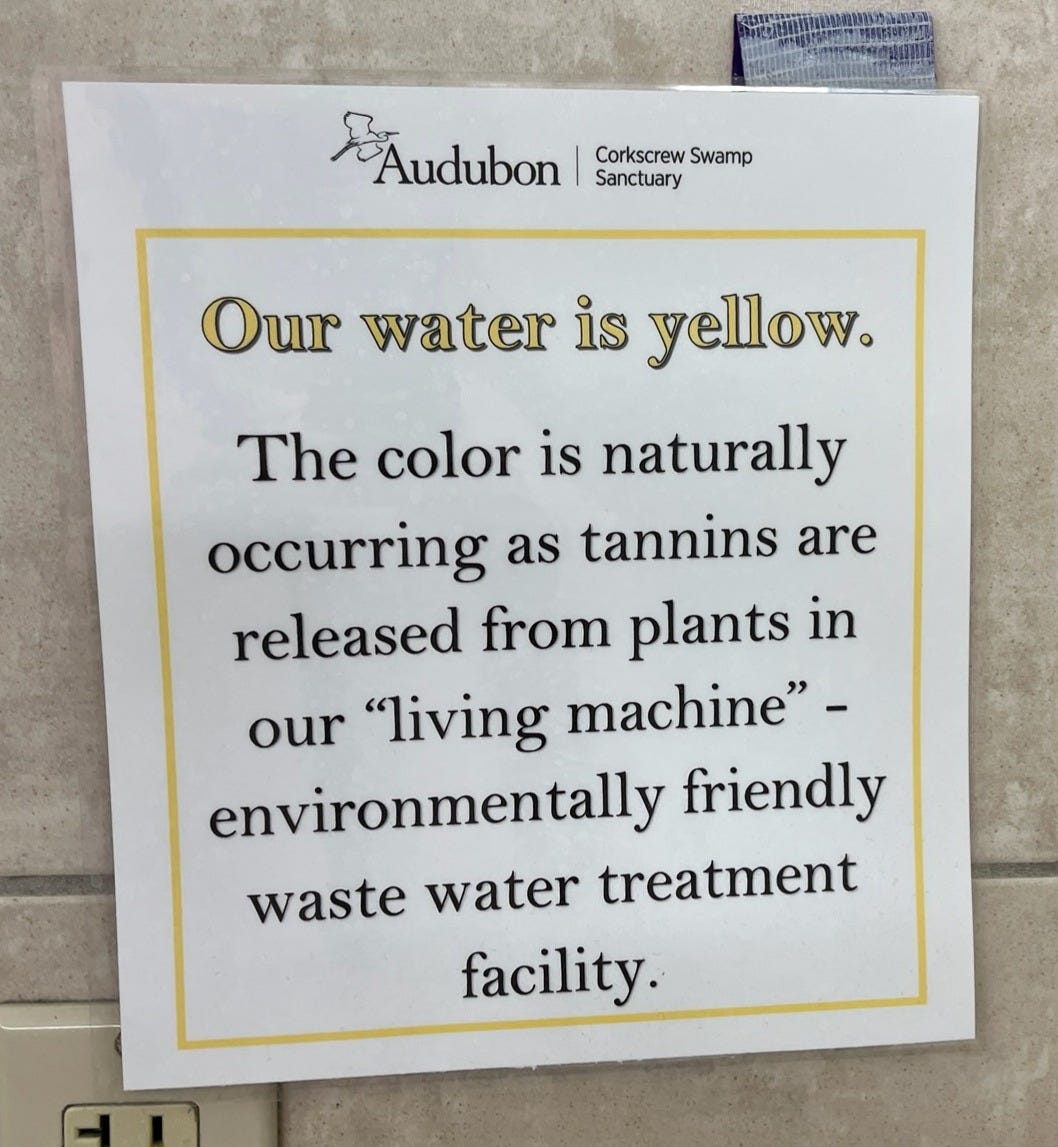
Last but hardly least was a simple photo sent by my college roommate Donna who was visiting Florida’s Corkscrew Swamp Sanctuary with her sisters. Donna, who may have known that I collect images of bathroom signs, texted me this poster she encountered while using the facilities. A home-grown laminated message taped to the tiled wall read: “Our water is yellow. The color is naturally occurring as tannins are released from plants in our “living machine” – environmentally friendly waste water treatment facility.”
Corkscrew’s Living Machine® – a trademarked name – has been treating and recycling the sanctuary’s wastewater for more than thirty years. In the early 1990’s The Audubon Society, which owns and operates the 13,000-acre preserve, was faced with having to upgrade its wastewater treatment. Conventional engineers advised them to install a small version of the wastewater treatment systems most towns and cities use. But not only was that going to be prohibitively expensive for the non-profit organization, it wasn’t in keeping with Audubon’s conservation goals. They went looking for another option.
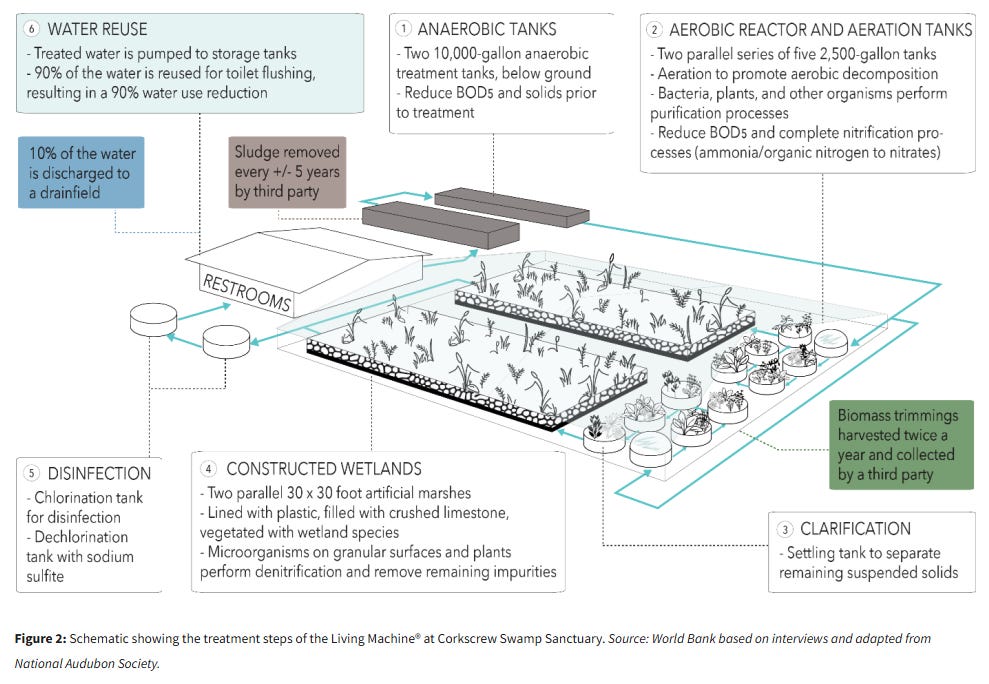
The Living Machine, which relies on plants and microbes to “eat” harmful microbes and absorb excess nutrients, wasn’t just less expensive to build and operate. It also was quieter, less odiferous, created less sludge, and used almost no electricity. A simple 0.7 kw motor was sufficient to operate the bubbler in the aeration tanks. For an organization that prioritizes climate, this was an especially attractive aspect. After thirty years of operation – never violating their environmental permits - some of the components need to be replaced, but that would be true of conventional treatment plants as well.
Rob, the friend who alerted me to the Swiss urinal/fertilizer machine, is a seasoned corporate sustainability director, so it’s perhaps not surprising that he’d come across urine news. But Marc, James, and Donna have no such excuse. What this tells me is that either my friends are weirder than I thought, or that the world is getting to be more interested in, and comfortable with, bathroom matters. Or maybe – hopefully – both those things are true!
As soon as I had I written this post and scheduled it for release on Monday, my podcast feed brought me yet another gift. Living on Earth’s Saturday release featured Dr. William Tarpeh, Stanford Associate Professor and recent MacArthur Fellowship awardee. Will didn’t highlight a particular technology, rather he took us to the 30,000-foot level to see the multitude of possibilities he sees in what other people view as waste. I encourage you to listen. And then listen again. It’s that good. (Note - the link might ask you to create an account, but you don’t need to do that. Just click “play”.)
If you’ve read this far, you’re likely to have a friend who’s also like to read this. Why not share?
No posts
Comments
Nothing yet. Say the first thing.
Sign in to join the conversation.