
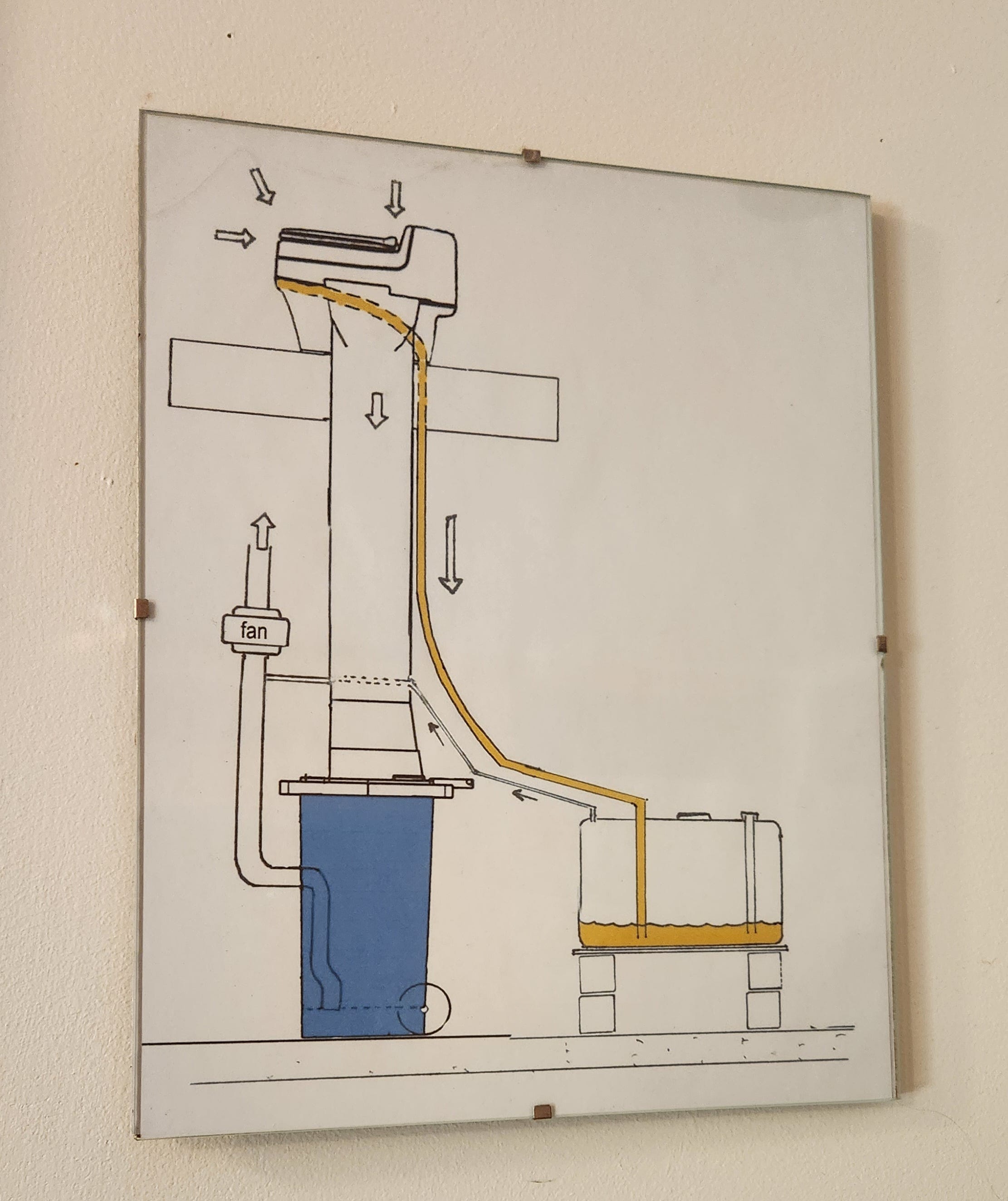
Photo of urine-diverting composting toilet schematic that hangs in Hilda Maingay’s and Earle Barnhart’s bathroom, Falmouth MA.
Last week’s post, Potty Talk, generated more comments and questions than I’m used to, some of them on Substack, most of them not. Going with the iceberg theory – that if one person is asking, there are probably many more who are wondering – I’m following up with this post, addressing some of the questions the collective “you” raised.
“What do they do with the urine?”, I was asked. The simple answer is that urine, high in both nitrogen, phosphorus, and essential micronutrients, yet generally without pathogens, is a terrific fertilizer. On Cape Cod the collected urine is diluted – generally about 5:1, water: urine ratio – and used on home vegetable and fruit gardens, while in Vermont, farmers vie for access to the urine to fertilizer their hay fields. Meanwhile, Bright Earth Tools has developed technologies that concentrate the fertilizer so that it can be affordably transported longer distances.
On Sunday I ran into my friend, whom I’ll refer to by his initials T.P. – after all, this is about toilets and what we do or do not put into them. Though he is deep into sustainability and lives lightly, the benefits of urine collection were new to him. T.P. asked the question that is probably on most people’s minds: How does a urine-diverting toilet work? While I can’t disclose trade secrets about the toilet I saw on Cape Cod, the one that will hopefully be available on the American market in early 2026, I have no such restrictions around describing other toilets designed to do something similar.
Unlike the mystery toilet I saw, most urine-separating toilets – yes, there are many models – are variants of composting toilets. I realize I’m opening a whole new line of conversation with the mention of composting toilets, but that will need to wait for another day. Suffice it to say that composting toilets work much better if liquids are kept to a minimum. Any gardener who’s ever kept a compost pile in their back yard knows that you want the ingredients to be moist enough to allow decomposing bacteria and fungi to do their work, but not so moist that you drown them out and cause the system to become anaerobic. It’s the same when you’re composting excrement.
To separate the urine, the fundamental principle is the same whether for a composting toilet or a water-using one: as the diagram at the top of the post illustrates, the toilet bowls have two exit routes, one in the rear of the bowl for feces while a separate exit at the front of the bowl receives urine and routes it to its own container or collection system. That’s the basic idea. Trade secrets and patents come into play around various designs for improving on that fundamental principle.
You’ve probably realized by now that the user has to sit down for this to work. Our plumber back in Wauwatosa, Wisconsin told me that when he was a young boy his father, also a plumber, put the fear of God into him about not missing the bowl and so he still, half a century later, always sat down to pee. But I don’t think that’s common.
Urinals – the world’s oldest pee separation technology – solve the problem for people who prefer to stand. Though urinals typically connect into the waste stream coming out of the toilet, there’s no reason they have to. In fact, if Cape Cod residents collected urine from just the people with penises – 50% of the population – their water quality problems would be solved without any new-fangled urine-separating toilets. However, urinals aren’t easily incorporated into typical residential bathrooms. That is, until now.
Let me introduce you to the P-pod. Cape Cod residents Earle Barnhart (whose voice you hear in the video) and Hilda Maingay worked for years to come up with a simple, durable urinal design that could be easily installed in a home. Their solution sits flush against the wall when it’s not in use, and hinges open from the bottom when being used. The white square, roughly 8” x 8”, is hardly noticeable unless you know what to look for. My anatomy isn’t suited for using it, but I spoke with several guys who gave it a try. To a person, they were impressed. Even the tall guys! No splash, no smell.
Another friend, Amy, asked “If we are on city water/sewer does the treatment plant separate out the urine for anything?” Unfortunately, no. Once urine and feces are mixed, the urine can’t be separated out. In fact, because the two materials are mixed, the treatment plant has to spend a lot of energy and money trying to remove urine’s nitrogen and phosphorus from the wastewater. What’s more, at the treatment plant, phosphorus often recombines with other minerals to form struvite, a mineral buildup that clogs the pipes much like plaque clogs human arteries. The treatment plant’s job would be a lot easier if we didn’t send urine down the pipes. So, even though they aren’t asking you to do so, every bit of urine that you keep out of your city’s system makes their job easier, and a wee bit less expensive.
My brother, Ike, an experienced sailor who’s crossed the Atlantic and Pacific oceans more times than I can track, wrote that years ago he rented a sailboat that had a Nature’s Head composting toilet “with a pee-bottle in the front and a dry-compost receptacle in the bottom that we would turn with a crank and add a little sawdust”. He went on to say “It actually worked really well. The amazing thing was that the poo side of things seemed to last forever before it needed to be emptied. And, there was absolutely no smell.”
Anyone who’s been responsible for the more typical toilets one encounters at sea will appreciate his observation that “[The] best part was that there were no pipes to get clogged, no ‘thru-holes’ in the hull to cause leaks, and no chance of accidentally dumping in the river when a guest flips the wrong switch.”
Unfortunately for my brother and his shipmates, when they returned the rented boat to the marina they were instructed to empty the collected urine into the toilet. An opportunity down the drain.
That said, it seems that we’re entering a time when at least some people are getting more comfortable talking about pee and poo. And technologies are making it easier for people to put that talk into action. While we’re not going to see the end of conventional toilets, septic, and sewers at a grand scale anytime soon, I do think that the momentum is in that direction.
· Manufacturing synthetic fertilizer (i.e. Miracle-Gro and that ilk) is energy intensive. If you’re an at-home gardener who is urine-curious, check out Pam Dawling’s blog on the topic. It’s full of practical information.
· Speaking of synthetic chemicals, Circle of Blue reports on USGS’s finding that pesticide residue is gradually diminishing in our groundwater. That’s good news. (Though why they didn’t test for glyphosate is beyond me.) But if agro-chemical giants have their way, funds for monitoring these chemicals will be slashed, while simultaneously giving them blanket immunity from the health impacts of their poisons.
I love it when people share!
No posts
Comments
Nothing yet. Say the first thing.
Sign in to join the conversation.