
A week or so ago my husband and I were in our front yard trying to rein in our exuberant slice of urban prairie. Neighbors on an evening stroll, making small talk as they neared, asked me “You’ve been away?”
“Yes, on Cape Cod for a few days – a conference. Got back yesterday,” I replied.
Husband Marc, apparently thinking my answer wasn’t sufficient, added “She saw a lot of toilets.”
We know these folks well, and one of them works in construction, so maybe he’d be interested in more detail? “It turns out that if you keep urine out of wastewater, it solves a lot of problems.” There. I’d said it. “Urine.” After a few chuckles our neighbors were able to escape back to their evening stroll. My husband, however, was stuck with me.
The conference I’d been to – the one Marc humorously claimed to be about toilets – indeed had its share of potty talk and potties, but it was all in the name of clean water. The kind of water that entices people to swim and fish. The kind that draws vacationers and retirees. The kind that supports robust property values and good health. Increasingly, however, pollution from excessive nitrogen and phosphorus – essential nutrients when they’re in balance – is catalyzing a downward spiral led by the explosive growth of harmful algae species, followed by their massive die-off. Not all algae are “harmful”, but high-nutrient environments – what ecologists call “eutrophic” – often encourage species that manufacture harmful, even deadly, toxins. Serious stuff that I’ve written about previously, as has Dan Egan in his 2023 book “The Devil’s Element”. But even without the toxins, bacteria that feed on decaying algae carcasses, miniscule as they are, can quickly deoxygenate a pond or stagnant stream, killing fish and the aquatic invertebrates they feed on. A dead zone has no silver lining – it’s as bleak and unappealing as it sounds.
In rural America, algae blooms and dead ponds are driven almost entirely by conventional agriculture. Excessive fertilizer and manure make their way to ponds, streams, and rivers – and eventually to coastal waters – where they wreak havoc. But areas with more people than farms aren’t off the hook, especially if those people live relatively close together and don’t have a well-functioning system for handling their, ahem, excretions. Such is the case on Cape Cod.
The people of the Cape believe in science. Being home to the internationally renowned Woods Hole Oceanographic Institute and culturally infused with Boston’s brain trust just 90 minutes north, rationality is in the air. So, twenty or so years ago when algae-choked ponds and shellfish advisories started ruining people’s weekends, they looked for data.
Whether they liked the answer or not, science clearly pointed to septic systems as the culprit. Lawn and golf course fertilizers shouldered some of the blame, to be sure, but the big kahuna was the thousands of septic systems that dot the peninsula, serving 85% of the homes and businesses on this sandy, porous spit of land jutting out into the Atlantic.
The kneejerk solution would be to build or expand centralized wastewater treatment plants, along with extensive networks to collect the wastewater and transport it to distant facilities. For homes and businesses near the handful of treatment systems already up and running, this was the obvious solution. But to sewer the entire Cape, with its plethora of homes on one-acre lots, would cost tens of thousands of dollars per home, with some estimates adding another zero to that. Money wasn’t the only roadblock. Designing, permitting and constructing big-box treatment systems easily requires a decade or more, and burying the pipe network would bring massive disruption, likely removing many of the mature trees that are a large part of the region’s charm. Thinking that there had to be a better option, a radical idea started circulating: “What if we kept the septic tanks but didn’t flush the urine?”
While urine makes up less than 1% of typical wastewater volume, it carries more than half of its phosphorus and about three-quarters of its nitrogen. Scientists estimated that capturing even half of the region’s urine would be sufficient to clean up the Cape’s beloved waters. As crazy as the idea may sound, there are entire communities in Europe that have proven that it’s possible. By keeping the nutrient-dense urine out of septic systems and finding another use for it – e.g. fertilizer - the pollution problem would be solved at a small fraction of the cost of constructing and operating central sewers. For the last dozen or so years, a cadre of dedicated people – on a technology adoption curve, they’re the earliest “innovators” – have been experimenting with collection methods.
Knowing that urine collection wasn’t as thrilling to Marc as it was to me, upon returning home from the conference I tried to keep my enthusiasm to myself. But after dinner that first evening back, I wanted to show Marc the impressive vegetable garden – fertilized with urine - I’d toured. Digging through my phone I had to scroll past the toilets, urinals, and composters I’d photographed on my trip. With each, I tried to make him more comfortable by adding – truthfully – that there was absolutely no odor to any of these. None. But I could see him retreating inward, pulling into his shell like a box turtle. With some prompting on my part he confessed, “I just want a normal toilet”.
My husband wants clean water as much as the next person, but he also, like pretty much everyone else, wants a normal toilet. Or at least a normal toileting experience. Which is why, if we ever want this to get past the enthusiastic pioneers, if we want to get enough urine out of septic systems to keep water clean for Cape Cod and lots of other places, we need toilets that do the separating for us. Toilets that don’t call attention to themselves. Europe has such toilets, but because North America uses a different plumbing code, the European toilets won’t easily work in an American bathroom. That’s about to change.
While we were in Falmouth, the town on Cape Cod that hosted the conference, some of us had the opportunity to see a prototype of the bathroom innovation poised to give Americans the ability to separate and capture urine independently from the rest of a home’s waste stream, all while giving people the bathroom experience they’ve come to expect over the last hundred years. After sessions ended on day one, I huddled in a back hallway with three others where we each signed a non-disclosure agreement and were told to leave our phones behind. We were then led into a small office where a draped bed sheet concealed what we’d promised not to photograph. I can’t say much but suffice to say that the American market will soon have its very own urine-separating toilet. One that allows people to have a “normal” toileting experience while the behind-the-scenes plumbing allows for a not-yet-normal capture of the liquid gold most people dismissively flush into their environment.
While we are still decades away from a toilet revolution in the U.S., the conference was abuzz about a pilot project that will bring these toilets to Falmouth in 2026. Twenty-five lucky homes, whose residents have been manually collecting urine for years, will be outfitted with one of the new urine-separating toilets. For the next year, scientists will carefully monitor the costs and nutrient recovery statistics, as well as the impact on water quality. Assuming good results, we’ll be one small step closer to clean water at an affordable price. All with a toilet that even Marc will love.
Want to learn more about urine separation and the pioneers who are finding better ways to collect and repurpose its nutrients? I suggest starting with the Rich Earth Institute in Brattleboro, Vermont. If you’re super interested, sign up for the Virtual Summit that they’re hosting Nov 12-14, 2025, bringing together a global suite of practitioners and researchers.
Other places your curiosity might enjoy traveling to:
The Green Center which has served as the epicenter for Cape Cod urine collectors and practitioners. Click on the “Nutrient Recycling” tab.
If you’re into the science of nutrient recovery and the hard data on urine use as fertilizer, check out Dr. Nancy Love’s lab at the University of Michigan, particularly the “Publications” tab.
If you want to learn more about technologies that complement the urine collection, check out Brightwater Tools, an outgrowth of the Rich Earth Institute. Their technology is finding additional applications for other, more traditional liquid “waste” streams that are high in nutrients. (Note - I’m an advisor to Brightwater Tools, but uncompensated and not a shareholder, so I’ve got no financial conflict of interest to worry about.)
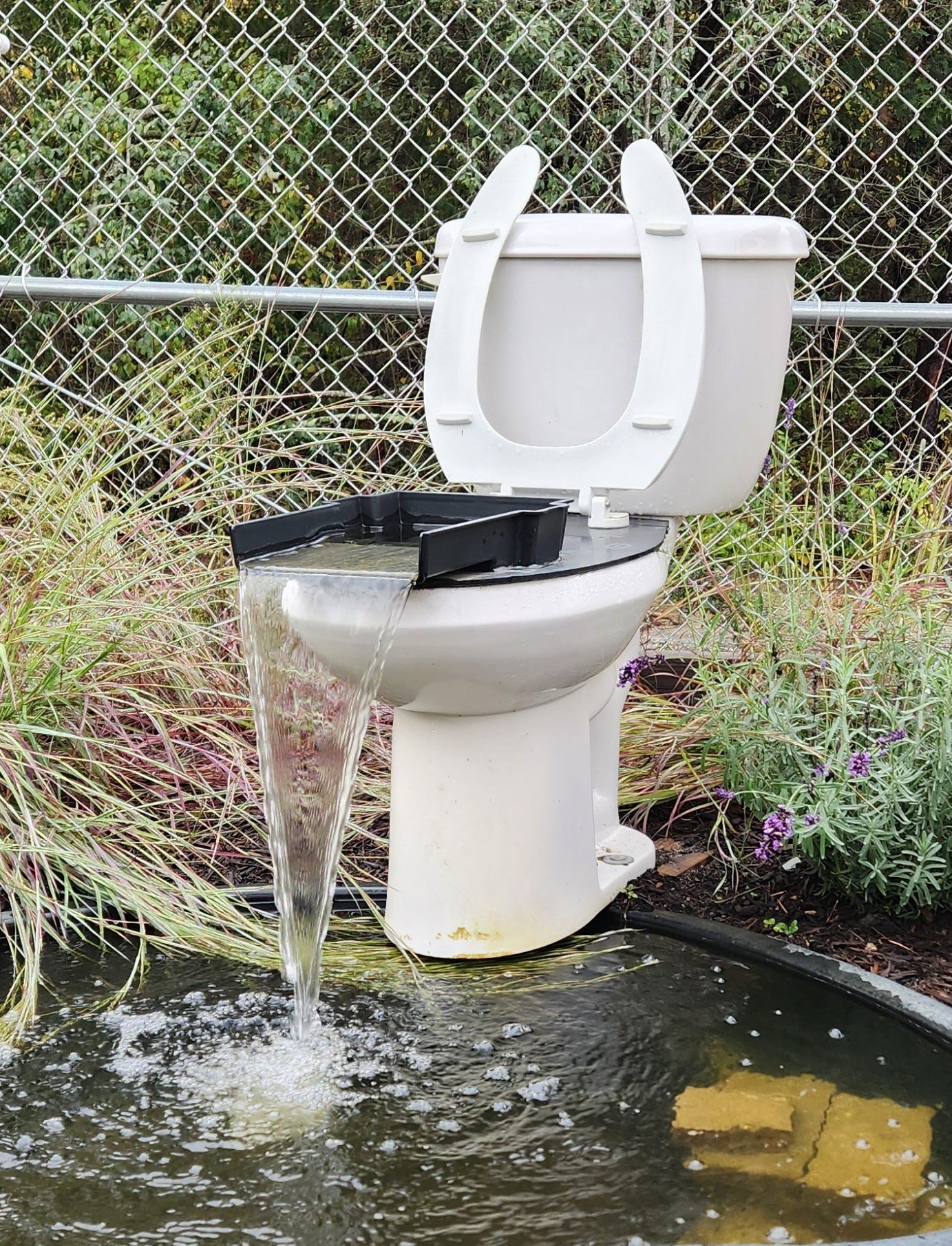
I took the toilet waterfall picture at the MASSTC, our host for Day 1 of the conference, and the folks who will be running the pilot urine-capture project in Falmouth.
Do you know someone else eccentric enough to want to read this? If so, please share!
No posts
Comments
Nothing yet. Say the first thing.
Sign in to join the conversation.