
I’ve been re-reading Annie Dillard’s 1974 “Pilgrim at Tinker Creek” off and on for the last month. My first-edition hardback copy sits on my office bookshelf after surviving at least eight moves with me, but it was a paperback reprint from a Milwaukee friend’s Little Free Library that lured me to re-read what I’ve long considered to be one of the handful of books that shaped me as a young woman. Never mind that not a single sentence rings familiar - the overall sentiment is still a literary homecoming.
Though I’ve never set foot on the banks of Tinker Creek, or disturbed the crickets in its adjacent fields, as a young woman I knew the region well. I’d spent countless days and nights hiking and camping in the national forests that drape the mountainous borderlands between Virginia and West Virginia, sometimes alone, but mostly with friends. It was, and still is, easy for me to picture the places Dillard described.
Midway through the book she takes us back to Hurricane Agnes – just a year before the time she was penning her draft – the 1972 storm that brought unprecedented flooding and destruction to the Mid-Atlantic. I was twelve years old that June, celebrating the freedom of school’s end. Weather forecasts forty years ago weren’t at all what they are today, but it was clear that after Agnes had made landfall in Florida, she was moving up through the interior of the country picking up moisture as she went. Communities braced for heavy rain, but little did we know just how bad it would get.
As the rains intensified over Northern Virginia, my best friends, Beth and Gwen, and I were scheming a sleepover at Beth’s. She and I lived back-to-back with a narrow strip of pines and a well-worn footpath separating our backyards. Gwen’s house, however, was a ten-minute walk down a narrow, dead-end lane that led to three or four houses on larger lots. No matter what was happening with the weather, we three needed to get to Gwen’s to collect her pajamas and whatever else she needed for the night.
Our route, typical of Virginia’s rolling Piedmont, took us down a long hill, across Popes Head Creek, and up the other side. As we traversed the single-lane wooden bridge we noticed that the creek, normally five feet or so below the bridge, was already lapping its underside. When we came back the other way – which couldn’t have been more than twenty minutes later - the café-au-lait torrent had risen to the bridge’s wooden railings. Gwen held her belongings high above her head, out of the water’s reach, and we waded in. By the time we reached the middle of the bridge, we were literally waist-deep in water, bracing ourselves against the crosswise current and clutching each other’s hands as tightly as we could, never once thinking that maybe we were putting our lives on the line. All for the sake of pajamas.
We made it through, drenched but safe. Our neighborhood, along with almost the entire region, lost power. Since our homes all had wells that relied on electric pumps, losing power also meant losing water, ironic given the amount of rain that had fallen. Our tribulations, however, were minor compared to the wide-scale damage Agnes left in her wake. The regional water authority, supplying water to 500,000 people, was out of commission for eight days. Its dams and facilities took four years to fully repair. Major bridges were destroyed.
All told, Agnes took 128 human lives and left 220,000 people stranded with nowhere to go because their homes had been swept away or were damaged beyond habitability. In Fairfax County, where I lived, the impact was much less than it could have been because of the foresight of county citizens and planners. Concerns about protecting the water supply and the natural beauty of the region amidst intense urban sprawl led “far-sighted Fairfax citizens and government” to protect 5,000 streamside acres, a revolutionary action for the 1950’s. Though the land protection was designed with water quality in mind, by keeping development well away from floodplains and streambanks, county leaders had also protected the region from intense storms. Little did they know how important that would become.
That experience, and Fairfax County’s wise planning, was on my mind during a recent trip back to Wauwatosa, Wisconsin - the Milwaukee suburb my husband and I, along with our two sons, lived in for 17 years. When our family arrived in 2000, feeling like we’d moved to the other side of the world from our Mid-Atlantic roots, the community was still talking about the devastating floods of 1997 when ten inches of rain fell in a few short hours. “When CNN shows up in your neighborhood, it’s time to worry” recounted Deb, one of my new neighbors who remembered it well.
Our block was a half mile away from, and elevated well above, the Menomonee River, so it had been spared the worst of the damage. My neighbors recounted their tales of flooded basements and impassable roads, but that was a cakewalk compared to those who lived close to the river.
Wauwatosa is a modest “first-ring” or inner suburb, snugging up to the western edge of Milwaukee, the larger and older city of the pair. From its beginning, Wauwatosa was defined by its river. Potawatomi and Menominee Indians made their home along the river until the 1830’s, and local lore claims that the city’s name is derived from a Native word meaning “firefly”. The first Euro-American settler staked his claim along the riverbanks, eventually building two mills. Not long after he set up shop, enterprising people built a road opening the way between Milwaukee and Madison, the territory’s capital 75 miles to the west, as well as a railroad line that took advantage of the river basin’s gentle terrain, straight through town and became the backbone of Wauwatosa’s business district. The years ahead would prove that building along a river had its drawbacks.
With every new settler and every new building, rain had fewer places to go. Instead of being slowed down and soaked up by meadows, savannas and wetlands, when downpours inevitably came, they rushed straight off roofs and roads, racing for the river. Like all rivers, the Menomonee had a natural rhythm, it rose and fell, sometimes going beyond its banks to replenish floodplains with sediment. Nature’s fertilizer. But as buildings encroached, the river had fewer places to spread when water ran high. Squeezed into smaller spaces, floods that had been part of the landscape for millennia became human catastrophes.
On June 21st, 1997, the skies opened on Milwaukee and adjacent Wauwatosa. The ground, already saturated from previous rains, may as well have been concrete for its utter lack of ability to absorb any more precipitation. A section of highway was suddenly under twelve feet of water, the Milwaukee Brewers’ stadium – just a stone’s throw from the river - was also under two to three feet of water. It was the first time a major league baseball game had to be canceled due to flooding. Wauwatosa’s entire downtown was inundated, as were the blocks of charming, 100-year-old homes on the other side of the river. All told, there was more than $53 million in damage.
Wauwatosa and Milwaukee were certainly not alone as they recovered from the 1997 floods - river communities flood all the time. It’s a familiar story – the heartache of flooded living rooms and kitchens, photos and treasured heirlooms forever gone, and all too often, the loss of human life. The financial loss, the outpouring of aid, and the eventual getting on with life. All too often, the lessons are forgotten only to repeat themselves a decade or two later. But in Wauwatosa’s case, the story took a different tact.
Municipal leaders from up and down the watershed, along with the regional sewerage district, went into high gear after the floodwaters receded, launching a years-long process of planning for, and getting the public to agree to (and pay for) changes that would better prepare the region for the next flood. Homes were torn down or moved, parks were expanded and sculpted to better absorb floods, pavement was removed. Hundreds of millions of taxpayer dollars were collectively invested into flood management projects. To the region’s credit, most of those projects worked with nature rather than against it. Lifeless concrete channels were restored to natural streambeds. Trees, whose leaves naturally capture precipitation, were planted, and raingardens installed. Asphalt parking lots, particularly those near the river, were replaced with permeable surfaces, designed to allow water to flow through them rather than off.
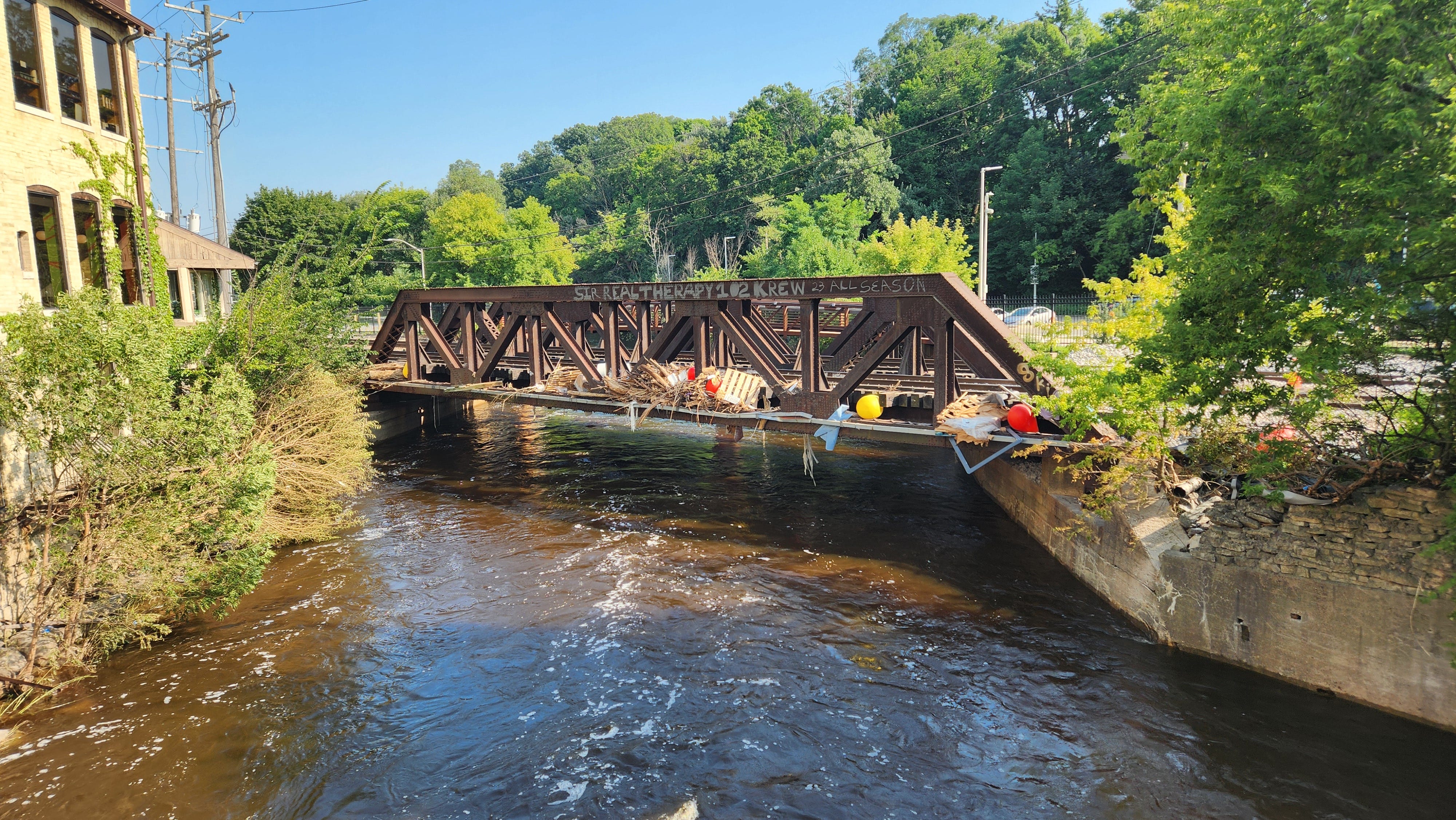
As fate would have it, a recent visit brought my husband and I back to Wauwatosa just days after a deluge even more cataclysmic than the 1997 downpour. When we arrived, we could easily tell which homes had flooded basements because of the soggy rugs, filing cabinets, and boxes of holiday ornaments sitting by the curb waiting to be hauled away and buried in the landfill. A savvy observer could see the dusting of mud on tree trunks, indicating the high-water mark. But the big story wasn’t what we saw. It was what we didn’t see. The downtown had not been underwater. Bridges had not been washed away. Life was flowing. The planning and investments had worked.
Before Wauwatosa, Marc and I lived in Wilmington, Delaware, where the corporate culture lived and breathed the mantra “Safety is no accident”. Preparing communities for new precipitation patterns doesn’t happen by accident – it requires intention. Building to survive and even thrive in flood-prone landscapes takes time. Lots of it. While the best time for other flood-prone communities to start planning has already passed, today is the next best option.
Would your Facebook or LinkedIn connections like to read this too?
Photographer and writer Eddee Daniel, who has lived in Wauwatosa since well before the 1997 floods, captured the 2025 inundation and reflects on how much worse it could have been in his lyrical piece posted on his blog “A Wealth of Nature”.
Speaking of rain, Gov. Younkin declared this week “Virginia Rain Harvesting Awareness Week”. Not quite a year ago the state became the first in the country to adopt potable rainwater harvesting standards and permitting guidance, largely due to the efforts of Tyrone and Leslie Jarvis, owners of Go Green Autocare in Newport News. The Certificate of Recognition was a well-deserved surprise birthday present - for Tyrone this week. I’m pasting an image of the certificate below because I’ve never seen a better enumeration of the justification for rain harvesting! Nicely done!
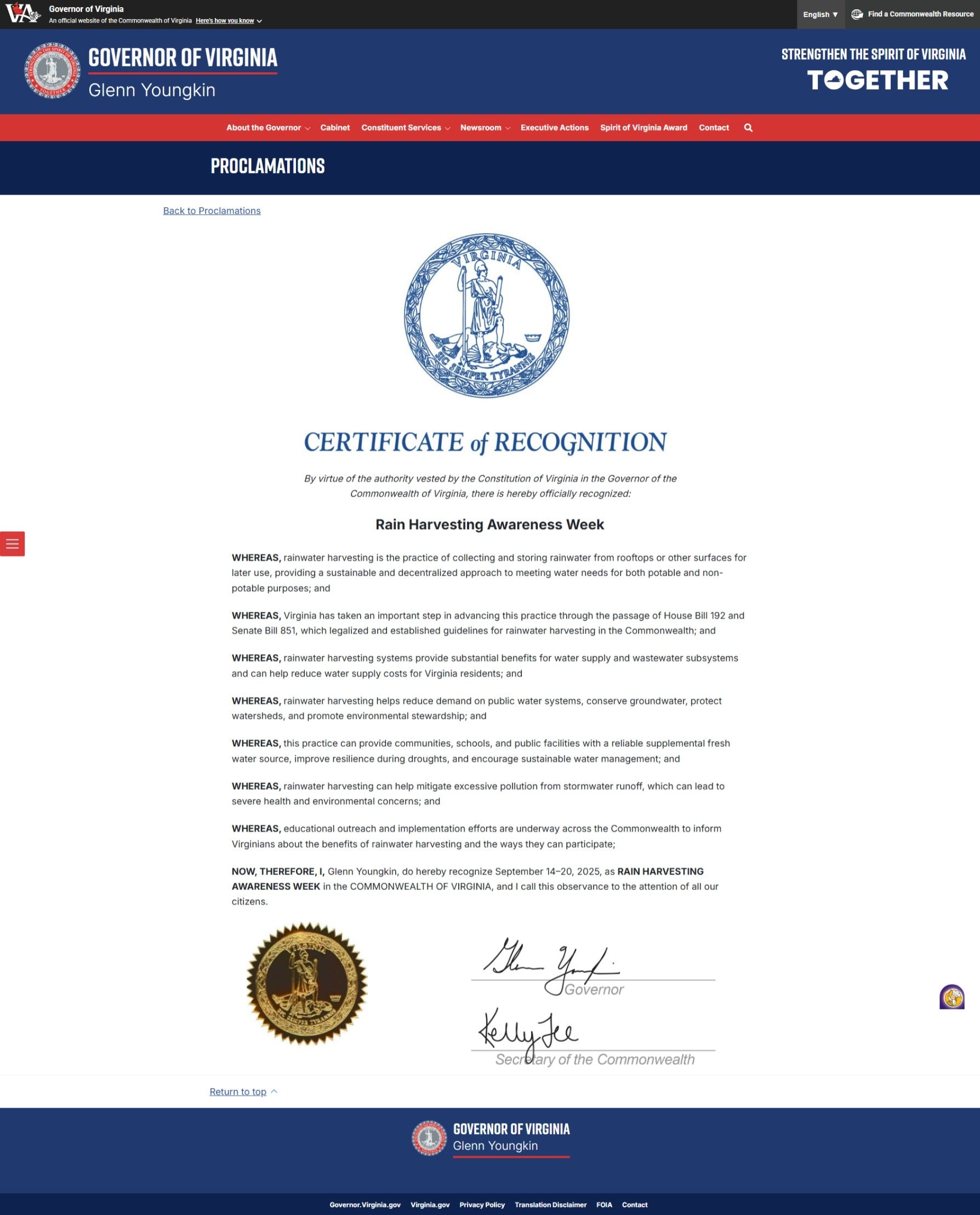
WHEREAS, rainwater harvesting is the practice of collecting and storing rainwater from rooftops or other surfaces for later use, providing a sustainable and decentralized approach to meeting water needs for both potable and non-potable purposes; and
WHEREAS, Virginia has taken an important step in advancing this practice through the passage of House Bill 192 and Senate Bill 851, which legalized and established guidelines for rainwater harvesting in the Commonwealth; and
WHEREAS, rainwater harvesting systems provide substantial benefits for water supply and wastewater subsystems and can help reduce water supply costs for Virginia residents; and
WHEREAS, rainwater harvesting helps reduce demand on public water systems, conserve groundwater, protect watersheds, and promote environmental stewardship; and
WHEREAS, this practice can provide communities, schools, and public facilities with a reliable supplemental fresh water source, improve resilience during droughts, and encourage sustainable water management; and
WHEREAS, rainwater harvesting can help mitigate excessive pollution from stormwater runoff, which can lead to severe health and environmental concerns; and
WHEREAS, educational outreach and implementation efforts are underway across the Commonwealth to inform Virginians about the benefits of rainwater harvesting and the ways they can participate;
NOW, THEREFORE, I, Glenn Youngkin, do hereby recognize September 14–20, 2025, as RAIN HARVESTING AWARENESS WEEK in the COMMONWEALTH OF VIRGINIA, and I call this observance to the attention of all our citizens.
References:
https://www.fairfaxwater.org/news/50th-anniversary-hurricane-agnes
https://en.wikipedia.org/wiki/Hurricane_Agnes
https://www.pwconserve.org/issues/occoquan/shoreline.html
No posts
Comments
Nothing yet. Say the first thing.
Sign in to join the conversation.