
They arrive with companions: titles, epigraphs, dedications, even the layout on the page, the font, or the words on a back cover. All of this—what surrounds the poem but isn’t the poem itself—is extrapoetic material—an umbrella term I use to describe anything that contributes to the poem, or to the reader’s understanding of the poem, but which isn’t the poem itself. It’s extra, or outside the poem.
You may be familiar with this kind of framing from other arts. At a gallery, you may pause to read the title of a work and a paragraph of text about it before you really take in the artwork. Then, you look at that artwork through the lens created by the information you just read.
Or, at a classical music concert, the programme folded in the concertgoer’s lap tells them that the piece they’re listening to is an homage to a philosopher, or explores love, or contemplates the devastation of a nuclear bomb.1 A title, a note from the composer, a single descriptive phrase—all of it reaches into your ears before the first violin bows a string, and helps guide your interpretation of the music.
In poetry, it’s just the same. If you’re a poet and you really want to communicate something, you always have much more than just the poem at your disposal.
Think: footnotes, endnotes, dedications, titles, epigraphs, marginalia. You might think of this type of material as belonging in the realm of mere afterthoughts or final touches — but it’s actually quite important, as it helps the reader contextualize and navigate a poem.
This material may even be fundamental to the poem’s structure—take Ocean Vuong’s poem that uses only extrapoetic material (specifically, an epigraph and footnotes):

A poem’s extrapoetic material might also include other art forms, like illustrations, diagrams, art installations, film/video, dance, soundscapes...
Think Claudia Rankine’s book Citizen: An American Lyric, which weaves in imagery and art among the writing; or video poems, like the short film version of Robin Coste Lewis’ poem Every Day.2
I’ll focus more on those types of extrapoetic cross-disciplinary collaborations in future instalments. For now, let’s focus on a few examples of marginalia and footnotes.
In Alice Oswald’s book, Dart, she traces the characters and elements in and around the River Dart, which runs through Devon, England. She spent several years researching the river and talking with the people who interacted with it, and then created a single, book-length poem.
Rather than separating out the body of writing into individual poems with titles, or using the poem itself to explain the voices and the context, she uses marginalia—small notes on the outer margins of each page to indicate when voices change or to explain or enhance the poem’s content.


Paul Hlava Ceballos composed the long poem and collaborative chapbook “Banana [ ]/we pilot the blood”3 by collaging together fragments found from historical texts—each of which contained the word “banana.”
Integral to the poem are its endnotes about each fragment, which educate the reader about the banana—as plant, as product, as vehicle of labour exploitation and environmental change. They dive into botanical fragility (diseases, pests, varieties) and systemic fragility of labour rights and ecological justice.4
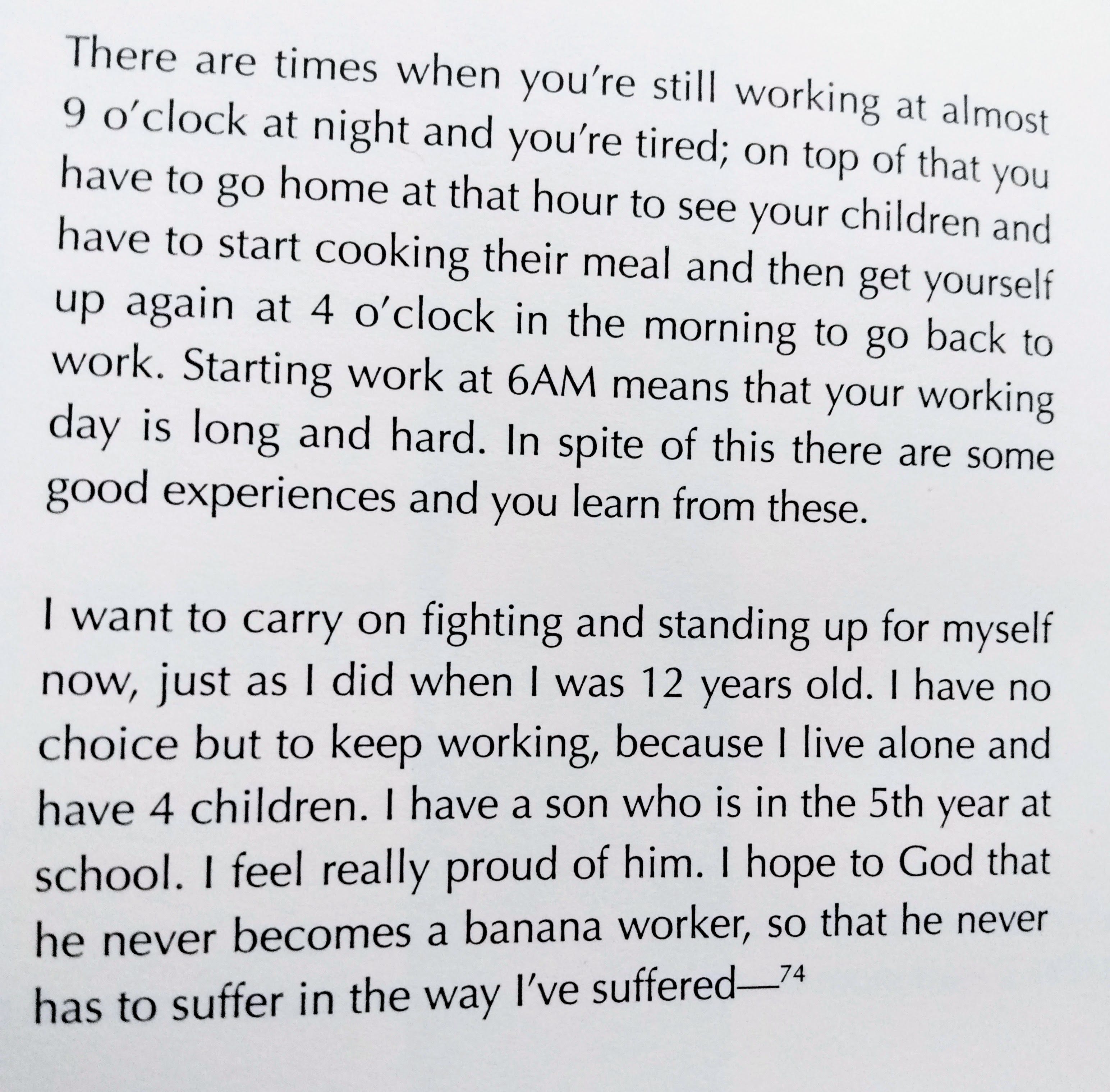
As I pick through the path Ceballos lays out, the experience is a go-at-your-own-pace, fascinating-and-horrifying-in-turns guided tour of the topic.
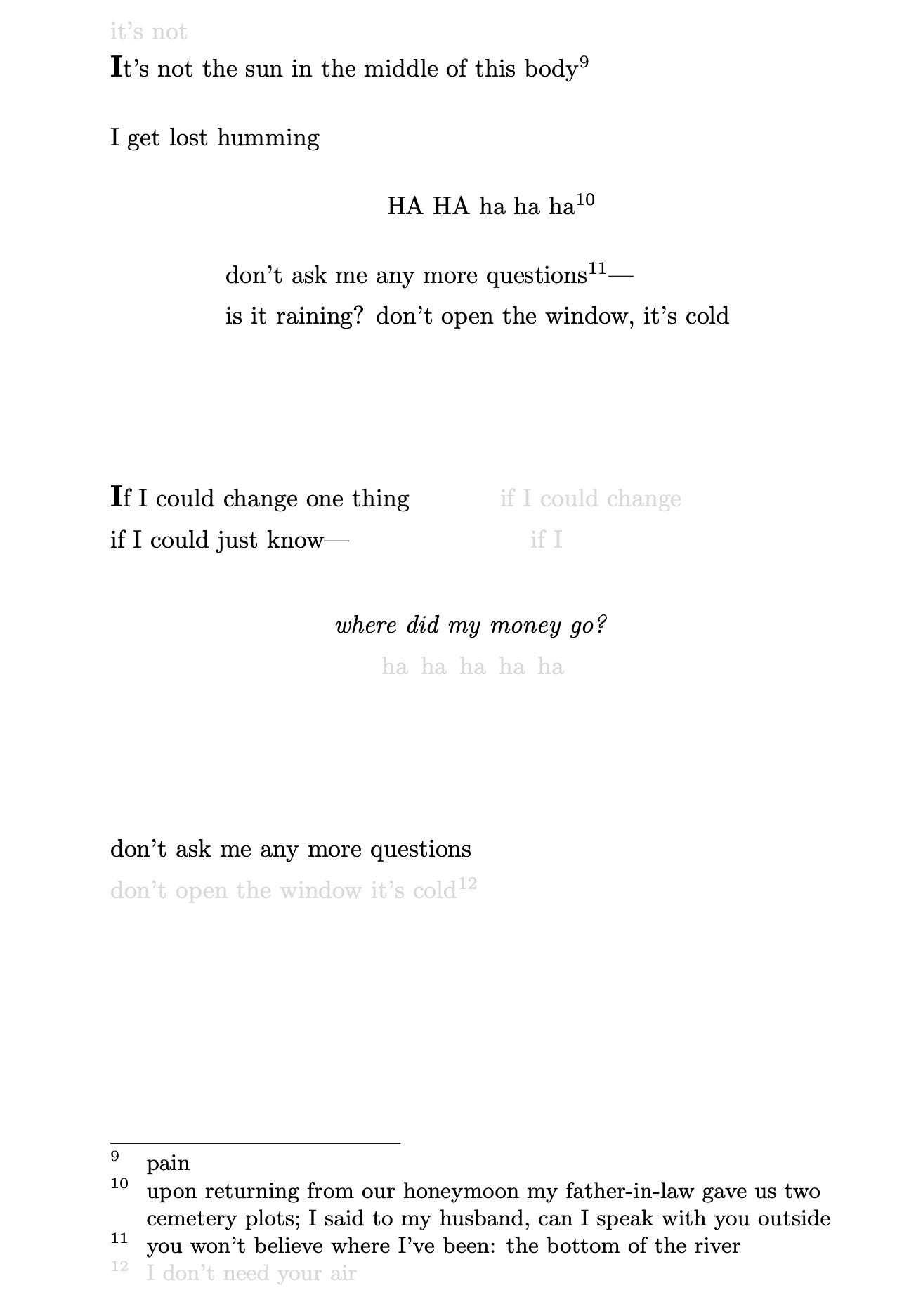
I have used footnotes before as an additive ingredient—meaning I cheated a bit, and wrote more poetry as footnotes. Here’s a page from a poem called “In the Middle of the Room”:5
Writing Challenge
Try writing a poem that uses marginalia or footnotes—you might compose something new, or add a new dimension to an already-written poem.
As ever, I’d love to see what you come up with, if you feel like sharing! Feel free to leave a comment, or reach out to me by email at ecblair@gmail.com.
See Penderecki’s piece Threnody for the Victims of Hiroshima. Intriguingly, the piece was called something completely different, and wasn’t written about Hiroshima at all, but Penderecki later renamed it and that piece of extrapoetic material (the new title) altered the music entirely—it was now “about” the horrors of the atomic bomb.
Made by Motionpoems — who have an archive of other poetry videos you should definitely check out.
As published in BANANA [ ] / WE PILOT THE BLOOD (year unknown; The 3rd Thing )
The full endnotes (also linked to in the book via a hyperlink and a QR code).
This poem (published in cream city review) was collaboratively born; I improvised vocally (singing!) while Jeff Morris did live electronic things. You can watch/listen to an audiovisual version, if you’re curious.
No posts
Comments
Nothing yet. Say the first thing.
Sign in to join the conversation.