
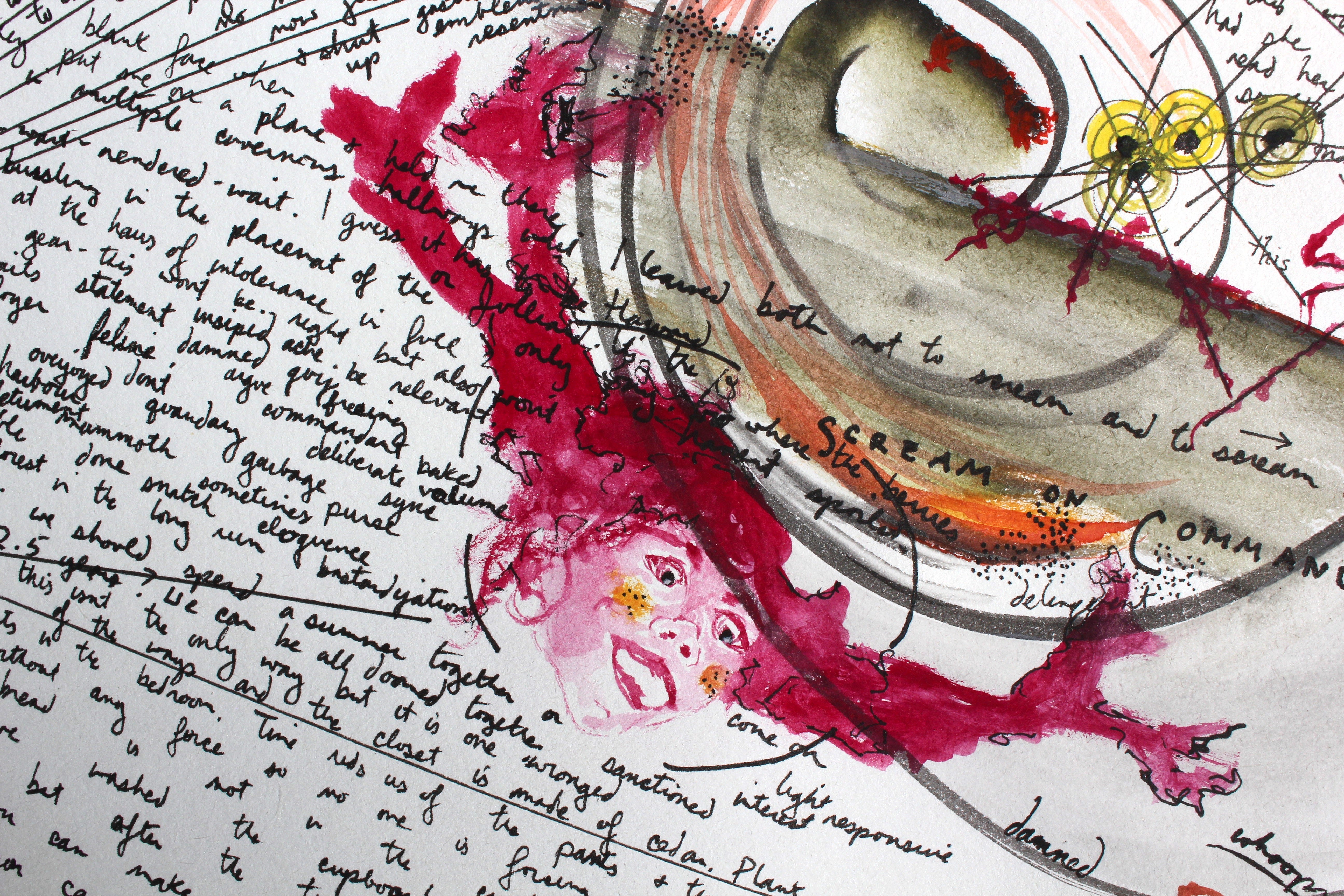
It’s nearly October, so it’s time to return to some delicious spookiness.
Early subscribers to this Substack (which I started in November 2021) may recall my very first essays, a trilogy about “our liminal minds.”
By “liminal” I mean a boundary zone, or space between two states of mind. The hypnagogic state—between waking and sleeping—is one example.1
Other examples are improvisational and/or inattentive states of mind—like those that come when one chases tangents, embraces and includes mistakes, or indulges in creating while drowsy, distracted, or zoned out.
To compose means to create by mental or artistic labour. But since I think and work so often with these other mind states, I use a more constrained working definition of that verb: Careful, conscious arranging performed while in alert, deliberate, intentional mind states.
There’s no clear line between mind states, of course, and anything we create may have many layers of work put into it—some of which may be less, or more, deliberate. The revision process, for example, is usually quite intentional.
“Sometimes I think that there is no poetry written without the intervention of the dead. It’s their voices speaking to you that allow you to find words from nowhere; they are the muse.”
– Alice Notley (1945–2025)2
When we write from a more inattentive state of mind—like free writing, automatic writing, trance speech, spirit writing, or improvisational writing—it can feel like the words appear out of nowhere—but I think that’s because we underestimate the intricate processes of which our minds are capable.
To walk you through some of what I mean, below is a typical chunk of freewriting/improvisational (improv) writing I created in a memo app on my phone, right before falling asleep. I’ve reproduced it here exactly:
The brink of kale, its rim uneaten and its hollow lush streets conveyed in words, its culled standard, its motivated stirring. The wool clutches at the panes of glass and brings all of us into its straight backed men-to-men talk with no sugar, just rake it back, double down into reveller,.there are none, so what is my own rush? I’m contained in stream-red announcements, like a stained clipped song sung absently by a flower, she cleans, that’s her superpower, but she doesn’t renovate. The new stuuf’s on you. She’ll lighten the generL load eith winners, real cloud calljng stupid into being callnng rest alone , as if it had structure or a noose. As if the morning rose like wool from a mill, its feathers still flooding the moment. We have garbage sighing into our veins and we don’t or cannot revoke time or shelter like the co.passnin the wood. Do you need quotes or do you have enouhh to work with? I had a light and stuck it in a sieve. The scattering plots, the points wriggle like men in flight, jnwilling. Guess. It’ll be a good one. You had, and will better. Her shock wS trh we shoild isolate a kalf bottle of whT hirts, and groe around it, roots clutching but no giving waj. Let’em.
So, quality-wise, at first glance, I can see a few parts worth remarking on and perhaps using in future writing—like “the morning rose like wool from a mill” and the idea of using a sieve on light to make scatter plots or wriggling points.
But most of it is apparently random. Spooky, eh? If you’re more spiritual, you may perhaps locate a supernatural source for this writing. If you’re a skeptic, you might say the subconscious is the key.
However! There does exist a logical process from which it all sprang. The connections between elements (words, phrases) are just different than we’re used to encountering—they’re sensory-based and prompt-based, rather than meaning-based, and they centre around language more than message.
For example, I can trace how I bounced forward using sonic assonance and consonance as crossing-stones:
clutches / glass / us
stained / song / sung
kale / hollow / culled
talk / rake / back
wool / mill / flooding
from which sometimes sprang near-rhyming phrases:
straight-backed / panes of glass
by a flower / her superpower
I can also see how I prompted myself, and used repetition and list-like options, in order to keep writing without stopping. I repeatedly used a reliable prompt phrase, “its,” to help me linger in expansion (its rim, its streets, its standard, its stirring…).
I used another prompt phrase (“as if”)—“as if it had structure”—then added a creepy option (“or a noose”), then repeated the prompt (“as if”).
I wrote “We have…” and then played with the concept of having (and its adjacent idea, needing) as a prompt for two following statements—needing quotes, having light.
And throughout, whenever in doubt, I reverted to twin notions of lack/negation:
no sugar
there are none
she doesn’t renovate
and presence/happening:
feathers flooding
garbage sighing
roots clutching
—as well as commands/the imperative:
rake it back
double down
Guess.
and questions:
what is my own rush?
do you have enough to work with?
So while it may seem mysterious and wild-eyed—like something a Delphic oracle might have ecstatically chanted as she breathed in fumes from a crack in the earth—I wrote this text (and hundreds like it) by playing with associations, tangents, sounds, senses, using various straightforward tools, such as self-prompting language, and deliberately accessing states of mind other than awake/alert/compositional.
Of course, the process doesn’t explain all the mystery away… there’s still room for nerding out over the brain’s capacity for generative language and creative spontaneity—or for pondering whether an Other of some sort is whispering into my proverbial ear.
Besides being spooky, fascinating, and exploratory in nature, writing in liminal mind-states can also be both freeing and fruitful.
Freeing: It feels amazing to shuck off the requirement to make sense or be coherent.
Fruitful: It sometimes results in bits or pieces that you’d never have otherwise written but can now put to good use.
So, if this interests you, then I recommend EITHER thumbing through the first three essays I ever wrote for lullabies & alarms (start here) and trying the writing challenges out, OR joining an upcoming class I’ll be teaching.
Through the excellent Seattle-based writing organization, Hugo House, I’ll be leading a weekly live Zoom class called Poetry as Process: Ignoring the Inner Critic from October 29th – December 10th. Here’s the description:
What if writing poetry could feel like a trance, a game, a scavenger hunt? What if the goal weren’t to make something good, but to let language lead you somewhere you didn’t expect?
This process-focused poetry class invites you to write fast, loose, and without apology. Through a series of unconventional exercises (freewriting, improvisation, persona play, trance(-ish) speech, and automatic writing) you’ll explore what happens when the inner critic steps aside and the strange, joyful self takes over. Think of it as creative disobedience: chasing tangents, making messes, and trusting that even your mistakes are leading you somewhere true.
The goal of this class isn’t to polish or revise. Instead, you’ll spend six weeks tuning your ear toward surprise and generating raw, startling language you might not have found otherwise. This class is especially helpful for writers feeling stuck, over-edited, or paralyzed by perfectionism. It’s a permission slip to loosen up, experiment wildly, and rediscover writing as a form of play.
You’ll leave with new language, new rituals, and the courage to keep going—even when the path ahead is blurry.
Open to poets of all levels and backgrounds.
In this class, we’ll be actively encouraging the parts of our brain that are normally in charge of perfectionism and cruelty to take a time-out. So we may still hear our shoulder monsters complaining that what we wrote wasn’t good enough, but the voice will be muffled, as if through a thick door.
That means we’ll make a little space for ourselves to get curious—about mistakes, “bad” writing, sounds, images, and building and following trails. In other words, it’ll leave room for us to have fun. I look forward to delving in the liminal and the unknown with fellow poetry nerds!
I’ve finished co-authoring a book on hypnagogia and it’s set to hit shelves in 2027, yay!
No posts
Comments
Nothing yet. Say the first thing.
Sign in to join the conversation.