
Quick Announcement / Writing Challenge
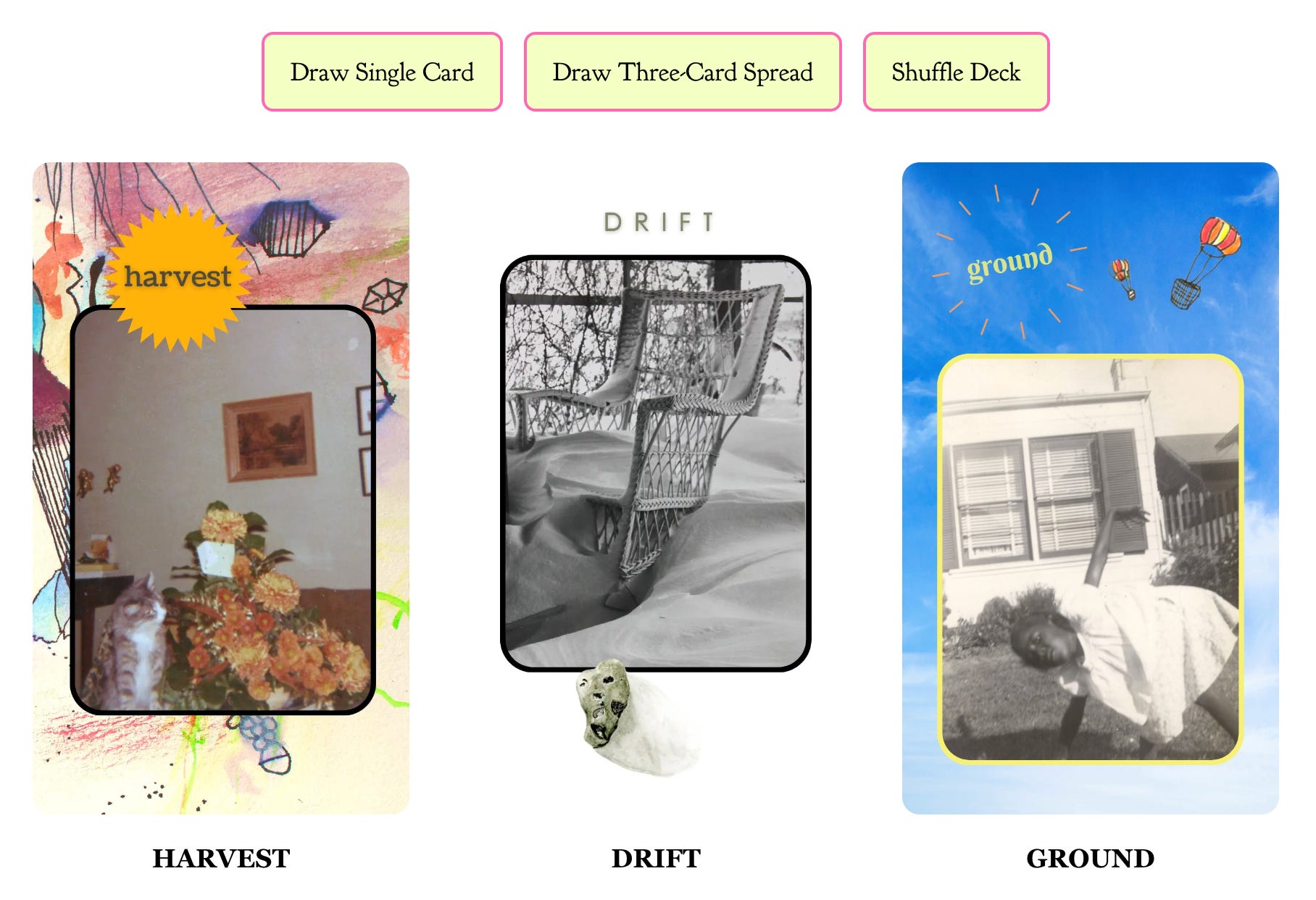
If you enjoy getting advice (or writing prompts) from mysterious, quirky sources, check out my free online oracle deck. I made the 45 cards using my physical collection of vintage snapshots, my drawings, and some digital design.
To use the oracle deck, hold a question in your mind and select either one card or a three-card-spread. Click/tap to turn the cards over. Have fun!
If you write a poem based on the deck, I’d love to see it!
Last time I wrote about circulating your writing, I focused on tips for submitting your poems to literary journals.
In this second of three instalments, I’ll focus on getting ready to submit large manuscripts for publication (rather than single poems)—including how to know which type of publisher is best for your goals, and tips for revising and honing your manuscript.
Before anything else, it’s helpful to get really clear on the specific reasons why you want to publish your book. You’ll save yourself a lot of headache if you make decisions about this early in the process. Below are some questions to help you navigate the different potential priorities.
I use “editorially curated” as an umbrella term to mean any publishing approach in which a press selectively evaluates submissions and chooses only the manuscripts it believes meet its artistic, literary, or quality standards—and then leads the editing, designing, and promotion of the work according to their (the press’s) own aesthetic and priorities.
Do you want your writing evaluated by editors?
Do you want your book alongside books written by peers whom you esteem, within a publisher’s catalogue?
Do you see your book, in part, as a tool to help you move forward in your career, gaining you some general “cred” in the academic poetry world?
Are you looking for publication with better-known and/or respected presses in order to bolster your applications to other opportunities—like for teaching positions, grants, prizes, or future publishers?
Do you admire the practices or principles of a particular press?
Are you drawn to certain presses because you fit well among the authors they prioritize (eg. Indigenous writers, expats, persons with disabilities, writers over 60, region-specific authors, etc)?
Do you want your book to be physically present in libraries and independent bookstores across your country (and perhaps internationally)?
If you answered “yes” to at least a few of the above questions, then you may want to go in the direction of editorially curated presses. This is a more challenging path than the route of author-subsidized presses, and even after you secure a publication contract, it may take years before your book is actually printed. However, staying true to what you want for your writing and your career will ultimately feel much more rewarding.
I use “author-subsidized” as an umbrella term for all pay-to-publish models—including those that don’t charge upfront but that may require authors to guarantee pre-sales, bulk buys, or other financial commitments.
Is joining the academic or “literary” community lower on your to-do list?
Are you focused more on the rewards of sharing your words than on the benefits publication might bring to your CV or career?
Would you prefer to be the client of a publisher rather than be evaluated by editorial staff?
Do you want to have more control over the end product (picking out the cover, deciding the size, shape, layout)?
Would you prefer to publish sooner rather than (much, much) later?
Is your primary goal to hold your book in your hands, give copies to friends and family and your local library, and perhaps sell them on consignment at your local independent bookshop?
Is the community you want to share the book with hyper-local? (For example, poems about local history may be aimed at readers within a local historical society.)
If you answered “yes” to a few of the above question, author-subsidized presses might be the best option for your book. The process will be much easier, your book will be a tangible reality much sooner, and you’ll have artistic and editorial control.
Regardless of which you choose, you’ll want to make your manuscript as strong as it can possibly be before you publish.
The process of submitting a manuscript to publishers may be divided up into two big chunks: First, preparing the manuscript. Second, everything else (and it’s a lot). (I’ll go over that “everything else” next time.)

In the past, I’ve written about techniques and approaches for revising individual poems. Specifically:
Revising a single poem is just the same, and somewhat different from, honing a whole collection.
It’s important to know the reason for being, or the essential message, of your book (the thesis), as this will help direct your organization and revision of the poems.
Streamlining a manuscript depends in part on knowing how to cull poems that may have been practice or take-off writing before you truly got airborne (determining where a manuscript begins).
Being strategic with how you deploy showing (using imagery and metaphor or other forms of roundabout language) and telling (using straightforward language) is key.
It can be helpful to adhere to a level of consistency among the topics/themes/vocabulary/metaphors/images/forms.
The title of a book can be more—or less—compelling; can pull a little weight or a lot; can offer new dimensions/reframing, or reiteration/summary.
It’s still extremely helpful to check in about whether you have been intentional (or intentionally unintentional) in as many aspects as possible:

With a collection, you need to also think through a number of questions around what I think of as the geography of a book—meaning, the shape of the world which the reader navigates through from cover to cover. Here are some important questions to consider:
Stasis & change – What is your book’s overall form? Every book has a beginning, middle, and end, but some formalize this by labeling or numbering sections. Is your manuscript divided into sections, and are their lengths, themes, and styles similar or different? Is the form symmetrical—for example, does the first section mirror the last in theme or density—or is it asymmetrical, with each section markedly different?
TIP: Insert visual, thematic, or formal shifts to break monotony: move from poetry to prose-poetry, sad to uplifting themes, or dense, lengthy poems to sparse, short ones.
Visual and cognitive space – Is the book packed together like tightly woven cloth, or is it more like lace, with lots of room (cognitive and/or visual) between poems? What density or complexity of content would serve the book best at each point in the manuscript? Is the emptiness, pause, and breath implied by any empty spaces in the book (anywhere that there isn’t anything printed) being used to the book’s best advantage?
Size – Similarly, are you arbitrarily trying to pack each of the manuscript’s poems onto one page for neatness’ sake, when they could sometimes really use three (or seven) pages to spread out into? Alternatively, are you spreading out the poems to lengthen your manuscript when they might benefit from being more jewel-like or close-knit, perhaps published as a chapbook rather than a book?
TIP: Get a bird’s-eye view of density, shape, and visual flow by spreading out a physical copy of the manuscript on a large table or the floor, or tacking it to a wall.
Flow – In comics and graphic novels, flow refers to the way choices around text, story, panel shapes and sizes, drawings, and colours guide the reader’s eye. A skillful flow can lead the reader successfully through even an unusual or chaotic layout. A poetry manuscript may lack drawings or even narrative, but it still has imagery, sound, and the visual shapes of words, lines, and verses. Are you considering flow? Think about how the reader moves from one metaphor, verse, idea, image, or mystery to the next.
TIP: To help you think about large-scale patterns in your book, make a map of your manuscript, or an outline of themes/ideas/images.
Building expectations – In music, comedy, and screenwriting, building expectations—and meeting or disrupting them—is central. Popular music leads listeners toward an arrival point (a chorus, key change, or climax), and film and TV rely on familiar devices—like repeated roadblocks in a hero’s journey to create suspense. In your manuscript, consider how your choices raise curiosity, hold attention, or create mystery. You might use slow reveals or add (or withdraw) information piece by piece across poems so something is built—or broken—over the course of the book.
TIP: You can have two versions of a poem: the stand-alone version you submit to literary journals, and the version that appears in your book, which may be altered to serve a larger purpose in the manuscript.
Extrapoetic devices – When shaping a manuscript, remember you have more than poems and blank spaces to work with. Section titles, notes, dedications, epigraphs, marginalia, illustrations, graphs, and other extrapoetic (outside-of-the-poem) elements can help illuminate any less straightforward poems, add subtlety and depth to more straightforward poems, and clarify the overall arc of the book.
Read more about extrapoetic devices:
In the third and final instalment of this series, I’ll explore the many reasons why publishing is (mostly) not a meritocracy, and how therefore you should really, really not feel bad about the inevitable rejection you’ll experience. I’ll also go over the submission process, and share tips and approaches that have helped me over the last 20 years both administratively (I’m a spreadsheet nerd) and emotionally/psychologically (hint: radically redefine “success”).
No posts
Comments
Nothing yet. Say the first thing.
Sign in to join the conversation.