
BOOKSTORE EVENTS 👉
August 6 @ 6-7 pm PT | Zibby's Bookshop | Santa Monica, CA | in conversation with Elise Loehnen | RSVP here!
August 12 @ 7-8 pm | Politics & Prose | Washington, DC | in conversation with Franklin Foer
August 15 @ 1-2 pm | Mitchell’s Book Corner | Nantucket, MA | book signing

What would you do if you woke up with out-of-the-blue chest pain?
Would you ignore it? Would you calmly take some deep breaths and think, I can handle this? Would you race toward the internet to Google heart attack symptoms? Or would you call your doctor immediately and do whatever they told you to do?
Over 25 years of patient care, I’ve witnessed a wide array of reactions to the same set of symptoms. Some people call me for every symptom, while others forget to mention the chest pain that signals serious heart disease.
I don’t judge patients for how they react—I have my own sometimes-helpful-and-sometimes-nonsensical response to vulnerability—but I do think it’s useful to reckon with something I call your patient personality.
We all have one. Your patient personality is the version of yourself that shows up in the doctor’s office or when you’re sick or faced with medical unknowns. It’s the set of beliefs and mental shortcuts we bring into the exam room. It is a product of your medical history, your threshold for asking for help, your relationship with certainty, your past experiences with doctors, and many other factors. In my experience, knowing your patient personality—and naming it out loud—can help you get what you need. It can also help you get out of your own way.
The Optimizer is someone who believes that willpower guarantees outcomes. They have great habits and are disciplined, but they can have a hard time accepting things out of their control. (This was me before I realized health is about much more than being fit. In fact, you can be fit and quite miserable at the same time.)
The Pleaser is the person we discussed last month, the one who thinks, If I can just get the doctor to like me everything will be fine! This is the person who only comes in for their checkup once they’ve lost weight so as not to disappoint the doctor. It’s also the person who minimizes their symptoms or tells their doctor things they want to hear in order to get the proverbial gold star. (This is me, too, when I recently told my doctor I exercise most days of the week. I don’t. I mean sure, I MOVE MY LIMBS daily, but let’s be honest.)
The Internet warrior is the patient who loves data and information, who spends hours on the internet researching symptoms and diseases, and who comes in with scientific studies—and often a lot of anxiety about their health. (This WOULD be me if I didn’t have a medical degree.)
The Outsourcer is someone who respects expertise and defers to medical advice. They are low on the anxiety scale and they often aren’t interested in the “why”—they just want the prescription or pills. They don’t want to think too hard; they’d rather just trust the experts and do what they’re told. (This is not me; sometimes I wish I didn’t need to understand the why and just DID THE THING without questioning it.)
None of these is good or bad. Each is a natural response to being in the patient role. Most people are some kind of Venn diagram of two, like I do. (Remember my neck pain problem? When the Denial Plan wasn’t working, I combed the internet for quick fixes, only to learn from an MRI that my spinal cord was compressed by a bulging disc. It took me a minute to notice my left arm wasn’t working, and only then did I call for help and get the medical care I needed.)
Not to shame and blame ourselves but rather to know yourself well enough to identify strengths to play up (e.g., understanding your body and respectfulness toward other people); identify weaknesses to work on (ruminating on symptoms without asking for help); and to communicate these things to your doctor so they can help you best.
For example, if you tend to be a Pleaser, you might say to your doctor, “Hey doc, I tend to minimize symptoms” or “Hey doc, I get worried about being judged by doctors.” Acknowledging your tendencies helps build a rapport and signals to your doctor that you know your biases and you’re working on them. That humility builds trust. It also might generate a reply from your doctor like, “No need to perform for me. I’m here to help the real you.”
Take my patient, a man in his mid 50s, who comes in to see me every year with spreadsheets and data from his various trackers and apps. When we discovered he had heart disease he was distraught, not just because of the test results showing coronary disease, but because he felt like a failure. I explained that his heart was better off because of his diligent exercise routine and careful attention to his diet and reminded him that we cannot control our genetics. And that this wasn’t his fault. For years he still refused to take cholesterol medication—not because he didn’t trust me but because it didn’t fit his self-concept. It was only when I was able to get at his internal narrative of guilt and shame that he agreed to take the medication his heart needs.
Chapter 15 of my book is all about the patient personality. (It’s the most asked-about chapter so far.)
For your pop-quiz pleasure, pasted below is a one-page self-assessment tool to help you identify your patient personality. It’s page 6 of my 11-page Patient Self-Advocacy Starter Pack (which comes free when you pre-order my book here!)
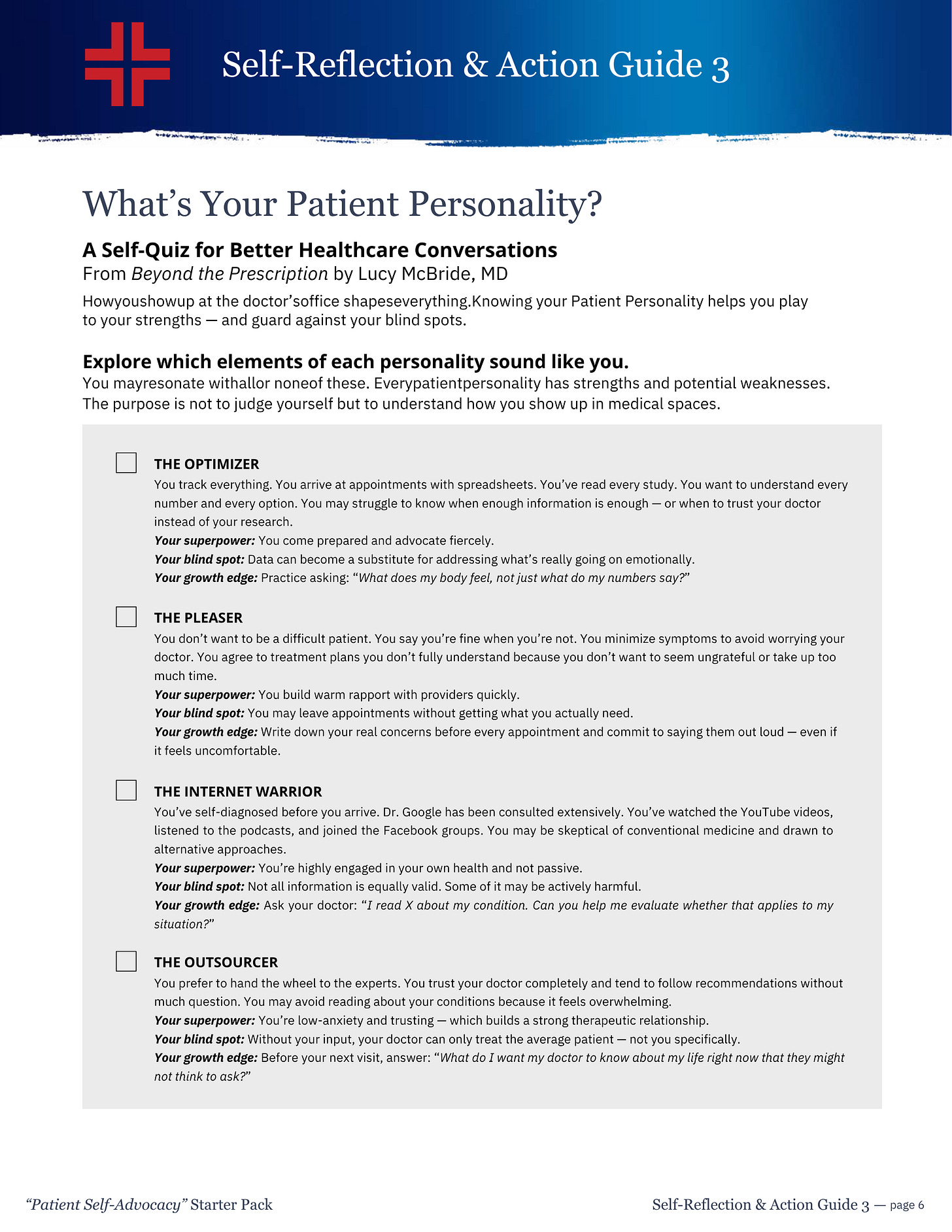
Get your free Patient Personality Quiz here!
So I’ll ask you, what is YOUR patient personality? What are your strengths as a patient? And what are your blind spots? Tell me—I am all ears!

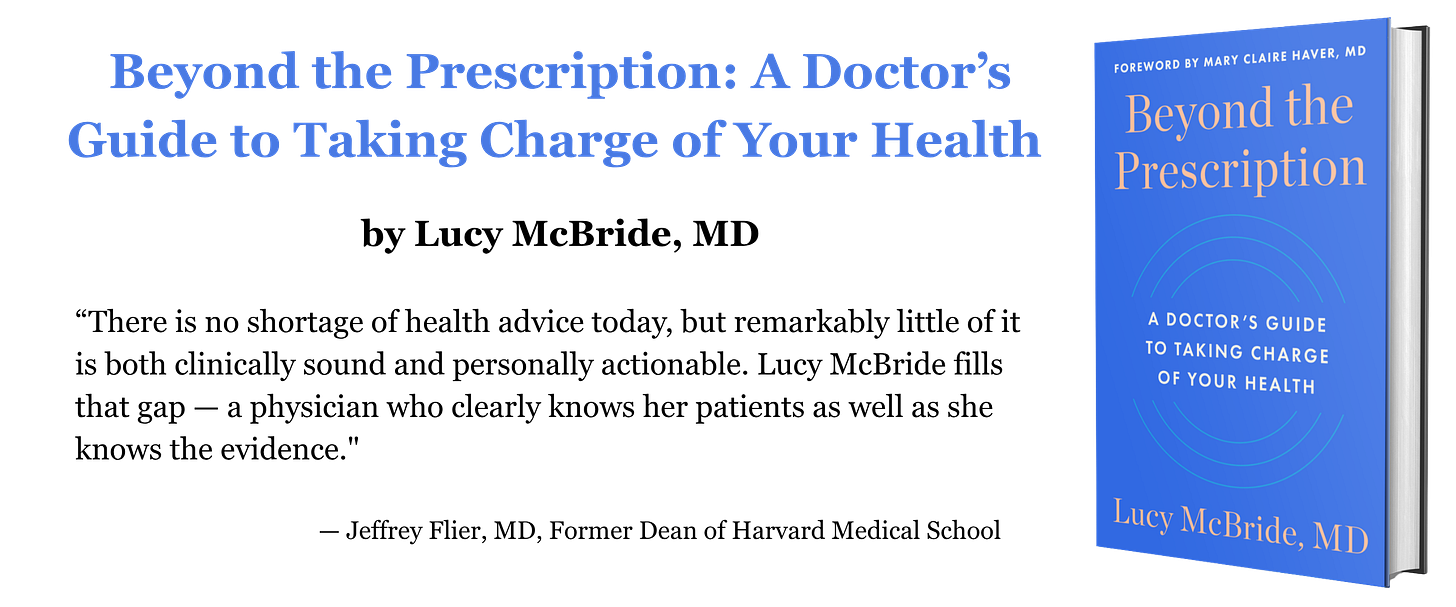
Beyond the Prescription comes out on August 11! I wrote it with you in mind.
Please hit the ❤️ or 🔄 button so more people can discover this post! Even better, please share it with friends and loved ones! 🙏
Comments
Nothing yet. Say the first thing.
Sign in to join the conversation.