
BOOK UPDATE: UPCOMING EVENTS 👉
August 6 @ 6-7 pm PT | Zibby’s Bookshop | Santa Monica, CA | in conversation with Elise Loehnen | RSVP here!
August 12 @ 7-8 pm | Politics & Prose | Washington, DC | in conversation with Franklin Foer
August 15 @ 1-2 pm | Mitchell’s Book Corner | Nantucket, MA | book signing

📣 Click here to send me your questions for future Q&As! ✍️
The following questions have been lightly edited for length and clarity.
Is there any utility to full-body MRIs as a health screening tool? I have seen a lot of health and wellness influencers promote this but haven’t seen any evidence.
—Angelica
Dear Angelica,
Great question. MRIs are wonderful for detecting a wide range of structural problems in the body—for example a herniated disc or an abdominal mass that an X-ray can’t capture. But using them as “kitchen-sink” screening tool for the whole body is not evidence-based, nor is it generally a good idea.
Here’s why:
Full body MRIs detect many abnormalities that are not clinically significant, leading to unnecessary anxiety, testing, and medical interventions. Just recently a patient of mine underwent a Prenuvo full body MRI that revealed benign findings that (understandably) sent her anxiety into overdrive.
Insurance doesn’t cover full body MRIs. They are expensive and time-consuming.
Having a normal full body MRI is not the same thing as being healthy. Full body MRI look at structure, not function. So it cannot detect some of the most common and important medical issues we see—for example diabetes, hypertension, metabolic dysfunction, non-specific inflammation, certain infections, fatigue, insomnia, depression, chronic pain, and cognitive impairment.
These scans can give people a false sense of security. MRIs provide a snaphot—a point in time—without context—in the same way a photograph of your family can’t possibly characterize the relationships between members or their individual personalities.
The American College of Radiology and other medical organizations do not recommend routine full body MRI for asymptomatic individuals, as the risks tend to outweigh the benefits. Better than any snapshot to assess your health is getting regular check-ups and targeted screening tests based on your age, family history, unique risk factors and symptoms. So, I suggest saving your money!

Hi, I struggle with insomnia sometimes due to anxiety and my mind whirring too much. So, I use Xanax for nights that I just cannot relax. But my doc wanted me to switch to Trazodone. Neither medication is great. This is not an everyday problem but it feels harrowing when I get into a weird insomnia phase. Do you have any thoughts on what to do? Thank you for considering my question. You are a blessing and great resource!
—Kathy
Dear Kathy,
As you know, sleep is the glue for our whole health, but getting adequate rest is easier said than done. I commonly hear from patients that they turn to sleep aids like Nyquil, Unisom, or even alcohol to quiet a noisy brain at bedtime. The problem with these stop-gap measures is that they produce a state that is closer to sedation and not actually restorative sleep. They can also be addictive and can cause unpleasant side effects like nighttime eating and fuzzy-headedness upon awakening. The same can be true for prescription sleep aids like Xanax and Ambien. Ambien can also negatively affect cognition over time. I generally prefer Trazodone because it is safer for long-term use compared to Xanax (or its cousins, Clonazepam or Lorazepam) which can be particularly habit-forming. While prescription medications can certainly be appropriate for some patients, it’s important to remember that everything we put in our bodies—prescription or not—carries risk and reward.
The best medicine is optimizing the environmental, behavioral, and psychological “ingredients” for sleep. People tend to sleep best when:
their bedroom is dark, quiet and cool—and when it’s free of pets or pesky bed partners (i.e. try using earplugs, eyeshades, or noise machines as needed).
they develop a bedtime routine in order to naturally wind down. Try ditching screens an hour before bedtime and instead writing in a journal, using a meditation app like Calm, Headspace, or Insight Timer; or taking a warm bath and listening to calming music.
they are managing their stress and anxiety. Sleep comes a lot easier to people who exercise regularly, actively process their worries (i.e., with a therapist, friend, or coach), and ask for support for emotional distress.
Some of these items—like ear plugs—are quick and easy. Others—like setting an electronic curfew—are easier said than done. And others—like reforming a snoring bed partner—may be close to impossible.
So just do the best you can. And remember that this is a process. For example, even if you can only manage a 15-minute window of screen-free time before bed, it’s well worth trying. If you notice it helping just a wee bit, you might try experimenting with it further. You might even delete an over-stimulating app or two and find yourself more refreshed upon awakening.
I am a Diabetes Nurse Practitioner and have been prescribing GLP1 such as Ozempic, Wegovy, and Zepbound. I have found they cause mild hair loss. What are your thoughts regarding these medications that are now consuming our time with Prior Authorizations and have become almost a request with every patient with or without DM for weight loss.
—Terri
Hello Terri,
I’ll answer this question in two parts. First, yes, these medications can cause hair loss—as can any intervention that causes significant weight loss or shift in metabolism. This is one of the many reasons gradual weight loss is better than sudden weight loss.
The best way to prevent hair loss from rapid weight loss is so go slow with GLP-1s. Be closely monitored by a board-certified physician, not someone you met online one time. Make sure you are getting your labs checked, including vitamin levels and blood counts. And remember you still have to eat while taking a GLP-1. Relative malnutrition causes a stress response that can cause hair loss—among other things—and is not the goal of GLP-1s in the first place.
As for my general thoughts on GLP-1 agonists, they are wonderful tools in the toolkit for patients with obesity, diabetes, metabolic problems, and the downstream effects on the heart, brain, and blood vessels. The applications for these drugs keeps growing. Thankfully the medical establishment is waking up to the fact that obesity is not an intellectual or willpower problem, but rather a chronic disease, and these medicines are terrific when used in conjunction with lifestyle modifications.
That said, they are not a panacea. They can have side effects. They are expensive if not covered by insurance. They require close medical monitoring. As for the prior authorization dance (read: nightmare) with insurance companies, it is extremely burdensome for patients, providers and staff. I could hire an army of assistants to help process these meds alone. As frustrating as it can be to get the drugs in hand, for the right person, and with appropriate medical guidance, they can be a wonderful way to help patients medically and psychologically in tandem.
My husband snores but denies it. It is negatively affecting our relationship (at least on my end!) How does one stop/prevent snoring that is negatively impacting a relationship?
—DL
Hi DL,
It sounds like there are two problems: your husband’s snoring and his denial about it. Let’s start with the first. Snoring by a bed partner is one of the more common complaints I hear about in my office. The best way to treat snoring is to address the underlying cause, which can include the following:
Obesity: Excess body weight, especially around the neck, can put pressure on the airways and lead to snoring.
Nasal congestion: If the nasal passages are blocked due to a cold, sinus infection, or other nasal issues, airflow can be restricted, contributing to snoring.
Sleeping position: Sleeping on your back may cause the tongue and soft palate to collapse to the back of the throat, narrowing the airway and causing snoring.
Alcohol and sedatives: Consuming these before bedtime can relax the muscles in the throat, increasing the likelihood of snoring.
Smoking: Smoking irritates the membranes of the throat and nose, leading to inflammation and increased snoring.
Age: As people age, the throat muscles may become weaker, increasing the likelihood of snoring.
Anatomical factors: Some people may have anatomical features that contribute to snoring, such as a low, thick soft palate, enlarged tonsils or adenoids, or a long uvula.
Sleep deprivation: Lack of proper sleep can relax throat muscles and contribute to snoring.
Sleep position and sleep hygiene: Poor sleep hygiene, irregular sleep patterns, or insufficient sleep can contribute to snoring.
Sleep apnea: In some cases, snoring may be a symptom of obstructive sleep apnea, a serious sleep disorder where breathing repeatedly stops and starts during sleep.
The second issue is more persnickety. Denial is a common response to being told you snore, but that doesn’t mean you aren’t making your bed partner crazy! My best advice is to lead the conversation about your husband’s snoring with empathy and curiosity about his health (this will land better than an accusation). Remind him that sleep disturbances can lead to heart disease, metabolic problems, and even memory issues. Then encourage him to seek medical attention. It’s also important to name how you feel, saying, for example, “I’m worried about you.” Or “I need more rest than I’m getting and I want to help you figure out your snoring issues.” You could always sleep in separate bedrooms (what people call a “sleep divorce”), however, addressing the problem head-on means you’re less likely to miss a significant health issue—and that might help you sleep at night. I hope that helps!

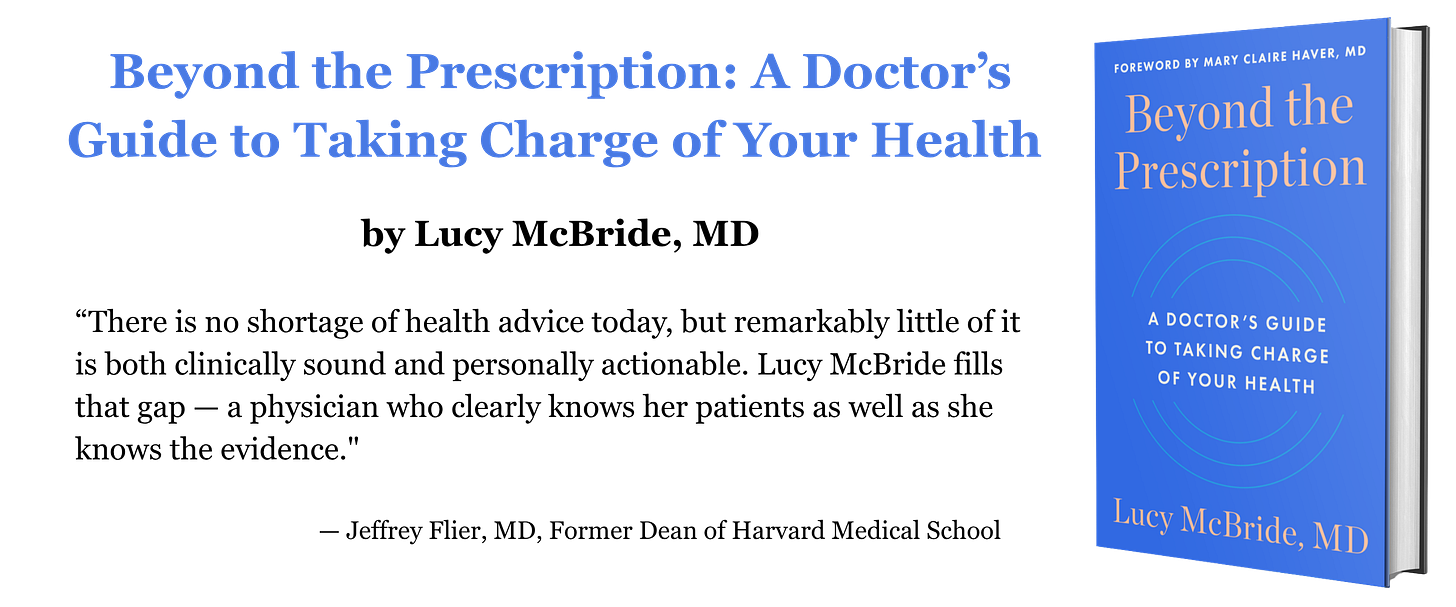
If it wasn’t SUPER OBVIOUS already, my book, Beyond the Prescription, comes out on August 11!
Comments
Nothing yet. Say the first thing.
Sign in to join the conversation.