
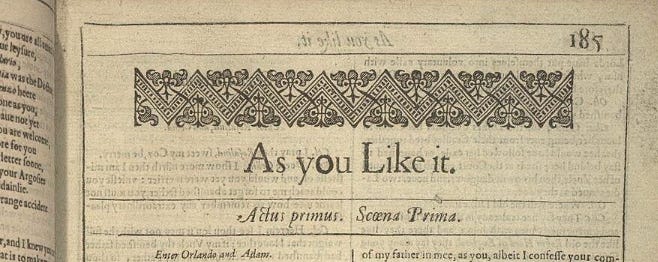
Last week I took my children to see the wonderful touring Shakespeare company, the Handlebards, perform As Your Like It in the Merchant Adventurer’s Hall in York. This is an event I’ve been enjoying for several years now. We first took my daughter when she was six and she was enchanted. I also love the venue in own right. It’s a beautiful medieval guild hall, complete with wonderfully wonky floorboard and beamed roof, and fascinating portraits around the walls.
The Handlebards perform Shakespeare by riding around the country on bikes, carrying all their gear. They always have very few actors and very, very few props, and offer funny, irreverent, and thought-provoking versions of the plays they perform. Last year, I wrote about their Much Ado. Rather cleverly, the necessity of replacing one of the central female characters with an inanimate object made a surprisingly sharp point about female agency, and about the notoriously absent mothers/wives who haunt the play.
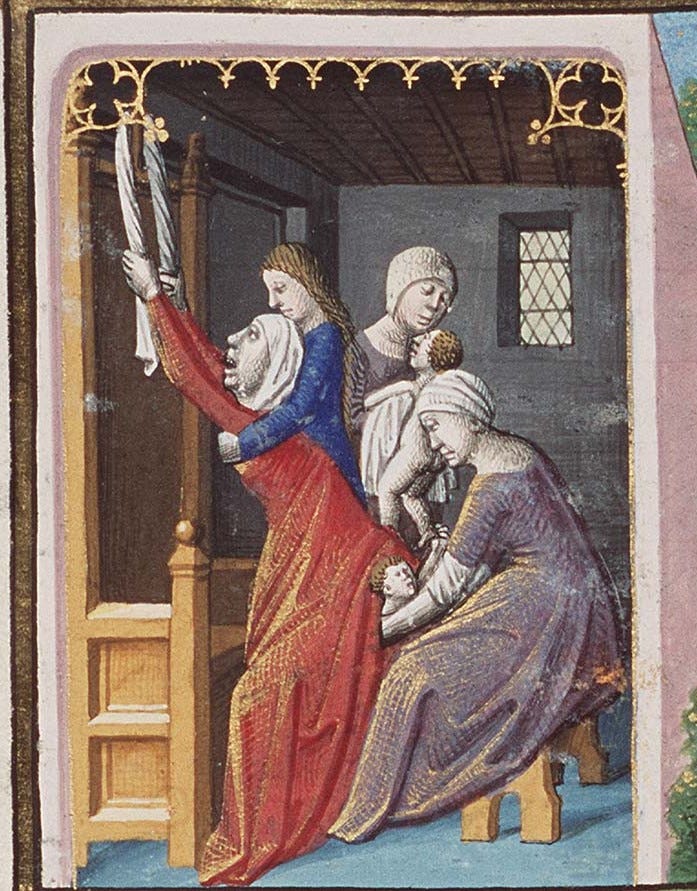
In As You Like It, by contrast, one mother was thoroughly unexpectedly present. I was sitting at the back of the hall, because Jamie is nine weeks old and therefore not entirely predictable as an audience member (he was fine, as it turned out). For a moment I was transported back to recent memories of the labour ward, as an entirely non-Shakespearean cry of ‘just one more big push!’ rose to the beautiful medieval roof-beams and roused the audience to laughter.
For the mother, in this case, was a sheep.
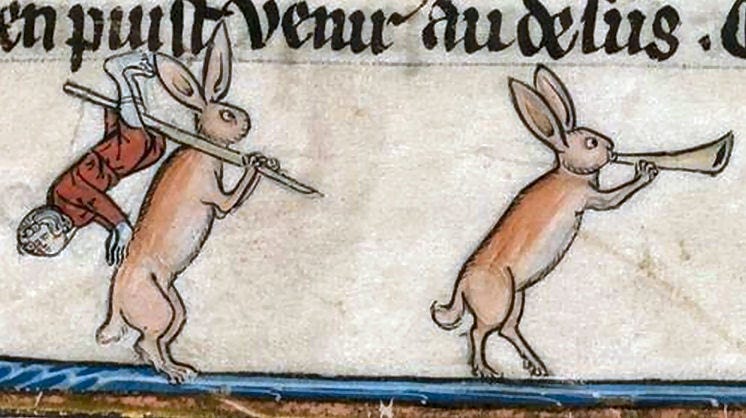
This role involved a considerable outlay of props, in a show that is was virtually prop-free, and for a seemingly minor, thoroughly non-Shakespearean scene. Sitting on an authentically Early Modern birthing stool, a sheep (in a bobbled wool costume) was delivered of a fine healthy lamb by a graphically gloved-up shepherdess. Imagining lambs in Tudor pastoral giving birth with period-appropriate human paraphernalia takes us straight to the wonderful topsy-turvey worlds of medieval illuminated manuscripts, where knights fight snails and rabbits engage in pitched battles, and a ewe certainly might take to the birthing chamber for her confinement.
The build-up to this scene had been coming for a while. The Handlebards almost invariably prey upon one or more members of the audience. During this performance they chose a very forbearing bloke their target for the evening. Before becoming a thoroughly embarrassed parturient ewe, poor Charlie found his first and most frequent bit part was that of a deer, acted to the accompaniment of a slow-motion firing of arrows towards him, and the gleeful refrain ‘we’re hunting, we’re hunting, we’re hunting … Charlie!’
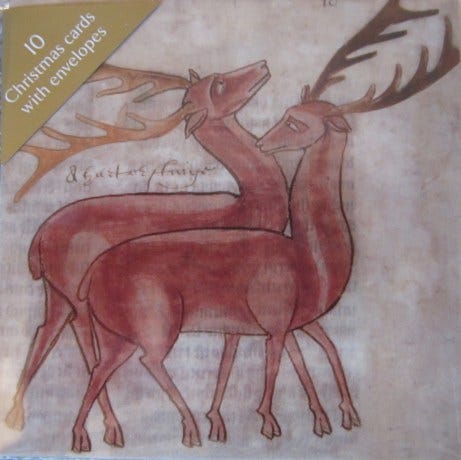
It made sense. The deer hunt is a well-worn trope for human desire in medieval and Tudor literature. Just think of Wyatt’s ‘Whose List To Hunt’. Women, like deer, must be hunted; to ‘die’ is the Tudor slang for orgasm. Deer are, too, are creatures with horns: cuckolds, as the play will remind us; men whose wives have cheated on them. The trope allows for readings of deer as both women and men, both desired quarry and despised symbol of shame. Years ago, I wrote about the ‘queer deer’ of a network of medieval texts and images, when the Fitzwilliam Museum started selling Christmas cards featuring a pair of coyly nuzzling deer, whose matching antlers and implied same-sex configuration amused me no end.
Yet in As You Like It, the metaphorical conflation of deer and human subjects is the source of some strange, even excessive, emotional imagery. Duke Senior - father to Rosalind, the central female character - wonders whether to identify with the hunted deer, noting that the ‘poor dappled fools’ he kills are native inhabitants of the forest, their place usurped - as his has been - by incomers. Orlando, Rosalind’s would-be lover, likewise draws on cervine imagery when he imagines himself seeking food for his fainting servant Adam. ‘Like a doe, I go to find my fawn/ And give it food.’ Finally, the melancholy Jaques - who sobs with the sobbing deer - accosts Duke Senior’s lords as they carry home the buck that they have killed. ‘Which is he that killed the deer?’ he asks, before suggesting they carry home that lord, ‘like a Roman conqueror’. This speech introduces one of the set-piece songs of the play:
What shall he have that killed the deer?
His leather skin and horns to wear.
Then sing him home.
Take thou no scorn to wear the horn.
It was a crest ere thou wast born.
Thy father’s father wore it,
And thy father bore it.
It’s an odd collision of poignancy - the elegaic song; the imagery of the conquered foe - and innuendo, for the 'horn’ is certainly the cuckold’s horn I mentioned above. This jarring vein of sadness or sombre intent underneath broad comedy is absolutely characteristic of As You Like It.
And it made me think again about that comical pregnant sheep.
We tend to think of animal costumes as funny or endearing, ready to raise a smile. The lioness headdress in Much Ado reminded me of nothing so much as the lion-motif sleeping bag my tiny son is now (just) big enough to wear. Picking him up in the morning is sheer delight: the bright yellow lion with his amiable smile and embroidered grey eyes; the baby all delighted with the world. Nine years before it was my daughter. The moments are so fleeting, all tangled up with tiredness and lack of sleep; before you know it the babies are not babies any more, and too old to play at being lions or deer. There is that same edge of poignancy, that same awareness that what makes us smile now, also has an undercurrent of sadness.


Suddenly, this helped me make sense of why the sheep scene had reminded me of medieval marginalia: for it looks back to that period, in the way Shakespeare often does: not just to marginalia, but to medieval mystery plays. In this case, it’s the Second Shepherds’ Pageant from the Towneley/Wakefield cycle. This play mixes the story of the angels’ coming to give the shepherds the news of Christ’s birth, with a strange interlude. A local conman Mak and his good-for-nothing wife Gill steal one of the shepherds’ lambs and, when challenged, hide it in the cradle and pretend it is a newborn baby. As doubts mount, so too do their desperate attempts to hide the truth. Fearing the lamb’s tell-tale bleating, Gill pretends to be in the loud throes of labour with a second baby, a twin to the first.
Obviously, the lamb is a kind of echo of the baby Jesus - the Lamb of God - and the fake pain of his false mother Gill is a weirdly twisted version of the medieval belief that Jesus’ mother, Mary, suffered no childbirth agony in her delivery of Christ.
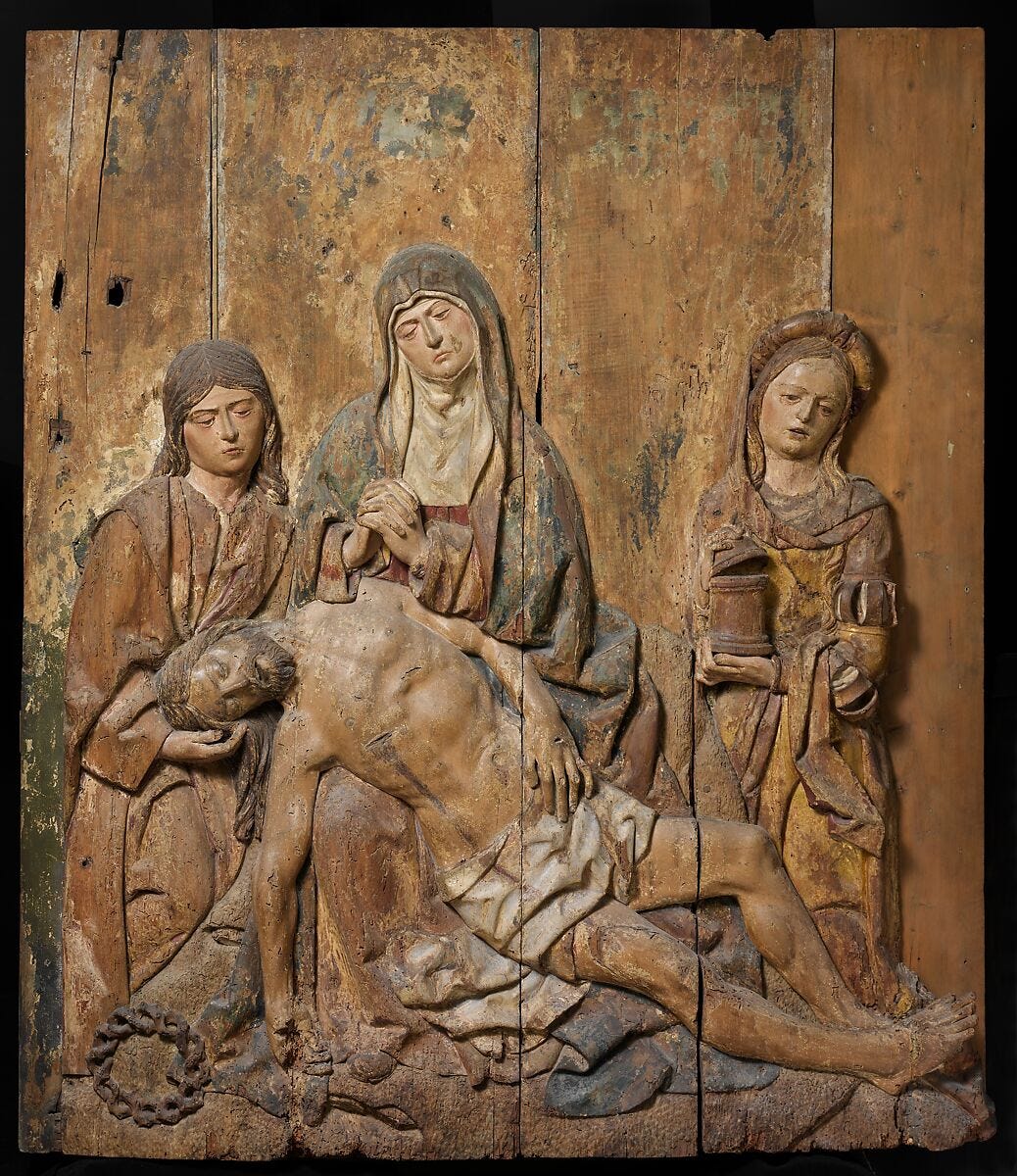
There is more than poignancy here. Why have the couple got an empty cradle so readily to hand? And what happened to the intended occupant of that cradle? Are the tears and groans Gill fakes, really fake: or is she crying for something else?
The medieval mystery play is ready to have us think about the sorrow on the edge of laughter; about the twist of pain at the end of the story of the shepherds and the angels’ message. This theme of hidden sorrow fits neatly with As You Like It’s preoccupation with usurpation, with people assuming the identities and taking the places of others. Christ, who takes on the identity of Mankind, is a sort of trickster; the Incarnation presses an unwilling figure onto the stage to play a role forced upon him. As You Like It is funny; sometimes it’s broad slapstick comedy, especially in the capable hands of the Handlebards. But it also has an edge of something else, something the ‘melancholy Jaques’ would recognise: the time slipping away so fast; the joy of the world always shadowed with a pang. Those whirling, joking, laughing couples who hunt the deer will pass through the Seven Ages of Man all too soon; the babies will grow up too fast, and the stage will be empty again …
No posts
Comments
Nothing yet. Say the first thing.
Sign in to join the conversation.