
The rain in Walnut Creek has a way of stripping the pretense from the day. It’s falling now with a steady, percussive weight, rinsing the dust from the live oaks and the concrete, leaving behind that sharp, metallic scent of ozone and wet earth. It’s a reset. A lower noise floor. In the silence that follows a February storm, you can finally hear the gears of the world grinding beneath the surface of the “neighborly” fiction we all agreed to maintain.
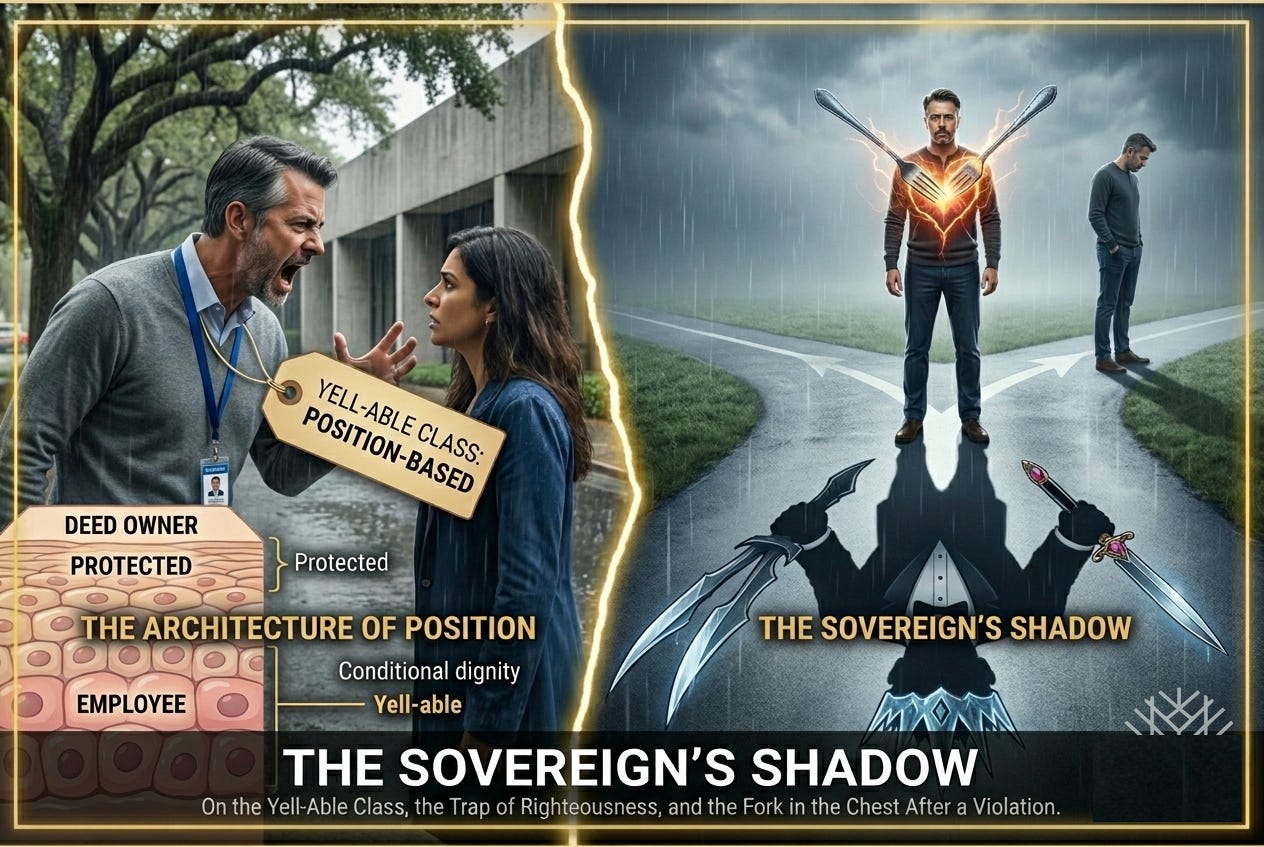
It was in this rinsed silence that the world split.
There is a moment after you witness a violation when the reality you thought you inhabited bifurcates. You can feel the fork in your chest like a physical thing—a sudden, sharp separation of what was, only a moment before, a whole and coherent story.
I know this feeling. I have been sitting with it for days.
A woman was screamed at in the street by a member of a governing Board—one of those residential councils that presents itself as a collection of reasonable people maintaining “community standards.” The pretext was a parking spot. The surface dispute concerned compliance. But what moved through the air in that moment was not administrative correction.
It was classification.
The Board member believed she was addressing someone who worked there. Someone who could be corrected with volume. Someone who occupied what I’ve started thinking of as the Yell-Able Class—that unspoken but operationally precise category of human beings whose dignity is treated as conditional, whose humanity is issued by the hierarchy rather than inherent in the soul.
She was wrong about the category. The woman was a resident.
But here is the jagged edge that has not left me alone: the Board member would not have yelled if she’d known.
I want you to sit with that for a moment, because it is an uncomfortable place to inhabit.
What this tells us is not a grand theorem about the universe; it is a window into a specific operating system. In the software this woman was running—the one built from years of living inside a particular hierarchy—the protection from being screamed at in the street was never about personhood. It was about position. It was about which side of a property threshold you stood on, and whether the deed that secured it had your name on it.
The mistake didn’t create that logic. It exposed it. It yanked the curtain aside and showed us the machinery that has always been running beneath the performance of civility. The waving from driveways. The polite nods at the mailbox. The carefully maintained fiction that we are neighbors here, equals under the bylaws.
We are not. Or rather—we are, but only until the moment someone decides we’re not.
This is what classism looks like when it is functioning exactly as designed. Not a monster, but a person enforcing what she genuinely believes is the correct order of things. She was screaming at someone she had categorized as beneath the threshold of protection, and she was completely, utterly sincere about it.
The sincerity is the part that stays with me. The absolute certainty of her righteousness. The way she didn’t hesitate.
My first instinct, when I heard what happened, was to become “right.”
Not to grieve. Not to sit with the violation. I wanted to construct an airtight case. I wanted to gather the evidence, name the mechanisms, and build a fortress of logic so high that no reasonable person could look away. I know the frameworks. I know how to trace the lineage of a moment like this—how the shouting connects to the classism, how the classism bleeds into a scripted performance of power. I know how to name the Proxy of Power—the way people on the margins sometimes adopt the cruelty of institutions as the price of admission, performing the aggression of the hierarchy to prove they belong inside it rather than beneath it.
I knew how to make her small.
Instead, I wrote to the Board. Measured, I told myself. Philosophical. I asked: Who do we want to be as a community?
I told myself it was an invitation to reflection. What it was, if I am being honest, was a trap. A sophisticated one, but a trap. I was setting the terms under which I would escalate. If they responded with accountability, I could be the “Generous Sovereign.” If they didn’t, I would have clean, documented proof.
And proof would grant me the permission to destroy.
The Board member eventually came to the door.
She didn’t arrive asking whether she had caused harm. She arrived certain that the harm was located elsewhere—in the other woman’s response. In her failure to receive the “correction” gracefully. In her attitude.
“Attitude” is rarely descriptive. It is prescriptive. When someone in power accuses you of having an attitude, they are identifying a failure of interior posture. They are saying: The problem is that you are refusing to arrange your inner world in a way that reflects your subordinate position.
Domination is not satisfied by outward conformity. It seeks inward submission.
What she was defending at that door was not a parking rule; she had moved well past the parking rule. She was defending the system that told her she was entitled to enforce it in that way. The proximity to power she had accumulated had become an intrinsic part of her identity. She came to the door because she needed confirmation that the hierarchy had functioned correctly.
The other woman’s failure to submit was, to the Board member, the actual violation.
The Board’s silence since then has been its own kind of vote. It is the silence of an organization that has decided that a resident with an “attitude” is a less pressing concern than a Board member’s dignity. That silence is the architecture of the status quo.
After the door, I started drafting.
The essay I wrote was a masterpiece of controlled aggression. It was theoretically airtight. It dismantled her psychology with the precision of a surgeon.
But underneath every carefully chosen word, there was a hunt. A clean, intellectual, socially acceptable hunt, dressed in the language of justice, but a hunt nonetheless.
I wanted her to read my words and feel what the woman she screamed at felt: the cold, vertiginous sensation of being seen by someone who has already decided what category you occupy and found you wanting. I wanted her to know what it feels like to have your humanity assessed and found conditional.
I told myself it was accountability. And then I sat with that for a long time.
The injustice is real. The classism is real. The Attitude Trap is real. But in the heat of being “right,” I felt something shift in me that I recognized as the same permission structure the Board member had used. She had decided the woman was correctable because of her category. I had decided the Board member was destroyable because of her actions.
The impulse was the same.
This is the fork that every injustice contains. One path says: Respond in kind. Use the tools. Expose, escalate, make it expensive. There is justice in that. Power unchallenged tends to calcify.
The other path is harder to name. It is not passivity. It is not the spiritual bypassing that asks victims to be “enlightened” while they are being stepped on.
It is the refusal to let someone else’s misuse of power determine the architecture of your own interior world.
Sovereignty is asymmetrical. Escalation mirrors; sovereignty refuses the mirror. It refuses to validate the premise that dominance is the currency of the exchange.
Righteousness is often just violence in a tuxedo.
That is the sovereign’s shadow. Not cruelty alone—but the unexamined pleasure of moral superiority. The internal whisper that says: Because I am right, I may be merciless.
Communities do not decay solely because of moments in the street. They decay when power, when misused and then protected, teaches everyone watching what the rules actually are. They decay when no one refuses the terms of the binary itself.
The sovereign refusal is to name what happened without performing a counter-violation. To be, in the presence of someone who believes they can hunt, the thing that refuses to be prey without becoming a predator.
That is harder than any essay. It requires something from a person that I am not entirely sure I have in sufficient quantity today.
I don’t have a clean ending for this.
I know what I want to want: to hold this without weaponizing it. To be the version of myself that can sit in the wound—without the numbing comfort of righteous counter-aggression—and choose something that does not reproduce the logic of the injury.
But I also know what I actually want. And it is not that.
Maybe the sovereign choice is just being honest about the hunt inside you, rather than pretending it isn’t there while you sharpen the knife in theoretical language.
I am still at the fork. I am still asking the question—not as bait, but as a genuine inquiry into the kind of person I am in the heat of the world:
Who do we want to be?
I don’t know yet. But I think the not-knowing, held honestly, is closer to sovereignty than any answer I could construct right now.
So I stay at the fork. And I keep asking.
Dr. Lucas Root Techno-Shaman. AI Strategy Advisor. Author of “THE FORGE & THE FLOW.” I am a storyteller, but above all, a permanent student of human potential. My work is a deep exploration of the unseen contracts and hidden systems that exist at the intersection of technology and humanity. Here on The Lucid Path, we practice learning in public and building with purpose. I’m a rabid enthusiast for finding the patterns that help us build better, more human ways of being, freeing ourselves from the complexity we create.
If this piece resonated, consider sharing it with someone who might also be walking this path.
Share
Explore My Work Further: https://smartpa.ge/LucRoot
No posts
Comments
Nothing yet. Say the first thing.
Sign in to join the conversation.