
I didn’t know I was going to say any of this.
Someone asked me a question and I opened my mouth and something came through. Not from me exactly. Through me. The way certain things move when you stop trying to steer and just follow the thread wherever it leads, trusting that it is going somewhere even when you can’t see the end of it.
The question was about forks. Whether they ever really resolve. Whether the unresolved things in us disappear over time or simply stop being visible. Whether the road we keep finding ourselves back on is a sign of failure or something else entirely, something that doesn’t have a clean name yet.
And before I had thought about it at all, I said: I like to imagine a tree.
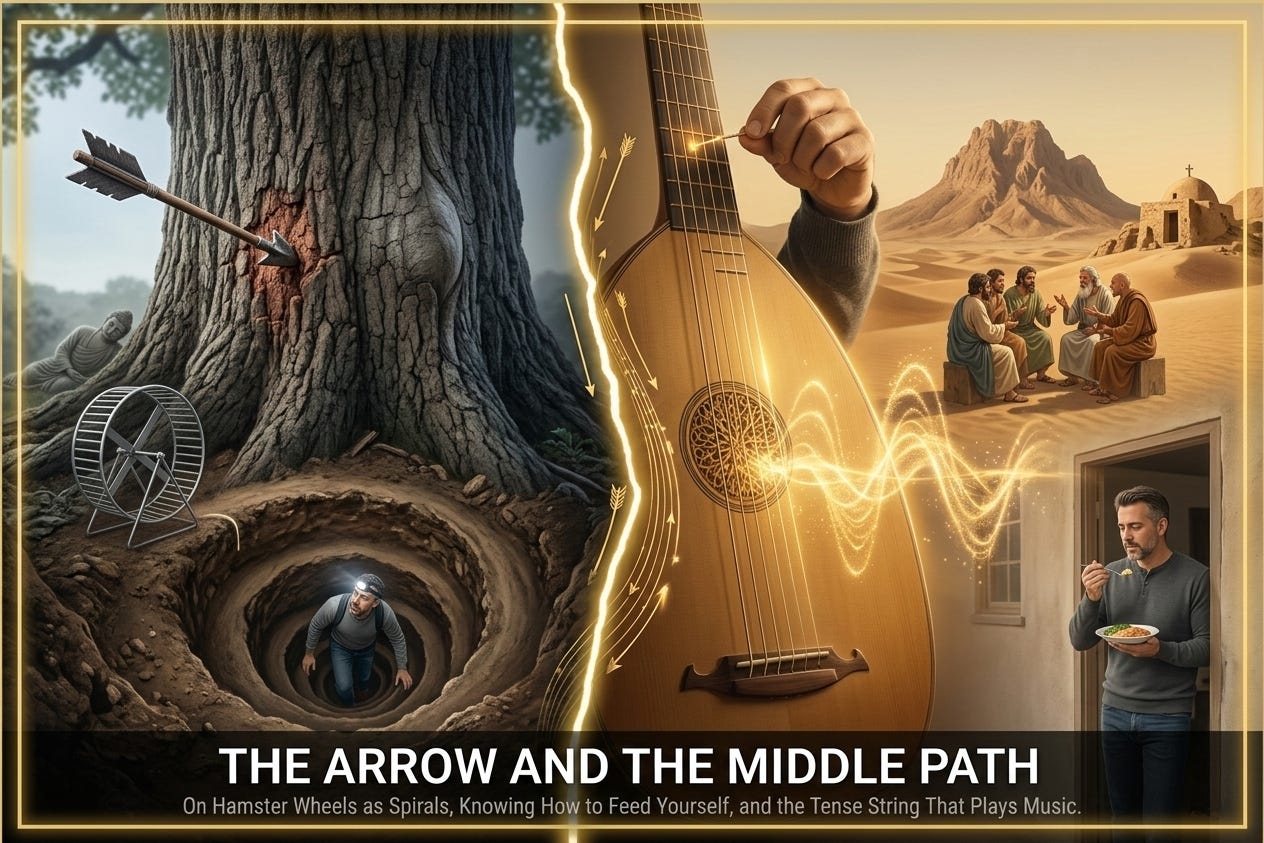
An actual tree. You shoot it with an arrow and the tip gets lodged in the wood and breaks off. For a while it just sticks there, exposed, a little raw, the way wounds are before the body decides what to do with them. You can see it. Anyone passing close enough can see it. There is nothing subtle about a piece of metal sticking out of living wood. And then, slowly, without asking permission, without making any announcement about it, the cambium layer begins its quiet alchemy. The bark grows over. A year. Two. Five. The tip disappears. There is still a bulge there, a slight irregularity you can feel if you run your hand along the surface and already know what you’re looking for. To anyone else it just looks like part of the tree. Just another feature of the landscape of a life lived long enough to accumulate texture.
It’s weaker there at first. Scrape the new bark aside and the metal is right there, still sharp, still cold, still capable of drawing blood from an unguarded hand. But after enough years the bulge flattens. The wood hardens around the intrusion and it becomes genuinely, organically part of the tree. Part of what the tree is. Part of how it stands in wind, part of why it bends the way it bends, part of the particular character that makes it different from every other tree in the forest.
Some of those arrowheads are lost to the heartwood forever. Or at least until someone cuts the tree down and the sawyer finds them there, bright and unexpected in the center of the wood, and wonders about the archer and the day and what was being defended or pursued. Some are worth going back for. Worth the painful loving work of excavating back through bark and wood to find what was once forgotten, to expose it to air again and discover that what lodged there as a wound has become, in the dark and the years, something closer to treasure.
Choose wisely though. The excavation can be painful. And not every arrowhead becomes treasure. Some are just old metal that never stopped being old metal.
The wisdom is in knowing the difference. And that wisdom can't be taught. It can only be earned.
I was still inside that image, still feeling my way through the dark interior of it, when the memory arrived. The kind that surfaces not because you summoned it but because it recognized itself in what you were saying, because the unconscious is always listening and occasionally decides you are finally ready to look at something directly.
My last day at a place where I had spent years of my life. Real years. Weight-bearing years. The kind of years that leave their mark on you whether you intended to give them or not. There was a lunch. People gathered, some I had worked alongside long enough that we had developed the particular shorthand of people who have been through things together, some brought in fresh to carry forward what I was leaving behind. Someone who knew me well had planned it. Someone who knew, among other things, that I eat differently than most, that this is not preference or fussiness but architecture, the way I have learned through years of getting it wrong and paying the price to keep myself running at the pitch that allows me to actually be present.
They had forgotten.
We walked in together and I saw the food and knew. Not through reasoning. Through the body, through whatever accumulated intelligence lives below the level of conscious thought, the kind that doesn’t deliberate but simply knows. I turned around. Offered a short simple explanation. And walked out to find food I could actually eat.
They didn’t choose to come.
I am standing in that doorway right now (literally and figuratively, since I am writing this at my standing desk), feeling the weight and texture of it, the specific quality of light that a moment has when it is ending something. I keep circling something in it I haven’t quite reached yet. The forgetting is not the story. The forgetting is just the door that opened onto the story. And the aloneness of the walk out is part of it, the particular grief of leaving a place where you built something real, knowing the work will continue, your fingerprints fading from its surfaces while the machine runs on without you. That grief is real and I won’t smooth it over.
But what I keep returning to, what I keep finding myself back at the edge of, is how ordinary the turning around was. How undramatic. I walked out without waiting for the room to remember, without performing injury, without shrinking myself to fit what was available, without making anyone wrong for the forgetting. I went and found what I needed. Simply. Quietly. As though I had been practicing that exact motion for years without knowing that’s what I was doing.
And standing here with it now I realize I had been. All those years, all those tests, all those moments of finding myself in rooms that could not quite hold what I needed. Somewhere in all of that, without any moment of clear arrival, without a day I could point to and say that’s when I learned this, the lesson had simply become part of the wood. Part of how I moved. Part of the grain.
Which is when the saying found me, the way sayings do when you are genuinely following a thought into the dark rather than arranging thoughts under good lighting for display.
First, God gives you the test. Then, God gives you the lesson.
There is a joke buried in that, the kind you can only laugh at after it has stopped being quite so funny from the inside. How many times did we have to strike out before we figured out how to ask someone to the movies? How many times did we have to starve at the communal table before we learned to carry our own bread? First the test, then, slowly, painfully, through no shortage of unnecessary suffering, the lesson. But there is a follow-up, and this one only lands after the first has been fully absorbed into the bones, after you have lived inside it long enough to stop resisting what it is telling you.
God gives you the same lesson over and over until you’ve learned it.
I said that out loud and felt it arrive somewhere below my sternum, the way true things do when they find you at exactly the right moment. Because I know my loops. I know the worn path of certain lessons I have circled so many times the grass has given up trying to grow back. There is something almost magnificent about my stubbornness if you squint at it from the right angle. And yet if I keep looping I miss the unknown. There is such delight in discovery. Such joy in expansion. Such aliveness in genuine newness. The hamster wheel run long enough begins to feel like destiny when it is just habit wearing familiarity like a coat and daring you to call it out.
And yet.
The deeper we go into ourselves, the more the world opens. I have heard this from enough directions, from enough people whose thinking has been tested against real experience, that I have stopped filing it under nice ideas and started holding it as a possibly true thing that I haven’t finished understanding yet.
What if the loop leads downward rather than just around?
What if the hamster wheel is actually a spiral, and what separates running in circles from descending into yourself is not the shape of the movement but the quality of attention you bring to the turning? What if the road you keep finding yourself back on is not evidence of failure but evidence that there is still something on that road you haven’t yet seen, something that will only become visible when you arrive at it with the eyes you have now rather than the eyes you had before?
I genuinely don’t know. I am standing at that question the same way I am standing in the memory of the doorway. Feeling the edge of it. Not ready to step back from it yet.
And then Buddha arrived. The way he tends to when you are following a thought somewhere real rather than performing the act of following a thought for an audience.
He was sleeping under a tree on a riverbank when he woke to the sound of a music teacher giving a lesson to his student. And what the teacher said has lived in the human conversation for two and a half thousand years because it is the kind of true that doesn’t age:
“If you tighten the string too much it will break and you will not be able to play music. If you leave it too loose it will not vibrate and you will not be able to play music. The middle path is the way.”
He had been tightening the string. They had all been tightening it, starving the body in hope of freeing the soul, as though enlightenment were something you could wring from yourself through sufficient suffering, as though the soul were a wet cloth and deprivation were the hands.
The string pulled tight enough simply breaks. And a broken string makes no music.
It makes nothing. It just lies there, having lost the very tension that gave it the capacity to sing. The hedonists were leaving it too loose. A loose string makes no music either. The experience of struggle and then breakthrough, of hard-won understanding earned through actual living rather than bypassed through comfort, is so woven into what it means to be here in a human body navigating a human life that to sidestep it is to rob yourself of the very thing you came here to feel. The glory of the arrival exists because of the difficulty of the journey. Remove the journey and you remove the glory, and what you have left is just arrival, which without context is just location.
The middle path is the string pulled to exactly the pitch that allows it to sing. Dynamic. Alive. The tension held not rigidly but responsively, the way a skilled musician adjusts without thinking, the way the body learns to calibrate itself to conditions that keep changing.
And I find myself standing here wondering whether the unresolved forks live here. Whether the ones we keep returning to are not failures of resolution but places where the tension hasn’t found its pitch yet. Where the string is still being tuned by the living of a life that isn’t finished yet.
History keeps arriving on both sides of this question and I find that comforting in a way I didn’t expect when I started following this thread. Jesus and his disciples, perhaps the most consequential gathering of minds toward a single purpose that history has on record, a tribe rising together toward something none of them could have reached alone. Buddha gathering his own after his awakening, because even enlightenment needs the trueing force of other minds, needs the friction of other perspectives to separate what is genuinely seen from what is merely imagined with great conviction. Moses on the mountain alone with whatever he was alone with up there, and then Moses coming back down, because the word received in solitude must be tested in community before it can become something others can live by.
And then the solitary ones. The monk in the cave. St. Anthony, who happened to be the wedding saint at my own wedding and whose story keeps revealing new dimensions the longer I carry it, moving between his desert and his civilization, needing the silence to hear and needing the friction of others to verify what he heard, to help him separate the voice of God from the voice of his own longing. Even Simeon Stylites on his pillar, that image of absolute solitude taken to its most extreme expression, was visible. Studied. Visited. The pillar was not a hiding place. It was a kind of radical exposure. Even the most extreme aloneness, it turns out, requires a witness.
God seems to want us to find a way to do both. To go deep and to go wide. To descend into the cave and to return from it with something that can be shared in the light. Which is absurd on its face, the kind of instruction that seems designed to be impossible. And yet every life that has bent genuinely toward wisdom rather than just toward age seems to have found a way, however imperfect and provisional, to do exactly that.
And I keep finding myself back at the lunch.
I walked out of that room and found food and stood in the particular quiet of a last day at a place where I had given real years of myself, standing in the ordinary afternoon of a city I had traveled to more times than I could count, a thousand miles from home, feeding myself while the room I had left continued on without me. And what I keep finding when I stand in that moment is how small it was. How undramatic. How completely ordinary. A man who knew what he needed, found the room couldn’t provide it, and went to take care of himself.
That is the lesson. Not a philosophy. Not a framework with a name and a diagram. Just a quiet competence at the most basic act of self-knowledge, the kind that doesn’t announce its arrival, that doesn’t come with a moment of clarity or a feeling of completion. It just becomes part of how you move through a day. Part of the grain that runs through everything you are, arrowheads and all, the healed places and the still-healing ones and the ones you don’t know about yet because the bark hasn’t grown over them enough to change their shape from wound to feature.
The forks don’t disappear. They become the grain.
They take you deeper, if you let them, into what was waiting down there in the dark the whole time.
First the test. Then the lesson. Then, if the string is tuned to exactly the right pitch, if you have learned to carry your own bread when the room forgets, if you are neither breaking nor silent but present, fully present, in the unrepeatable specific gravity of the life you have been given to live —
The music.
I didn’t know I was going to say any of this.
But here we are.
Dr. Lucas Root Techno-Shaman. AI Strategy Advisor. Author of “THE FORGE & THE FLOW.”
I am a storyteller, but above all, a permanent student of human potential. My work is a deep exploration of the unseen contracts and hidden systems that exist at the intersection of technology and humanity. Here on The Lucid Path, we practice learning in public and building with purpose. I’m a rabid enthusiast for finding the patterns that help us build better, more human ways of being, freeing ourselves from the complexity we create.
If this piece resonated, consider sharing it with someone who might also be walking this path.
Share
Explore My Work Further: https://smartpa.ge/LucRoot
No posts
Comments
Nothing yet. Say the first thing.
Sign in to join the conversation.