
The lightning and thunder of this morning were a rare treat, but they didn’t last long. The rain, however, has not stopped here in Walnut Creek. It keeps falling with that steady insistence that isn’t trying to entertain you, only to continue being true. In between the drops, there’s that specific, heavy silence that only comes after a storm—when the world feels rinsed, and the noise floor lowers enough that you can hear yourself again.
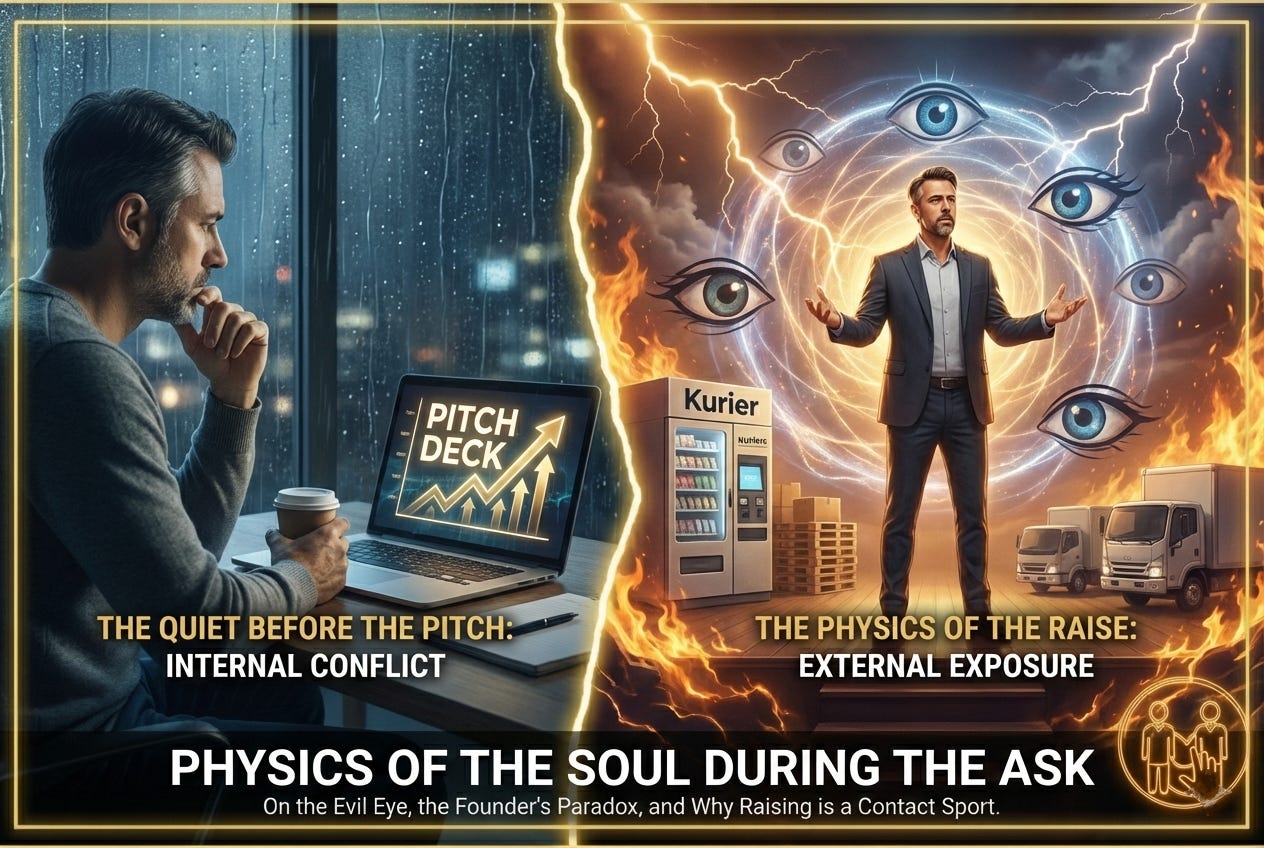
The air smells like wet concrete and ozone—the scent of a reset—and there’s something about that smell that slips past interpretation. It doesn’t ask what you believe. It simply delivers the body a message: something has changed; pay attention.
Wednesday—tomorrow—is going to be filled to the brim. The calendar is a wall of blocks, color-coded and unyielding, stacked so tightly it stops looking like time and starts looking like a defensive structure. I am pitching. The deck is open on my second monitor, a glowing rectangle of promises: projections, timelines, arrows that tilt obediently up and to the right. It’s the familiar ritual of coherence—assembling a story with clean edges, selecting the numbers that behave, flattening uncertainty into the kind of confidence you can place on a slide.
A deck is a performance of inevitability. It’s a request for belief dressed up as analysis.
But tonight, I’m not looking at the numbers. I’m looking at the empty space between them.
The numbers are a costume. They’re the part of the story that pretends to be stable. They’re the part that can be argued with and debated and adjusted until they look “reasonable,” which is to say: socially acceptable. The real transaction is invisible: certainty for risk, belonging for belief, attention for consequence. You don’t pitch a deck. You pitch a version of yourself that has already survived the story you’re still living. You stand there and let the room imagine you as the person who can hold the weight of what you’re claiming.
That is the thing that doesn’t get said, because it sounds dramatic, or spiritual, or too naked for a business environment. But that is exactly what is happening. When you raise money, you are asking for more than capital. You are asking people to lend you the shape of a future, to co-sign it with their credibility, to place their own nervous system beside yours for long enough that your dream doesn’t flicker out under the wind of doubt.
The spreadsheet is not the point. It is a language we use so we don’t have to admit that we are actually doing something older than commerce. We are doing a ritual of collective imagination. We are trying to make something invisible become visible, and then trying to make it stay.
The buzz of the pitch is a strange frequency. It’s sharp and exhilarating—the dopamine hit of possibility, the rush of “What if.” It makes you feel fast. It makes you feel brilliant. It makes you want to narrate your own victory before the world has agreed to fund it. It’s the part of the founder psyche that loves the leap, the part that thrives on compression, the part that knows how to step into the room and behave like the future is already here.
But underneath that buzz, there is a hum. A lower vibration. A signal that arrives less as a thought than as a change in the body—right where breath turns into speech, where intention becomes language, where language becomes a bid for reality. Sometimes it shows up as a tightening in the throat. Sometimes it’s a heaviness in the sternum. Sometimes it’s the visceral sense that you’re standing at the edge of something that will not be kind if you fall.
Being seen is not free.
Asking is not neutral.
Gravity is felt even by the brave.
I want to talk about raising—not the mechanics of the deck, or the valuation cap, or the size of the round. You can read about that on TechCrunch or a thousand VC blogs, and most of it will be accurate in the way technical descriptions are accurate: they’ll describe the instrument while ignoring the fact that the instrument is being played by a human soul. They will talk about ownership and dilution and governance, but the center is the Ask itself. It is the moment you open your hands and say: I need your participation for this to become real.
I want to talk about the physics of the soul during the Ask. It is the energy exchange that happens when you try to pull a future reality into the present moment. This is the collapse of a possibility into a plan. A plan into a commitment. A commitment into a life. The part that catches in the ribs is not the math; it’s the exposure. It’s the vulnerability of letting your future be touched by someone else’s gaze.
“Gaze” is the right word. You can feel a gaze. You can feel the difference between someone looking at you as a person and someone looking at you as a risk profile. You can feel the difference between curiosity and judgment, between resonance and skepticism. And when you are raising, you are placing yourself in the path of many gazes—some benevolent, some indifferent, some quietly hungry to be right about your failure.
This week, I’ve been carrying internal conflict that has mass. It isn’t abstract; it has weight. It sits in the chest like a physical object, like a stone placed exactly where the voice needs room. The conflict isn’t whether I can do the work. The work is execution, logistics, follow-through. That part is almost boring to me because I have done hard things before. The conflict is what happens when you say your dream out loud while it’s still tender, still forming, still susceptible to the invisible pressures of other people’s doubt, envy, or fear.
We are taught to walk softly and carry a big stick. Be humble. Move in silence. Don’t name the thing you want until it is already yours. Keep your cards close to your vest until the river card is turned. There’s wisdom in that, but there’s also an inherited trauma—a generational instruction: if you want to survive, do not become a target.
That advice is practical, but it is small. It is caution masquerading as virtue.
I refuse to build a life out of concealment. I like to live out loud, loudly. I love to paint a vivid, technicolor picture of a future that includes me and invite people into it. Description recruits attention, and attention recruits allies, and allies recruit momentum. But then there is the thing you’re not supposed to say in modern rooms because it sounds like superstition: Mal de Ojo. The Evil Eye.
As a physicist, I know that attention changes systems. In a social field, being witnessed is a measurement. It becomes pressure. It becomes heat. It alters the internal probability landscape of the person being observed. It changes what they can hold steady long enough to bring into form.
Sometimes the Evil Eye isn’t hatred. Sometimes it’s admiration that curdles into comparison. Sometimes it’s love that can’t metabolize your size. Sometimes it’s the smile that’s just a little too tight—the “must be nice” that lands like grit in the teeth. You feel it as a subtle drag, like walking into a headwind you didn’t earn.
Stealth protects the seed. Raising requires fire. And fire attracts eyes.
This is the founder’s paradox. You cannot raise money in the dark. You cannot build a movement in silence. You must stand in the center of the room and say, “This is the future,” while it’s still fragile enough to be misunderstood.
So the real questions arrive: Am I big enough to hold my own goals? Am I steady enough to keep my center when a dozen minds are measuring me? I’ve spent years trying to understand the collapse of plans without turning it into superstition, but it is hard to deny that when you live out loud, you are doing your work while being touched by other people’s stories about what someone like you deserves.
And then the sharpest question of all: am I confident enough to ask friends, family, and colleagues to invest in something I know I can deliver… but they have to pay for the delivery? This is where the Ask stops being business and becomes personal. Not because money is sacred, but because trust is. The soul experiences this as contact. As exposure.
So I am doing the inner work. I am clearing the channel. I am not trying to become invulnerable, but I am trying to become less porous to the wrong frequencies. I am stepping more fully into the Yes, And universe—the abundant timeline where your success does not preclude mine, and mine does not diminish you. I am sanding down the places where my own doubt offers handles for someone else’s doubt to grab.
I asked. I showed up. I offered. And it is working.
As of today, I give myself better than a fifty percent chance of succeeding in the raise. I have five commitments already. The idea is catching fire with my personal network. That moment when an idea stops being private and starts being communal—when it begins to travel without you pushing it—is quiet proof that you are not hallucinating alone.
The window is closing, but the door is open.
I am learning to hold urgency without panic, opportunity without mania. And when I succeed—when I have succeeded—the hill won’t be abstract. It will be pallets and contracts and lead times. It will be the slow discipline of making the future boring enough to be real.
It will be turning lightning into infrastructure, turning thunder into delivery, turning a vision into a system that doesn’t require constant adrenaline to stay alive. That is its own kind of spirituality: the willingness to trade the intoxication of possibility for the devotion of execution.
The storm this morning was brief. The rain is not.
Tomorrow I will pitch the future with charts and arrows because that is the language the room speaks. But tonight, in this rain, I’m listening to the deeper language underneath.
The one that says: yes, you are inviting the eyes. Yes, you are inviting the drag.
And still.
This is the future. And I can climb it.
Alongside you.
Dr. Lucas Root Techno-Shaman. AI Strategy Advisor. Author of “THE FORGE & THE FLOW.” I am a storyteller, but above all, a permanent student of human potential. My work is a deep exploration of the unseen contracts and hidden systems that exist at the intersection of technology and humanity. Here on The Lucid Path, we practice learning in public and building with purpose. I’m a rabid enthusiast for finding the patterns that help us build better, more human ways of being, freeing ourselves from the complexity we create.
If this piece resonated, consider sharing it with someone who might also be walking this path.
Explore My Work Further: https://smartpa.ge/LucRoot
No posts
Comments
Nothing yet. Say the first thing.
Sign in to join the conversation.