
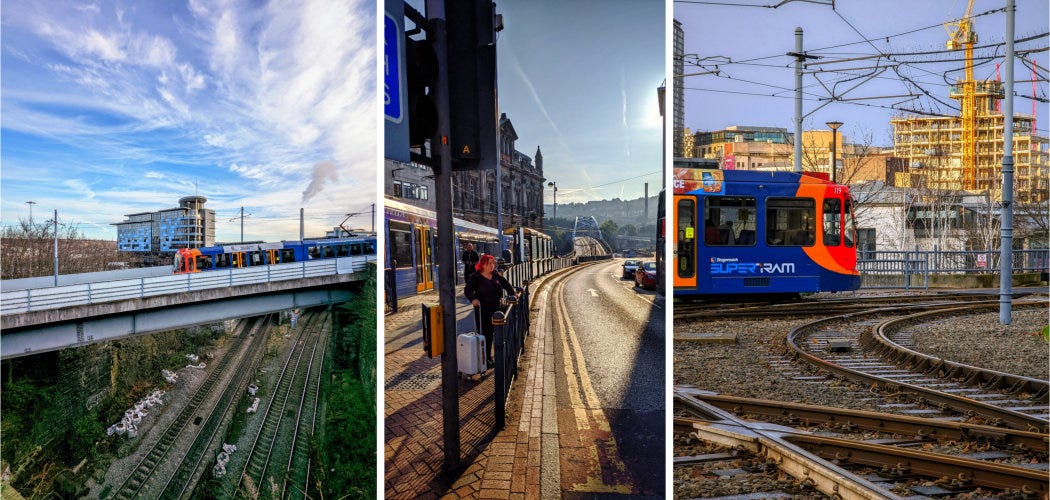
If you’ve tried to travel through Sheffield by tram over the last couple of days, you may already have noticed that something fairly significant is happening above Park Square.
The Delta Junction, the great tangle of track that allows trams to move between different parts of the network, is being replaced. It has been doing that job for 32 years. More than 440 trams would normally cross it every day and, when the work is finished at the end of August, the new junction is expected to keep doing its job for another 30 years.
I find something quite wonderful about the timing.
Because while engineers are pulling apart and rebuilding a piece of Sheffield’s transport infrastructure inherited from the 1990s, today, Monday 10 August, we are being invited to think about the trams that will replace those from the same era.
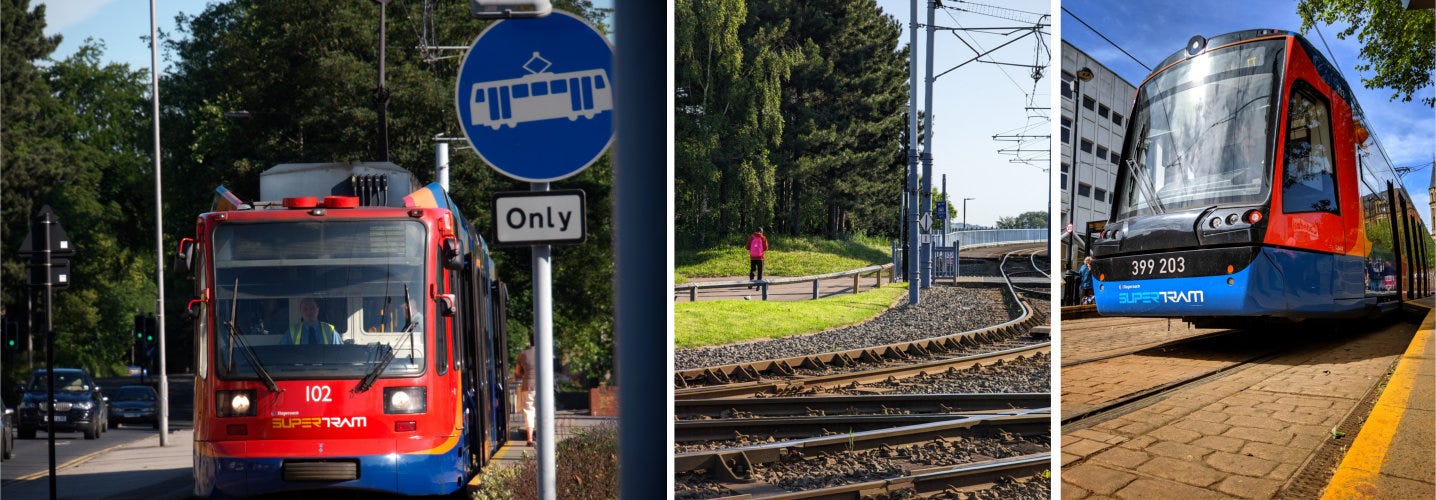
South Yorkshire Mayoral Combined Authority has opened a public consultation on our next generation of Supertrams. There is £90 million committed to the new fleet, and what people say over the next few weeks will help shape the specification that eventually goes out to the manufacturers who will build them.
This isn’t yet about deciding where future tram lines might run.
It is much more immediate than that.
What should it actually be like to use one?
How easy should it be to get on if you use a wheelchair? How much room should there be for pushchairs or bikes? What sort of seating works best? What about air conditioning, safety, information screens and all those little details that eventually determine whether a journey feels easy or awkward?
Somebody has to make those decisions.
And they aren’t easy.
Every tram has finite space. Every design choice affects another one. There are questions of cost, reliability, accessibility, maintenance and technology, alongside the simple human experience of travelling from one place to another.
The people making those decisions can have all the technical expertise in the world, but they can’t possibly know what daily life feels like for everybody across South Yorkshire.
And that isn’t a criticism.
It’s simply distance.
Which brings me to something I’ve been thinking about a lot.
We have become very used to consultation.
An important decision is coming. A webpage appears. Perhaps we notice it on social media or somebody sends us a link. We sit down one evening with our phone or laptop and answer some questions.
Then we get on with our lives.
Thousands of people may take part.
Thousands of different experiences.
Thousands of individual responses.
But perhaps almost no connection between the people giving them.
What might happen if we changed just that bit?
Imagine discovering the tram consultation because somebody in your own neighbourhood mentions it.
You realise that five or six people nearby are already talking about it.
One regularly travels with a buggy.
One uses a wheelchair.
Someone’s teenager takes the tram independently to college.
Another neighbour commutes across the city every morning.
Someone worked in engineering for thirty years and understands why one apparently obvious solution might be rather more complicated than it looks.
And someone else hardly uses the tram at all.
They might ask the question nobody else thought to ask.
Suddenly, before you’ve even filled in the questionnaire, something has changed.
You haven’t lost your opinion.
You’ve encountered somebody else’s reality.
Perhaps you still think exactly what you thought before. Perhaps somebody changes your mind. More likely, your understanding simply becomes a little richer.
And importantly, nobody needs to agree.
Nobody takes a vote and announces that “Wadsley thinks this” or “Burngreave wants that”.
Neighbourhoods don’t have opinions.
People do.
Different experiences and different views are part of what makes the conversation useful.
Imagine instead that we learn before we speak.
Someone finds the actual consultation information. Someone spots a detail everybody else missed. Someone understands the engineering. Someone understands the human consequence.
We ask questions of one another.
Then we decide for ourselves what we want to do.
One person responds to the official consultation. Another sends a completely different response. A few neighbours might decide they want to contribute something together. Someone might contact their councillor. Somebody else decides they’ve learned something interesting but doesn’t feel strongly enough to do anything at all.
All perfectly fine.
The difference is that we reached the democratic process having first had the opportunity to reach one another.
And this is one of the possibilities I’ve been trying to make easier through Seven Hills.
Not another polling platform.
Not another organisation claiming to speak on behalf of communities.
And certainly not somewhere that takes all the beautiful complexity of a neighbourhood and turns it into another dataset.
Something much simpler.
A protected common space where we can discover other people nearby who care about the same thing, explore what it means together, find useful knowledge and then decide what we ourselves want to do next.
The technology really isn’t the exciting bit.
If it works properly, you should barely notice it.
The exciting bit is discovering that the woman three streets away understands accessibility, the chap around the corner spent his career solving engineering problems, somebody else has direct experience you’d never considered, and all of them were there yesterday.
We just couldn’t find one another.
And perhaps that matters after the consultation too.
Because civic life doesn’t finish when we press Submit.
Eventually decisions get made. Sometimes we get what we hoped for. Sometimes we don’t. Sometimes something happens that none of us expected.
Connected neighbours can still ask:
What happened?
What did we learn?
And given what is happening now, what can we do together?
That, to me, is where agency becomes much more than having a say.
Which takes me back to Park Square.
Somebody designed that junction more than thirty years ago.
Somebody specified those points, rails and signals.
Somebody made decisions that millions of journeys later Sheffielders are still living with today.
And now we are beginning another cycle.
Some of the children travelling around Sheffield today may still be travelling on our next generation of trams as middle-aged adults.
There’s something rather beautiful about that.
We inherit yesterday’s decisions.
We live with today’s.
And we leave tomorrow’s infrastructure to people we may never meet.
The consultation on the new tram fleet is open until Friday 18 September. There is also a public exhibition at The Workstation in Sheffield this Wednesday, 12 August, from 11am to 2pm and again from 3pm to 6pm, with online sessions on Tuesday 18 August.
Please do have a look.
But perhaps, before you tell South Yorkshire what matters to you, ask somebody who might use those future trams differently what matters to them.
The people making Sheffield’s difficult decisions need the best knowledge our city can give them.
And the rest of us need better ways to become part of what happens around us.
We know the system isn’t working as well as it could. Fewer than half of Sheffield’s eligible voters took part in our last council election.
Perhaps connection gives us another place to start.
Not waiting until somebody asks what we think, but finding one another, learning from each other and becoming a bigger part of making the systems around us work better.
Perhaps the best response begins before we ever open the questionnaire.
Kind regards,
Brian Mosley
Founder of Love Sheffield & Project Ignite
Author of The Connected Enterprise
Creator of Seven Hills
Comments
Nothing yet. Say the first thing.
Sign in to join the conversation.