
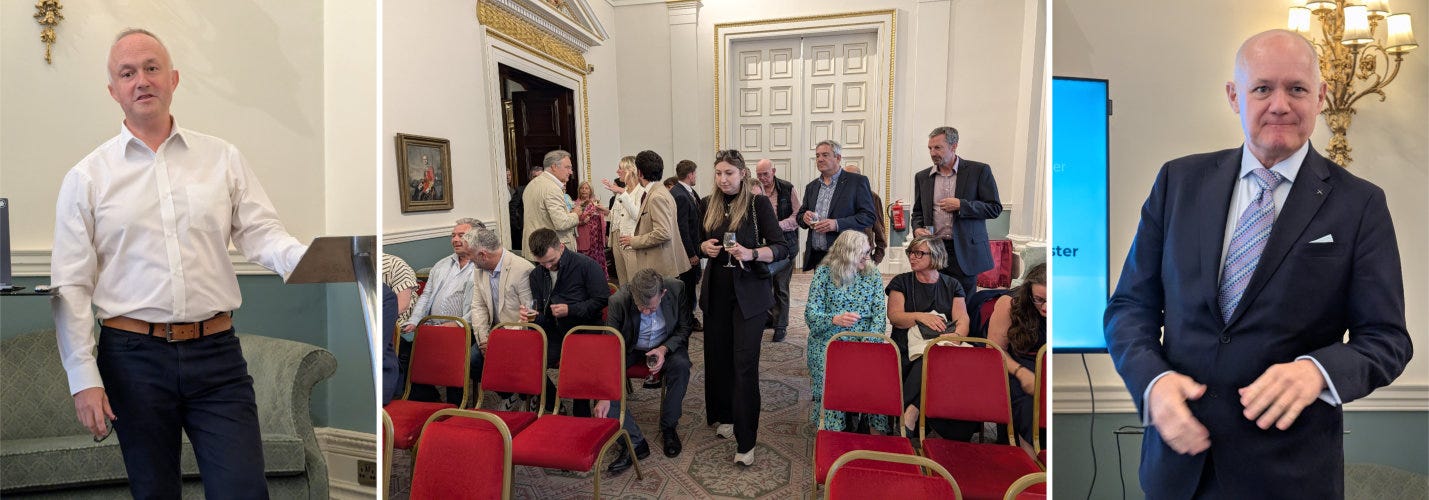
Last night, I found myself back in Cutlers’ Hall for the second Cutlers Connect evening, surrounded by around fifty people from Sheffield and South Yorkshire’s manufacturing community.
Richard Gould opened the evening by reminding us what these gatherings are really for. Connections. Sharing knowledge. Knowing who to call when you need help.
He then invited our Master Cutler, Professor Keith Jackson, to say a few words. Keith appeared to have been given about thirty seconds’ notice, which he took with ease.
What followed was a brilliant off-the-cuff overview of the importance of manufacturing to Sheffield and South Yorkshire, the extraordinary capability that still exists across our region, and the responsibility we share to connect it, champion it and help it grow.
Then came three brief introductions, continuing to build a sense of who was actually in the room.
Lyn Dario, Partner at Shakespeare Martineau, spoke about the firm’s work with manufacturers. Petros Efthymiou, an engineering section leader with the UK Atomic Energy Authority, introduced some of the extraordinary fusion, advanced manufacturing and radiation-hardened robotics work being developed here in South Yorkshire. Pete Shillito, of the Shillito Group and Sheffield Hallam Students’ Union, spoke about connecting emerging talent with local manufacturing.
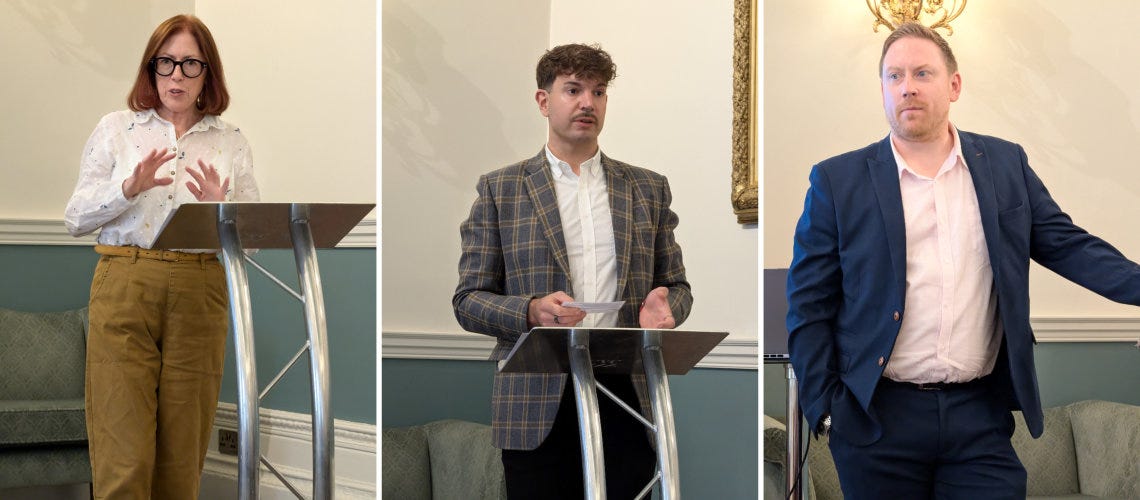
It was a really nice way to open the event. We weren’t just an audience waiting for a speaker. We were beginning to understand who was there and what they might bring.
Then Andrew Butt stood up to talk about manufacturing for defence.
And the show really began.
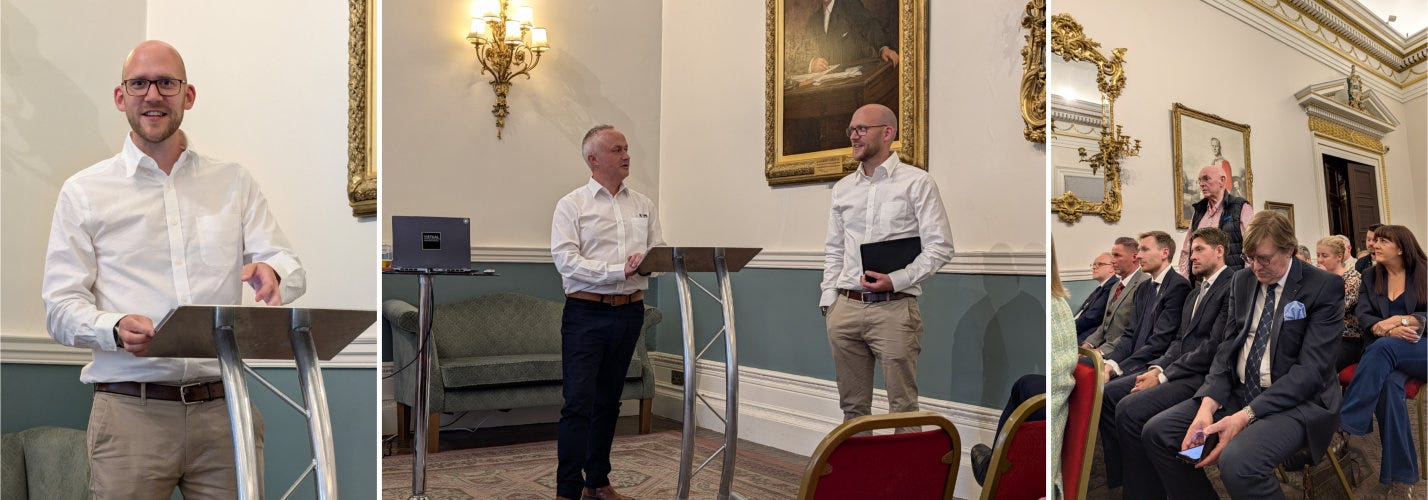
Andrew chairs the Yorkshire Regional Defence & Security Cluster and the Make UK Defence Advisory Board. He began by saying that he doesn’t usually spend too much time talking about the geopolitical threat because, the further you get from people immersed in defence, the more frightening that conversation can become.
He joked that mentioning undersea cables being cut and children losing TikTok usually gets people’s attention.
It raised a laugh.
But only to balance the next point.
The threat, he said, is very real.
I’d arrived as a Sheffielder and a telemetry systems engineer interested in manufacturing, capability and the future of our region. But I was also sitting there as a father and grandfather, thinking about the kind of country and world I hope my family will inherit.
And I found myself confronting reality.
Most of my work is grounded in kindness, compassion, creativity and connection. I spend a lot of my time thinking about how we might create stronger communities, release people’s ability to contribute and build a society in which more of us can flourish.
So where does defence fit into that?
Perhaps the better question is what kindness, compassion and creativity ask of us when we meet the world as it actually is.
Kindness has never been the weak option.
Real kindness sometimes means listening when it would be easier to attack. Sometimes it means crossing a divide, helping someone who can’t repay you, or standing beside somebody when doing so carries a cost.
Sometimes, surely, it asks us to protect.
Kindness without the ability to protect those who are vulnerable can leave them exposed.
Power without kindness can become something much worse.
That distinction matters to me.
Much of what I’ve written about connection concerns another kind of power. Not power over people, but the influence that emerges through trust, example, shared values and authentic relationships.
I once described influence as gently tilting the floor rather than pushing or pulling people. We don’t force others towards a better future. We create conditions in which people can see something worthwhile and choose to move towards it themselves.
At the level of a nation, we might call some of that soft power.
A country should surely aspire to be respected not simply because others fear its weapons, but because people trust its institutions, value its friendships, admire its creativity, share its science, learn in its universities, work with its businesses and see something in its way of life worth protecting.
A country worth defending should also be a country worth being influenced by.
But soft power works through choice.
And we don’t live in a world where everybody will always choose cooperation. Recognising that isn’t pessimism. It’s simply part of seeing the world as it is.
That’s the reality Andrew brought into the room.
If we genuinely want peace, then we also need enough strength that anyone considering attacking us has very good reasons not to.
Not because we love war.
Precisely because we don’t.
Andrew’s presentation then became reassuringly practical.
Defence needs physical capability. Software and cyber matter enormously, but at some point, as he put it, somebody still has to “bend the metal”.
That’s language Sheffield understands.
Forging. Casting. Machining. Precision. Materials. Control systems. Skilled hands. Experienced judgement.
Andrew talked about a desperately renewed need for capacity, but also about the very real difficulties facing businesses that want to enter defence markets.
Who’s actually buying? What compliance is required? What are you signing? Can you repeatedly manufacture what you promise? Can you afford the long journey to a contract? Why should anyone trust you?
His advice was refreshingly simple.
Don’t begin by asking, “How can I sell what I already make to defence?”
Ask instead:
What defence problem are we unusually well placed to solve?
That question stayed with me throughout the evening.
After Andrew’s main presentation, we shared a delicious meal and the room returned to conversation. People moved between tables, exchanged experiences and began doing exactly what Richard had hoped we would do at the beginning of the night.
We connected.
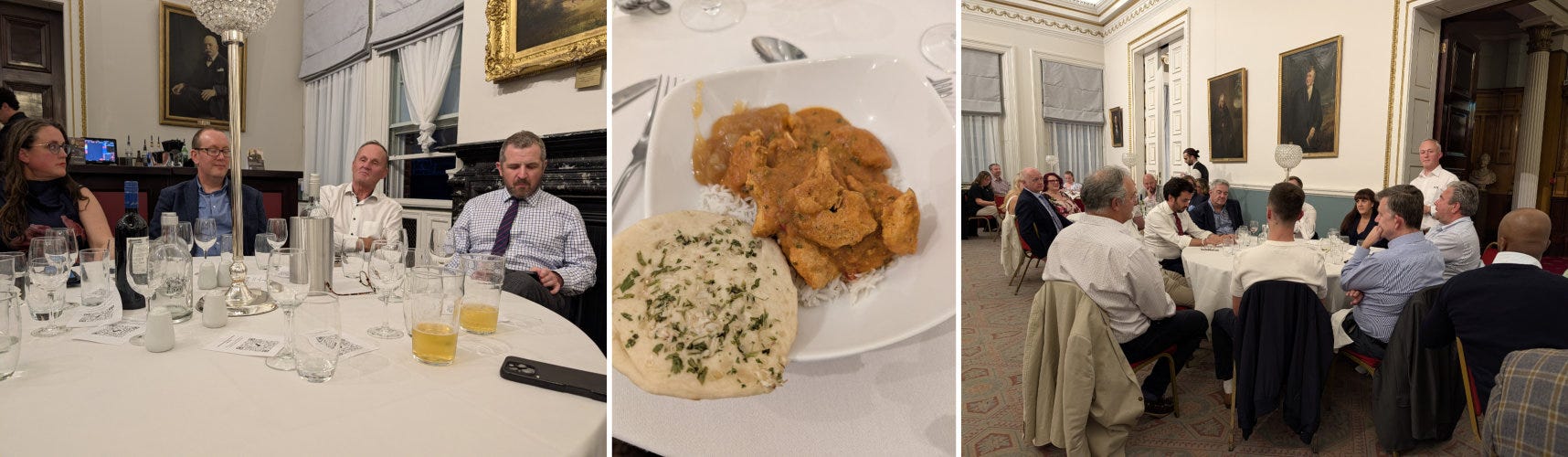
After a time, Andrew took questions.
The conversation revealed another part of the challenge. Systems designed to reduce risk can sometimes create another kind of risk altogether, by making it harder to respond quickly enough when circumstances change.
Andrew described procurement processes so cautious that by the time a perfect solution arrives, the technology, and sometimes the threat itself, may already have moved on.
That problem isn’t unique to defence.
As an engineer, I’ve spent much of my life thinking about systems.
A complicated collection of components doesn’t automatically make a capable system.
Capability emerges through connection.
Sensors need communication. Information needs somewhere to travel. Different parts of a system need to respond to one another. Feedback needs to move quickly enough for the whole thing to adapt.
Living organisms work in much the same way.
Their strength doesn’t sit in one central component. It emerges from millions of connected parts sensing, responding and acting together.
Increasingly, that’s how I think about society too.
A connected society can become more capable than any institution acting alone.
But connection by itself isn’t enough.
Bad information, panic and hostility can spread through networks too.
What matters is connection combined with trust, good information, shared values, local knowledge and the confidence to act.
This is one reason I’ve become so committed to building Seven Hills.
Not because I imagine an app will save Sheffield during some future crisis.
It won’t.
But I want the connections to exist before we need them.
The time to meet your neighbours isn’t when the floodwater is coming through the door.
The time to discover who nearby has practical skills, medical experience, tools, transport, local knowledge, spare capacity, or simply the ability to check on somebody vulnerable isn’t after something has gone badly wrong.
We need those relationships while life is ordinary.
Last night made me think differently about national resilience.
Of course we need strong armed forces. We need equipment, ammunition, cyber capability and manufacturers capable of producing what the country requires.
But resilience also lives in universities, businesses, neighbourhoods, voluntary groups and ordinary people.
It lives in whether we know one another.
Whether we trust one another.
Whether we’ve practised contributing rather than merely consuming.
Whether, when something happens that no central organisation could possibly have planned in detail, people feel able to ask:
What can I do?
That’s where I found hope last night.
Not because the threats Andrew described disappeared. They didn’t.
Not because Sheffield already has all the industrial capacity, skills or answers we need. We clearly don’t.
But I looked around that room and saw manufacturers, engineers, educators, researchers and others beginning to connect around a shared challenge.
Sheffield has done hard things before.
Perhaps our opportunity now isn’t simply to become a bigger supplier to defence.
Perhaps it’s to become part of a country strong in a much fuller sense.
Strong enough to influence through the values we live.
Strong enough to defend those values when necessary.
Connected enough to respond intelligently when something unexpected happens.
And kind enough never to forget what all that strength is for.
Perhaps peace isn’t the absence of strength.
Perhaps lasting peace depends on having enough strength, and enough humanity, to know how to use it.
Kind regards,
Brian Mosley
Founder of Love Sheffield & Project Ignite
Author of The Connected Enterprise
Creator of Seven Hills
Comments
Nothing yet. Say the first thing.
Sign in to join the conversation.