
“We are developing machines that don’t exist, to do tests that have never been done, to prove technology that doesn’t exist yet.” — Prof. Matt Stephenson, Head of UKAEA South Yorkshire
This morning, several parts of my life seemed to arrive in the same room.
I was returning to UKAEA South Yorkshire, based at the Fusion Technology Facility on the Advanced Manufacturing Park in Rotherham, for the second time.
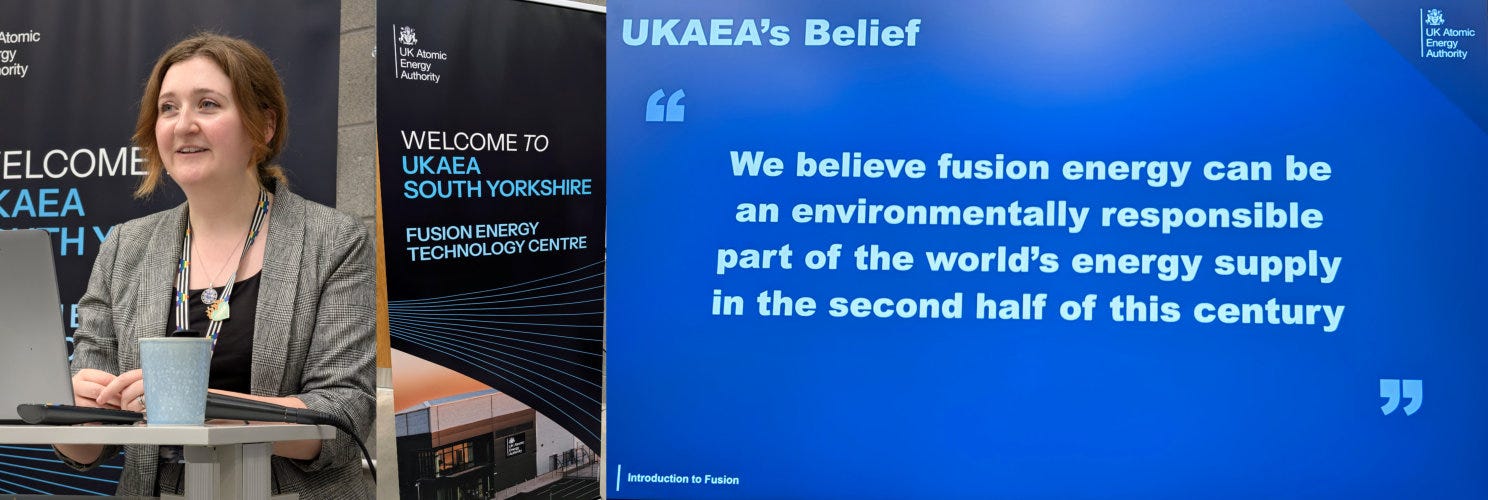
I was there as a Sheffielder, as an engineer, and as someone passionately supportive of Britain’s pursuit of fusion energy.
My first visit, earlier this year, had been a personal tour with Prof. Matt Stephenson, Head of UKAEA South Yorkshire. Matt spoke then about fusion moving north, the STEP prototype power station planned for West Burton, and his hope that by 2040 there would be a rich seam of suppliers running through this region towards it.
That thought stayed with me.
This morning gave me a clearer sense of what creating that rich seam might actually involve.
Jordan d’Arras began by making the science remarkably accessible.
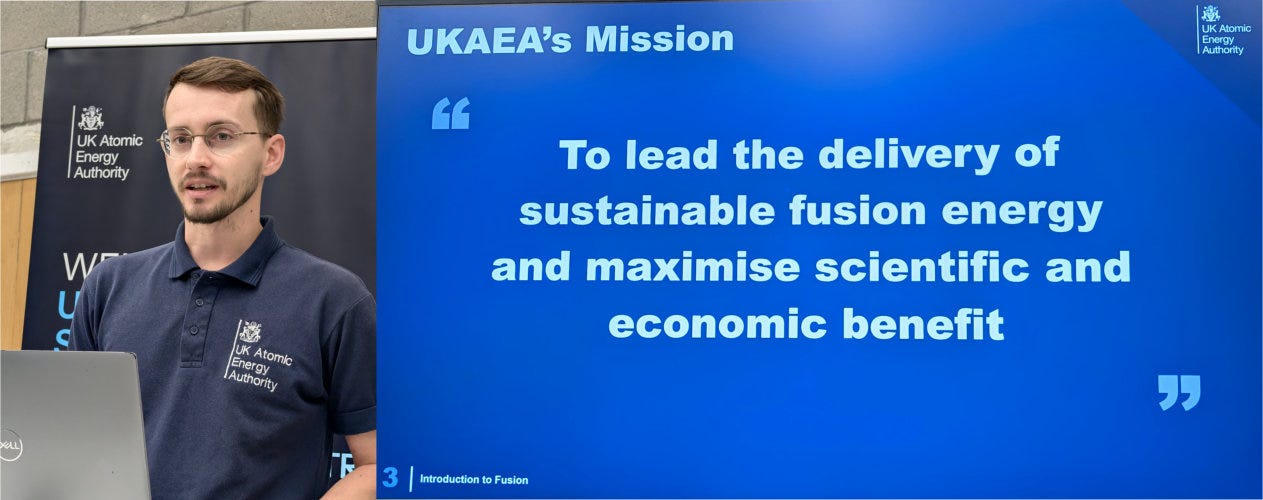
Fusion is sometimes described as creating a star in a jar. It sounds like the sort of phrase dreamed up to make science exciting, until you discover that it’s surprisingly close to the truth.
Inside a fusion machine called a tokamak, forms of hydrogen are heated until they become plasma. That plasma must reach around 150 million degrees Celsius, roughly ten times hotter than the core of the sun, so that atomic nuclei can overcome their natural resistance and fuse together.
Powerful magnetic fields hold this miniature star away from the machine around it.
The energy released is eventually used for the ordinary business of boiling water, producing steam and turning a turbine. Humanity may one day create energy by holding something hotter than the sun inside a vast metal doughnut, only to finish the job with a steam engine.
That’s often how engineering begins. The first workable solution is rarely the simplest one. Simplicity comes later, once we’ve learned what can safely be removed.
But once we’ve imagined the star, another question quickly follows.
Who’s going to build the jar?
Paul Goodwin, who leads the Manufacturing Technology and Equipment Qualification group, brought the morning firmly onto the factory floor.
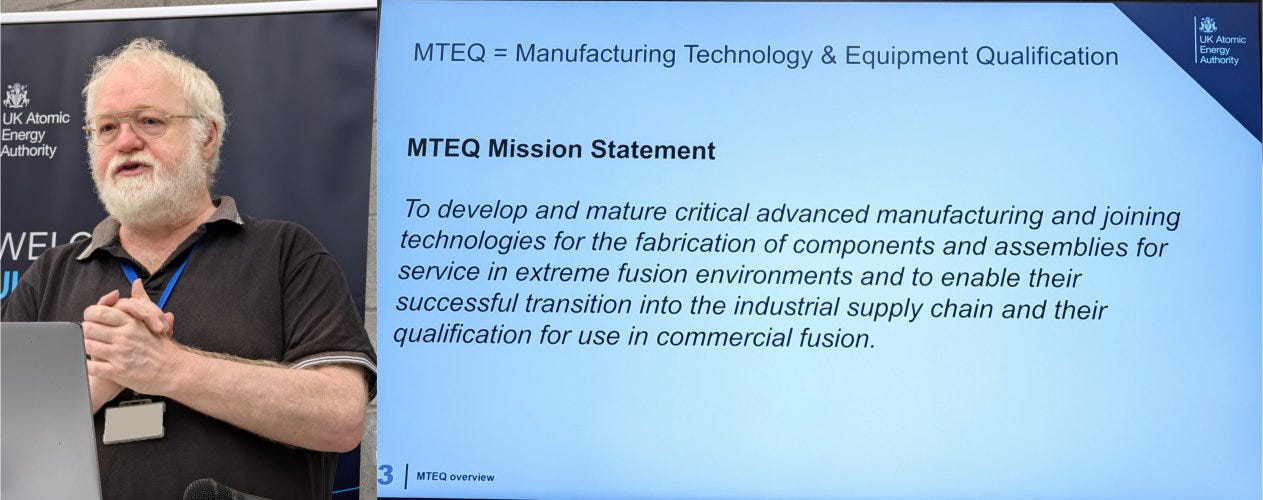
A tokamak must contain plasma at 150 million degrees while superconducting magnets operate at temperatures close to absolute zero only metres away. Between those extremes sit walls, joints, cooling channels, magnets, sensors and exhaust components. They must survive heat, radiation, electromagnetic forces and repeated operation.
It’s one thing to describe a star.
It’s another thing entirely to manufacture everything around it.
Fusion isn’t waiting for one great breakthrough that will suddenly make everything work.
There are difficult problems in materials, joining, robotics, control systems, inspection, simulation, cooling, vacuum technology, maintenance and qualification. Many of the required components have never been produced at the scale, consistency or reliability a working power station will demand.
It’s a bit like designing a Formula 1 car, refining the engine and preparing it to race at 200 miles per hour, while the tyres capable of surviving that speed have yet to be invented.
Everyone may be cheering for the engine designers, but the car still can’t race.
And the tyre manufacturer can’t afford to build an entirely new factory just because someone says there may be a race several years from now.
Paul described this circular problem very honestly. Manufacturers are reluctant to invest without confidence that demand is coming. Fusion designers are reluctant to depend upon materials and processes where no reliable supply chain exists. In some cases, materials may not be selected for STEP precisely because nobody is yet ready to supply them.
There’s no supply chain because there’s no demand.
There’s no demand because there’s no supply chain.
Somewhere, that circle has to be broken.
Before the visit, I’d been reading about one particularly interesting example involving oxide dispersion strengthened steel, usually shortened to ODS steel.
ODS steel contains tiny oxide particles that help it retain its strength under extreme heat and radiation. You might think of it as something like reinforced concrete, but at a microscopic scale.
The problem is that the same structure which gives the material its unusual strength also makes it extremely difficult to join without damaging the properties that made it useful in the first place.
UKAEA’s industry report describes world-first work producing highly complex ODS components with internal cooling features. The lead supplier brought together the Henry Royce Institute and several specialist subcontractors based in Sheffield, using advanced hot isostatic pressing, metallic interlayers and sacrificial inserts to solve a problem that no participant necessarily held the complete answer to alone. The supplier owns the process and technique-based intellectual property, while UKAEA has a non-exclusive licence to use it.
That meant public investment helped solve a national engineering problem while leaving commercially valuable knowledge and capability inside the company and the wider industrial community that helped create it.
That seems enormously important to me.
This isn’t merely the story of a clever component.
It’s an example of several pieces of specialist knowledge being joined around a shared challenge.
And it makes me wonder: how many more pieces are already out there?
Perhaps a small company somewhere in South Yorkshire has developed an unusual coating process.
Perhaps an experienced machinist understands the behaviour of a difficult material long before that knowledge appears in a formal data sheet.
Perhaps a controls engineer can see a failure mode that a materials scientist would never think to ask about.
Perhaps a postgraduate, given a real industrial problem and access to experienced people, could bring a completely new tool or method into the conversation.
These capabilities may already exist.
The problem is that they can’t always see one another.
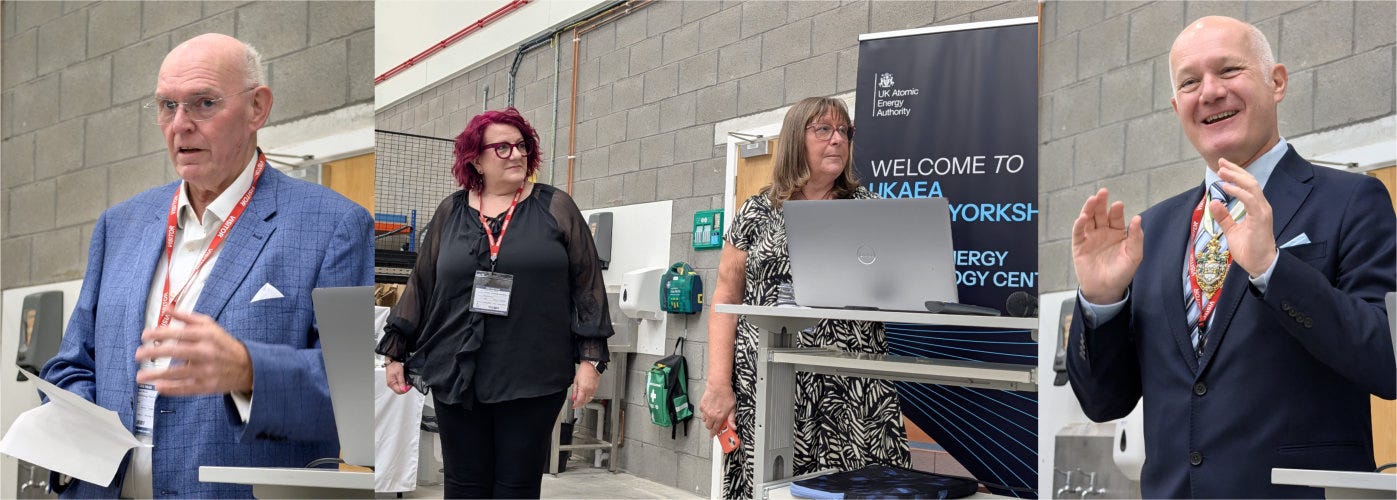
South Yorkshire manufacturing isn’t one community.
It’s a community of communities.
There are metallurgists, machine shops, fabricators, software engineers, robotics specialists, inspection companies, university researchers, apprentices, retired engineers and people who have spent forty years learning how materials behave when the drawing meets reality.
Each group has its own language, pressures, relationships and hard-earned knowledge.
We don’t need to place them all inside one enormous organisation. Heaven help us.
We need to make it easier for the right people to find one another around specific problems.
The careers presentations from Petros Efthymiou and Davidson Sabu also made the human side of this visible. Their work crosses materials, manufacturing, contracts, testing, business planning and new facilities such as HALO, designed to test how components respond to extreme heat.
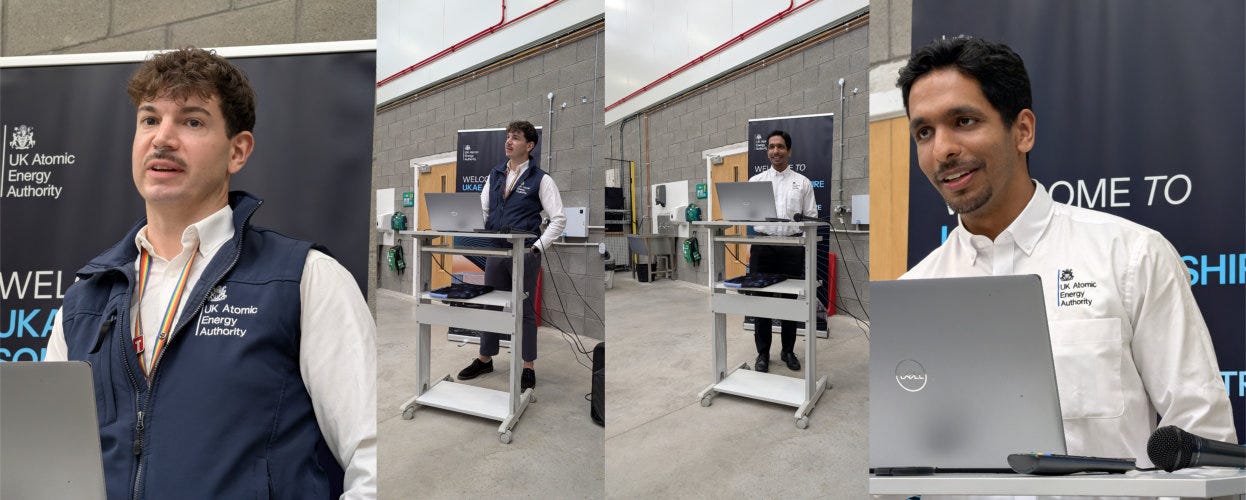
A discussion about mentoring followed.
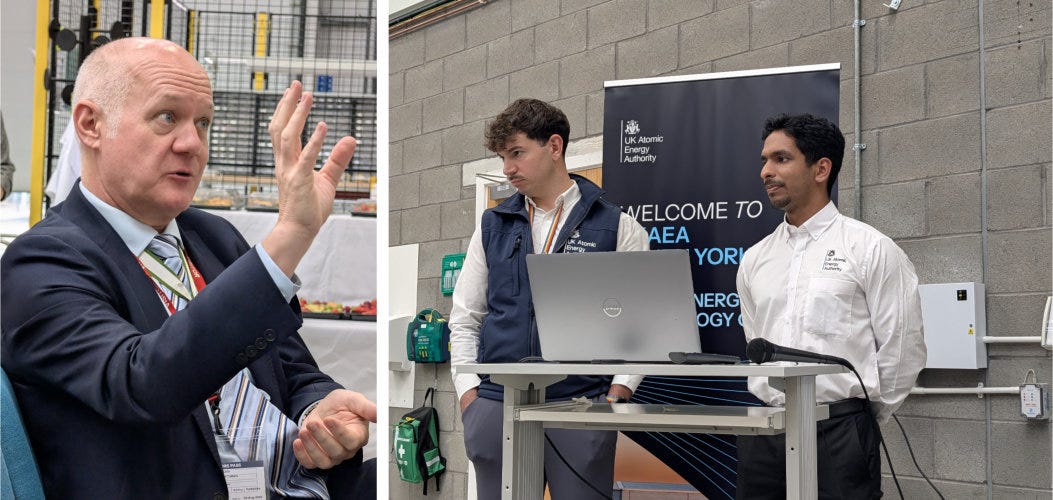
It struck me that South Yorkshire contains a huge reserve of experienced people who could support the next generation, but knowledge doesn’t pass between generations simply because both generations happen to live in the same region.
We have to create the relationships through which it can travel.
At the end of the morning, I spoke with Adam, an engineering analyst in UKAEA’s Office of the Chief Engineer.
His work involves structural and electromagnetic analysis of tokamak components, followed by experimental validation to test whether the simulations match physical reality.
That led us into a conversation about the tension between experimentation and engineering standards.
Private fusion companies bring investment, energy and speed. But the Silicon Valley instruction to “move fast and break things” becomes slightly less appealing when the thing being broken is a billion-pound experiment.
Adam agreed that experiments are essential because sometimes we only learn by breaking something. But fusion has to find ways to learn rapidly without being reckless.
We spoke about learning loops.
Simulations inform experiments. Experiments expose faulty assumptions. Manufacturers reveal practical limits. The lessons then need to travel back to designers, scientists and researchers.
The value isn’t in any one part of the loop.
It’s in the connection between them.
I told Adam that I believe intelligence is distributed throughout our communities. South Yorkshire has an extraordinary amount of scientific, technical and manufacturing knowledge, but we don’t always connect it well enough.
Our intelligence struggles to see itself.
I’d love to see more porous connections, making it easier for UKAEA teams to find the capabilities held by manufacturers, and for manufacturers to understand the problems emerging inside fusion research.
I reflected with Adam about Britain’s history of giving “boffins” and useful outsiders room to develop ideas beyond the established system, while also recognising that standards, finance, commercial value and intellectual property all matter.
The choice isn’t between inspired outsiders and engineering discipline.
Fusion will need both.
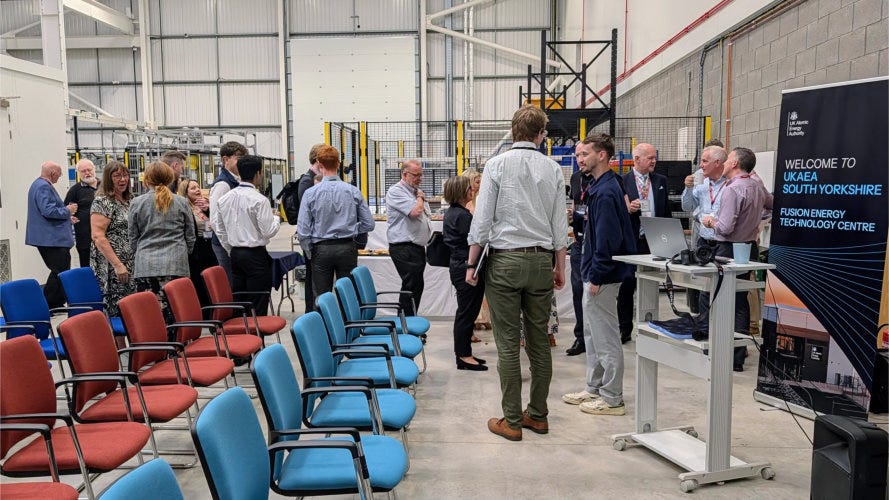
Manufacturers regularly tell me that they’re under the cosh.
British energy costs make it extremely difficult to compete with Europe, China and the United States. That’s a serious national problem.
But during my conversation with Adam, another way of looking at it occurred to me.
We still have an extraordinary manufacturing industry despite that handicap.
What does that tell us about the capability, inventiveness and sheer determination that remain here?
And what might those people accomplish if Britain can connect them to a long-term national purpose, credible demand, world-class research facilities and, one day, abundant sovereign energy?
I think we have the need for a national vision that connects UKAEA, STEP, universities, researchers and the whole industrial supply chain.
Not one company controlling everything from the centre, but an ecosystem working towards something none could achieve alone.
I would describe it as a connected community of communities.
A shared purpose large enough to call forward the gifts of scientists, engineers, businesses, students and practical makers across the country.
I left encouraged, not because fusion has suddenly become easy.
It hasn’t.
We’re trying to build machines that don’t yet exist, from materials that may not yet have supply chains, using tests and standards that are still being developed.
But Sheffield has never built its identity around doing the easy part.
Our history was shaped by people who understood difficult materials, difficult temperatures and difficult industrial problems. Much of that capability remains here, sometimes hidden inside small businesses and inside the memories of experienced people whose contribution isn’t always visible.
Somewhere in South Yorkshire, another piece of the fusion solution may already exist.
It may be inside a large manufacturer, a ten-person specialist business, a university laboratory or the mind of an engineer who has never imagined that their knowledge might matter to a star in a jar.
Our opportunity is to make those pieces visible, and to make it easier for them to connect.
We’re unlikely to build Britain’s fusion future through one institution working alone.
But we might build it through a connected community of communities, each bringing its own difficult piece to a solution none of us could create by ourselves.
I can see that the Company of Cutlers in Hallamshire has a serious part to play in hosting and strengthening that community of communities. Not through a single meeting or presentation, but through continuing events where manufacturers, researchers, engineers and the next generation can meet, learn what others are working on and begin to recognise where their own capabilities might fit.
I’ll be booking myself into the next one, Cutlers Connect: Manufacturing for Defence, at Cutlers’ Hall on Thursday 20 August 2026. It’s a different national challenge, but the same important question sits beneath it: how do we help the people with the necessary knowledge, experience and capacity find one another?
Because the hard part isn’t only inventing what doesn’t yet exist.
Sometimes, it’s connecting what already does.
Kind regards,
Brian Mosley
Founder of Love Sheffield & Project Ignite
Author of The Connected Enterprise
Creator of Seven Hills
Comments
Nothing yet. Say the first thing.
Sign in to join the conversation.