
“For as long as stories are told, hope remains in our world.” — Noa Baum
This afternoon, I experienced something that felt like a deep validation of almost everything I’ve been trying to understand through Love Sheffield, Project Ignite, Seven Hills and my own journey of connection.
It wasn’t a new theory. Nobody presented a grand plan for world peace. There were no neat answers to the hatred, fear and division we can see spreading around us.
Instead, people sat together in a beautiful room, listened to stories and began to see one another more clearly.
The event was called The Power of Storytelling: Building Bridges of Peace and Understanding, featuring the internationally acclaimed storyteller Noa Baum, author of A Land Twice Promised.
Before I say more about Noa, I want to recognise Fiona Cooper, who imagined, organised and persisted with this gathering. Fiona spoke honestly at the end about putting up posters, worrying that she might simply be annoying people and wondering whether anyone would come.
Then she looked around the room and realised she’d found people who shared her longing for peace, understanding and connection.
Fiona also spoke movingly about the venue. When she first entered Highfield Trinity Church, her response was simply: “Wow. This is sacred space.”
Whatever our faith or background, it was difficult to disagree. The church had generously opened a beautiful building where strangers could meet, listen and stay afterwards to continue their conversations.
That hospitality mattered.
Connection needs more than good intentions. It needs an invitation, a room, some chairs, a cup of tea and people willing to take the risk of showing up.
Noa began by acknowledging how dark the world can feel. There are times, she said, when hope threatens to leave us.
I feel that too.
I sometimes think of modern society as a toxic fish tank. That doesn’t mean the people swimming in it are toxic. It means the water around us is becoming increasingly polluted by fear, outrage, suspicion and contempt.
Our attention is fought over by media companies, political movements and technology platforms that have discovered anger keeps us watching. Social media repeatedly shows us the worst thing said by the worst representative of another group, then quietly encourages us to believe this is what all of “those people” are like.
After long enough in that environment, even decent people can become hardened.
Noa’s stories offered a very different experience.
She spoke about growing up as an Israeli Jew in Jerusalem, shaped by her family’s history, the Holocaust, war and fear. She later became friends with Jumana, a Palestinian woman who had grown up only a few miles away, but within a completely different experience of the same city.
For the first time, Noa began hearing what life under Israeli occupation had actually felt like to her friend.
She described the shock of realising that the soldiers who represented safety to her had represented fear to Jumana. Her people had become the “them” in somebody else’s story.
That didn’t mean Noa’s own history became false. It didn’t erase her family’s suffering or ask her to abandon her identity. It meant she had to make room for another human experience alongside her own.
That’s difficult.
When someone challenges the story through which we understand ourselves, our instinct is often to defend it. We reach for facts, arguments and evidence. We stop listening because it feels as though our identity is under attack.
A personal story does something different.
It doesn’t necessarily demand agreement. It asks us to remain present long enough to recognise that another person’s pain is real.
After Noa had shared her stories, she invited us to take part.
We moved out from behind our rows of chairs, introduced ourselves to people we didn’t know, then sat facing a stranger and shared a moment from our own lives. We were asked to listen without interrupting, offer a specific appreciation and then ask curious questions.
It sounds simple.
It was remarkably powerful.
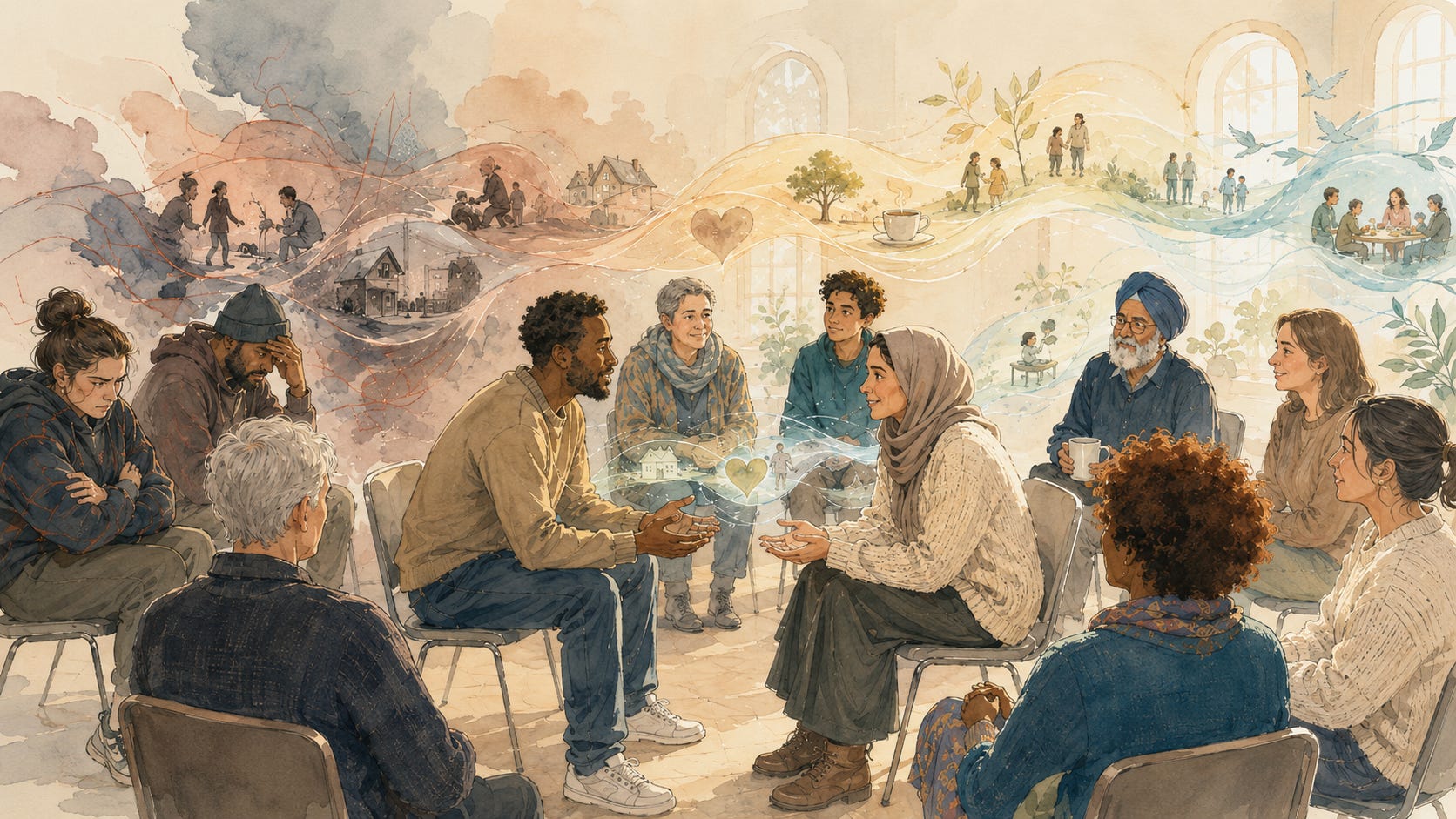
My partner told me about advice she’d given her daughter, drawing on her own experience of marriage and parenthood. As I listened, our conversation moved towards what it means to become a grandparent, the wisdom gathered across a lifetime and the value of having family close by.
I found myself thinking about how much wisdom is quietly living in homes across Sheffield.
Families have often dispersed in search of work and opportunity. Older people can find themselves isolated, while younger families struggle through experiences that somebody living three doors away may deeply understand.
We live physically near to one another, but our stories remain invisible, locked behind closed doors.
When it was my turn, I told the story of driving along Penistone Road and seeing that a row of healthy trees had been reduced to ugly stumps. That moment drew me from a life focused largely on engineering and earning a living into the Sheffield street-tree crisis, creating Love Sheffield and everything that’s followed.
My partner told me she could still feel how alive that moment was for me.
I realised Noa had helped us do something very close to what I’ve been trying to describe for years.
We’d moved the chairs into place and allowed people to connect for themselves.
Around the room, others had similar experiences. Two people discovered that they had very different relationships with belonging. One person found unexpected hope in somebody else’s story. Others were surprised by how quickly a stranger became a rich and complicated human being.
As Noa explained, spoken storytelling isn’t only about the storyteller.
The listener creates the space in which the story can exist.
That led me to the most difficult question I carried into the afternoon.
What do we do when we meet someone who has genuinely learned to hate?
How do we listen without accepting cruelty? How do we recognise someone’s humanity without excusing the harm contained in their beliefs?
Noa didn’t offer a sugary answer. She acknowledged that this work can be slow, difficult and painful. Not every situation is safe. Nobody should be expected to remain in an abusive encounter.
But where a genuine conversation is possible, we can become curious about the story beneath the anger.
Hatred often grows around a wound. It may be fear, grief, humiliation, abandonment or a belief that something precious has been taken away.
Recognising that wound doesn’t make the hatred acceptable.
Listening to someone’s pain isn’t the same as agreeing with their prejudice.
It may, however, allow us to explore their world, understand what has shaped that opinion, then offer our own experience and begin finding a route towards compassion.
An attendee described seeing fascists and anti-fascists shouting at one another across a road. A friend stepped away from the shouting, crossed the street and said, in effect: “I don’t agree with you, but I’d like to understand where your ideas came from.”
That takes courage. It also requires judgement. But it breaks the pattern.
So much of our public life now follows a predictable pattern. Someone says something offensive. Someone else responds with equal force. Each side performs for its own audience. Nobody learns anything, and the water becomes slightly more poisonous.
Breaking that pattern may be one of the most important creative acts we can take.
We can’t solve every war through storytelling. We can’t dismantle hatred with one good conversation. We shouldn’t pretend that injustice disappears when people are simply nicer to one another.
But peace becomes almost impossible when people are reduced to labels, statistics, enemies or avatars on a screen.
This is why connection isn’t a pleasant extra. It’s part of the critical infrastructure of a healthy society.
Imagine more spaces across Sheffield where people could share experiences before exchanging opinions. In schools, faith communities, workplaces, community centres and neighbourhood gatherings. Spaces where we could become visible to one another again.
This is also part of the purpose behind Seven Hills. Technology shouldn’t become another place where strangers shout into the fog. It can be a useful bridge, allowing neighbours to find one another before the real work continues face-to-face, between actual human beings.
At the end of the afternoon, Fiona said she hoped the gathering might be the beginning of something. A kindling of a fire that could allow people to meet like this again.
That image stayed with me because Noa had begun with an ancient story about preserving the fire of hope during dark times.
Fiona created the invitation. Highfield Trinity offered the space. Noa brought her extraordinary gifts. Everyone in the room brought their attention, honesty and willingness to listen.
Together, for a few hours in Sheffield, they kept that fire alive.
Noa closed with a wonderfully simple Sufi story about Nasruddin, the wise fool of Middle Eastern folklore.
Someone once asked him the rather enormous question: “Why are we here?”
Nasruddin told of a man walking home alone late at night. In the darkness, he saw a group of people approaching. His imagination quickly supplied the rest. They must be thieves, robbers, perhaps even murderers.
Terrified, he scrambled over the wall of a cemetery and hid inside an open grave.
The approaching group saw a shadowy figure suddenly disappear over the wall. Wondering what he was up to, they followed him into the cemetery and found their own neighbour trembling in the grave.
“What are you doing here?” they asked.
The man looked up at them and replied:
“I’m here because of you. You’re here because of me.”
“And that,” said Nasruddin, “is why we’re here.”
Perhaps that’s the truth we’re in danger of forgetting.
We shape one another all the time.
We may not be able to clean the whole fish tank today. But we can refuse to add more poison. We can listen for the story beneath the anger and create spaces where people meet as human beings.
Most importantly, we can refuse to let the politics of hatred decide who we become.
With hope and compassion,
Brian Mosley
Founder, Love Sheffield and Project Ignite
Creator of Seven Hills
Author of “Uniting Hearts, Igniting Change“
Comments
Nothing yet. Say the first thing.
Sign in to join the conversation.