
“None of us is as smart as all of us.” — Kenneth Blanchard
Earlier this week, I was delighted to attend the Cutlers’ First Tuesday Business Breakfast, hosted by Sheffield Hallam University at their wonderful new Business School in the Langsett Building.
Toby, our Ridgeback, had another restless night, so I arrived just as the presentation was beginning, grabbed a glass of water, found a seat, and joined the audience hoping that I hadn’t missed anything too important.
Thankfully, I hadn’t.
Or perhaps more accurately, I arrived just in time to hear something that felt much bigger than a business breakfast.
The setting itself mattered. Langsett is the new home of Sheffield Business School, designed around collaboration, hands-on learning and real-world impact. But sitting there, listening to people talk about manufacturers, mentors, students, digital tools, shop floors, growth, and the daily realities of running an SME, those words began to take on a more practical meaning.
It felt like a small glimpse of something Sheffield has in abundance: intelligence spread across people, businesses, institutions and communities, waiting to be better connected.
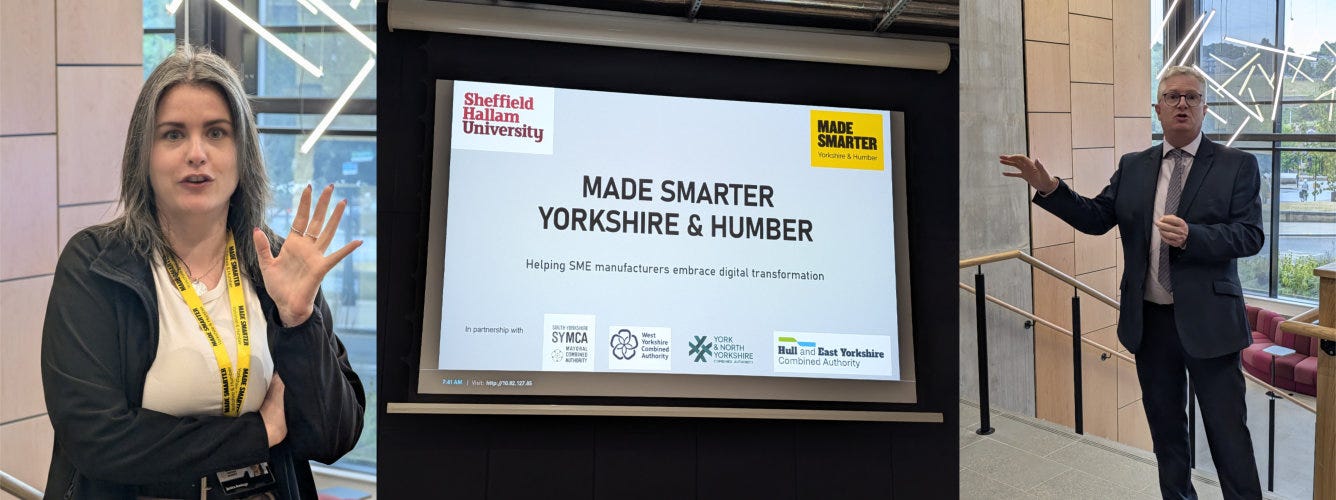
The first presentation came from Jess Armitage, Programme Manager for Made Smarter Yorkshire & Humber. The Made Smarter programme helps manufacturing businesses explore digital technologies, innovation and skills, with access to advice, digital roadmaps, technical support, skills support and grant funding.
What struck me wasn’t simply the technology.
It would be easy to reduce all this to robotics, automation, AI, digital twins, cyber security and grant funding. All important, of course. Especially the grant funding, because we need confident investment.
But I’ll be honest, I do have a slight reservation about any programme that arrives from above with technology in its hands.
Manufacturers are not empty vessels waiting to be filled with clever kit. They are living organisations, full of skill, memory, judgement, pressure, pride, frustration and hard-won practical knowledge. If digital transformation is treated as “here is the fix, now please adopt it”, then we risk missing the most important intelligence in the room: the people already doing the work.
So the value I saw in Made Smarter was not simply that expertise can be dropped into a business from the outside. It was that the programme can help bring new possibilities into view. It can help business leaders see tools, suppliers, students, skills and forms of support they may not otherwise have had time, confidence or access to explore.
That matters.
Because one of the hardest things in business, and in life, is that we don’t know what we don’t know.
That phrase can sound like something from a management slide deck, but it points to something very practical. If a business can’t see the real constraint, it can spend money on the wrong solution. If a leader can’t see the hidden risk, a threat can arrive before anyone has taken it seriously. If a city can’t see the knowledge, skill and care already spread across its people, it can keep importing answers while ignoring the intelligence already here.
This is situational awareness.
It sounds military, but it is deeply human. It is the ability to understand where you are, what is changing, what matters, what is at risk, and what might be possible next.
For a business, good situational awareness can mean long-term survival. Sometimes it can mean immediate survival. But at its best, it is about more than avoiding danger. It is about learning how to thrive.
And that is where the morning became really interesting.
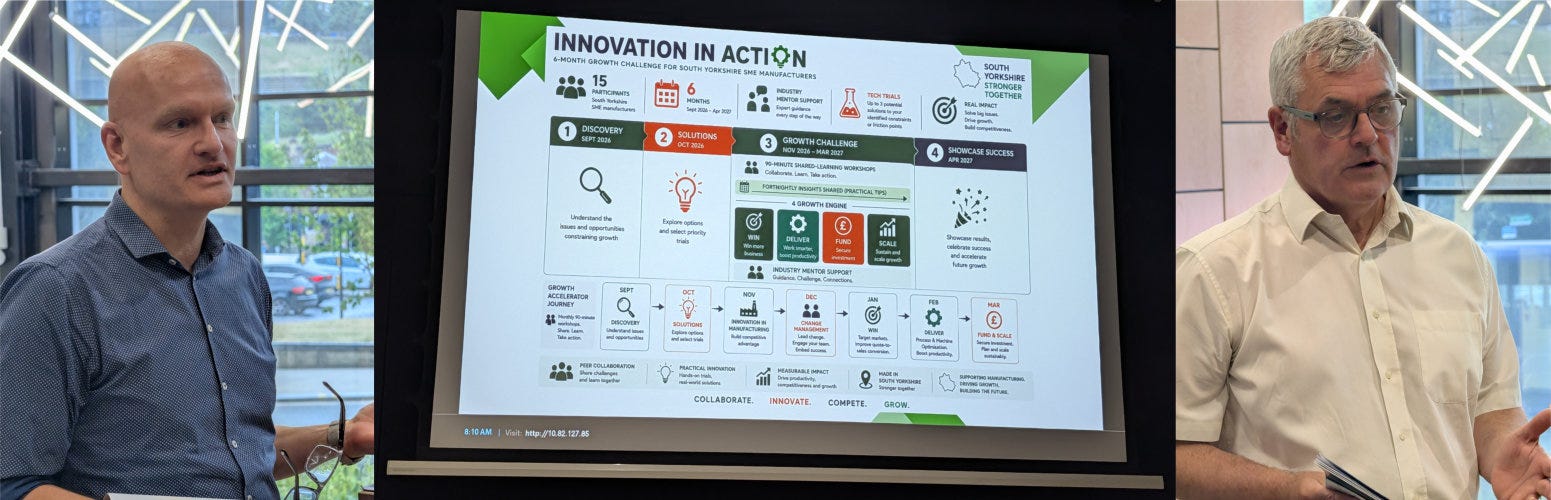
The next presentation focused on Innovation In Action, a South Yorkshire programme that brings SME manufacturers together with tech experts, industry mentors and regional partners to trial practical solutions on site.
This was the part of the morning that really caught my imagination.
Innovation can sound grand, expensive and slightly frightening, especially when you’re already busy running a business. It can feel like a leap into the unknown, with a large invoice waiting at the bottom. Very motivating. In the same way a cliff edge is motivating.
But what excited me about Innovation In Action was that it offers something much more grounded: a way to de-risk innovation through relationship.
The programme doesn’t begin with the technology. It begins with the problem or constraint. What is slowing the business down? Where is the friction? What is unsafe, inefficient, repetitive, wasteful or harder than it needs to be?
Then, instead of asking businesses to make a huge commitment on a hunch, it brings people together. Manufacturers, tech providers, mentors and regional partners. People with different experience, different tools, different scars and different ideas about what might work.
That matters because innovation is not always about inventing something new.
Very often, it is about discovering what already exists, then understanding how it might be applied to this particular business, this particular team, this particular process, this particular constraint.
But the biggest value I saw was not simply access to technology.
It was the building of relationships across companies.
Small businesses can easily become little islands. Skilled, proud, busy, under pressure, solving problems every day, but often solving them alone. Innovation In Action seemed to offer something more like a connected community of communities: small businesses learning alongside one another, seeing where collaboration might be possible, sharing what has worked, sharing what hasn’t, and realising they are not the only ones carrying these challenges.
That is where resilience starts to build.
Not just in one business, but across a region.
When businesses know one another, trust one another, and can see the skills and possibilities around them, they become less fragile. They can spot opportunities sooner. They can avoid each other’s mistakes. They can collaborate on problems that would be too large or too risky to tackle alone.
One example brought this to life beautifully. A business already had a robot, but it was only active around 30% of the time. The answer wasn’t to buy three more robots. The answer was to understand the work better and explore how the existing robot could be moved between different functions across different processes.
The assumed solution would have cost hundreds of thousands of pounds. The better answer needed a couple of thousand pounds, a clearer view of the real constraint, and the right connection to people who understood what was possible.
That is the sort of discovery that makes me sit up.
Not because I’m against new technology. Far from it. I’ve spent enough of my life working with telemetry, automation and control systems to know the power of getting the right information to the right people at the right time.
But technology without relationship is just a very expensive way of becoming confused faster.
The real value is not the machine on its own. It is the connection between the people who understand the problem, the people who understand the tool, and the people who can help the business take the next step with confidence.
That is why the relationship piece matters so much.
A business can have the right machine, the right software, even the right grant, and still miss the deeper opportunity if the right people are not learning together.
The most useful knowledge may sit with the owner trying to protect the business, the worker who knows where the process really jams, the mentor who has seen the pattern before, the student with fresh digital skill, or the tech provider who knows a tool that already exists.
None of them holds the whole answer alone.
But together, they can begin to see more clearly.
That is distributed intelligence.
Not intelligence locked in one expert. Not intelligence trapped in one boardroom. Not intelligence kept in a university, a council, a business network, a community group or a consultancy report.
Distributed intelligence is what happens when the knowledge of many people, in many places, starts to connect.
It’s the managing director who knows the pressure of payroll.
It’s the shop-floor worker who knows where the process really jams.
It’s the student who brings fresh digital skill into a business that has never had time to breathe.
It’s the mentor who has seen the same problem before and can ask the one question no one inside the business is able to ask.
It’s the academic who can bring research down from the shelf and into the real world.
It’s the neighbour, volunteer, parent, carer, technician, cleaner, founder, artist, nurse, road sweeper or retired engineer who carries a piece of Sheffield’s wisdom that no spreadsheet can see.
The question is not whether Sheffield has intelligence.
The question is whether we have enough ways for that intelligence to find itself.
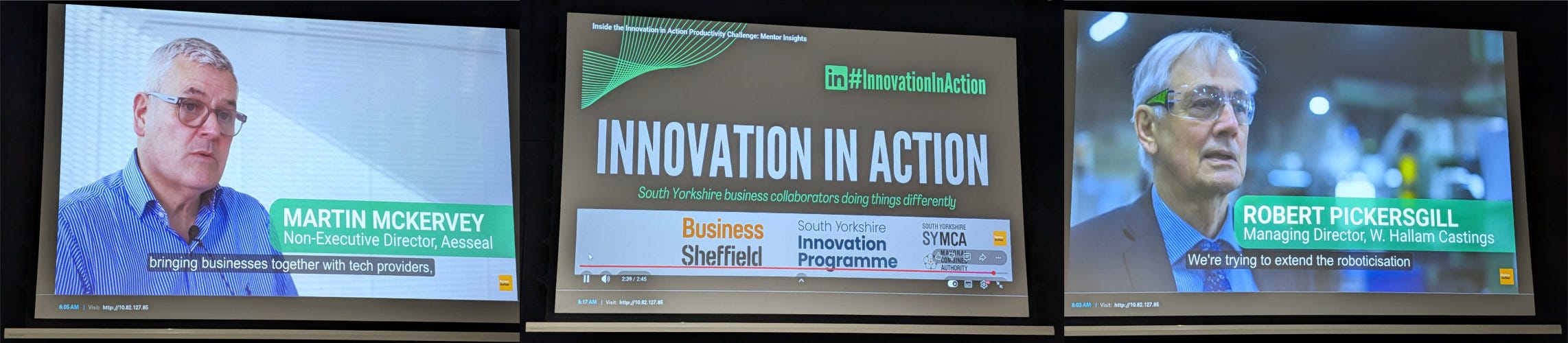
Martin McKervey, speaking about the mentor side of Innovation In Action, put his finger on something that goes far beyond manufacturing. He said that for many SMEs, running a business is a pretty lonely place. Some are led by one person. Some by a family. Some by two or three people carrying far more than most people realise.
The programme found that bringing in an external voice, someone who listens, constructively challenges and gives the business owner space to step back, has been transformational.
That’s not soft. It’s not fluffy. It is hard commercial reality with a human face.
Lonely leaders make decisions under pressure. Isolated organisations repeat mistakes. Disconnected businesses miss opportunities. And when everyone is trying to work it out alone, the whole region pays the price.
Peer support matters because it reduces the cost of learning, especially the painful sort.
It means someone can say, “We tried that supplier.”
Or, “Don’t buy that before you’ve tested this.”
Or, “You’re not the only one struggling with that.”
Or sometimes, simply, “I know someone you should talk to.”
There is so much civic and economic value in that sentence.
I know someone you should talk to.
That is how a city begins to think better.
It also raises a serious question about the future of work, especially as AI and automation become more powerful.
We are entering a time when “human-heavy” organisations will face a fork in the road.
On one path, people are treated mainly as costs. AI becomes a way to reduce headcount, squeeze wages, increase monitoring, and push more profit to fewer people. In that world, human beings become a target for redundancy in a sprint for lower costs.
That path may look efficient for a while.
But there is a danger in cutting people out of an organisation before we’ve understood what they actually know.
Sometimes the intelligence of an organisation is not in the formal system. It’s in the workaround. The habit. The relationship. The judgement of the person who has done the job 4,000 times. The quiet skill that keeps the place running even when the process map says something completely different.
Cut too quickly, and a business can make the spreadsheet look better while making itself weaker.
There is another path.
Human potential unleashed.
A kind, compassionate and creative community of communities, where technology helps people learn faster, see more clearly, document what matters, share knowledge, reduce waste, improve safety, and give more people the confidence to contribute.
That is not sentimental.
It is strategic.
Made Smarter’s current skills programmes are explicitly aimed at helping manufacturing SMEs build leadership capability as technologies such as AI become central to productivity and growth. South Yorkshire MCA’s recent update explains that the Digital Leaders and Digital Champions programmes support both senior decision-makers and operational leads, and that they are delivered by Sheffield Hallam experts across business, technology and engineering.
The same update includes a line from Vincent Traynor at Sheffield Hallam that gets to the heart of this. The programmes may focus on AI, robotics and digital technology, but their real impact is on people, helping leaders at every level learn from others and build the confidence to lead change successfully.
That feels very Sheffield to me.
Practical. Skilled. Human. No nonsense.
It also points towards the challenge facing our wider society.
At the moment, it feels like we are living with a configuration that is not fit for purpose. Too much knowledge is trapped in silos. Business over here. Education over there. Public institutions somewhere else. Communities doing extraordinary things in the gaps, often with too little support and too little recognition.
The result is not just inefficiency.
It is disconnection.
And disconnection makes us weaker.
A city thinks better when more of its people are connected to the question.
That is why the final presentation from Jennifer Smith Maguire, Executive Dean for Sheffield Hallam’s College of Business, Technology and Engineering, landed so strongly for me.
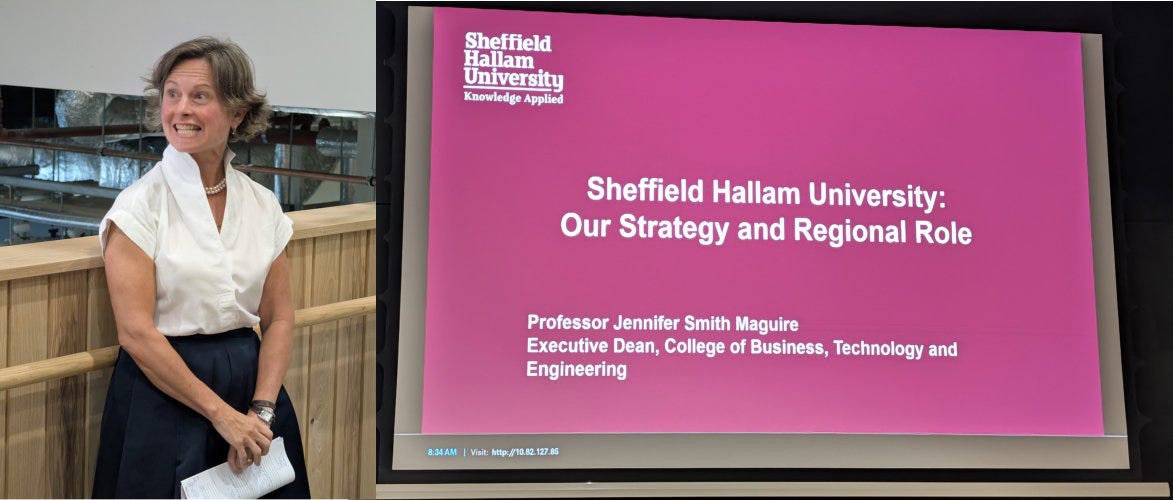
She spoke about Hallam as a university of purpose, people and place, not as an ivory tower, but as an institution trying to work with industry, partners and the region on real-world challenges.
Large institutions can sometimes be treated as dinosaurs, and sometimes, if we’re honest, they can move as if their bodies are powerful but their nervous systems are still catching up.
But I don’t think that’s the most useful way to see Hallam.
There is great hope in what Sheffield Hallam says about itself. Its mission is simple, “we transform lives.” Its stated values include collaboration, ambition, inclusion, innovation and integrity. Those are not small words.
The test, of course, is not whether they look good on a website. The test is whether ordinary people, small businesses, community groups, students, staff and partners can feel them in real life.
And that is where I think the future begins to open.
Sheffield Hallam is not short of resources, talent or stated purpose. The question is how those strengths connect with the living intelligence of the city.
How does a small manufacturer find the right academic support before making the wrong investment?
How does a student with digital skill find a business that needs exactly what they can offer?
How does a local community group share what it has learned about trust, belonging and practical action with institutions that are trying to understand civic life from the outside?
How does a business leader who feels alone find a peer community before the pressure becomes too heavy?
How does Sheffield stop treating human knowledge as scattered noise and start seeing it as civic intelligence?
These are not questions for Hallam alone.
They are questions for all of us.
A thriving city needs big institutions. It needs serious businesses. It needs skilled workers, good public services, civic leadership, neighbourhood groups, artists, volunteers, students, campaigners, carers and people who quietly make things work without asking for applause.
But having all those pieces is not enough.
The real work is connection.
This is where Seven Hills becomes significant.
Not as another institution telling Sheffield what it needs.
Not as a replacement for democratic engagement, councils, community groups, business networks or universities.
Seven Hills is being designed to help Sheffield notice what it already knows.
It is a way of making it easier for neighbours to connect, learn from one another, organise around what matters, and contribute through the right civic and community channels. It is about helping the gifts, concerns, ideas and local knowledge of Sheffielders become more visible to one another, while always respecting people’s agency.
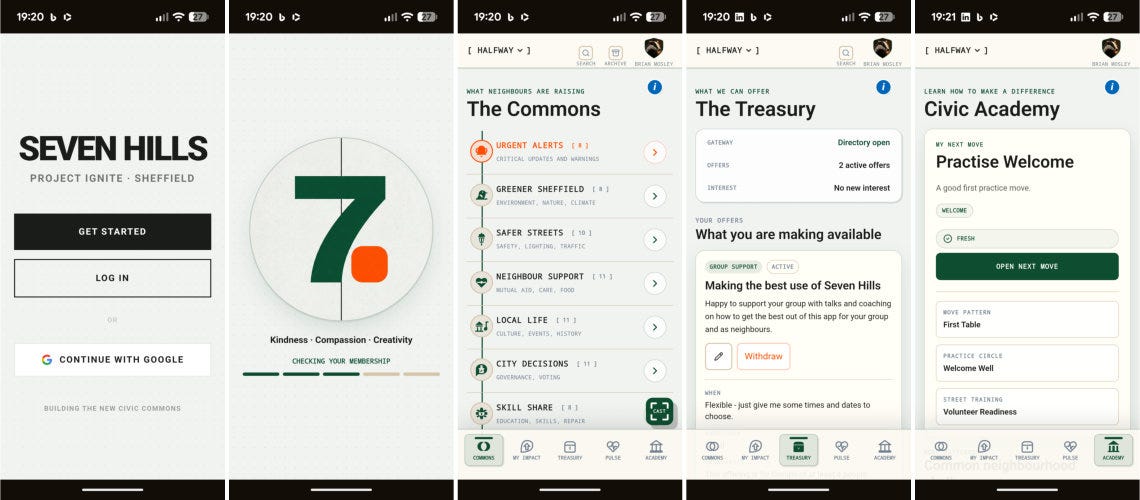
At its best, Seven Hills can become part of the connective tissue between residents, communities, businesses, educational institutions and civic life.
Imagine if educational institutions could see more clearly what people across Sheffield are trying to learn, build, repair, understand and contribute.
Imagine if businesses could find not just customers or workers, but local knowledge, goodwill, practical skill and peer support.
Imagine if communities could be recognised not as “hard to reach”, that stupid phrase, but as full of people already reaching for one another.
Imagine if the question changed from, “How do we get people to engage with our system?” to, “How do we make it easier for people to connect with each other, share what they know, and act on what matters?”
That is a very different city.
And it is a very different region.
I left the breakfast encouraged.
Not because everything is fixed. It clearly isn’t. Our businesses are under pressure. Our public institutions are stretched. Our communities are tired. AI is accelerating. The temptation to cut people out in the name of lower costs will be very real.
But I was encouraged because I could see the ingredients of a better future already in the room.
Manufacturers willing to learn.
Mentors willing to give back.
Students being brought into real business challenges.
A university with the stated mission and resources to serve its place.
Programmes like Made Smarter and Innovation In Action helping businesses step back, see differently, test safely and learn together.
And underneath all of it, a simple truth.
Sheffield does not lack intelligence, kindness, skill or ambition.
We lack enough ways for them to find each other.
That is why connection matters.
Not as a nice extra. Not as a warm feeling after the serious work has been done.
Connection is the serious work.
It is how we improve our situational awareness as businesses, communities and institutions. It is how we discover the unknown unknowns before they trip us up. It is how we make better decisions, spot risks earlier, see opportunities sooner, and remember that no single person, organisation or system can hold the whole picture.
So perhaps the invitation from this breakfast is simple.
If you run a business, don’t try to carry it all alone.
If you know a business owner, ask who they have around them.
If you work in an institution, ask whether the people you serve can genuinely find the front door.
If you’re part of a community, don’t underestimate what you know.
And if you care about Sheffield, help connect one person, one group, one business, or one neighbour who should not have to work it out alone.
Because the intelligence is already in the room.
Our task now is to connect it.
With hope and determination,
Brian Mosley
Founder, Love Sheffield and Project Ignite
Creator of Seven Hills
Author of The Connected Enterprise
Comments
Nothing yet. Say the first thing.
Sign in to join the conversation.