
“What would our children or grandchildren want us to have decided today?”
— Richard Threlfall, launch of the South Yorkshire Strategic Infrastructure Inquiry
Over the last year, I’ve been trying to understand Sheffield’s civic leadership spaces more deeply.
Not from a distance, and not as a critic stood at the edge of the room, but by showing up, listening, learning, and gradually recognising the people who are carrying real responsibility for the future of our city and region.
Something has started to shift.
At the launch of the South Yorkshire Strategic Infrastructure Inquiry, I was warmly welcomed by Martin McKervey, someone I’ve grown to trust and admire for our shared values and his deep commitment to our city. I noticed familiar faces too, including Pam Daniel, Dave Hembrough and Terry Murphy. I had a good conversation with Mark Powell, whose work through Yes2Ventures connects strongly with the kind of future I believe Sheffield is ready to build. Before the event began, I was also able to meet and speak properly with Richard Threlfall.
That may sound like a small thing, but it mattered to me.
It gave me a quiet confidence that I belonged in the room. Not because I was there with a formal title, a large institution behind me, or a shiny badge that made me look more important than I am, but because the work we are doing through Love Sheffield, Project Ignite and Seven Hills is circling the same question from another direction.
How do we help South Yorkshire shape a future that is not simply done to people, but built with them?
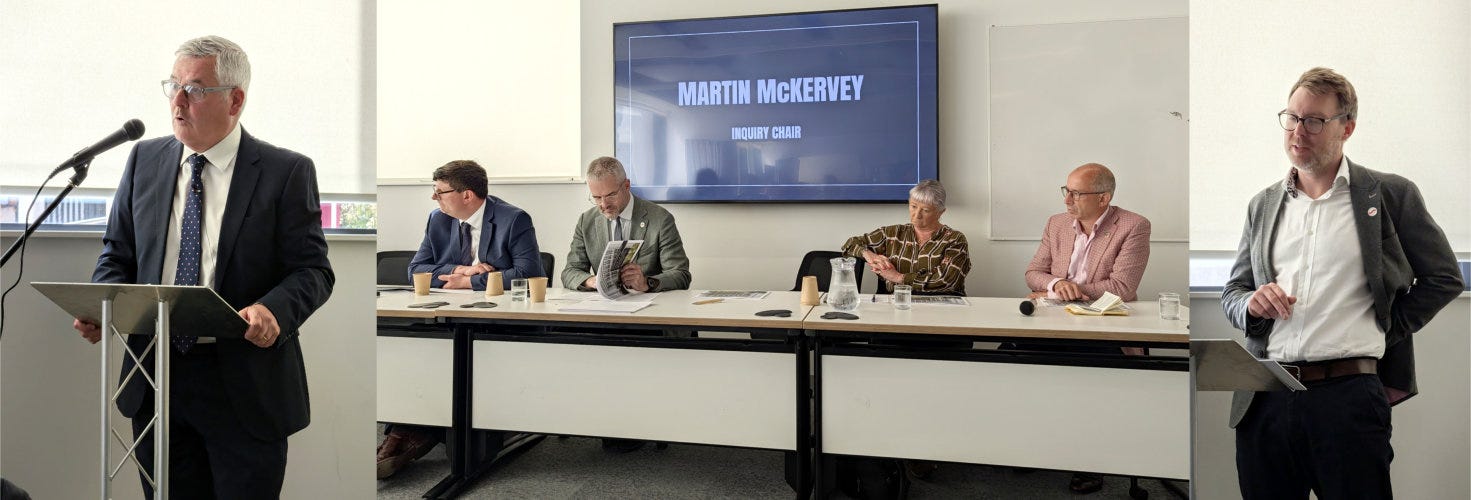
The Inquiry began with the closure of Doncaster Sheffield Airport, but it quickly became clear that this was about something much bigger than one airport.
It was about what happens when something that matters to a whole place is owned or controlled by a private company. An airport, a transport link, a power supply, a major site for jobs and investment. The owner may be making a decision that makes sense on a balance sheet, but the consequences do not stay neatly inside the business. They spread into people’s lives, into local jobs, into the confidence of a region, and into the choices families and businesses make about the future.
That is the heart of the matter.
Some things are too important to a place to be treated as just another private decision.
That does not mean business is the enemy. Far from it. South Yorkshire needs private investment. We need companies willing to take risks, create jobs, build things, train people, back ideas, and stay with this region for the long term. A good business can be a source of pride, skill, confidence and belonging. Anyone from Sheffield’s industrial story knows that.
But a company has its own responsibilities. A chief executive has to think about costs, customers, staff, investors, shareholders, risk and long-term value. Good companies will also be guided by their values, and many are sincere about their commitment to place. But they are not elected to represent everyone who will be affected by their decisions.
Politicians carry a different responsibility. They rely on support from the electorate. They are expected to speak for the people who live and work here, make difficult choices, and somehow hold together the hopes, frustrations and needs of thousands of people who may not agree with each other about very much at all.
That relationship feels increasingly fragile.
Not because people do not care. I think people care deeply. They care about their families, their streets, their jobs, their parks, their buses, their schools, their safety, their bills, their children’s future, and whether their neighbourhood still feels like somewhere they belong.
The problem is that our ways of hearing that care are badly damaged.
A few loud voices online can sound like the whole city. A public meeting can miss the people most affected. A consultation form can make a human life feel like a tick box. Local journalism, which once helped a city have a shared conversation with itself, is not what it was. Social media gives everyone a microphone, but not always a way to listen.
So we end up with a strange and dangerous gap.
People care, but their care is scattered.
Politicians need to hear from people, but the signals are distorted.
Companies need to understand the communities they affect, but community impact can appear soft, vague or too difficult to measure.
And communities are too often asked to respond only when a decision is already halfway down the road.
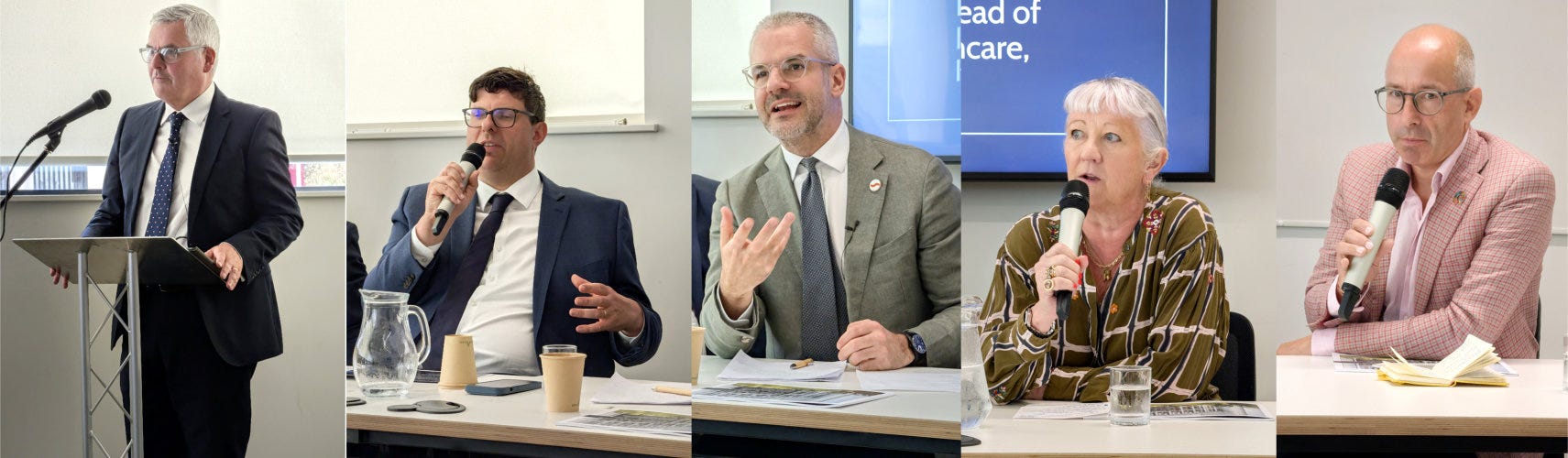
That is why my question to South Yorkshire’s Mayor Oliver Coppard mattered so much to me.
We had been talking about physical infrastructure. Airports, transport, investment, assets, planning, regulation, ownership. All important. All serious. All very real.
But I wanted to ask about the infrastructure we cannot see quite so easily.
The relationships. The trust. The local knowledge. The community groups. The small businesses. The faith communities. The volunteers. The conversations on doorsteps. The youth workers. The neighbours who notice when someone has gone quiet. The people who give their time because they love where they live.
So I asked what attention we are giving to the social infrastructure that allows communities, institutions and businesses to work together. If regional resilience depends on both physical and social infrastructure, how do we invest in both?
Oliver’s reply was striking.
He spoke about the decline of the civic square, the loss of shared local conversation, and the difficulty of making tough decisions when public debate can be pulled apart by distorted online spaces. He recognised that this is under-discussed, even though it affects the ability of local leaders to make decisions that matter.
That phrase stayed with me.
The civic square.
Because a city needs places where it can talk to itself. Not just shout. Not just perform. Not just react. Talk. Listen. Learn. Disagree well. Share knowledge. Build enough trust to make decisions before crisis forces our hand.
Without that, even the best infrastructure plan is working on weak ground.
The Inquiry report makes sensible and serious recommendations. It looks at whether public bodies need better powers when a major asset is at risk. It asks whether planning rules should better reflect resilience, community impact and the loss of major infrastructure. It calls for clearer thinking about regional aviation and long-term connectivity.
Put simply, it asks how we stop important things slipping away before anyone local has the tools to act.
That matters.
But legal powers alone will not be enough.
A law can create a right to intervene. A strategy can identify an asset. A mayor can make the case for devolution. A company can commit to partnership. A report can recommend better rules.
But trust is what helps a place know what it values before the emergency arrives.
Trust is what helps people believe the process is real.
Trust is what helps businesses understand that community engagement is not a nuisance, but a source of better decisions.
Trust is what helps politicians act with confidence, not just react to whoever is angriest that week.
And trust is built slowly, through real connection.
This is where I keep coming back to the future we are building with Seven Hills.
Seven Hills is not being created to represent communities. That is important. It is not there to replace councillors, community organisations, voluntary groups, faith leaders, trade unions, local media, campaigners, or the many people already doing serious work on the ground.
Seven Hills is being built to help neighbours connect, learn, organise and contribute.
It is a way of helping people find others nearby who care about similar things, so that concern can become action. Safer streets. Greener places. Neighbour support. Youth opportunity. Local skills. Better information. Small circles of people doing useful things together.
Not likes on a screen.
Not outrage followed by exhaustion.
Not another comment thread where everyone leaves slightly worse than when they arrived.
Something more grounded.
Pixels on a screen to boots on the ground.
That matters because care becomes useful to decision-makers when it is visible, connected and grounded in action.
Imagine if public leaders could see not only what people were angry about, but where people were already helping.
Imagine if companies planning major projects could understand the real human map of a place, the local groups, small businesses, skills, fears, hopes and quiet strengths that never appear in a standard spreadsheet.
Imagine if Sheffielders could take part in shaping their city without needing to become experts in planning law, transport strategy or economic development. Though you can be sure there are those experts in every part of Sheffield.
Most people do not want another committee.
They want to know where their care can go.
This is especially important because our environment will shape our lives for decades to come.
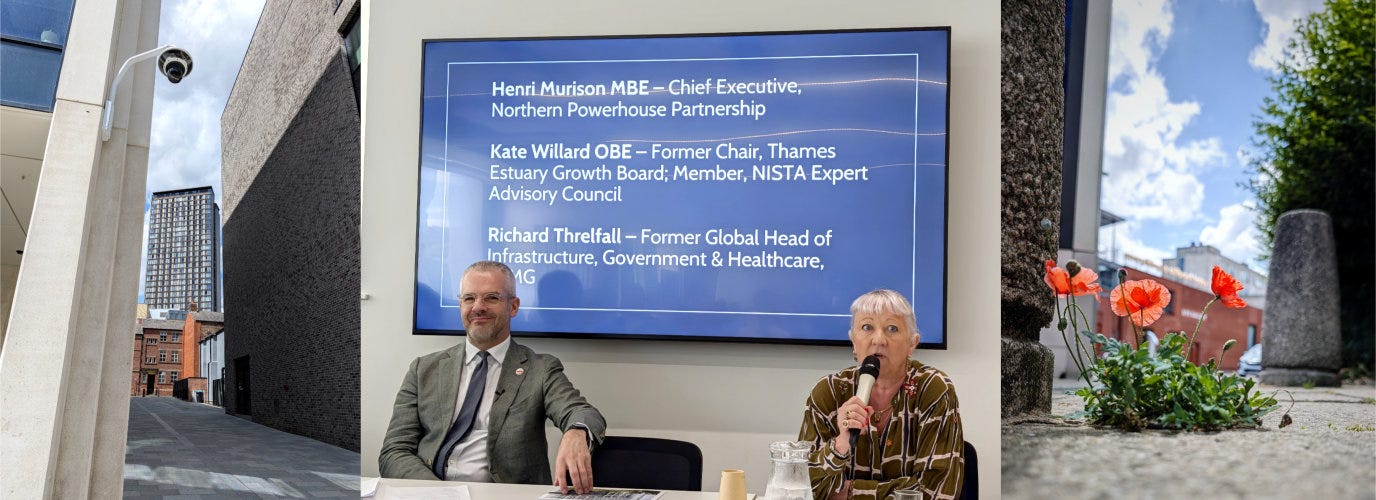
The places we build, protect or lose will affect how we move around, where our children work, how businesses grow, whether older people stay connected, whether young people see a future here, and whether our neighbourhoods feel like places of possibility or places of neglect.
Sheffield is not one neat block of public opinion.
It is a community of communities.
Wadsley is not Darnall. Manor is not Crookes. Stocksbridge is not Nether Edge. Burngreave is not Totley. Each place has its own history, strengths, pressures, relationships and hopes. That is not a problem to be managed. It is a strength to be understood.
But we need better ways to understand it.
We need to hear from the engineer and the road sweeper. The nurse and the café owner. The student and the grandparent. The charity founder and the apprentice. The person running a small workshop. The person keeping a community centre alive. The person who never goes to civic events but knows exactly which alley feels unsafe, which bus route fails people, which green space holds a neighbourhood together, and which young people are quietly losing faith.
That kind of knowledge matters.
It may not always arrive in polished language. It may not come with a graph. It may not be wearing a lanyard. But it is real.
And if we are serious about building a stronger South Yorkshire, we need to take it seriously.
One of the most important points made during the panel came from Kate Willard OBE. She said we do not engage with people simply so they feel involved. We engage because people outside the room often have very good ideas.
That is exactly right.
Good engagement is not a kindness added at the end. It is part of making better decisions.
Richard Threlfall added another question that made a real impact: what would our children and grandchildren want us to have decided today?
That question cuts through a lot of noise.
Would they want us to leave everything to short-term pressure, loud argument and late-stage consultation?
Would they want us to protect only what is already profitable?
Would they want us to build infrastructure without understanding how people actually live?
Or would they want us to become wiser ancestors?
People who saw the warning signs early. People who built trust before the crisis. People who understood that a city is not just roads, buildings, pipes, wires, airports and investment sites. A city is people, relationships, memory, work, care, hope and shared responsibility.
South Yorkshire knows what happens when big decisions are made too far away from the people whose lives they shape.
We carry that history.
But I do not believe our future has to be trapped by it.
The answer is not bitterness. The answer is not waiting for someone else to fix everything. The answer is not pretending that every problem can be solved by a new app, a new policy, a new slogan or one more meeting with the great and the good.
The answer is to rebuild our civic strength.
To connect people before they are isolated.
To listen before trust is broken.
To act before the damage is done.
To make it easier for Sheffielders to find each other, contribute what they can, and help shape the places they love.
That is the infrastructure of trust.
It is not as visible as an airport runway, a railway line or a reservoir wall.
But without it, everything else becomes harder to build, harder to protect and harder to believe in.
As I left the launch, I felt grateful.
Grateful for Martin’s leadership and the seriousness of the Inquiry. Grateful for Oliver’s response and his recognition that the civic square needs attention. Grateful for conversations with people like Mark Powell and Richard Threlfall, who are asking big questions about investment, responsibility and the future. Grateful, too, that after a year of learning these civic spaces, I no longer felt like I was peering through the window.
I felt part of the conversation.
And more than that, I felt clearer about the work ahead.
Seven Hills is one part of that work. Love Sheffield is one part of that work. Project Ignite is one part of that work. But the real work belongs to all of us.
If you know someone who is already helping their street, their neighbourhood or their community to become more connected, I’d love to hear about them.
If you are part of a group quietly making Sheffield kinder, safer, greener, more creative or more hopeful, please tell me.
These are the people and stories Seven Hills is being built to connect.
Because the future of South Yorkshire will not only be shaped by the infrastructure we protect.
It will be shaped by the trust we build together.
With hope and determination,
Brian Mosley
Founder, Love Sheffield and Project Ignite
Creator of Seven Hills
Author of The Action on Poverty Trilogy
Comments
Nothing yet. Say the first thing.
Sign in to join the conversation.