
E. M. Forster’s famous words from Howards End, “Only connect,” felt especially fitting last night in Cutlers’ Hall. It is a romantic, literary and historical line, but in that room, surrounded by Sheffield’s industrial memory, it also felt deeply practical.
I used those two words as I stood to introduce myself at Cutlers Connect. I’ve always loved the phrase, but not because it sounds warm and agreeable. For me, it carries a kind of operational truth.
Connection is not just a nice human feeling. It is how knowledge moves. It is how trust grows. It is how a good idea finds the person who can use it. It is how a system learns before it fails.
And that matters more than ever as we think seriously about the role of artificial intelligence in Sheffield’s manufacturing future.
I was there as a business guest, but also as a very genuine supporter and promoter of the Company of Cutlers in Hallamshire, and of manufacturing across this region. My connection with the Cutlers began early last year when my friend through Love Sheffield, Kevin Parkin, invited me to speak at a First Tuesday Breakfast. What struck me then, and struck me again last night, was that the Cutlers are not simply preserving Sheffield’s industrial story.
At their best, they are helping carry it forward.
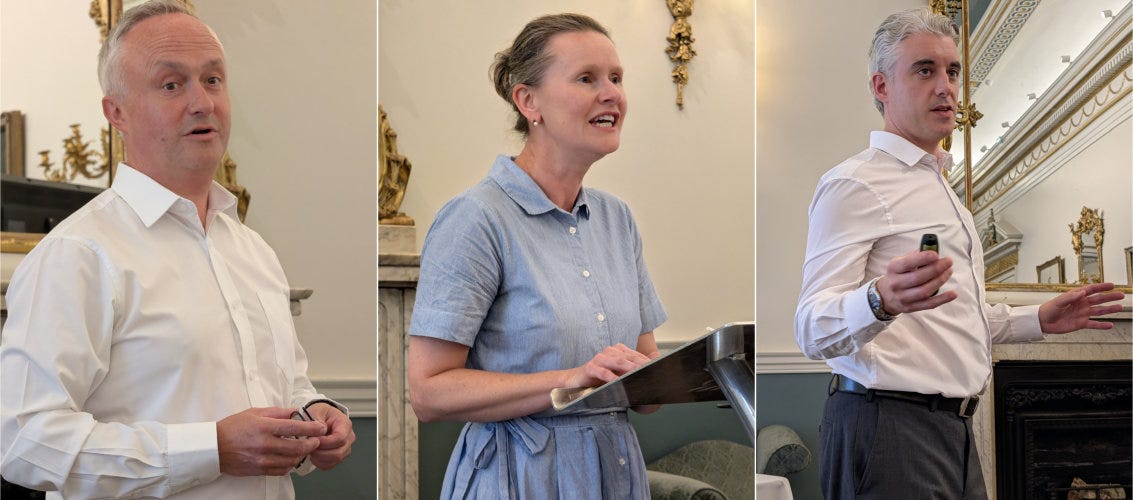
That thought stayed with me throughout the evening because the next speaker, Emma, spoke beautifully about heritage. She spoke about archives, collections, objects, documents, stories, digitisation, database issues, and the living fabric of the building itself.
That may sound like a charming warm-up before the serious business of AI and advanced manufacturing. But I think it was much more than that.
In fact, I think it may have been the key to the whole evening.
Before the machine learns, the organisation must remember.
Every organisation has an archive, whether it knows it or not. It might be a formal archive of documents, objects and records. It might be the memory held in a senior engineer’s head. It might be the quiet knowledge of the person who knows why machine three sounds wrong on a damp Tuesday morning. It might be the old design decision no-one can quite trace, the customer exception that was never written down, or the workaround everyone uses but nobody has dared to put in the official process.
This is not dead information. It is living knowledge.
And if we are serious about using AI well, we need to start taking much better care of it.
My own professional background is systems engineering. I spent more than 30 years working with telemetry, SCADA, automation and control systems across water utilities, flood control and food production. That teaches you a few things.
Systems don’t fail in neat ways. They fail in messy, real, operational ways.
Sensors drift. Data is incomplete. Specifications are optimistic. Nobody has quite described the real problem. And somewhere, at 2am, a system still has to work with no-one to press a reset button.
So when I hear people talk about AI, I don’t immediately imagine a shiny future where everything becomes effortless and intelligent. Nice sales pitch. Also, possibly written by someone who has never had to get a real system working at 2am with dozens of operators stood around tapping their feet.
I think about context. I think about trust. I think about the quality of the information going into the system. I think about the people who know the work, the people who feel the consequences, and the people who must decide what good actually looks like.
That is why Chris Dungey’s talk was so important.
Chris is Chief Technology Officer at the High Value Manufacturing Catapult and the Government’s AI Champion for Advanced Manufacturing. His report, AI Adoption Plan: Advanced Manufacturing, is not about distant science fiction. It is about the practical challenge of moving industrial AI from pilot projects into real manufacturing environments.
And the report is clear: the UK has world-class strengths in manufacturing, engineering and artificial intelligence, but adoption is still uneven and slow, especially in operational technology. It also reminds us that manufacturing is not the same as dropping a chatbot into an office workflow. Industrial AI has to work in real factories, beside real machines, with real people, live processes, safety demands, legacy systems, fragmented data and consequences that matter.
In other words, it has to work in the real world.
That is why I came away thinking there are two connected AI opportunities for manufacturing.
The first is the one most people probably imagine: AI embedded into advanced manufacturing processes. Predictive maintenance. Quality inspection. Supply chain optimisation. Production systems that respond faster and more intelligently. Digital twins. Robotics. Energy optimisation. All of that matters, and Chris set out the national importance of moving from experimentation to trusted deployment.
But I think there is a second opportunity that may be more immediate, more accessible and perhaps even more human.
Before AI changes the machinery of manufacturing, its most immediate value may be in enhancing the capability of the people around it, helping engineers, managers and operators reason better, document better, learn faster and act with clearer intent.
That is the opportunity I find most immediate, most strategic and most exciting.
A design engineer can use AI to explore options, compare materials, test assumptions, interrogate trade-offs and prepare clearer design rationale.
A manager can use AI to make sense of scattered information, prepare better questions, draft more useful briefings, clarify risks and think through possible consequences before making decisions.
An operator can use AI to access years of maintenance wisdom, process notes, fault histories and practical guidance, provided that knowledge has been captured and organised well enough to be useful.
A small manufacturer can begin to use AI without waiting for a huge transformation programme, simply by improving how it documents, shares and reasons from what it already knows.
This is where I think we need to move beyond prompting, useful though it can be, and talk more about context engineering.
The skill is not just asking AI a clever question. The skill is giving it the right information to work with.
What are we trying to achieve? What are the constraints? What standards apply? What is the risk? Who will use the answer? What data can we trust? What previous decisions matter? What does experience tell us? What values should guide the outcome?
This is not just technical. It is deeply human.
AI can process language, organise information and suggest patterns at extraordinary speed. But it doesn’t know what matters unless we help it understand the context. It doesn’t carry our intent. It doesn’t know our responsibilities. It doesn’t feel pride in a good job, concern for a colleague, or the gut feeling that tells an experienced engineer something isn’t right.
That is still ours.
In my book The Human Edge, I wrote about the uneasy feeling many people experience when AI begins to perform tasks they once thought belonged safely to human judgement. It is not just fear of job loss. It is the deeper question of meaning. If a machine can draft, analyse, compare, predict and advise, what remains uniquely human?
Last night reminded me that the answer is not to compete with AI on speed, volume or memory.
The answer is to become clearer about our intent.
AI does not replace human intent. It magnifies it.
If our intent is narrow, it may help us optimise the wrong thing faster. If our culture is extractive, it may make extraction more efficient. If our documentation is poor, it may help us produce confident nonsense with impressive formatting. Bad news.
But if our intent is rooted in contribution, care, quality, learning and shared purpose, AI can become something very different.
It can help people see more clearly.
It can help organisations remember what they know.
It can help younger workers access hard-won experience more quickly.
It can help leaders ask better questions before they commit to costly decisions.
It can help businesses turn hidden knowledge into shared capability.
This is why documentation suddenly matters in a new way.
For years, documentation has too often been treated as the thing we do after the real work, usually when someone important asks for it, or when a poor soul is trapped in a compliance process with a spreadsheet and a fading will to live.
But in the age of AI, documentation becomes a pair of work overalls with a life jacket sewn in.
Good documentation is not bureaucracy. It is memory with handles. It is the means by which people, teams and now intelligent tools can reason from a shared understanding of reality. And AI makes it easier than ever to collect and maintain at scale as you work.
That includes process notes, design rationale, maintenance histories, customer requirements, meeting decisions, risk logs, lessons learned, supplier knowledge, training materials and the small pieces of practical wisdom that usually sit in the gaps between formal systems.
The heritage discussion at Cutlers’ Hall illustrated this perfectly. Emma was not simply talking about old things. She was talking about access, meaning, preservation, usefulness and shared memory. She was asking what should be retained, how it should be organised, who might want to learn from it, and how it could help people understand the living story of the place.
Every manufacturing organisation now needs to ask similar questions.
What do we know?
Where is it held?
Who understands it?
What has never been written down?
What have we learned the hard way?
What would a new starter need to understand in week one, month one and year one?
What knowledge is at risk of disappearing when someone retires?
And what could become possible if that knowledge became easier for everyone to access and use?
In The Connected Enterprise, I explored the idea that an organisation is not a machine of productivity, but a living system of purpose, people and shared intelligence. That feels even more important now. AI will not make disconnected organisations wise. It may simply make their disconnection faster.
Real intelligence in an organisation does not sit in one system, one leader, one expert or one dashboard. It lives in the connections between people. It lives in the conversations where someone feels safe enough to say, “I don’t think that will work.” It lives in the confidence of an apprentice asking a question. It lives in the judgement of an experienced operator. It lives in the trust between design, production, leadership, customers and community.
Connection is not a soft value. It is how collective intelligence becomes possible.
That is why I believe Sheffield has something distinctive to offer.
We are not China. We are not America. We are not going to win by pretending we can out-scale the biggest players in the world. But perhaps we can be more agile. More connected. More human. More rooted. More willing to bring old wisdom and young imagination into the same room.
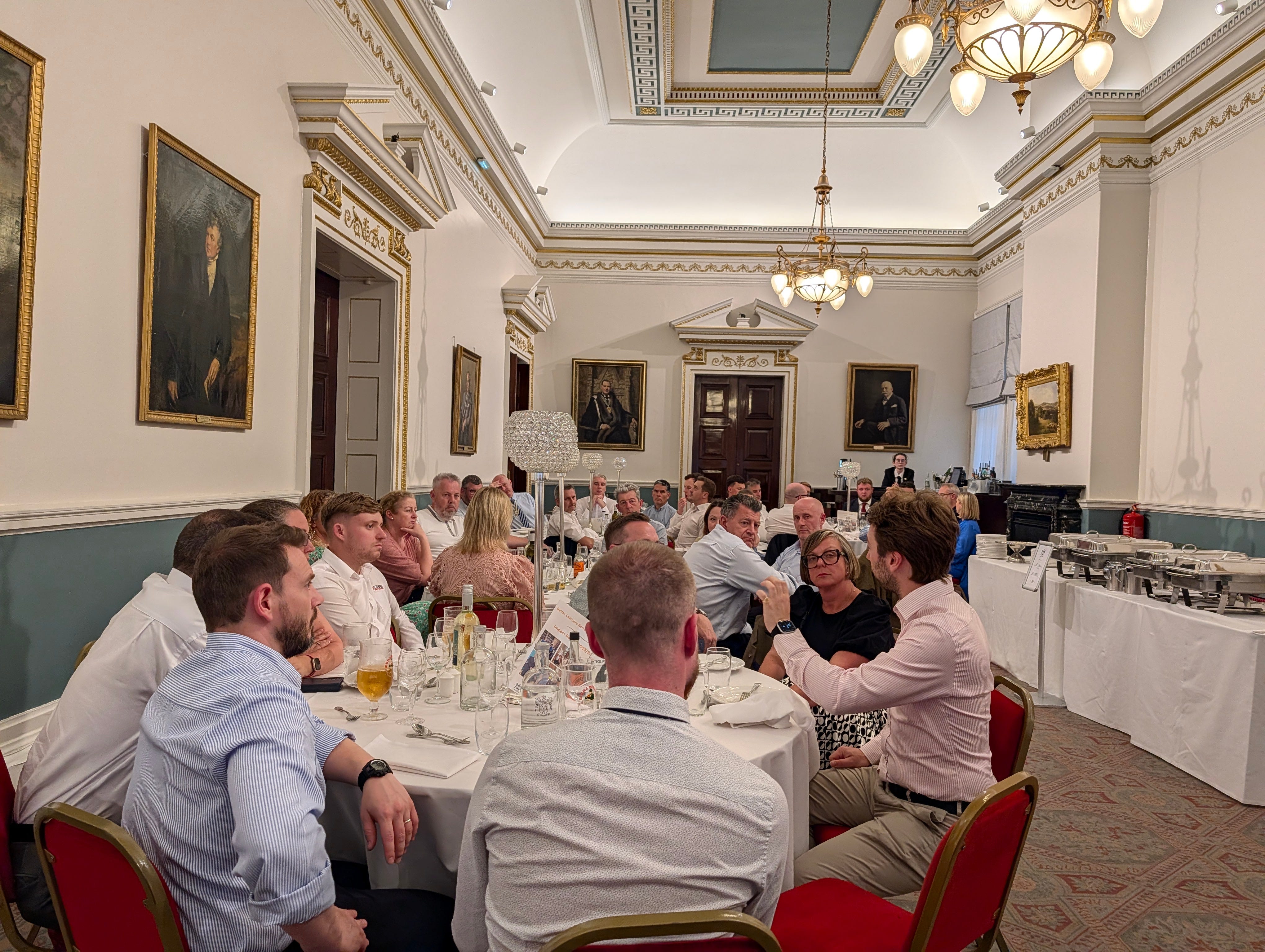
At dinner, I found myself describing China as a fleet of Boeing 747s heading towards the future. The UK, and especially regions like ours, may need to be more like a fleet of Spitfires: smaller, quicker, more responsive, and deeply dependent on the skill, courage and judgement of the people involved.
Perhaps that is Sheffield’s opportunity.
Not automated manufacturing in the cold sense.
Human-inspired manufacturing.
Manufacturing where AI doesn’t replace human brilliance, but helps magnify it.
Manufacturing where experienced workers are not treated as legacy knowledge to be extracted before they leave, but as holders of wisdom to be honoured, organised and passed on.
Manufacturing where younger people are not expected to wait 20 years before they can contribute meaningfully, because better tools and better knowledge design help them learn faster and think more confidently.
Manufacturing where leaders do not chase AI because it sounds impressive, but because they have clarified the future they want to build.
And this brings me back, as it so often does, to our Love Sheffield values: kindness, compassion and creativity.
In ordinary times, those values matter.
In an age of AI, they matter even more.
Kindness asks us to see the person affected by the system.
Compassion asks us to notice who may be frightened, excluded, deskilled or left behind.
Creativity asks us to imagine uses of technology that do more than cut cost, speed output or dress up old processes in new language.
As AI enhances the capability of individuals, each of us becomes more powerful. We can research faster, write faster, compare more options, ask better questions, design new possibilities and reach further than before.
That is a gift.
It is also a responsibility.
Because the more powerful we become, the more important our intent becomes.
This is as true in communities as it is in companies. Seven Hills, the digital commons I’ve been developing for Sheffield, is built from a similar understanding. The aim is not to replace real connection with technology. The aim is to help neighbours, groups, businesses and institutions find one another, understand what people care about, offer what they can, and turn that into practical local action.
In engineering terms, it improves the civic control loop: better signals from communities, better routing of offers and needs, and better feedback on what is actually working.
In human terms, it is simply this: helping people become more connected, more capable and more confident in their own contribution.
That, for me, is the deeper promise of AI.
Not machines replacing people.
Not people becoming passive passengers in systems they no longer understand.
But people using new tools to remember better, reason better, connect better and contribute more fully.
Before the machine learns, the organisation must remember.
Before we bring AI deeper into manufacturing, we must decide what kind of manufacturing we want.
Before we ask what the technology can do, we must ask what we are here to build.
And if Sheffield can answer that question with courage, clarity and heart, I believe our next great contribution to the world may not simply be advanced manufacturing.
It may be human-inspired manufacturing.
A future where intelligence serves wisdom.
Where capability serves contribution.
Where technology serves life.
And where, in Forster’s beautifully simple words, we remember to only connect.
Kind regards,
Brian Mosley
Founder, Love Sheffield and Project Ignite
Creator of Seven Hills
Author of The Human Edge and The Connected Enterprise
Comments
Nothing yet. Say the first thing.
Sign in to join the conversation.