
Dear Scotland,
The smell of seaweed drying on a rocky shore near Dunnet Head is not pleasant in any conventional sense, but it is honest — salt and decay and the sea's refuse, all of it necessary, all of it part of the cycle that keeps the coast alive. Breathe it in. It smells like Scotland's ruthlessness, the part that does not apologise for its climate or its harshness, that simply is.

NEW! THE LOVE SCOTLAND APP IS HERE!
We’ve just launched the Love Scotland app on the App Store — everything you love about Love Scotland, beautifully built for your iPhone. Browse thousands of stories, places, castles and pubs in a clean, fast, made-for-mobile experience!

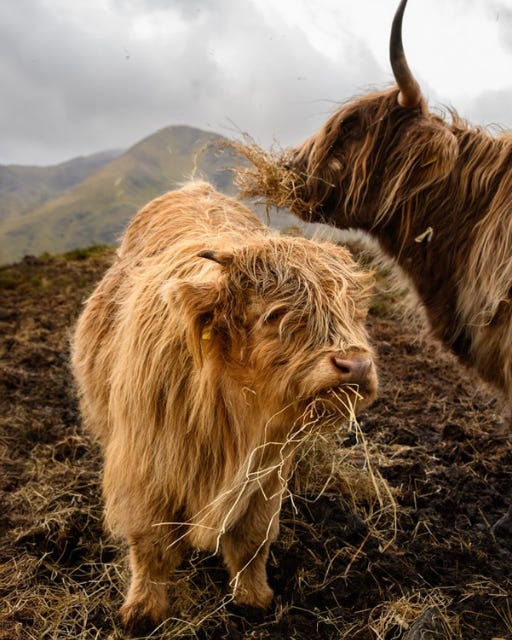
Where to see Scotland's Highland Coos
Planning your trip: Three days in Glasgow (and the coos in Pollok Park)
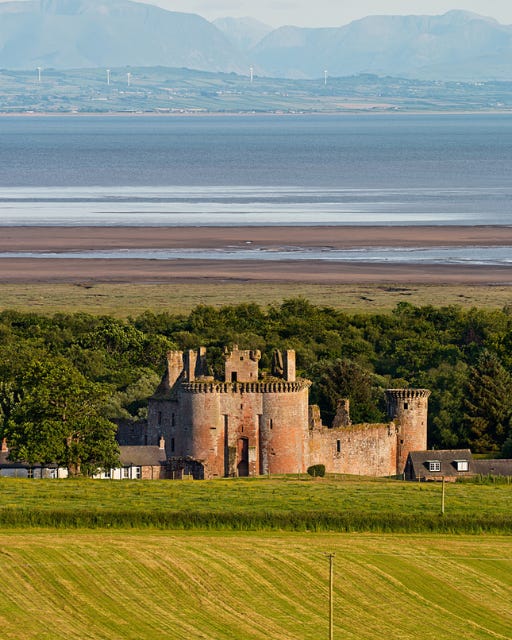
Castles and Heritage: Clan Armstrong and the age of the cattle reivers
Around the Web: Scotland’s best beaches for a late-summer escape + Loch Ness Monster Sightings Set a New Annual Record plus Five Days in Scotland’s Quiet South-West and more…
Experiences Likely To Sell Out
In Case You Missed It: Learn Scottish slang + The hidden vaults beneath Edinburgh
The Love of Whisky: We raise a glass to Dufftown Distillery
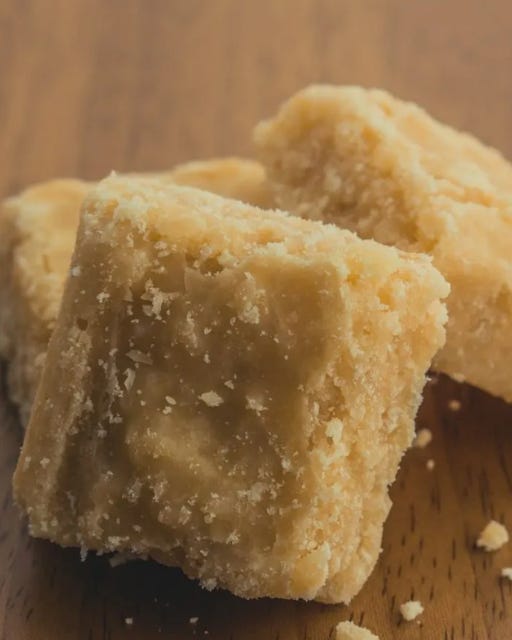
Scottish Food You Will Love: Scottish Tablet anyone?
💙Send a piece of Scotland to someone you love 💙
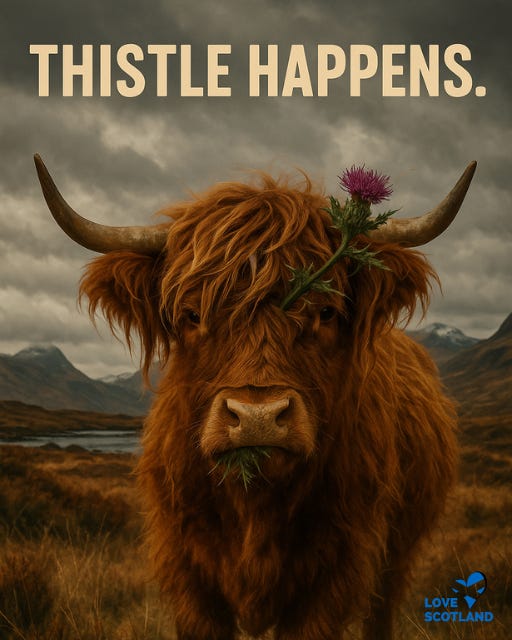
Your daily dose of #CooWisdom + Are Midges in Scotland Really That Bad?
They are, quite simply, Scotland’s most photographed residents — those shaggy, ginger, long-horned coos that stop tourists mid-stride and send phones reaching for their pockets. One of the oldest registered cattle breeds in the world, with a lineage traced back more than a thousand years, the Highland coo has barely changed a whisker in all that time: that famous fringe (the “dossan”) still shields their eyes from driving rain and stinging snow, and that unhurried, gentle temperament still makes them the most photogenic beasts in the country. But where do you actually go to meet one?
Our guide gathers the best places to see them the length of Scotland — from Highland Wildlife Park near Kingussie and the free-roaming fold at Pollok Country Park in the heart of Glasgow, to the working farms of Argyll and the windswept glens where they graze against a backdrop of loch and mountain. Spring visitors are rewarded with the impossibly cute sight of a ginger calf finding its legs.
Have you ever come face to fringe with a Highland coo — and where were you standing when you did? Hit reply and tell us.

You don’t have to disappear into the Highlands to meet a Highland coo — one of the friendliest folds in Scotland grazes right inside Glasgow, in the woodlands and parkland of Pollok Country Park, a short hop from the city centre and the dazzling Burrell Collection. Our three-day Glasgow itinerary threads the city’s Victorian grandeur, its mural-splashed lanes and its warm, wisecracking welcome into an easy long weekend, with the Pollok coos as a gentle green-space breather between the galleries and the buzz of Finnieston. It’s the perfect proof that Scotland’s shaggy icons and its liveliest city belong on the very same trip.
Would you add a coo-spotting stroll to a city break — or save it for the glens?

Long before the Highland coo became a selfie sensation, cattle were the beating heart of Scottish life — currency, wealth and status on four legs. Nowhere was that truer than in wild Liddesdale, homeland of Clan Armstrong, who for two centuries ruled the lawless Borders and built their name (and their notoriety) on the reiving of cattle by moonlight.
Their story is one of raw power, ballads sung around peat fires, and a fierce independence that saw them feared, celebrated and finally scattered across the world — a reminder that Scotland’s love affair with its cattle runs far deeper than a shaggy fringe and a pretty photograph. If Armstrong sits in your family tree, this is where your story begins.
Does your surname carry a clan story you’ve never fully traced?
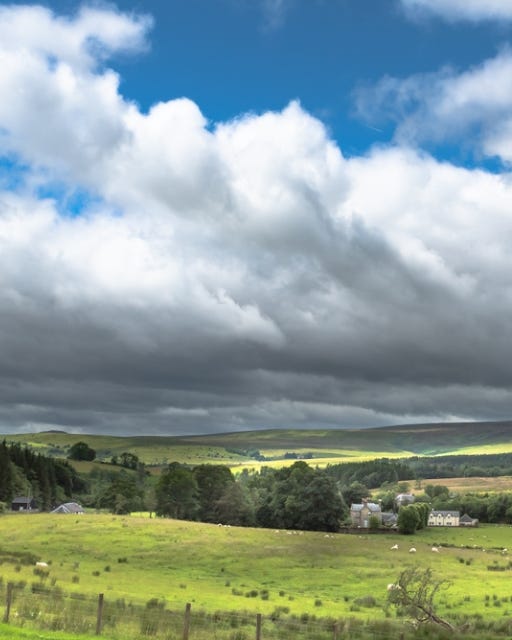
Most people planning a first or second trip to Scotland look north. They think of Skye, the Highlands, and the road to the isles. Dumfries and Galloway sits in the opposite direction — the far south-west corner of the country, along the Solway Firth, closer to the English border than to Inverness. It is one of the least crowded regions in Scotland, and for slow travellers that is exactly the point.
This is a landscape of green hills, quiet estuaries, forgotten abbeys, and small towns where people still know their neighbours. Robert Burns spent his final years here and is buried in Dumfries. The area holds one of the oldest Christian sites in Scotland, a castle shaped like a triangle, and a forest park so free of light pollution that it became the first Dark Sky Park in the United Kingdom. Yet you can visit all of it without the coach tours and long queues you find further north.


VOTE for your Top Places to Visit in Scotland here!
A “coo” is just the start — Scots is a whole language of “dreich” days, “wheesht” and “gallus” grins that’ll have you talking like a local before your flight lands. Read more: Learn Scottish Slang — Real Words, Real Wit
Deep under the South Bridge lies a warren of stone chambers that vanished from memory for a century and a half before being rediscovered — and reopened to visitors. Read more: The Hidden Vaults Beneath Edinburgh That Were Sealed and Forgotten for 150 Years
Today we raise a glass to Dufftown Distillery, at the very heart of the town that calls itself the whisky capital of the world. Founded in 1896, Dufftown is one of seven distilleries in this small Speyside town — giving rise to the old saying that ‘Rome was built on seven hills; Dufftown was built on seven stills.’ Its whisky is sold as The Singleton of Dufftown, a rich, sweet, fruit-forward expression designed for the global market. Visit Dufftown Distillery here!
Scottish Food you will love
👉 Vote for your favourite food here!
If the Highland coo is Scotland’s most beloved animal, tablet might just be its most beloved sweet — and fittingly, it leans on the same rich dairy that Scotland’s cattle country is famous for. Made from little more than sugar, butter and creamy condensed milk, slowly stirred until it turns golden and fragrant with vanilla, tablet sets into a hard, crumbly square that melts into grainy sweetness the moment it hits your tongue.
Every Scottish granny had her own method and swore it was the only right one, and the smell of it bubbling on the cooker is pure childhood for generations of Scots. It’s firmer and more brittle than fudge, sweeter than almost anything else in the tin, and utterly, unmistakably Scottish. Traditionally it appears at Hogmanay, church sales, weddings and ceilidhs — anywhere a wee treat is called for.
Get the recipes here: The Scottish Sweet That Every Granny Made and No Shop Has Ever Matched
Ever wondered how the Highland coo copes with Scotland's most notorious wee beastie — the midge? That double-layered shaggy coat and constantly swishing tail aren't just for good looks; they're a coo's built-in defence against the clouds of midges that rise off the glens on a still summer evening. While the rest of us are slapping on repellent, the coo simply flicks, twitches and carries on chewing — the most unbothered creature in the Highlands.
Read more here: Are Midges in Scotland Really That Bad?
💙Send a piece of Scotland
to someone you love 💙
Beautiful Scottish-themed digital cards for every occasion. Birthdays, blessings, thank-yous, and more — sent with warmth from the Highlands.
Browse the cards here!
This newsletter grows because of you — every time you share it with a friend, a colleague, or that person who keeps saying “I really must go to Scotland one day,” you help build something special: a community of people who genuinely love this wee country. Every subscriber has a unique referral link at the bottom of this email. Share it with your friends.
Comments
Nothing yet. Say the first thing.
Sign in to join the conversation.