
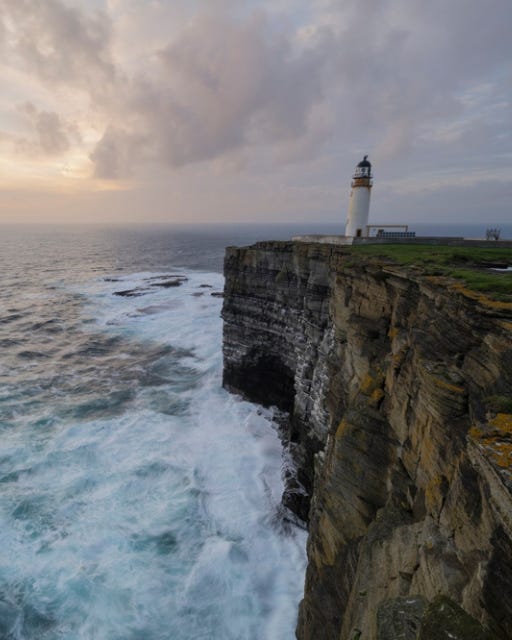
Orkney sits off the north coast of mainland Scotland, a group of around 70 islands where the North Sea meets the Atlantic. It is closer to Norway in feel than to the Highlands, and its history runs deeper than almost anywhere else in Britain. People have farmed this land, buried their dead, and raised great stones here for more than 5,000 years. When you stand in the middle of Orkney, you are standing among some of the oldest surviving human settlements in Europe.
What makes Orkney different is how much of that history is still visible and how close it all sits together. On a single afternoon you can walk through a Stone Age house, trace runes carved by Viking raiders, and look out over the same water where the British fleet once anchored. The islands are green and low, shaped by wind rather than mountains, and the light shifts constantly. Many visitors say the sky feels bigger here than anywhere else they have been.
This is a place made for slow travel. Distances are short, the pace is gentle, and the pleasure comes from lingering rather than rushing between sights. Orkney suits travellers who want to understand a place, not just tick it off a list — walkers, readers, those tracing family roots, and anyone drawn to history, craft, and quiet coastlines. Give it time, and it stays with you.
Orkney’s Ancient Stones, Wild Coastlines and Island Life in Five Days - Let us take you through five of Orkney’s most rewarding places and show you how to link them into a relaxed five-day itinerary. You will learn what to see, when to go, how to get there, and how long to stay. By the end, you will have a clear, practical plan for a trip that balances ancient history with island calm.
Skara Brae
The Ring of Brodgar
Maeshowe
St Magnus Cathedral, Kirkwall
The Italian Chapel, Lamb Holm
A suggested five-day itinerary
When to visit Orkney
How to get there and how long to stay
Comments
Nothing yet. Say the first thing.
Sign in to join the conversation.