
Some of you know me for Hell of a Hat, the newsletter I started in 2021 to promote my book Hell of a Hat: The Rise of ’90s Ska and Swing. This is something different. It’s a love letter to freestyle music, and if you’re not sure what that is, please check out the introductory article I published last year. Also, I’m in a band called Be Decent, and today, we released our debut single, “Human Nature.” Give it a listen!
George Lamond is the people’s champ. Back in the late ’80s and early ’90s, Lamond only released about a half-dozen songs that fit freestyle’s narrow stylistic confines, and of those, he’s primarily known for just three, the all-timers “Bad Of the Heart,” “Look Into My Eyes,” and “Without You.” And yet he’s often mentioned alongside Stevie B—a man who placed 11 singles on the Billboard Hot 100 and even managed to top that chart once—as a contender for the “King of Freestyle” crown. There are many reasons for this.
The singer born George Garcia on February 25, 1967, in the Georgetown section of Washington, D.C., is a good-looking, good-natured performer who projects an air of humility on stage and in interviews. His singing voice is light and airy with ample muscle, and in his prime, he could rock a double-breasted Armani suit and dance as well as anyone in the scene. Respected DJ and podcaster CPR Jose Ortiz, host of CPR’s Clubhouse, refers to Lamond as “the Michael Jackson of freestyle,” and that feels correct.
Lamond has always repped his Puerto Rican roots, and after the dance hits dried up in the ’90s, he segued nicely into salsa, a viable late-career pivot for many freestyle artists. While Lamond admits that he and Stevie B had some beef back in the day, they’re cool now, and George isn’t trying to start trouble with any of his fellow genre survivors. He’s about the best ambassador freestyle could ask for.
DC to PR to BX
One of eight children, Lamond didn’t spend much time in his hometown of D.C. His mother was a cook at one of the embassies, and when George was two, she sent him to Puerto Rico, where he lived on a farm until he was seven. He then moved with his family to The Bronx, New York, which was about to become the epicenter of a new musical genre and corresponding street culture known as hip-hop.
In the early days, before the Sugarhill Gang made it a recorded artform, hip-hop comprised four disciplines: DJing, rapping, breakdancing, and graffiti writing. Lamond was drawn to the latter two. He danced with the New York City Chief Rockers crew and sprayed walls across the city with the tag “Loose.” His art skills were such that he got into the High School of Art and Design in Manhattan. George loved classic Bugs Bunny cartoons and wanted to study animation, but those courses were only available to seniors, so he had to settle for commercial art. He got excellent grades, but the hip-hop lifestyle “ruined” him, as he told CJ the DJ in 2025, and he stopped going to class.
Unbeknownst to many people—including members of his own family—George could also sing. There was a Coke commercial in the late ’70s featuring doo-wop dudes harmonizing on a stoop, and George would croon the jingle in the bathroom, making use of the acoustics. He loved R&B singers like Luther Vandross and Peabo Bryson, and he was a huge fan of the Puerto Rican boy band Menudo, one of the few modern Latino pop acts he could look up to. George actually auditioned for Menudo in Newark in what must have been 1984, because he claims Ricky Martin wound up getting the gig.
As the early ’80s gave way to the middle part of the decade, a new sound initially dubbed “Latin hip-hop” and later termed “freestyle” began to explode out of New York City, The Bronx in particular. The music combined fast, syncopated drum-machine beats with lovesick lyrics, and it was an avenue for young Latinos—who hadn’t yet been accepted as rappers—to find their niche in hip-hop culture. George was a huge fan of Shannon’s seminal hits “Let the Music Play” and “Give Me Tonight,” and one evening, while driving into Manhattan to go clubbing with friends, one of those tunes came on the radio. George told his buddies that someday, he was going to work with whoever produced that song.
A Heartbreak Classic
Somewhere around this time, when he was 19 or 20, George happened to meet songwriter Marilyn Rodriguez, who’d co-authored “No Reason to Cry,” the 1986 breakthrough single for Bronx freestyle star Judy Torres, as well as “I Won’t Stop Loving You,” a 1986 club jam by C-Bank, the recording project launched producer and Arthur Baker associate John Robie in 1982. One of George’s friends was dating Rodriguez, and this pal passed her a tape of George singing a Luther Vandross tune. Rodriguez liked it, and she and George linked up and began making demos. They recorded three songs, only one of which, in George’s estimation, was any good.
The song was “Bad of the Heart,” written by Rodriguez and one Philip Andreula, who’d go on to author a bunch more songs for Lamond before committing himself to video production. George’s original demo of “Bad of the Heart” doesn’t seem to have made its way to the internet, so it’s hard to know what the song sounded like in its earliest form. In a 2024 podcast interview with DJ Dream, George said the production was “shitty.” But the lyrics alone are enough to make this song compelling.
“Bad of the Heart” is one of the more accusatory heartbreak songs in the freestyle canon. It’s sung from the perspective of a man who thought he’d found the love of his life. But this woman played him for a sucker and treated him with nothing but cruelty. Here’s the pre-chorus:
I thought that when you came along
My life would start to change (Ah-ah-ah-ah)
Instead, I saw that I was wrong
My life was rearranged
How I wonder why
You just put my love aside (Ah-ah-ah-ah)
You threw me in the gutter
And you left me there to lie
On the chorus, Lamond’s character is ready to make a diagnosis. His ex wasn’t just the villain in this particular relationship. Her coldness reflects a pattern of behavior. There’s something defective about her, emotionally speaking. He’s basically calling her a sociopath.
Bad of the heart
You never wanted to start
‘Cause you’re just bad of the heart
You never played the game too smart
(Ooh-ooh) ‘Cause you know you’re (Bad)
Although George wasn’t thrilled with the production on the demo, he began sending cassettes to record labels. He’d mail them in super-colorful envelopes, so they’d stand out in a sea of bland manila submissions. The tactic might’ve worked, because the package sent to Ligosa Records—the label started by Mark Liggett and Chris Barbosa, the producers behind Shannon’s “Let the Music Play” and “Give Me Tonight” and a host of other unimpeachable dance classics—actually did reach its intended audience.
Barbosa, a fellow Nuyorican from The Bronx, phoned George and invited him to audition at the Ligosa offices on Park Avenue in Manhattan. But when George arrived, the producer wasn’t there. Dejected, George returned to the Bronx and promptly received a call from Rodriguez. Apparently, Barbosa felt terrible that he missed the appointment, and he wanted to give the aspiring singer a second chance. What’s more, Barbosa was at Rodriguez’s apartment 10 blocks away. George ran over as fast as he could and immediately clocked Barbosa’s fancy car and mobile phone.
“I felt like Babyface was sitting in front of me,” Lamond told DJ Dream.
George sang Luther Vandross’s “So Amazing.” Barbosa liked the youngster’s range and signed him to a one-single deal. The song they recorded, naturally, was “Bad of the Heart,” and in Barbosa and Liggett’s very capable hands, it became a record worthy of its lyrics. The A side of the single, which landed in 1988, leads off with the “Club Mix,” the first of four versions. It’s anchored by 50-megaton drums, record scratching, and layers upon layers of synths.
“Bad of the Heart” is sturdily constructed and musical in a way that most of the day’s freestyle records are not. There’s more than a little Depeche Mode drama baked into the intro, and once George jumps in around 1:37, there’s vocal star power to match the absolutely slamming backing track. And it’s not just George’s voice relaying this tale of woe. Barbosa and Liggett famously used male session singer Jimi Tunnell to handle the hook on “Let the Music Play,” and for “Bad of the Heart,” they enlisted Debbie Cole to harmonize with George and thicken up the chorus. The male-female combo adds another level of intrigue. Is Cole supposed to represent a protective friend of George’s, or perhaps a romantic rival of the treacherous spider-woman the song villainizes?
It’s probably wrongheaded to think about it that deeply. “Bad of the Heart” was engineered for the club, and once George arrived for the session and heard those gigantic drums, he knew the song was a smash. “If it doesn’t hit the dance floor, you’ve got a wack song,” he told CJ the DJ. Statements about club music don’t get any truer than that one, and “Bad of the Heart” wound up selling nearly 100,000 copies—impressive for an unknown artist on an indie label.
“Bad of the Heart” wasn’t actually credited to George. The name on the label is Loose Touch, which derives from George’s old graffiti tag, Loose. Everyone thought Loose Touch was a band—especially since Lamond performed with a pair of backup dancers—but it was not. In any event, George had a next-level live show, and as “Bad of the Heart” took off in the clubs, he had ample opportunities to rock local stages. One night, Columbia Records A&R man David Jurman, the same guy responsible for signing Exposé, happened to catch George at La Mirage in the South Bronx, and he saw the potential for another freestyle-to-pop crossover.
Top of the Charts
Columbia didn’t exactly sign George, though. The label did a production deal with Barbosa and Liggett, and George was part of the package. Still, it was a three-album deal, and to sell their new star to the public, Columbia decided a name change was in order. Loose Touch was out, and so was George Garcia, his birth name, as it didn’t have the right pizazz. And it sounded a little too ethnic for the white label heads hoping to reach a wide audience.
“I didn’t like the fact that the corporation was changing my name,” George told TikTok creator Cheche in 2025. “I didn’t like the fact they were hiding the Latin in me. But I get it.”
It was Columbia’s manager of dance music production, Johnny Coppola, who came up with the name George Lamond. As you may recall from 8th grade language class, “Le monde” is French for “the world,” and the name had a global—and perhaps more importantly, European—flavor. For the first single, released in 1989, Columbia decided against rereleasing “Bad of the Heart,” which had the benefit of being a proven club record, and instead tried “Without You.” It was another Philip Andreula composition, except this time, it wasn’t all about that heavy club rhythm.
“Without You” leads with a sophisticated string riff inspired by something Andreula heard in a telenovela score. Upon listening to a more ballad-like early version of the track at Liggett’s studio in Cincinnati, Lamond told his producers, “This is not freestyle.” To which Liggett and Barbosa replied, “We’ll make it freestyle.” And they did. For all its sleek catchiness—at times, the staccato synths recall New Order’s “Bizarre Love Triangle”—the track retains a rhythmic toughness that goes into overdrive when the pre-chorus begins at 1:04, and the hi-hats turn louder and sharper. It’s the dramatic turning point of the song.
Lamond spends most of “Without You” lamenting the fact that he’s no longer with his special lady. He’s absolutely lost, and he’s not really sure how he’s supposed to live out the rest of his years. So what brought him to this point? He never really tells us, but on the pre-chorus, when those hi-hats get extra frantic, he offers this bit of back-story.
Every night I think as time just passes by
Why I left your love and how it made me cry
Now that I find I don’t know what to do
My life feels so empty, so empty, alone without you
It seems he left her, so there’s an element of guilt mixed into his lonesomeness. George throws himself into the vocal, and even though he’d never experienced heartbreak of that magnitude, he did his best to find himself in the storyline. He recorded with a photo of his then-girlfriend in the booth and pretended like he was serenading her. Barbosa told him, “You almost sound like you’re crying.”
“People weren’t ready for a song like that,” Lamond told Miami Radio One in 2020. “It sounded totally different from every other dance record that was out there. It didn’t have that punch with the bass and the kick and the snare. But it was very radio friendly. The women drooled all over it.”
Columbia believed in Lamond’s potential. They commissioned a slick “Without You” music video featuring Lamond in stylish boxy suits, singing into an old-fashioned ribbon microphone against solid black and white backgrounds. He’s flanked by his dancers, resplendent in fedoras and suspenders, and a couple of white fashion models. A quartet of Asian beauties with violins mime the string part.
This bid for crossover appeal didn’t exactly work. “Without You” peaked at No. 4 on Billboard’s all-important Dance Club Songs chart but missed the Hot 100 entirely. For the second single, released in 1990, Columbia went back to Lamond’s first choice, “Bad of the Heart,” which still sounded plenty fresh, even two years after it first impacted clubland.
Again, there was a music video, and this time, we see Lamond in his natural habitat, New York City, with his dancers once again in tow. Lamond is dapper as hell in a plum-colored GQ-worthy suit, and he’s got a companion: an insanely gorgeous model whom the internet has never identified. (A couple of sites claim it’s actress Jami Gertz, but it’s not.) Lamond and this mystery woman get very friendly with each other, and if the director needed a lot of takes, George probably didn’t mind.
Whether it was the song or the video or a combination of the two, Lamond fared way better this time around. “Bad of the Heart” landed the singer back in the Top 5 of the Dance Club Songs tally, and it went all the way to No. 25 on the Hot 100. It would be his only Top 40 pop hit.
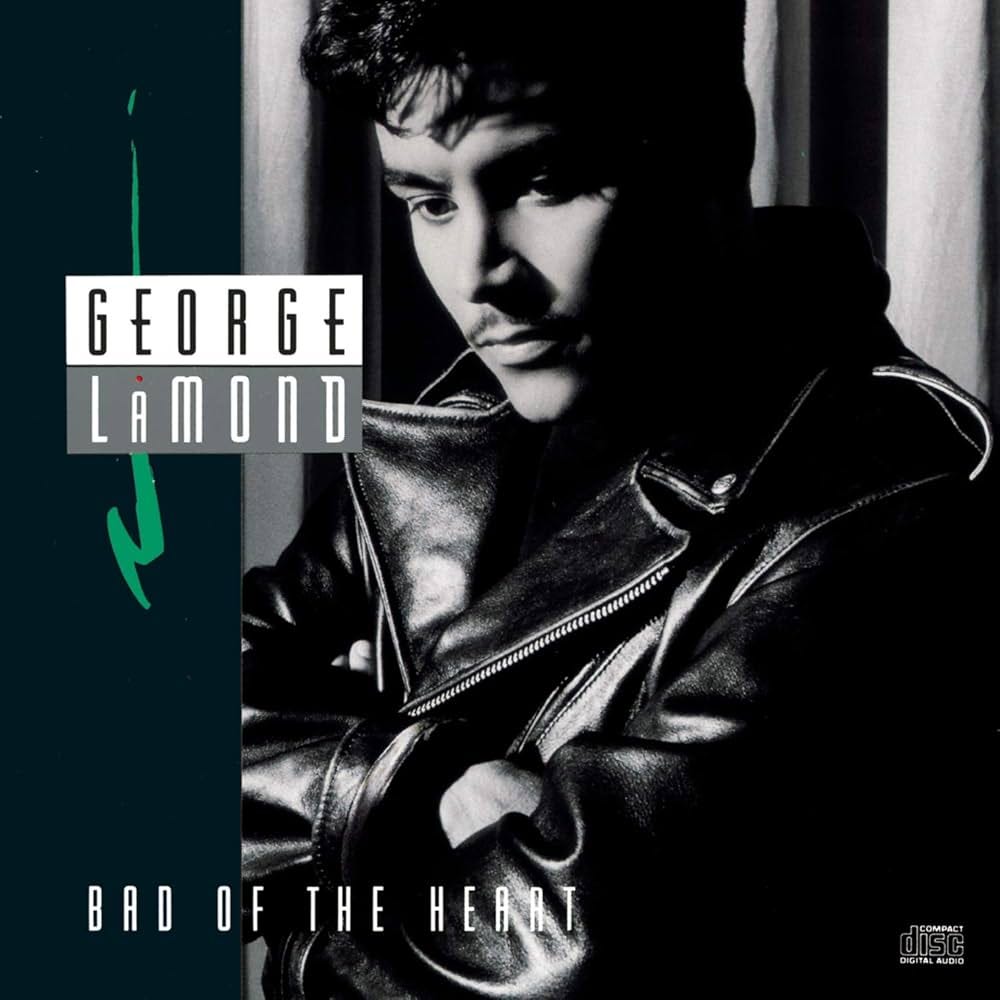
Both “Without You” and “Bad of the Heart” appear on Lamond’s debut album, Bad of the Heart, released in the summer of 1990. Soon after the LP dropped, Columbia issued a third single, “Look Into My Eyes,” another hook-filled Philip Andreula joint (Dominic Marabeti also gets a writing credit) given extra pop by Liggett and Barbosa’s production. “Look Into My Eyes” is a state-of-the-relationship song: Lamond and his girl have been through some rough times together, and now he wants to forget all that and secure a future together. In the first verse, he begins to ask her whether she feels the same way.
It’s been so long, girl, since I’ve felt this way
So many times you stole my heart away
Before I say the things I want to say
I need to know that you will be the one for, one for me
It all builds to the chorus, where he shares his grand vision for what could be. He’s a romantic prophet who knows that in order to move forward, they must forget parts of their past.
Just look into my eyes
And tell me what you see
Promises were broken
Now it’s you, girl, that I need
Just look into my eyes
You’ll see a rainbow we can share
Please don’t let this be another lie
The “Look Into My Eyes” music video doesn’t stray from the “Bad of the Heart” template. Another suit, another squad of backup dancers (this time with some ladies in the mix), and another smoke-show model with a kissable neck. The single reached No. 4 on Dance Club Songs and made Lamond the first male artist to score three Top 5 dance hits on his debut album. It also reached the lower half of the Hot 100, peaking at No. 63.
The album spun off two more singles. “No Matter What,” the LP’s closing track, is a duet ballad with Brenda K. Starr, a pop singer who’d dabbled in freestyle, most notably on her 1985 debut album, I Want Your Love. “No Matter What” was co-written by Ann Godwin, whom Shannon credits with co-authoring “Let the Music Play,” even though Ed Chisolm’s name appears on the record. When Godwin and collaborator Larry Lange submitted their demo of “No Matter What” for consideration on Lamond’s album, they suggested George record the song with Lisa Lisa. But she was too busy “doing her own shit,” as Lamond told Cheche. So they got Starr, whom Lamond had recently dated.
“No Matter What” is an us-against-the-world love anthem, and Lamond and Starr look fantastic together in the music video. Neither of them is wearing bluejeans, but the whole thing has the look of an early-’90s Levi’s commercial. The single reached a respectable No. 49 on the Hot 100.
The fifth single, “Love’s Contagious,” marked a return to freestyle—and it’s one of the genre’s few “message” songs. Written by Larry Lange and John Bastianelli, it’s about saving our messed-up world by spreading the love, and in the opening verse, Lamond suggests we all start by looking inward. It’s corny and simplistic and borderline “Kumbaya,” but it’s hard to argue with the sentiment.
First, start with your own heart
Learn to love yourself
Then take it over to your next-door neighbor
Don’t keep it on a shelf
“Love’s Contagious” proved a minor club hit but missed the pop charts altogether. Elsewhere on Bad of the Heart, Lamond delivers saccharine ballads (“Passing Time”), lite Latin fare (“Serenade You”), and pleasantly nondescript pop jams (“Who Needs Love,” “What Could’ve Been”). The slightly uneven collection succeeds more often than it fails, and appearing on the Dope Nostalgia podcast in 2025, Lamond said the first album remains his favorite.
“I was so naive,” he said. “I was so green. I didn’t know what I was doing. But I guess that was the magic. I was 19 years old, and I’m talking about love and life. What was I thinking? I didn’t even experience love yet. But that was the fascinating thing, the way I connected to those songs.”
It was also a learning experience, and Lamond has spoken at length about how Barbosa acted as a mentor. “He taught me everything I know in this music business,” Lamond told Harv Roman in 2025. “He was one of the first people that instilled that honesty in me. He always said, ‘Don’t be rude. Be respectful and remember where you came from.’”
Lamond promoted that first album by supporting New Kids On the Block on tour. He only had like five minutes to perform each night, and that entailed singing over a backing track—unlike the Boston heartthrobs, who got a live band—but it probably helped to build his fanbase.
Unfortunately, that didn’t translate to a blockbuster second album. Lamond returned in 1992 with In My Life, produced once again by Liggett and Barbosa. At the time, house, hip-hop, and R&B were ascendent, and the LP only contains three songs with freestyle’s requisite syncopated drums. Among them is the leadoff track, which was also the lead single, “Where Does That Leave Love,” another Lange/Bastianelli heater that captures the bewilderment of getting dumped. As with “Bad of the Heart,” Lamond’s narrator thought he’d found his soulmate, but she’s left him for another man, and he’s left asking a bunch of questions in the chorus that he probably doesn’t want her honest answers to.
Where does that leave love? Where does that leave us?
What about the promises and dreams that mean so much?
Where does that leave me, living without you?
How can I go on when you are telling me we’re through?
“Where Does That Leave Love” didn’t make the Dance Club Songs chart, but it did receive a music video featuring Lamond and his boys doing all kinds of aerobic dancing. In the clip, they’re rehearsing for a tour or video shoot, and Lamond’s wardrobe says a lot about how the times were changing. Instead of sporting a snazzy suit—his uniform in every video up to this point—he’s in baseball caps and oversized T-shirts. The single topped out at No. 59 on the Hot 100.
For some reason, In My Life also has two songs that sound just like Paul Young’s “Every Time You Go Away,” complete with electric sitar. One of those, “Baby, I Believe In You,” a New Kids on the Block cover, was the second single. The black-and-white music video finds Lamond back on his hanging-out-with-models bullshit, and the song reached No. 66 on the Hot 100. It was the singer’s fifth and final time making America’s flagship pop chart.
“I was a priority for CBS,” Lamond told DJ Dream. “The problem was they had this Mexican-looking Puerto Rican, and he just looked very Latino. They didn’t know how to market me.”
In 1993, Lamond returned with Creo En Ti, comprising mostly Spanish-language versions of his earlier songs. “Baby Creo En Tu,” a remake of “Baby, I Believe In You,” reached No. 10 on Billboard’s Hot Latin Songs chart, and “No Moira,” an update of “No Matter What” featuring Tejano singer Lisa Lopez in place of Brenda K. Starr, cracked the Top 20. It was a sign of things to come.
George’s good buddy Marc Anthony—who sang backup on Lamond’s cover of The Jackson 5’s “I Want You Back,” a Top 40 Dance Club Songs hit from In My Life—later convinced Lamond to try salsa. The result was 1999’s Entrega, which yielded the single “Que Te Vas,” a No. 23 hit on Hot Latin Songs. The album arrived during the “Latin boom” of the late ’90s, and while artists like Ricky Martin and Marc Anthony were making the jump from Spanish to English in hopes of reaching the mainstream American pop market, Lamond went the opposite direction.
Where Does That Leave Us?
Lamond’s transition to salsa may have saved more than just his career. In the mid-’90s, as hip-hop conquered the radio and freestyle artists watched their bookings disappear overnight, he suffered a nervous breakdown. He was with his wife one day and everything went blank. He couldn’t speak, he burst into tears, and in his mind, it was like someone was playing a videotape of his life on fast-forward. “That was a very humbling experience,” Lamond told Miami’s 91.1 FM in 2011. “It told me, ‘Don’t take anything for granted.’”
At some point in the ’90s, Lamond also served a brief stint in the freestyle boy band TKA, though it’s unclear when, exactly, this happened. In his interview with CJ the DJ, Lamond said it was around 1996 or 1997, and that it only lasted about nine months. This version of the group never released any music, though Lamond later collaborated with TKA leader Louis “K7” Sharpe on the 2006 reggaeton jam “Raspa,” off Lamond’s album Oye Mi Canto.
“It was great at the beginning, and then I saw things breaking apart, and communication was weird,” Lamond told CPR’s Clubhouse, describing his time in TKA. “Everyone had their own management and their own cliques … I didn’t like what I was seeing. It wound up ending early, which was a blessing, maybe.”
In the 21st century, Lamond has continued releasing salsa, freestyle, and house music. His 2008 dance-pop cover of Journey’s “Don’t Stop Believing” was the No. 1 song on NYC’s WKTU that year, and he’s a constant presence on the freestyle nostalgia circuit. He knows the genre that launched and defined him represents more than just frivolous club music.
“I truly believe that freestyle was a lifestyle and a movement,” he told Harv Roman. “This is our rap. This is our reggaeton. This is our hustle disco. This is our rock. This is our punk rock. This is our doo-wop. This is our Philly sound. This is our freestyle.”
“It was talking about life and love, and love is a major part of living,” he added. “Heartbreaks and pains and pleasures and happiness and regret all go in that emotional bowl of freestyle … We had a lot to say, and at one time, we had the whole United States listening to us.”
No posts
Comments
Nothing yet. Say the first thing.
Sign in to join the conversation.