
Some of you know me for Hell of a Hat, the newsletter I started in 2021 to promote my book Hell of a Hat: The Rise of ’90s Ska and Swing. This is something different. It’s a love letter to freestyle music, and if you’re not sure what that is, please check out the introductory article I published last year.
Freestyle is rooted in real emotion. If it weren’t, nobody would still be talking (or writing insanely long newsletters) about it three decades after its demise. It’s club music concerned with love gone extremely right or extremely wrong, and anyone who’s been in a romantic relationship for any length of time will relate to one or both of those things. But freestyle is also fantasy music, and that’s where its true appeal lies.
In freestyle lyrics, new love is pure euphoria; heartbreak is armageddon. The feelings are heightened to the point where reality is no longer a chief concern. The music is similarly unbothered with authenticity. Freestyle is built on drum machines playing beats that no human drummer could manage and synths that sound like no acoustic instruments. The singers are real, of course, but their voices are often drenched in reverb, a production choice that comes with the added benefit of masking vocal shortcomings.
Freestyle songs exist not in the mundane 9-to-5 world, but rather in a nocturnal big-city dreamscape filled with nightclubs, smoke machines, and potential lovers with unknown intentions. Because the genre’s lifespan was so short—approximately a decade beginning in 1983—it’s forever frozen in time. Freestyle evokes sweet, aching nostalgia for folks old enough to have heard these songs at middle and high school dances. For slightly younger fans—those born in 1980, say—freestyle conjures hazy childhood memories of listening to pop radio late at night and wondering whether these strange dance songs were at all representative of what adulthood would be like. (The answer: yes and no.)
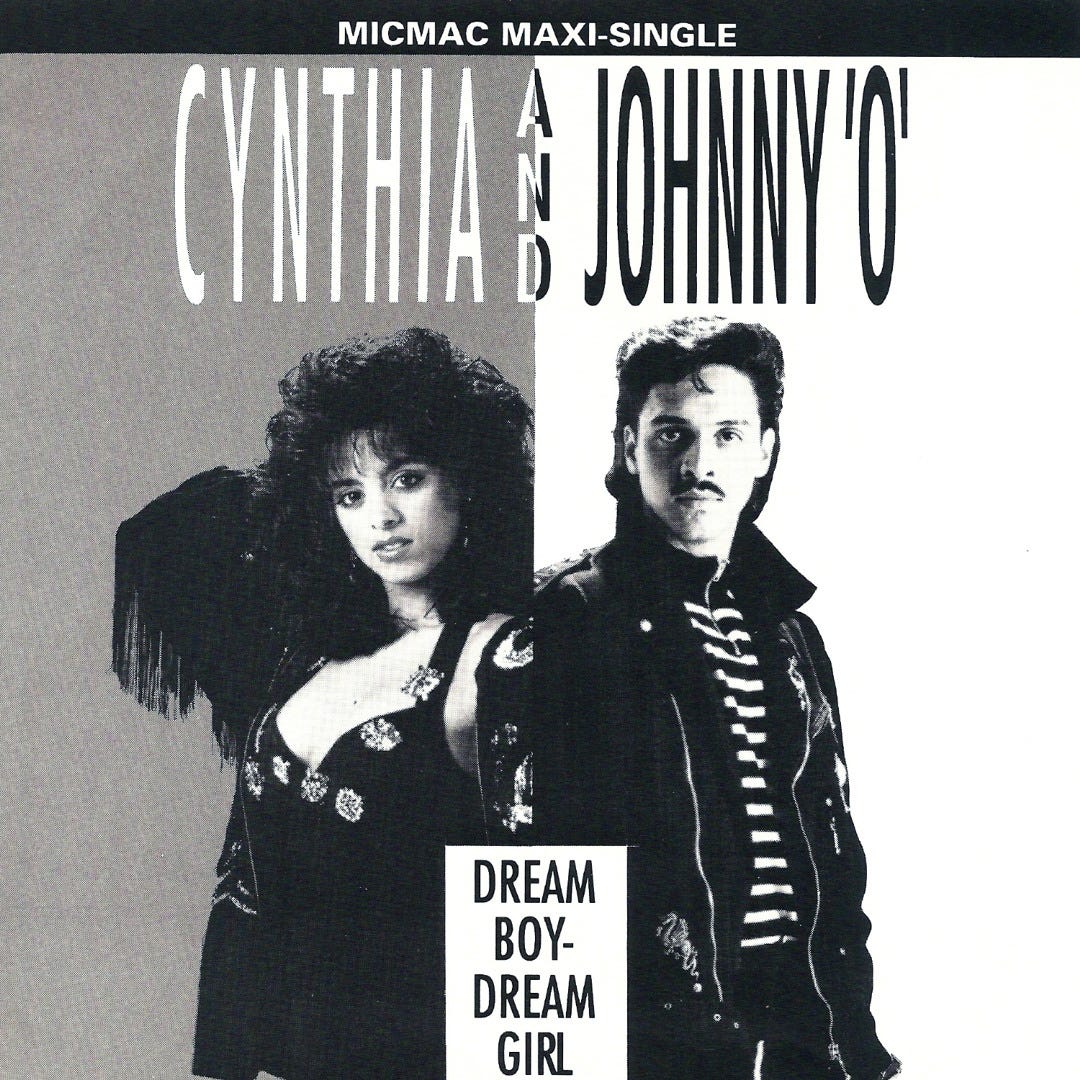
This is all a preamble to a bold declaration: “Dreamboy/Dreamgirl,” the 1990 duet by Cynthia and Johnny O, is the most freestyle freestyle song of all time.
Johnny O was born Juan Ortiz in Brooklyn, while Cynthia Torres hails from Spanish Harlem, the same neighborhood that gave rise to TKA and Marc Anthony, among others. Both Johnny and Cynthia had pretty typical freestyle careers. They were Latino kids from New York City who came out of nowhere, scored a bunch of club hits, and enjoyed limited pop crossover success.
Neither got super rich or became a household name outside of the freestyle community. Today, Johnny and Cynthia are genre icons and constants on the nostalgia circuit, and their names will forever be linked thanks to one haunting classic.
Dreamboy
The Johnny O saga begins at The Clam Bar Lounge on Flatbush Avenue in Brooklyn. Johnny’s uncle worked there—in what capacity, it’s not clear—and in 1982, the venue hired a young DJ by the name of Mickey Garcia. He’s a guy worth knowing.
Born in lower Manhattan with mixed Puerto Rican and Italian heritage, Garcia began DJing in the mid-’70s and made cassette mixes that found their way to a friend of a friend named George Vascones, leader of the Latin Symbolics Dance Company, the first professional urban dance company in New York City. Vascones helped Garcia land a job at a disco called La Mariposa in the Washington Heights neighborhood of Manhattan. Garcia replaced Jellybean Benitez, who would soon become a freestyle pioneer (and Madonna’s boyfriend).
Garcia went on to spin records at Manhattan nightpots like The Valcano Disco and Adam’s Apple, and in 1983, he began doing mix shows for the popular radio station 98.7 KISS FM. In 1986, Garcia broke into the other side of the business by co-producing “I Won’t Stop Loving You,” a banging freestyle jam credited to C-Bank, a recording project started several years earlier by producer John Robie, who worked with Arthur Baker on Afrika Bambaataa’s seminal “Planet Rock.”
The following year, Garcia co-produced the all-timers “No Reason to Cry” and “Come Into My Arms” (which he also co-wrote) for Queen of Freestyle contender Judy Torres, and he founded the label MicMac Records with executive Marvin Schlachte.
Sometime in 1987, Garcia came into the Clam Bar, and Johnny O took notice of Garcia’s fancy clothes and brand-new Lincoln Continental. At first, Johnny thought Garcia was hustling drugs, but then he found out Mickey’s money came from selling records. Johnny had grown up listening to Michael Jackson and Luther Vandross, as well as Credence Clearwater Revival, AC/DC, and Janice Joplin. He’d always sung in his bedroom with a hairbrush, and he fancied himself pretty good. Thinking he might get some of that sweet music-biz moolah, he asked Mickey for an audition.
“You’ve never even sung ‘Happy Birthday’ to me,’” an incredulous Garcia replied, but he agreed to the tryout. Johnny sang a couple MJ and Luther tunes, as well as the suave synth-R&B groover “Don’t Disturb This Groove,” a massive hit for The System in the summer of 1987. Garcia was impressed, and he gave Johnny a cassette recording of an anxious, gothy freestyle track he’d written and produced with Elvin Molina. Johnny took the tape home on the subway and wrote some lyrics about an ex-girlfriend who’d died of leukemia after breaking up with him.
“She didn’t want to be with me no more because she didn’t want me to see her perish,” Johnny told Spanglish Entertainment in 2024. “It broke my heart because I wanted to be there for her, but it wasn’t her intention.”
The song Johnny wrote is called “Fantasy Girl,” a spectral ode to a woman he loves madly but can’t seem to grasp. In the opening verse, Johnny sings with unblinking earnestness and a slight ladies’-man lisp about how this girl upended his existence.
The first time I saw you there
In my world, I wasn’t prepared
And what I witnessed from your heart
’Cause I knew, baby girl, it was ready to start
Nowhere in the song do we get the impression Johnny and this girl are actually together—or that they ever will be. She’s an idealized vision he’ll never wrap his arms around. His lyrics are all yearning, cajoling, and pining, and by the third verse, his eloquence has left him completely.
Oh, sweet love, won’t you be mine?
I’ll treat you like no other man has tried
I’ll be your man, never let you down
And I’ll always be true not to make you go
Over the years, Johnny has leveled many allegations against MicMac Records, and he claims the mistreatment started at the very beginning. After he recorded “Fantasy Girl,” he says, the label tricked him into signing a contract that robbed him of his publishing and gave him only 4% of the total royalties.
“No lawyer of mine ever saw it, nor was I granted the opportunity to know how much I was signing for!” he told Freestyle Mania in 2012. “I was taken for a ride, so while all these songs were going platinum and gold and making them millions, me and my family gained practically nothing in royalties or anything.”
According to the RIAA searchable database, none of Johnny’s songs went gold or platinum, but that doesn’t mean they weren’t sizable club hits that generated a lot of money. Released in 1988, “Fantasy Girl” faltered out of the gates but found an audience after about a month. Johnny was about to cease promotion of the track and move on to his next tune, the excellent “Highways of Love,” when his manager called to say that seven radio stations with more than a million listeners each had added “Fantasy Girl” to their playlists.
“I was driving a Pontiac at the time, and then I had a Mustang,” Johnny told The Big Tim Spinnin Schommer Show in 2018. “I was on top of the world, baby.”
“Fantasy Girl” reached a respectable No. 48 on Billboard’s Dance Singles Sales chart. The follow-up, “Highways of Love,” also co-written by Johnny, somehow missed that tally, even as it delivered more of the Brooklyn singer’s signature overdramatic eeriness. On “Highways,” the music suggests Depeche Mode scoring a daytime soap opera, while the lyrics have the semi-sensical charm of a man trying too hard to woo with his words.
Can’t you see my rhythms deep inside
Singing the songs of love and pride
Making me want you?
The way that I feel real in my mind, it’s so good
Loving me, loving you
Can’t you see that’s love that’s true?
The hook’s central plea is even more wonderfully confounding. Who jumps into a highway?
Jump into the highways of my heart, girl
Can’t you see the road of love is everywhere?
Those two songs—plus “Memories,” which returned Johnny to the lower rungs of Dance Singles Sales—appeared on Johnny’s self-titled 1989 debut album. His greatest triumph would come the following year, when he teamed up with his MicMac labelmate Cynthia for the duet that would cement both of their legacies.
Dreamgirl
By 1990, Cynthia had followed a very similar career trajectory, though music hadn’t been her first passion. As a little girl in Spanish Harlem, she dreamed of becoming a doctor. “Instead of buying a doll for Christmas, my mother bought me a stethoscope,” she told Celebrity Parents in 2022.
Over time, Cynthia got more into singing, and as a teenager, she became friends with one Wilma Cosmé, who worked with her sister at a stationary store. Cynthia and Wilma formed a group with another girl named Doris, and local hero K7 from TKA helped the burgeoning trio with some vocal arrangements. Eventually, they broke up, and Wilma blossomed into Sa-Fire, the solo freestyle phenom behind the crossover hits “Boy, I’ve Been Told” and “Thinking of You,” which reached No. 48 and No. 12 on the Billboard Hot 100, respectively.
Born in Puerto Rico and raised in Spanish Harlem, Sa-fire had a fantastic look—Bettie Page bangs and thick eyebrows—and a heavy Nuyorican accent that carried through even to her singing. She was so striking that SPIN magazine tapped her for the cover of their April 1988 issue, which featured a trend piece on “Latin hip-hop,” as freestyle was called at the time.
At some point in the mid-’80s, Sa-Fire introduced Cynthia to Mickey Garcia, and Cynthia auditioned for the MicMac label boss in the stairwell of a Bronx nightclub following a DJ contest. Cynthia passed the test and made her debut with 1988’s “Change On Me,” based on a hook she’d written on the 6 train while commuting to work at Bloomingdale’s.
“Change On Me” makes ample use of the effect where a sampled voice is played staccato across the keyboard, stuttering-robot style. We hear this cyber-Cynthia over heavy-duty freestyle drums and a pensive synth figure that sets the mood for the song. Then Cynthia floats onto the track with an innocent charm she couldn’t possibly fake. Some dude promised her the stars and then reversed course, leaving her with a severe case of whiplash.
When we met, it all happened so fast
You said you loved me and that it would last
But now it seems that it was all a lie
And all my love for you will soon pass you by
And then the iconic hook, where she begs for answers she knows she’ll never get.
Why did you have to change on me?
Your love was so easy to see
Oh, boy, I gave you all my time
But why couldn’t I make you mine?
“Change On Me” climbed to No. 47 on Billboard’s Dance Club Songs chart and just missed the Top 40 on Dance Singles Sales. Cynthia followed that with two more minor club hits. “Endless Night” belongs in the lineage of great freestyle songs that celebrate the world after dark. A delusional Cynthia believes she and her estranged lover can settle their differences and live forever in the magic of this evening.
So please make this an endless night
With just a little love, we can make it right
It’s there, I know I always loved you so
I hope this endless night won’t let you go
Next was “Thief of Hearts,” a kind of sequel to “Change on Me” that’s the exact opposite of “Endless Night.” Here, a heartbroken Cynthia faces a nighttime completely devoid of promise. At least she recognizes the type of man she’s dealing with, and she crowns him the “Thief of Hearts,” a loftier title than he probably deserves. It’s perhaps one of the only freestyle songs that mentions God, though the Almighty is strictly an observer of this sad tale.
Looking through the moonlight, baby
And what do I see?
Reflections of the times we had
And how it used to be
Two lovers that were looked as one
As one looked to be loved
A romance that would take its cost
As God looked from above
Cynthia co-wrote both tunes, and “Endless Nights” was a collaboration with her then-boyfriend, Jean Lauture. In 1990, MicMac issued Cynthia’s self-titled debut album, a six-track collection featuring “Change On Me,” “Endless Nights,” and “Thief of Hearts.” By this point, Cynthia and Johnny O had combined for about a half a dozen successful club records, so the execs at MicMac had an idea: Why not take the top two artists from their roster and stick them on the same track?
Dreamboy/Dreamgirl
Johnny O and Cynthia almost didn’t get “Dreamboy/Dreamgirl.” As Cynthia told the podcast CPR’s Clubhouse in 2018, songwriter and producer Charlie “Rock” Jimenez originally intended the song for Maria Respeto, aka Giggles, the Brooklyn native behind the 1987 freestyle delight “Love Letter.” For whatever reason, Jimenez wound up giving the song to MicMac’s reigning king and queen, and they took it someplace completely unexpected.
There are many strange and wondrous things about “Dreamboy/Dreamgirl,” the strangest and most wondrous being the key change that happens at 1:33, when Cynthia dips out following her opening verse and chorus and Johnny takes over lead vocals. This was likely due to the vocal ranges of the two singers, but as with so many freestyle records, this imperfection suits the subject matter and actually heightens the mood. Cynthia and Johnny O sound like two everyday teens professing their undying love but somehow talking right past each other.
At its core, “Dreamboy/Dreamgirl” is about two young people with emotional baggage seeking happiness together. In the opening verse, a relieved Cynthia sings as if in a trance. Other guys lied to her and left her all alone, but now she’s found someone who’s apparently true to his word.
I still remember the first time
You said that you loved me
You held me in your arms and said
You’d never ever leave me
(You’d never ever leave me)
And all these promises you kept
Have erased the past when I once wept
You made my fantasies come true
My heart belongs to you
On the chorus, Cynthia returns to this idea of fidelity. The best thing she can say about this boyfriend is that he doesn’t cheat on her. (To her knowledge.)
You’re my dream boy
You show me your love in every way
You’re faithful to me every day
Now I know that dreams come true
You’re my dream boy
Johnny O brings a certain grit to his verse, like when Michael Jackson would sing like a tough guy. He’s also been hurt, and he thinks he’s found an answer to his problems.
My friends told me that I’m real lucky
To have a girl like you
‘Cause all the girls I ever had
Their love was never true
(Their love was never true)
On his chorus, Johnny sets an even lower bar for happiness than Cynthia does. His girlfriend doesn’t neglect him, and that somehow makes her an ideal companion.
You’re my dream girl
You don’t neglect me in any way
You make me feel special every day
Now I know that dreams come true
The key change, outré lyrics, and unconventional singing—not to mention the reverb-soaked synth-brass that adds Latin flavor throughout—make for a song that seems to exist outside of time, within the liminal space separating two people’s hearts. Whatever’s going on in “Dreamboy/Dreamgirl,” the public felt it, too. The single cracked the Top 20 on Billboard’s Dance Single Sales chart and made it all the way to No. 53 on the Hot 100. It was the biggest pop hit either artist would ever score, and it appeared on both of their sophomore albums.
For Johnny O, this pop breakthrough was not without disappointment. In his 2012 interview with Freestyle Mania, he claimed that he was the uncredited arranger on the track, and that he was cheated out of recognition that would’ve boosted his career immeasurably.
“The original demo track of ‘Dream Boy/Dream Girl’ was whacked at best,” Johnny said. “It sounded robotic and dead. I even remember singing it in the studio in different ranges to help the song along. But still it was missing a clear direction until I came and placed my vocals down in about 15 minutes.
“The producers went ballistic, and when the ideas were needed for the end of the song, guess who created it? You got it, little old me! By the way, when the producers went ballistic it was because it sounded amazing, and they became angry because as they put it, ‘We don’t want to share publishing with you (Johnny), but we loved what you did!’”
When the song became a hit, Johnny O and Cynthia had to tour behind it, and that led to more problems. There were “constant arguments and disagreements” on the road, Johnny told Freestyle Mania, and at some point, things really went sideways.
“To put things into perspective, I was a martial artist when I was in my teen years and a very good fighter and when things got bad I would become Mr. Bruce Lee, and my pride just fueled more problems than solved them,” Johnny said. “It got so bad that one night at a club where we were about to perform, fists were about to fly when a big fight broke out in the basement of this club.”
After that, Johnny says, there was a “meeting between both soloists,” and they wound up cancelling the tour for three months. Which was probably a wise move.
“It was just two kids with two chips on their shoulders, and no one was moving,” he said. “The decision I made created anger and disappointment, but someone had to put a stop to all this abuse. Management lacked experience and a clear understanding on pricing and promoting successful recording artists like myself!”
Johnny said in 2012 that he and Cynthia had since patched things up, and she’s seemingly never referenced the drama in any interviews she’s given. They still perform the song, both separately and together, and in 2018, Johnny told Tim Spinnin’ Schommer that he was trying to get “Dreamboy/Dreamgirl” a Guinness World Record for most frequently performed duet. It doesn’t appear his efforts have been successful.
In 2023, Red Hot Chili Peppers debuted a stark live cover of the song featuring guitarist John Frusciante on lead vocals. Footage from their performance at that year’s Global Citizen Festival in Central Park shows fans crying in the audience, and rightfully so.
Life After Dreams
Johnny O released the album Like A Stranger on MicMac in 1990. It yielded three singles: “Dreamboy/Dreamgirl,” the lovelorn freestyle tearjerker “We Can’t Go On This Way,” and the cheeseball R&B ballad “I Just Want to Get to Know You (If It’s Alright With You).” The latter two failed to chart. Afterward, Johnny had a massive falling-out with MicMac.
In his 2012 interview with Freestyle Mania, Johnny claimed that when his MicMac contract was up, he asked the label for $1 more per record sold. Their counter offer was “ten cents more against wholesale,” and Johnny walked out. At that point, he said, the label’s vice president—whom he didn’t name—plotted to hurt Johnny and his family. One night at Rick’s Bar in Miami, Johnny claims, thugs attacked his wife with a pool stick.
“I turned into Bruce Lee and kicked all their butts and bloodied many of them,” Johnny told Freestyle Mania, explaining that the vice president was arrested for aggravated assault years later at the Winter Music Conference in Miami.
Johnny admits that he fell victim to the trappings of the music industry—drugs, money, women, etc. So in the early ’90s, he became a born-again Christian, and in 1997, while performing gospel music at an evangelical event, he got a message directly from the Lord. “Am I not worthy of freestyle?” God apparently asked. Johnny O wept and realized he could make dance songs for Jesus. His 2007 album Peace on Earth 2012 contains a bunch of them.
Like Johnny, Cynthia released one more MicMac album, the aptly titled Cynthia II, which also includes “Dreamboy/Dreamgirl.” It’s mostly filled with freestyle winners—“Never Thought I’d Let You Go” and “What Will It Take” are a pair of icy betrayal anthems—though Cynthia also covers The Stylistics’ 1972 soul chestnut “Break Up To Make Up.” The delicate ballad doesn’t necessarily play to Cynthia’s strengths, but she gets some help from a backup vocalist Julian Hernandez, and the tune wound up reaching No. 70 on the Billboard Hot 100.
Even as her career took off, Cynthia always held down day jobs. After Bloomingdale’s, she worked at Victoria’s Secret and later Chase Bank, where she climbed the ladder from teller to branch manager. Following Cynthia II, she decided to leave MicMac, as she wanted to collaborate with other producers and record for a label more willing to invest in music videos and other promotions.
“Everyone knew my music, but no one knew who Cynthia was or what I looked like,” she told Reminiscing with Gene DiNapoli in 2021.
Cynthia landed on the Tommy Boy subsidiary Timber! for 1999’s Thinking About You. Freestyle wasn’t really happening anymore, but the album’s leadoff track, a house-informed take on the classic genre formula, complete with fizzy synth burbles, reached No. 83 on the Billboard Hot 100. It would be Cynthia’s final placement on America’s flagship pop chart.
While the rest of the album veers briefly into R&B and house, Cynthia mostly sings over freestyle beats—perhaps because Joey Gardner (TKA) and Latin Rascals co-founder Tony Moran (The Cover Girls, Sa-Fire) were among the producers. But even the all-star roster couldn’t save her from an inevitable decline. A decade after giving the world one of the all-time great dance music duets—if not the greatest, since that category of song isn’t really a thing—Cynthia’s hitmaking days were drawing to a close.
“Freestyle never reached its peak,” she told Celebrity Parents, again citing a lack of artist development on the part of labels. “It just disappeared off the face of the Earth.”
These days, as she sings her songs for the true believers, Cynthia prefers to avoid online controversy and let the music speak for itself. Freestyle is a dream that devotees need never wake from.
“We’re all out here to enjoy what we do, what we set out to do, what we feel so passionate about,” she told CPR’s Clubhouse. “And we want to just make the best of it for whatever time we have left. There shouldn’t be any type of bickering, fighting—‘I own this; I own that.’ Get over it. Enough with the questions. Just let us enjoy the time and enjoy the music.”
No posts
Comments
Nothing yet. Say the first thing.
Sign in to join the conversation.