
Some of you know me for Hell of a Hat, the newsletter I started in 2021 to promote my book Hell of a Hat: The Rise of ’90s Ska and Swing. This is something different. It’s a love letter to freestyle music, and if you’re not sure what that is, please check out the introductory article I published last year.
During her live shows, the great Judy Torres likes to tell a short story illustrating the enduring appeal of freestyle music. It’s a tale of a boy and a girl falling in and out of love, and at each stage of their relationship—infatuation, courtship, breakup—Torres sings a few bars of a freestyle classic whose lyrics correspond to the situation. Because this is what freestyle does: It captures the highs and lows of romance and turns those feelings into dance fuel.
When she gets to the point where the two young lovers are finally hooking up, Torres reaches for what she calls “the only dirty freestyle song we have.”
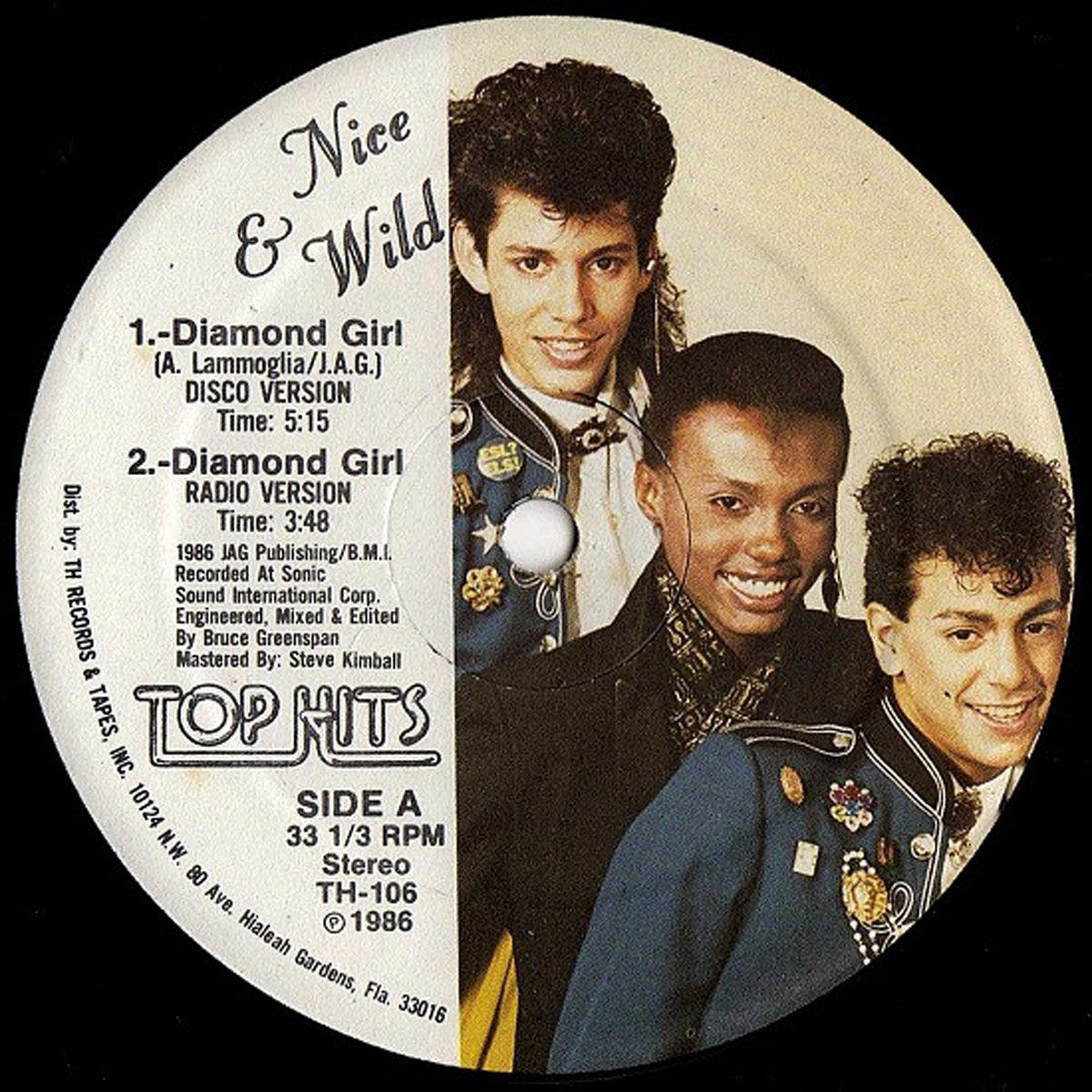
That song is “Diamond Girl,” a 1986 novelty sex jam by Nice & Wild that really is pretty filthy. Before the song even reaches the 10-second mark, we hear a giant splashing sound, like Shamu has just landed a front flip. Only we are not at SeaWorld. Next, we get some heavy breathing—the kind you’d expect from an obscene phone caller—and once we reach the chorus, there’s a pervy ASMR voice in the background whispering, “Wet, wet.” It’s all preface to the orgasmic moaning at 3:35.
And then there are the lyrics, which require a little unpacking. According to various sources that seem reputable enough for our purposes, “ice” has been a slang term for diamonds since at least 1906. Up to the present day, rappers love to describe their wrists and necks as “iced out” or “icy,” and because ice melts, an especially bejeweled rhymer like Future might spit something like this, from his 2017 song “Good Dope”: “My paint wet, my neck wet, my ears wet, my wrist wet.”
The reverse is happening on “Diamond Girl.” Here, diamonds are meant to signify ice, and because ice is wet, the whole thing is a metaphor for, well, you know. But Nice & Wild actually employ a second—and even raunchier—metaphor when they liken the song’s titular woman to a diamond ring. These are the actual lyrics that were all over the radio in 1986.
You fit right on my finger
I’m so proud to have me in you
I persist to enjoy all your gifts
There’s an audacious lustiness animating “Diamond Girl,” and that sets it apart from virtually every other tune in the freestyle canon. While freestyle’s beats promote bumping and grinding—and there would’ve been plenty of that going on in the clubs when this music was at its peak—the lyrics are fairly chaste.
Simply put, freestyle is about love, not sex. Lisa Lisa may need you tonight, but what she really wants is for you to love her tomorrow. When Connie chats you up at the party, she’s hoping to get to know you better. Even when Stevie B endeavors to “Party Your Body,” he might just be talking about dancing. But Nice & Wild are definitely here to get nasty.
While the sexual tone of “Diamond Girl” sets the song apart from most freestyle hits, the story of its creation—and the ways in which some of the involved artists were not properly credited—is fairly common for the genre. The saga begins in Miami in 1982, just as electro was starting to shake the roller rinks and dance clubs and lay the groundwork for freestyle. Three dudes named Remy Palacios, Reggie Pierre, and David Torres formed a breakdance crew called Floor Breakers Inc. and began entering talent contests all over the city. That’s how they met their manager, an industrious multi-talent named Joe Granda.
A native of Cuba, Granda moved with his parents to the United States when he was five years old to escape Castro’s regime. As a young boy, he worked as a magician and ventriloquist and appeared on the Telemundo children’s series Cabalgata Infantil. Growing up, Granda gravitated toward rock bands like The Beatles, The Rolling Stones, Journey, and STYX, but he always heard salsa and merengue at family functions. Over time, he learned the history of Latin music without sacrificing his love for rock.
As a teenager, Granda fronted the disco band Majesty in his hometown of Hialeah, and he apparently wrote all of the music for their one and only studio album, 1977’s The Disco Sound of… He credits his high school poetry courses with teaching him how to write songs. The LP includes “Hey Y’all We’re Majesty,” which employs a melody and lyrical conceit that will be instantly familiar to anyone who’s heard Nice & Wild’s debut album.
After Majesty ran its course, Granda got into music promotion—everything from making flyers to renting venues and drafting contracts. As per his website, he eventually played a key role in helping Latin artists like Gloria Estefan, Ricky Martin, Pitbull, and Enrique Iglesias reach mainstream Anglo audiences. He also worked as a music producer and composer, and he made his vinyl debut by co-producing the 1984 electro jam “Rockin’ It” by M.C. Flex & the FBI Crew. It became a club hit in New York City and appeared in the long-forgotten and totally bonkers 1986 action film Knights of the City.
Around this time, Floor Breakers Inc. were looking to dance to their own original tunes, so Granda and someone named Arthur Lammoglia teamed up to write “Diamond Girl.” Granda penned the lyrics, and Lammoglia—who’s not credited on any other song on Discogs—handled the music. (If you’re only going be associated with one song, let it be something as good as “Diamond Girl.”) Rather than have Remy, Reggie, or David sing lead on this tawdry dance ditty he’d concocted, Granda enlisted John Minnis, a local singer he discovered at another talent show. Minnis had a huge, soulful voice and a rough personal history; he’s the heart and soul of the “Diamond Girl” story.
An only child born in Miami to Bahamian parents, Minnis was attending Miami Dade Community College on a drama scholarship when he met Granda. Ever since he was nine years old, Minnis had been tasked with caring for his mother, who was paralyzed from the waist down in a motorcycle accident. While other kids were off enjoying their childhoods, Minnis was changing bedpans and dressing bedsores. Singing was his escape, and when Granda asked him to record four or five songs for Floor Breakers, now known as Nice & Wild, Minnis was game. He claims he never signed a contract, and that he didn’t know the music would be commercially released.
So imagine his surprise when, in 1986, he heard “Diamond Girl” on Miami’s Power 96 while working as a night security guard. Originally released on the local indie label Top Hits, “Diamond Girl” must’ve taken off in the clubs, because soon Atlantic Records offered Nice & Wild a deal. The problem was, Nice & Wild weren’t really responsible for the success of “Diamond Girl.” The song is 95% Minnis’s vocals. David Torres does the Spanish-language part that comes near the end, but Minnis is the star. He gives “Diamond Girl” a cologne-scented air of late-night cool that camouflages the smuttiness.
“When I heard the song ‘Diamond Girl,’ I didn’t even know what ‘Diamond Girl’ was about,” Minnis told The Felix Sama Podcast in 2023. “It took me years to understand what I was singing.”
Prior to the Arista deal, Nice & Wild lip-synced “Diamond Girl” on stage, and if anybody noticed, they probably didn’t care. Miming to backing tracks was standard procedure for dance acts at the time. But with Arista in the picture, Granda needed Minnis in the group, and Minnis claimed the manager begged him to join. But Minnis had to continue caring for his mother, and what’s more, he had little interest in the music business. His love for singing was pure.
“I’m not a brown-noser or one of those ‘I’ll do anything to make it’ type people,” Minnis told Hitwave Music in 2019. “I have an issue with people trying to bully me or control me.”
According to Minnis, Arista didn’t realize they’d signed a bunch of lip-syncers, and there was some type of lawsuit that ultimately held much of the “Diamond Girl” money in escrow for years. At some point, Minnis’s aunt came to live with them, and the singer was finally free to join Nice & Wild on the road. As he recalls, a couple of the members weren’t happy about him entering the fold, even though he was the voice behind their mealticket song.
Many websites claim that “Diamond Girl” reached No. 31 on the Billboard Hot 100, but this was not the case. The single never made America’s flagship pop chart, nor did it impact the R&B charts. Like a lot of freestyle records, it fell somewhere in between and found airplay on a new radio format. This is why Billboard created a freestyle-centric chart called the Hot 30 Crossover. The magazine explained its reasoning in the issue dated February 28, 1987.
“Several months ago, we found some stations that were officially classified as pop or black were integrating dance records that didn’t chart either pop or black,” said Michael Ellis, Billboard’s assistant director of charts. “These stations still fit into their respective formats, but a significant percentage of their playlists is given over to these crossover records. We also found that a number of big-selling records—like ‘Diamond Girl’ by Nice & Wild—never charted Black or pop because their airplay was split among a handful of pop and a handful of Black stations. So we found music being ignored and stations that were moving toward a new format.”
“Diamond Girl” was included on Nice & Wild’s 1987 debut album, Energy, Love & Unity, a hodgepodge of freestyle and pop tunes that presumably features Minnis on more than one song, though it’s a little hard to tell. The liner notes credit Remy, Reggie, David, Minnis, Granda, co-producer Gary Henry, and someone named Bobby Chapman as the vocalists. It doesn’t specify who’s on what track.
There are no vocals on the album’s zaniest cut, the synthed-out title track, save for the voiceover that tells us about a treasure that’s been discovered on a sunken ship in the Bermuda Triangle. Here, the voice presents diamonds as something wholesome and suggests that Nice & Wild have come to save the world, Bill and Ted style.
One of the most precious diamonds was found
This diamond has brought us
Three important spiritual elements:
Energy, love and unity
Reggie, Remy and David
They are Nice & Wild
The version of Nice & Wild with Minnis in the lineup eventually petered out. Minnis reached his breaking point one night in New York City, when a club promoter refused to give him a deposit before the show and withheld the money afterward, claiming there weren’t enough people in the audience to justify payment.
“I said, ‘If you don’t give me my money, you better call security,’” Minnis told Trinere on her Queen Talk Radio podcast. “After that, my stress level was so high. I was like, ‘You know, I’m done. I can’t do this anymore.’ They don’t really appreciate talent. In freestyle, music is not respected. With all this fake stuff going on and the lip-syncers, it shows no respect for the fans, and it shows no respect for the genre, the music. As long as they can get their pockets filled, they don’t care about the audience.”
In 1991, not long after Nice & Wild ended, Minnis competed on the TV talent show Star Search. Again, he wasn’t seeking fame and fortune, but a female friend was a contestant, and the producers asked her if she knew any good male singers. Minnis wound up winning first place, but he claims he was never able to capitalize because he refused to go to dinner with an unnamed executive who seemingly wanted more than a dining companion.
“Star Search showed me exactly how ugly things can be if you don’t say yes to certain people,” Minnis told Trinere. “When I won, I didn’t hear from anyone. It was crazy.”
In 1996, it somehow transpired that Minnis became lead vocalist on a second Nice & Wild album, Infatuation. Executive produced by Joe Granda and mixed by the great Lewis A. Martineé, the man behind Exposé, Infatuation includes a handful of solid freestyle joints, including the closing “Dream Girl,” a “Diamond Girl” sequel with similarly suggestive lyrics.
Dream girl
My thoughts are always about you
I dream of all the things that we can do
I wanna feel me inside you, girl
There’s virtually no information about Infatuation on the internet, but it seemingly came and went without much fanfare. In the years that followed, Minnis became a personal trainer and weathered a couple of health setbacks, including temporarily losing his voice due to allergies and undergoing brain surgery in 2006. Through it all, he’s continued singing, mostly at South Florida restaurants like Fishtails in Fort Lauderdale and JP Mulligan’s in Pembroke Pines. While other freestyle singers took the nostalgia circuit, Minnis initially resisted, and he resented seeing former Nice & Wild member David Torres onstage, lip-syncing to Minnis’s voice on “Diamond Girl.”
As it happens, Torres had a pretty nice little post-“Diamond Girl” freestyle career. He signed with MicMac, the New York City label behind Johnny O and Cynthia, among others, and made his solo debut with the self-penned 1991 single “No Regrets,” which seems at least partially based on his experiences in Nice & Wild. Check this verse:
I’ve spent time on the road
It’s such a heavy load
A big chance with no circumstance
I said fame and glory were my domain
The lights went out and it wasn’t the same
“No Regrets” was featured on a Brazilian soap opera, and Torres wound up getting a full-album deal with MicMac. The LP, Love Is the Answer, arrived in 1995 and offered a mixture of freestyle and house jams. After all, it was the mid-’90s, and freestyle was no longer America’s primary dance crossover genre.
“Freestyle was sort of like a roller coaster ride,” Torres told Spanglish Entertainment in 2024. “We were up in the ’80s and ’90s, and then it took a little bit of a downfall. I like to say the veterans of the game ... we still stuck with it, and we were still doing shows, and we still believed, just like I believed in the genre. Because I love freestyle music. And that’s why I stayed.”
Minnis eventually did come around and start performing “Diamond Girl” in public. As he sometimes explains from the stage, a lot of people on the internet mistakenly label the song as being by Stevie B. For what it’s worth, Stevie calls Minnis “the most underrated freestyle vocalist, if not the best voice in freestyle.” If he’s still salty about Torres lip-syncing the tune live, Minnis might take solace in the fact that he himself is the only one who can truly deliver “Diamond Girl” in all its freaky glory.
“Freestyle fell in my lap,” Minnis told Freestyle Music Magazine in 2023. “The thing I love about freestyle is it’s not a negative thing. Whether [the artists] can sing or not, we’re talking about love and breakups and stuff like that. We’re not talking about shooting and B’s and hoes. There’s a lot of rock ’n’ roll singers that can’t sing. There’s a lot of R&B singers that can’t sing. But their message and the way they deliver it comes through. If you’re passionate about it, it comes through. Whatever road God has for me, I’ll take it.”
No posts
Comments
Nothing yet. Say the first thing.
Sign in to join the conversation.