
After the last issue’s fabulations (which went over somewhat like a lead ballon, confirming my suspicion that a love for fantastic bibliographies is a limited one (but which did nothing to dampen my joy in creating them)), and because I’m in the lovely city of Tours during another one of France’s very, very “unusually warm weeks” where we all know this is what our relentless spewing of stuff into the atmosphere will get us, and where despite it all, and where we’re all doing more of the same, and where the prime minister has helped bring the temperature down dramatically by announcing he'd really, really like to take away a couple of national holidays, where if you know anything about France and French culture we all know will lead to something akin to revolution, or at least the burning of tires, the occasional police car, and if the farmers get on board, a few hundred tons of cow shit, and where I find myself immersed for two weeks in the finer points, because dear God they are all the finer points, of Le subjonctif, I thought I’d talk about baths. And death.
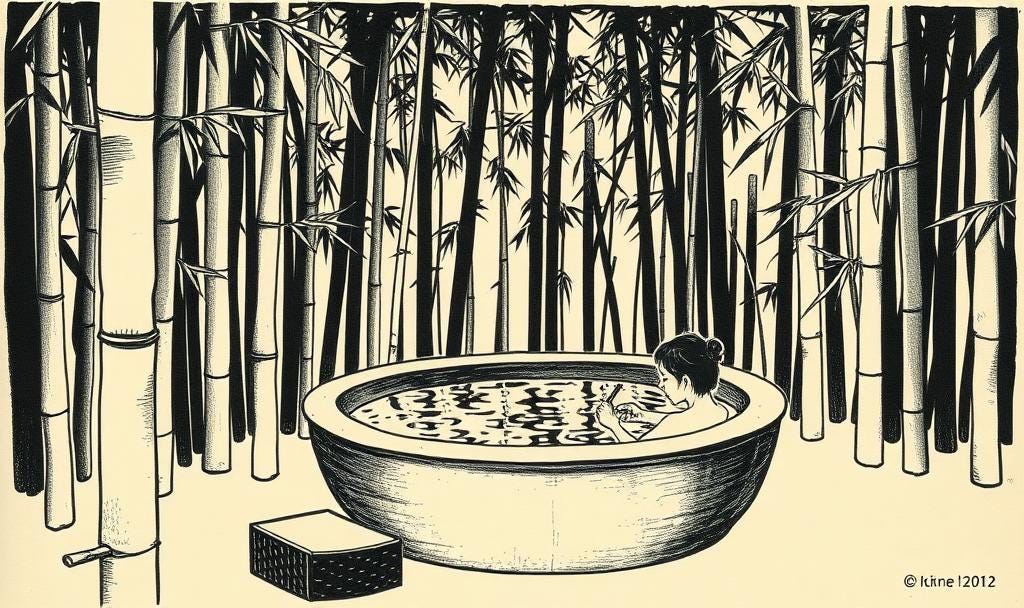
This all began with a willy little idea, that came to me, unsurprisingly perhaps, in a Japanese bath—an ofuro—in our garden at La Bucherie.
I find my way to these things eventually. I have always been an idea-in-the-shower kind of guy. But, Archimedes figured out how and why things float while stepping into a bath. Beethoven was convinced that plunging his head into cold water was instrumental in his process. Jung found bathing to be a reliable gateway to the unconscious, to the symbolic world that underlay his psychology.
And entire cultures and belief systems embrace the wet for getting things done, in this world and the others. The Greeks and the Hindu both tied bathing to spiritual intercession. Ditto for the Mayans, the Aztec, and Nordic folks. And, of course, there is Christian baptism.
Any way…I was neck deep in the ofuro, gazing out at the straggly bamboo that has refused to do much of anything this year, other than slightly shade a small portion of the pond around which it is planted. A cloud passed across the waning sun, and I thought of Kozan Ichikyo’s poem:
Empty-handed I entered the world
Barefoot I leave it.
My coming, my going —
Two simple happenings
That got entangled.
And, so things did. I’m not of the habit to recall death poems while soaking away the pains of garden labor, except I’d been reading lots and lots of them as part of a deeper engagement with Zen Buddhist thinking and teaching about death—something that has become unavoidable as those around me insist on growing old. Oh, and me too.
Here’s where I’ve ended up…and I swear if anything resembling the subjunctive case shows up in here—in any language—I apologize, and you can just put it down to trauma.
Back in the olden days in Japan, influenced by Shinto beliefs, bathing was about purification, especially in bodies of moving water and in those heated from deep within the earth. Mountain streams and hot springs were (and are) a big deal.
Sometime around the 7th-century, the Buddhists show up (as they do), and began to incorporate baths into their monasteries, taking an early crack at ‘cleanliness is next to Buddhaliness’. Aside from lowering the BO quotient in a place packed full of enthusiastic young men, the bath became also an expression of compassion, for others and for one’s self.
Increasingly embedded into Japanese culture more generally—like many Buddhist developments (hello, tea!!)—it developed along with everything else until it passed into something resembling a general marker for domestic refinement.
Throughout however, the ofuro reflected and reflects the essential Japanese aesthetic principles of wabi-sabi (beauty in simplicity and imperfection), ma (space and time), and a recognition of the importance of the intimacy of everyday rituals.
Soaking in an ofuro is not just an opportunity to sit in some hot water—it’s a moment of respite, contemplation, and care.
Which brings us—believe it or not—to death poems ( jisei no ku 辞世の句). A jisei (literally “resignation from the world”) is a poem written, as the English translation suggests, as a final farewell, usually shortly before slipping this mortal coil.
Death poems go back aways in Japan, with the first notable examples coming from the Heian Period (794–1185), where we are already seeing them as way to express mono no aware—a deep sensitivity to, and appreciation of, the ephemeral nature of life.
By the Edo Period (1603–1868), monks, samurai, and the literati were all working away in their last moments (or so) on jisei, and during this period, the haiku masters like Bashō and Issa further refined the practice, paradoxically buffing up the wabi-sabi nature of their work.
Ichikyo’s poem, above, was written in the 14th-century. Three hundred years later, we have Bashō’s:
sick on my journey,
my dreams go wandering
on this withered field
The centuries separating them dissolve in their essence.
They share a worldview shaped by impermanence, almost ritual simplicity, and the intimate awareness of fleeting, ephemeral, beauty. So does the ofuro.
There is, of course, wabi-sabi. Which despite it showing up in the most lux and refined places these days, is still just an appreciation of impermanence, simplicity, and imperfection. Ofuro and death poems embrace it—the transience, the decay, and the beauty that can come from austerity.
The ofuro is at its ancient heart a ritual of letting go, of releasing or dissolving tension, of shedding the day. It offers a mini-death—what is done is done. The patina—at least with those made of wood—deepens with age and use, a marker of impermanence.
Similarly, death poems are composed as their own ritualistic acknowledgment of the great universal truth of our necessary and inevitable not-being—the shedding of the weight of life and engagement.
They are pared-down, in their best examples, to almost nothing. But often encompass the whole world, compressed into a single image of nature and the nature of our existence—a falling cherry blossom, the fading moon. They are not laments, but acceptances— silent acknowledgments of impermanence, resonating nonetheless.
In addition to this impermanence, there is another cultural and and aesthetic values that ofuro and death poems share, and that’s called ma (間). Ma is often understood as the space between things. It is the space that often gives meaning to those things which it embraces. One can also think about it as negative space as well, as a pause, as a silence. It is ma that often expresses what its contents cannot, alone.
Ofuros—not as material objects, but as containers for ritual and reflection—create a pause in time, both a sensory and temporal threshold. There is nothing rushed. It takes time for the fire to heat the water; it takes time to settle into the water; it takes time for the world to retreat through the steam; it takes time for the self to adjust.
Because the ofuro is often taken at night or near to, there too, is a sort of ma—the liminality of light and dark; of activity and respite; of the doing and the being.
The death poem occupies a similar ma, a final moment between life and death, a space of stillness and heightened clarity. A falling away of what was, and an acceptance of that which comes.
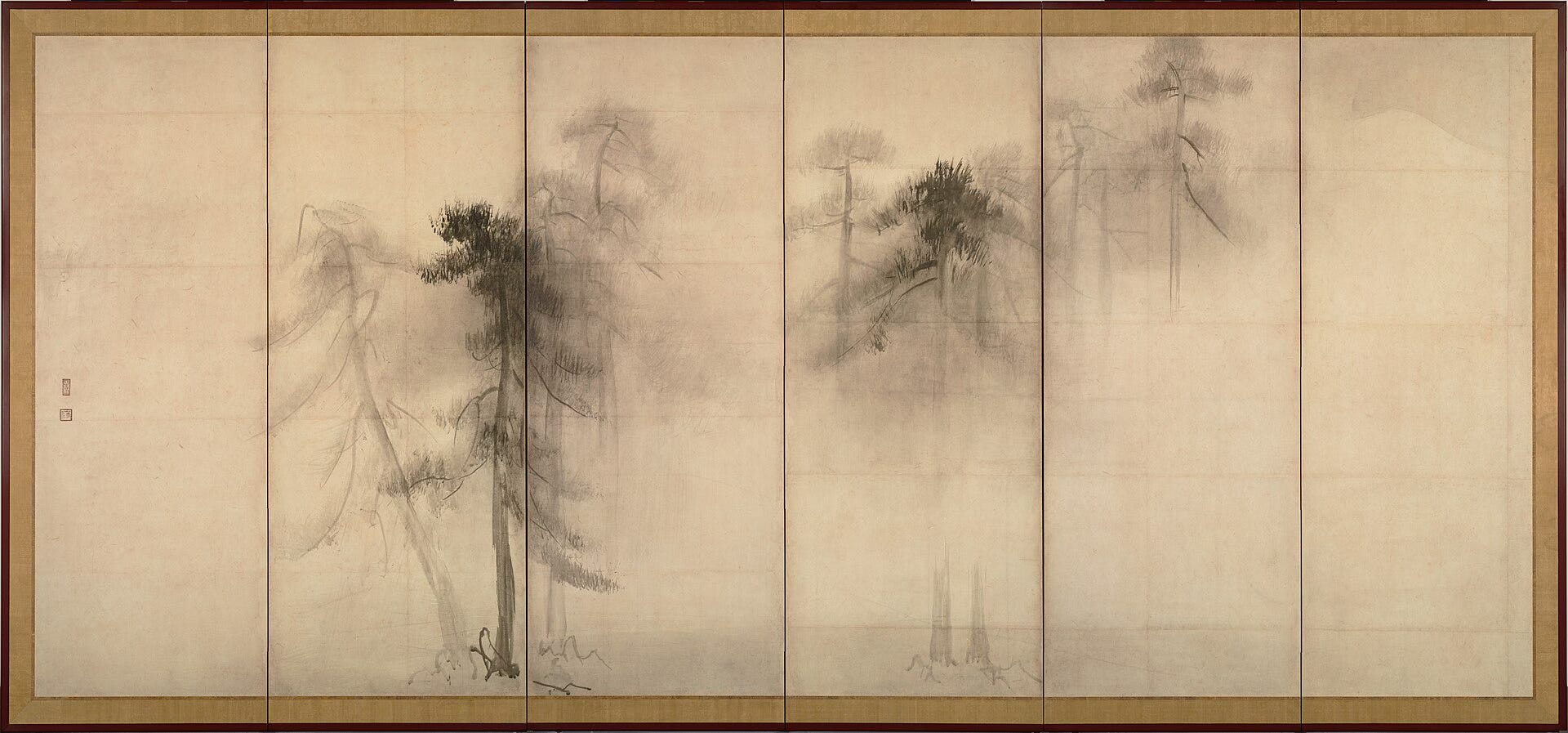
Both are done with deliberation, and often in silence. And the experiences of both—the writing and the soaking—lie partly in what is not said. Rituals in themselves, of purification and clarity and acceptance.
It is perhaps not all that surprising that there is such aesthetic and spiritual confusion (in the original, proper meaning of the word). Both, after all, are products of the same world. A world that is intensely self-reflective, traditional, and forever culturally multimodal. But still, I find it an interesting lens into just how a few ideas can seep into everything, given the right conditions.
No posts
Comments
Nothing yet. Say the first thing.
Sign in to join the conversation.