
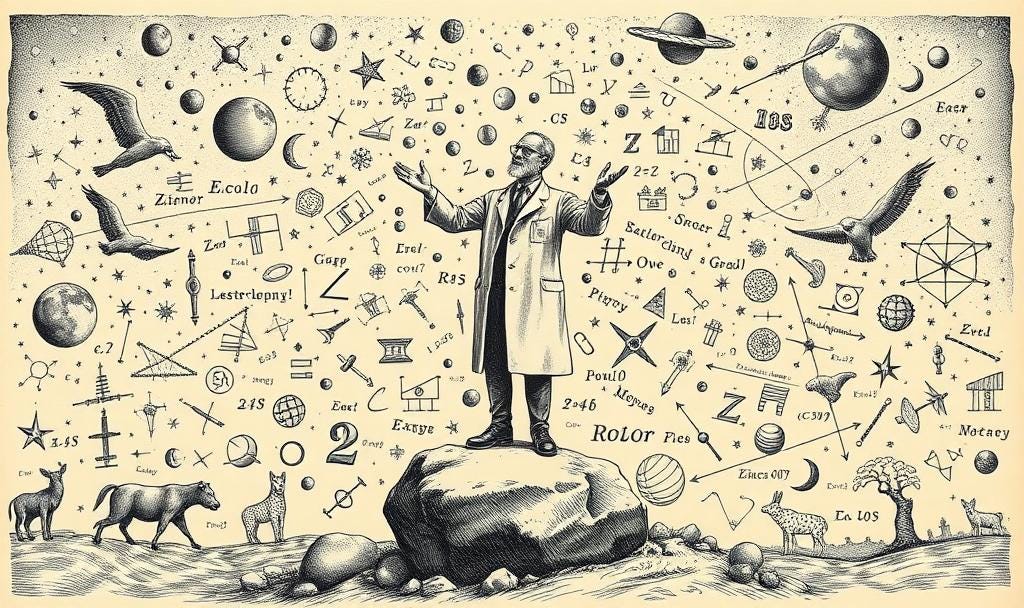
We expect symbols to speak to us, or at least make themselves useful.
The god-help-us heart emoji, the still-there-but-oft-ignored stop sign, the swoosh of sport fantasy deliver, if not a whole world of meaning, at least a meaningful something.
But what happens when symbols fail us, and do nothing of the sort?
The oldest human marks—lines, chevrons, dots, spirals, ladders—repeat across caves and continents, stretching back tens of thousands of years. They appear in Chauvet in France, in Sulawesi in Indonesia, in shelters in South Africa. They crop up again and again across millennia, a frightfully stubborn handful of signs that refuse to explain themselves.
There are theories, pet industries of interpretation, fantastical hypothesis, and of course aliens. All possible. All inconclusive. The reality is, we just don’t know. And in that not-knowing is power, is force.
Unlike the animals painted on the cave walls—the horses, the bison, the mammoths—these marks do not yield. They don’t describe anything familiar. They don’t even offer a context—really—that is any help. They insist on presence without translation, without knowledge. They are mute, and they are powerful precisely because they are mute.
Silence here is not absence. It’s pressure.
Confronted with these marks, we can’t help but interpret. We project stories, rituals, meanings into them. We see things that aren’t really there. We are, afterall, pareidolic creatures.
We test ideas. We encircle them, and when we fail to pin them down, to make them matter, we return again with new questions. But like all such problems, these symbols in their unknowing act as mirrors, reflecting the structures of thought, argumentation, and preferences we bring to them. The marks remain unresolved, and that unresolvedness keeps them alive.
Some of our most compelling ancient monuments share this quality. The standing stones of Carnac in Brittany, stretching in lines across the landscape. The Nazca Lines etched into desert in Peru, visible only from above. The hand stencils sprayed in ochre on the cave walls of Sulawesi. None of these explain themselves. They endure not because we’ve decoded them, but because we haven’t.
Ambiguity is what makes them last. It is their true power.
I’ve been thinking about this a lot in a current project of mine. I’ve been making objects that carry the aura of evidence—stoneware carved with ancient tools, marked with symbols that look like code—but they refuse to settle into a clear story. They look like artifacts. They behave like fragments. And yet they withhold.
People respond in fascinating ways. Some are frustrated, wanting an answer. Others are pulled in, circling the objects, trying to read them as if they were clues in a mystery novel. The refusal itself is the point. By not delivering an explanation, the objects open a space for projection and speculation. Each encounter is different, contingent on who is looking and what they bring with them. To me, this too is power. Not power that accrues to me as the artist, but to our deeply curious instrinsic selves.
This feels especially urgent now, when everything around us is explained often to the point of absurdity. Go to an art exhibition and you’re guided by wall texts, audio guides, QR codes that lead to layers of commentary. Scroll online and every image is accompanied by metadata, captions, hashtags, think pieces, fucking podcasts. We are surrounded by explanation, expertise, neat universes of Cartesian sense making.
Against this, silence can feel almost violent. An object that refuses to explain itself breaks the flow, maybe even the rules. It asks more of us. It denies closure.
But that denial can be a form of generosity. Instead of a finished statement, the mute object offers something delicious: possibility, an open field. Meaning isn’t delivered; it’s shared, co-produced, unstable. You return to it not to “solve” it, but to keep thinking with it.
This is what the paleo- and neolithic marks continue to teach me, to teach us. Their silence is not a failure of communication. It’s a refusal to be reduced, a way of sustaining themselves across time. To withhold is to remain alive, unfossilized.
We tend to think of ambiguity as a problem, a gap to be filled, a mystery to be solved. But what if ambiguity is the point? What if the unsolved is what keeps us circling, keeps us awake, keeps the encounter alive? Keeps us alive?
Some of the most powerful things we encounter are those that insist on silence. They give us no answers, only the life-affirming pressure of too many possible answers at once. They confront us with the limits of what we can know—and that confrontation is not failure but invitation.
No posts
Comments
Nothing yet. Say the first thing.
Sign in to join the conversation.