
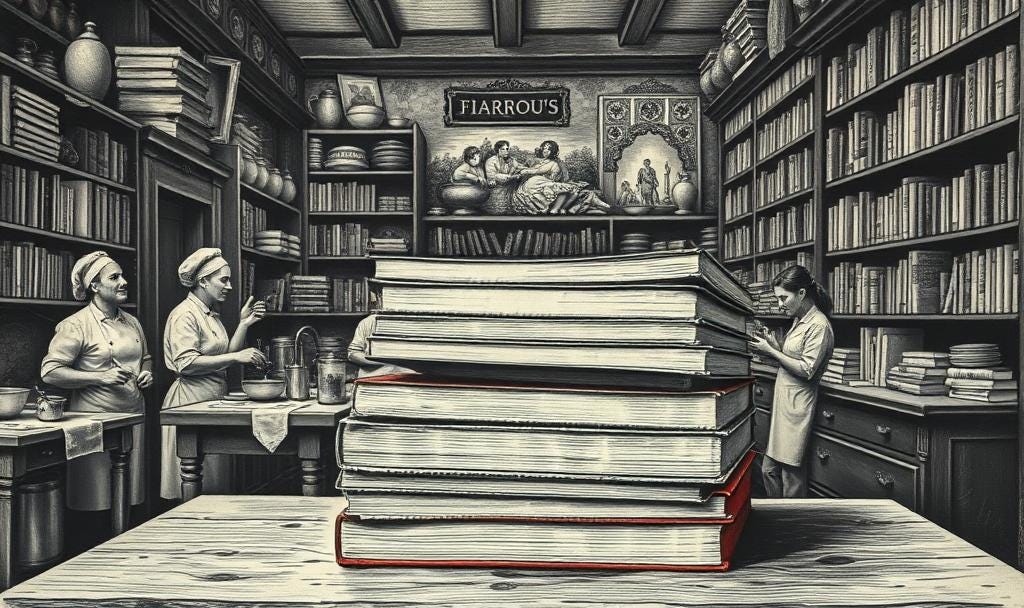
There’s a long history of painful experiences—particularly those wrought by nature in all of its horrific and awesome power—to engender new ways of seeing things. When that is a hornet at three-thirty in the morning, the flush of adrenalin and the deep brainstem assurance that death is imminent from the fire wrapping around your arm, discernment blossoms.
Earlier this week, Monsieur le Frelon did his duty, bringing on a delirium of potential insight in the guise of two books. The first, À bouche que veux-tu : Archives orales du désir et de la débauche culinaire (in English, Mouths Wide Open: Oral Archives of Desire and Culinary Debauchery). And, the second, The Tasting Room: A Novel of Appetite and Arrangement. By something—perhaps a little less than absolute serendipity—they sit only a few volumes apart in a larger collection of fantastical works, that read carefully, almost certainly reveals something beyond the shallows of my interests.
Mouths—aside from the wonderful wordplay of the title—is an intriguing exploration of the planetary traces of food (and eating) in the universe of pleasure. One governed by its own set of rules—some spoken, some stitched silently into skin or menus—and, in this book, the moments when they were broken, or bent, or consumed slowly in the dark.
Drawn from the voices of some of those who lived at the most frayed edges of ‘polite’ society—male and female sex workers in 19th-century France—Mouths offers a record not of scandal, as so many such books do in the historiography of France’s Belle Époque, but of appetite: for touch, for language, for anchovy butter spread too thick on a perfect piece of bread. The accounts are quiet, intimate, and insistently embodied. These are not confessions. They are rituals, instructions, warnings.
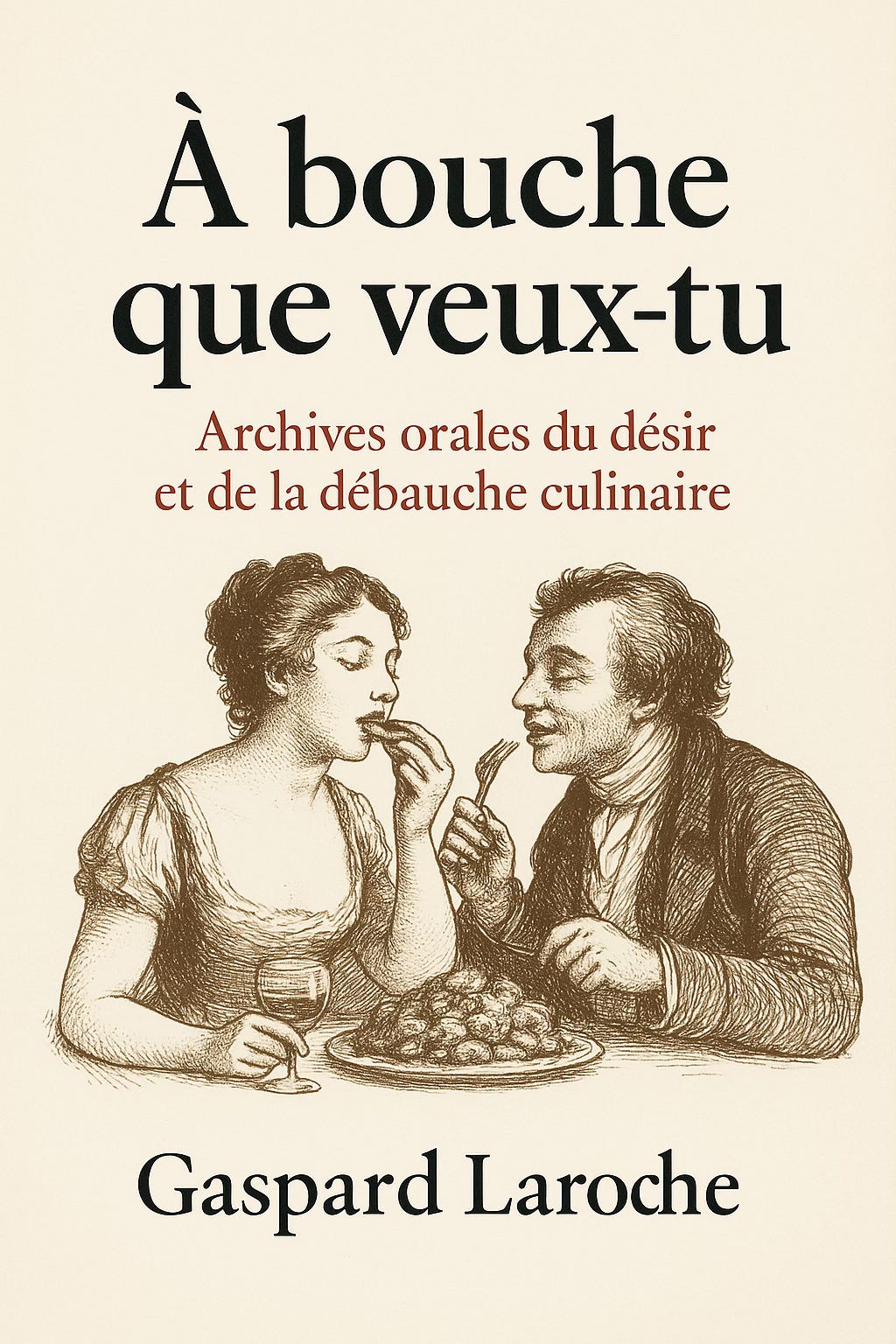
Across ten chapters, these personal testimonies—some only fragments, some rendered in lush, looping, at times lugubrious prose—detail the small ecstasies and precise preferences of the workers who labored (and loved?) in the accents and shadows of the brothels' velvet lamps. Oysters hidden under floorboards. Salted figs exchanged in lieu of cash. A roasted quail eaten naked on the rooftops of Lyon, legs still trembling in postcoital pleasure.
But the stories are more than sensory indulgence and an editor’s prurient interests. They are acts of survival, defiance, remembrance. In a world that tried to erase them, these workers built memory into the body: by eating, they marked time; by feeding others, they carved space for themselves. Food here is not metaphor—it is evidence. Of who they were, what they feared, who they loved. And what, ultimately, they refused to forget. It is a story, I suspect, of labor since time immemorial.
An example?
Recorded in 1874, Paris. From the account of “Violette,” a 32-year-old courtesan working near Montmartre.
It is not the champagne. It’s the oysters. A dozen, sometimes two. I eat them before he arrives—before anyone arrives—when I want to remember I’m alive. The sea slides down my throat and I feel it settle, cold and briny, lower than it ought to.
I once served a man an oyster from between my thighs. He paid extra, of course, but not for the reason you’d think. He said it reminded him of eating something forbidden in church. That was the word he used. Sacrament.
I have a secret pantry—just behind the screen. Tins of sardines packed in lemon oil, candied violets, a jar of preserved duck hearts that no one touches but me. The other girls laugh, but they come asking when they’re too tired to laugh anymore. Food makes you real again. Especially when they’ve paid to pretend you’re not.
And, perhaps, another?
Recorded in 1881, Marseille. From the account of “Julien,” a 27-year-old ex-sailor working the port-side taverns.
They always ask if I can eat like a gentleman. Knife in the right hand, no slurping, wine poured only halfway up the glass. I do it for them, if they’re paying. But left alone, I eat like a drowning man.
Once, after a long night with an English trader—dry hands, heavy gold ring, breath like boiled eggs—he left behind a basket of oranges, the kind with skin so thin it peels itself. I ate six in a row, standing naked by the stove, the juice running down my chest, sticky as sap.
I don’t cook, but I know how to warm oily little fish on the lid of a kettle, and I’ve taught three different men how to eat oysters without flinching. They think I’m teaching them how to be French. I’m not. I’m teaching them how not to be afraid of what’s soft, slow, and still alive.
The Tasting Room is something different, but not all the way entirely different. It is the story of Émile, an escort who demands (and offers) something very different from the usual.
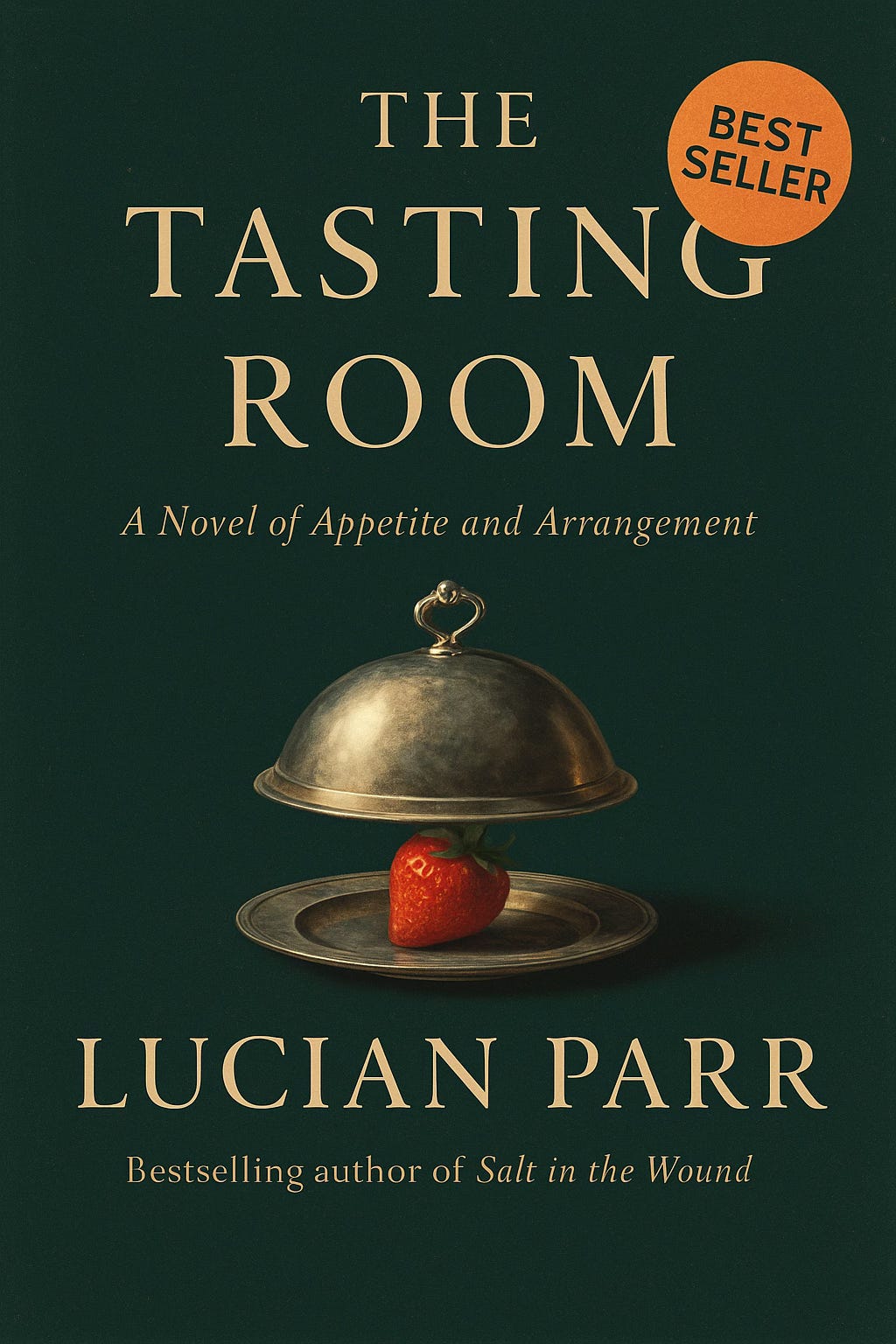
Émile trades in appetites—his clients’ first, then his own, though over time the distinction softens like an Epoisse left too long at room temperature. He offers his presence, his body, his impeccable and irrevocable silence. In return, he receives compensation not in currency as one might imagine, but in flavor: a jar of honey extracted from hives kept aboard a drifting barge on the Nile; sashimi sliced from a fish rumored to live only in a volcanic lake in Kamchatka; a single clove of garlic aged beneath a monastery floor, tasting faintly of prayers and mildew.
The women who hire him—museum donors, faded starlets, diplomats’ widows who know too much and say too little—treat him as a kind of ceremonial instrument, a sort of reliquary. They feed him, dress him, occasionally use him, and always send him away with something edible, perishable, and charged with intent.
Over time, as the books grows in scope, the offerings grow less plausible. A chilled mousse that tastes of childhood but not his own. A bottle of ice wine that can only be opened during a thunderstorm. One woman serves him something he doesn’t remember eating, but dreams of nightly for weeks.
As Émile moves deeper into this culinary and gustatory economy, he begins to lose track of what, exactly, is being exchanged. The meals begin to resemble memories; the women, rituals; himself, an ingredient.
The Tasting Room is a novel about the very, very porous border between desire and consumption, and the quiet horror of becoming the object of one’s own performance. It is unclear whether Émile is being paid—or preserved.
In his introduction at the beginning of The Tasting Room, Émile writes:
I have been paid in rose-petal liquor, in ice sculpted from the meltwater of a forgotten glacier, in a cheese so illegal it arrived inside the false bottom of a cello case. Once, a woman gave me a single fig and said nothing except: “Eat it in winter, with your hands cold."
You might call me an escort. Or a companion. Or a merchant of sustained illusion. The language doesn’t matter much. I have offered what was asked, and in return, I have received not currency, but rarity—specifically, the kind that melts, ferments, crumbles, or sings briefly in the mouth before disappearing. Payment, as I understand it, is a flavor.
What follows is not a memoir. Not in the usual sense. It is a record of transactions, arranged in courses, each marked by what was served and what was surrendered. You will find names withheld, places displaced, timelines gently poached in narrative. That is not a deception. It is a seasoning.
I began all this believing I was in control. That a man who names his price—even in Stilton, even in Tokaji—remains sovereign over his own body. That proved... optimistic.
Still, there were moments. A slice of smoked eel consumed on a Venetian balcony at four in the morning. A vinaigrette made from something untranslatable. The stillness that comes when someone feeds you and you choose not to ask why.
If you wish to judge me, wait until dessert.
These two books—improbable as they are, paired like this—work well together. One, a serious popular-academic treatment, that served as a basis for a museum show, and a good-selling glossy catalog of archival evidence, and the other a literary exegesis that was optioned for a movie, both center food as an essential and unpredictable pleasure, an experience that far removes it from pure instrumentalism.
Some years ago (as some of you, perhaps only a few remember), I ran a website called Delicious Libertine, which did a similar sort of thing, so I’m very susceptible to the world these two works evoke/promote—one in which we navigate pleasure in its myriad forms, embracing the vocabulary (and the the weird repressed frisson that wells up) of appetites sliding free from their polite social moorings.
Also, some other years ago, I wrote a performance piece along these same themes. You can read it (if you are of a delicate nature, or on a corporate network with a delicate filter, feel free not to click) here. Just imagine it being chanted into a microphone on a darkened stage surrounded by hungry souls (as all of ours’ are).
No posts
Comments
Nothing yet. Say the first thing.
Sign in to join the conversation.