
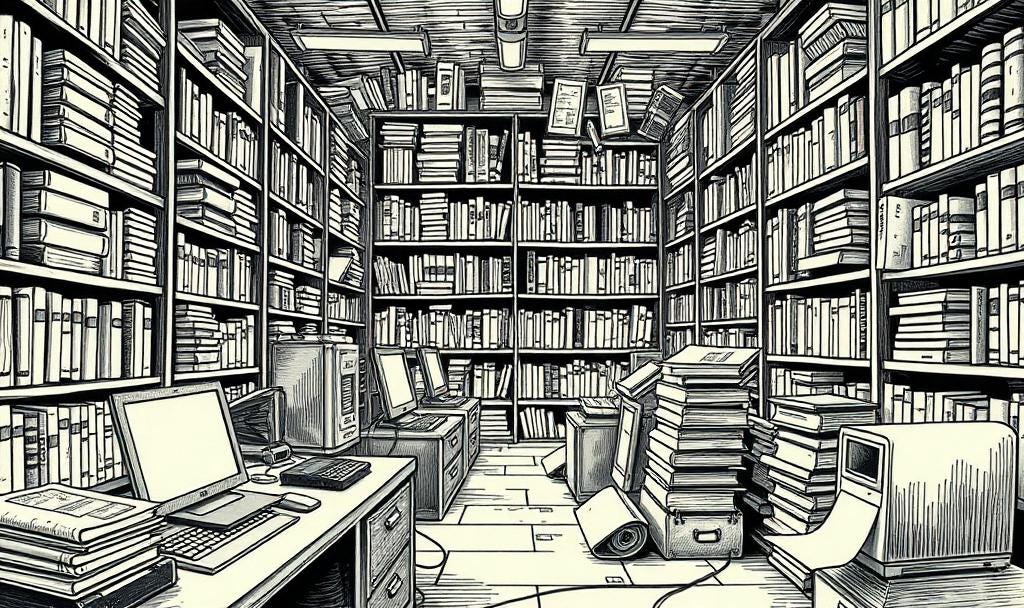
We rarely think about archives (or at least, most normal people don’t, so perhaps you and I do, but certainly not all of the time).
They sit somewhere off to the side, or in the background—dusty papyrus scrolls, boxes in climate-controlled rooms (or locked behind granite doors), vaults stacked high with arcane records, or more recently, servers humming in anonymous buildings somewhere in the countryside of Texas—holding and preserving “the record.” Not perfect, not pristine, but stable enough to reassure. While a certain group of people will argue the opposite, the past, we generally assume, is at least somewhere.
But look closer and the archive is always less than it appears. It isn’t just a building, or a cave, or an overengineered aluminum box, and it certainly isn’t a depository (complete or otherwise) of objective fact. Nor, is it passive—just a container. It reveals its own contradictions the moment you lean in.
Loss is obvious, fracture endemic. Tablets broken, inscriptions weathered, photographs curling into dust. The ravenous maw of fire, the ever-seeking damp. Libraries burned to bedrock, disks corrupted, documents misfiled beyond recovery. Whole lives, peoples, ideas vanished from the record without a trace.
But, of course, fracture isn’t only accident. It is also selection. Someone made decisions about what entered the archive and what didn’t. What mattered, what was disposable, what was too inconvenient to keep. An archive is never neutral; it is always partial, always tilted. The gaps are not just voids—they are choices.
And so, not surprisingly, even what survives is rarely coherent. Accounts overlap with nary a matching fact (people live and die, so too their archival predilections!). Reports contradict; testimonies collide. The same event appears as triumph in one folder and catastrophe in another.
The archive isn’t a clean, gilded anything. It is a heap of fragments. To shape it into narrative, you have to impose order—smoothing edges, discarding the discordant, forcing coherence. Imposing narrative.
This is why archives are fertile ground for both scholars and folks driven by the frisson of deep conspiracy and paranoia. They demand interpretation. They provoke invention. In this world, you don’t just consult the archive; you wrestle with it.
Institutions know this, but they rarely say it out loud.
Museums often arrange their collections as if they held the answers, something like a complete story. States guard their national archives with the gravity of final authority. Data companies build vast repositories under the illusion that more is enough — that capture equals truth.
Even privately, we collude. Hard drives, cloud storage, feeds: we treat them as mirrors of our lives. Until the crash, the forgotten password, the platform collapse. Then we see the cracks. Or to bastardize Nietzsche, the cracks see us.
It is nothing more than stability performance masking the reality of fracture.
An archive is never simply anything. It is what survived, or what someone allowed to survive, or what was framed as worth saving.
That makes every archive an argument—about memory, about value, about power.
Which doesn’t strip archives of importance. It sharpens it. Their incompleteness makes them generative. The gaps, the silences, the contradictions: these are the places where hard-won thought begins, where invention takes hold. The archive doesn’t hand us history. It forces us into the struggle over it.
The task, then, is not to accept the dream—never real—of the archive as complete or stable witness.
The task is to live with the brokenness. To recognize missing pieces, contradictions, odd divergences as part of the record, not defects in it. To let contradictions remain contradictions instead of hammering them into false alignment. To refuse the comfort of wholeness and acknowledge fracture as the actual condition of memory.
This is uneasy work. Completeness offers stability, firm ground to stand on. Fracture keeps us shifting. But unease is where the real work happens.
This is familiar terrain—perhaps the terrain—inhabited by a current project of mine (the same I mentioned last time—Chronoliths). Eight pieces of black stoneware, carved with a Paleolithic blade and inscribed with the oldest consistent set of symbols us humans have. Around them, an archive has been assembled — papers, fragments, recordings. Nothing aligns. Nothing resolves.
The objects themselves don’t explain. They don’t yield. And the archive around them doesn’t clarify; it contradicts, misleads, withholds. It is deliberately provisional, fractured by design.
The point is not to frustrate. The point is to make visible the condition we live with all the time but rarely acknowledge: every archive is already, necessarily, and irrevocably incomplete. And everything, especially our relationship to knowledge follows. This one simply admits it.
The honest condition is fracture. Contradiction. Silence. The archive against itself.
Look instead at the seams, the contradictions, the silence that binds them. That is the true archive. That is where the work begins. That is our hope.
No posts
Comments
Nothing yet. Say the first thing.
Sign in to join the conversation.