
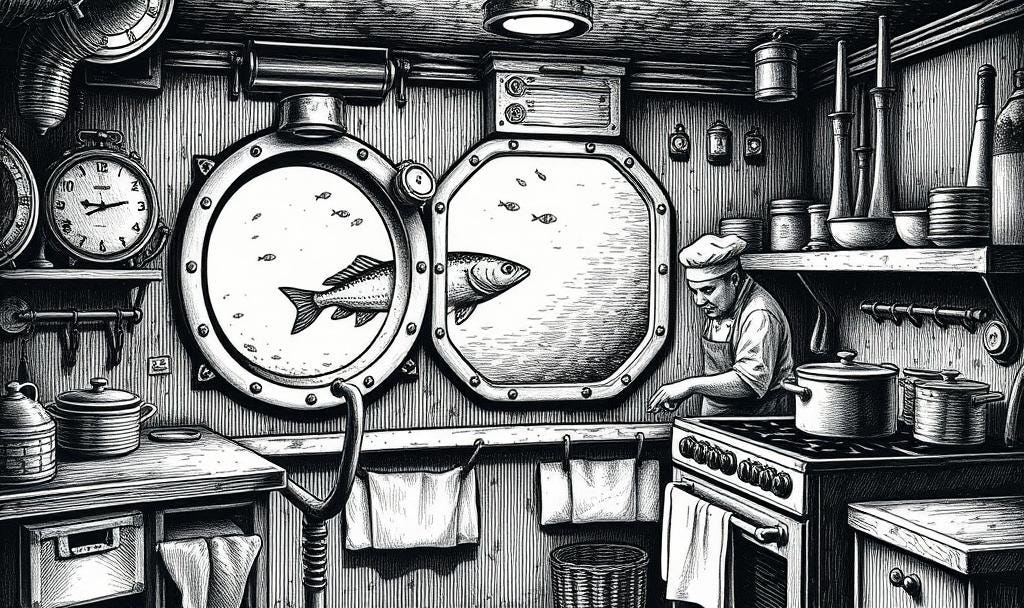
Jean-Marc Pelloux’s La Cuisine Sonore surfaced in 1997 and baffled almost everyone. Supposedly an ethnography of submarine cooking, it was written after months aboard a French nuclear sub—an assignment Pelloux claimed was about documenting morale under pressure (a clever double entendre characteristic of the academic struggle to be heard while adrift in a sea of sameness).1 Instead of cataloguing menus, he came back with a theory: lentil soup wasn’t flavor, it was droning hum. Curry wasn’t a rice and meat dish, it was percussion. A can of peaches in syrup cracked open in the galley—sweet motif in D minor, echoing through steel.
The Navy banned the book almost immediately (‘simply not serious fodder for aspiring silent warriors’—officially). Libération snickered, as only Libération could. Paris musicians got hold of the book and began performing “Sunday Curry” as a noise piece in large empty, booming-friendly urban spaces. A couple years later, Semiotext(e) published the English edition (The Sonic Kitchen) and Williamsburg basements were vibrating to Soup Drone (Silent Running Mix). On cassette no less.
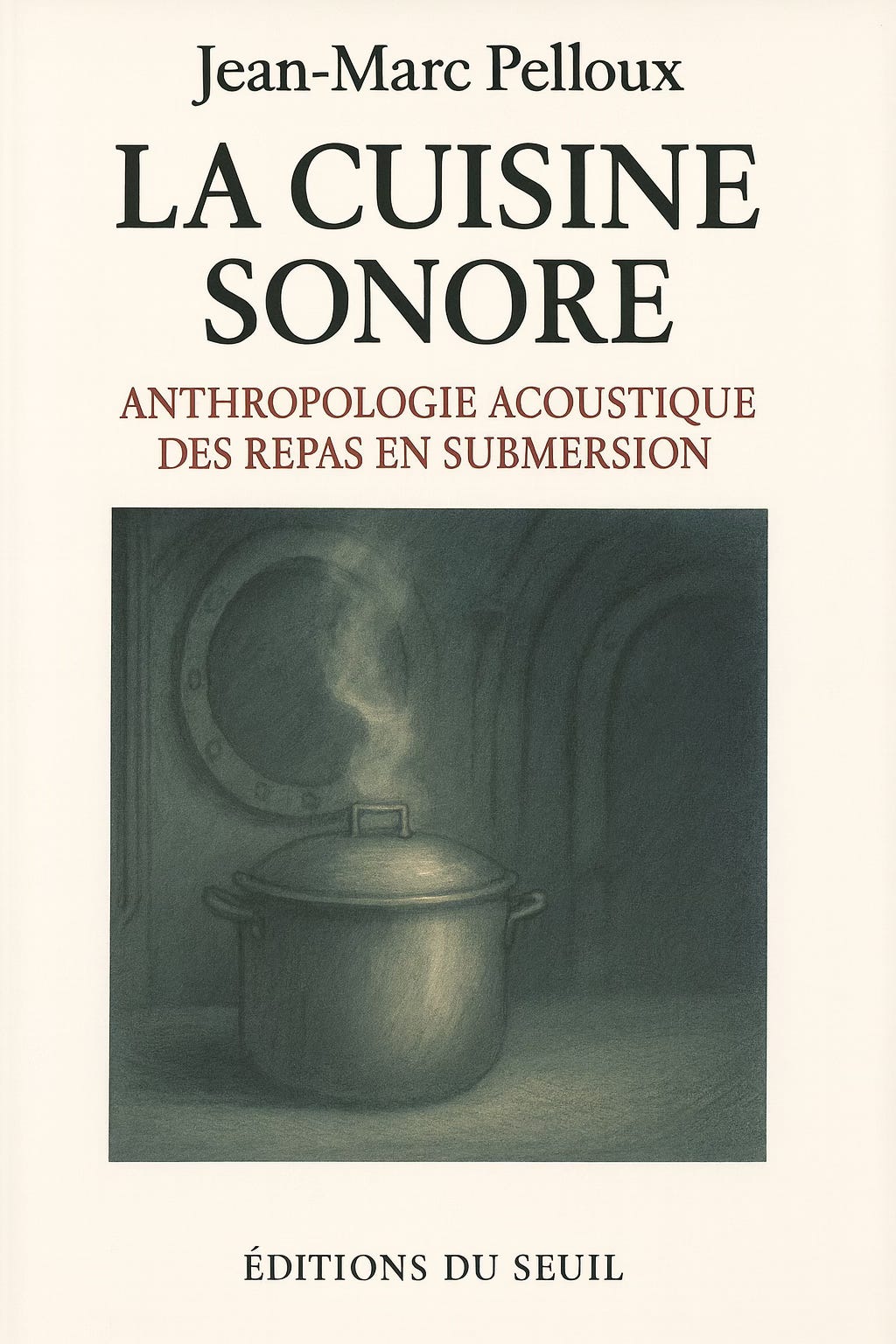
But, but, but…despite the eye-rolling, the ironic hipster appropriation (is there any other sort?), the vacillating official denials and derision, the journalistic confusion, Pelloux wasn’t wrong.
If my own, admittedly oft-times strange library is any indication, most food writing of the 1990s was paperback tourism. Glossy covers, a plate of couscous shot at dusk, terroir packaged for consumption. Provence in 120 pages. Tuscany in 90.
Pelloux went the opposite direction: down. Into a submarine. No vineyards, no tomatoes warmed by the sun. On board, freshness is gone in a week. Everything is tinned, rationed, repetitive. Meals are stripped of choice. Nothing picturesque to sell.
And yet: as it does everywhere and in all times, culture explodes. Scarcity creates pressure, and under pressure, rituals multiply. Stir lentil soup clockwise to keep the propellers turning. Exchange the rattle of a pepper jar for a small favor. Treat Curry Day as collective percussion practice. Food as survival, food as superstition, food as orchestration.
Something Monsiuer Pelloux knew fully well, claiming (most outrageously to his critics) that: every submarine meal is a concert. In a very real sense. Pelloux actually notates the rhythms of chopping onions (half-a-page). He diagrams tonal qualities of different can openers (over two pages). He describes Sunday curry as a polyphonic percussion piece worthy of Pierre Boulez.
The critics sneered—John Cage with a ladle. But Pelloux was tuned to something obvious. Meals are temporal. They unfold. They shape mood, rhythm, atmosphere. Anyone who has lived near a kitchen or worked in one knows this: you don’t just smell dinner, cook dinner, you hear dinner.
Pelloux simply pushed the point until it snapped (with the sound of a resinous bow giving way): cuisine is also music.
It was not all about the rhythm and the harmonies; he also catalogued the taboos, the never-dos, the never-eats. Flatfish cursed. Sardines dangerous if opened backwards. Stir the wrong way, and you risk the whole mission.
Even here, though, Pelloux (probably) hasn’t lost entirely the beat. Under pressure, of course, ritual can become architecture, a support for other things. He records stories of tins that grew heavier over time, jars that resealed themselves, food that behaved as if it had a will of its own.
The naval brass called it nonsense. But sailors swore by it. Food became the place where chance, danger, and hope could be managed. You chew to live, but you also chew to keep the boat afloat.
Pelloux refused the clichés of food writing. He gave us the claustrophobic. The hiss of oil at midnight. Men nibbling silently during stealth protocol. The repetition of lentil soup until it became not a meal but a background hum, almost geological, and certainly chthonic.
He stripped food of the tourist gloss and gave us the other. Foodways as culture, yes, but culture under duress.
For all of this, the book stuck around on reading lists in anthropology departments because it was both serious and absurd. It forced readers to listen differently. It turned the galley into a soundstage, made the ordinary orchestral.
As we’ve learned in the thirty years since, foodways are not just plates and flavors. They’re rhythms, noises, taboos, improvisations. They exist in market squares and Michelin restaurants—but also in steel tubes, in scarcity, in silence. This was—and continues to be—a good lesson.
Look, I know, four instances of punning—of pundigrions—not only in a single paragraph, but in a single sentence—things are slow here in the country. Sorry, not sorry.
No posts
Comments
Nothing yet. Say the first thing.
Sign in to join the conversation.