
Every TASTE | Pacific Northwest post is human-created: personally written, personally read to you… with every human flaw.
TASTE has gratitude for every subscriber. Our particular thanks to our paid subscribers, our TASTE Buds, whose generosity supports every reader.
Buy a Slice of Roasted Pear Galette
Share TASTE | Pacific Northwest
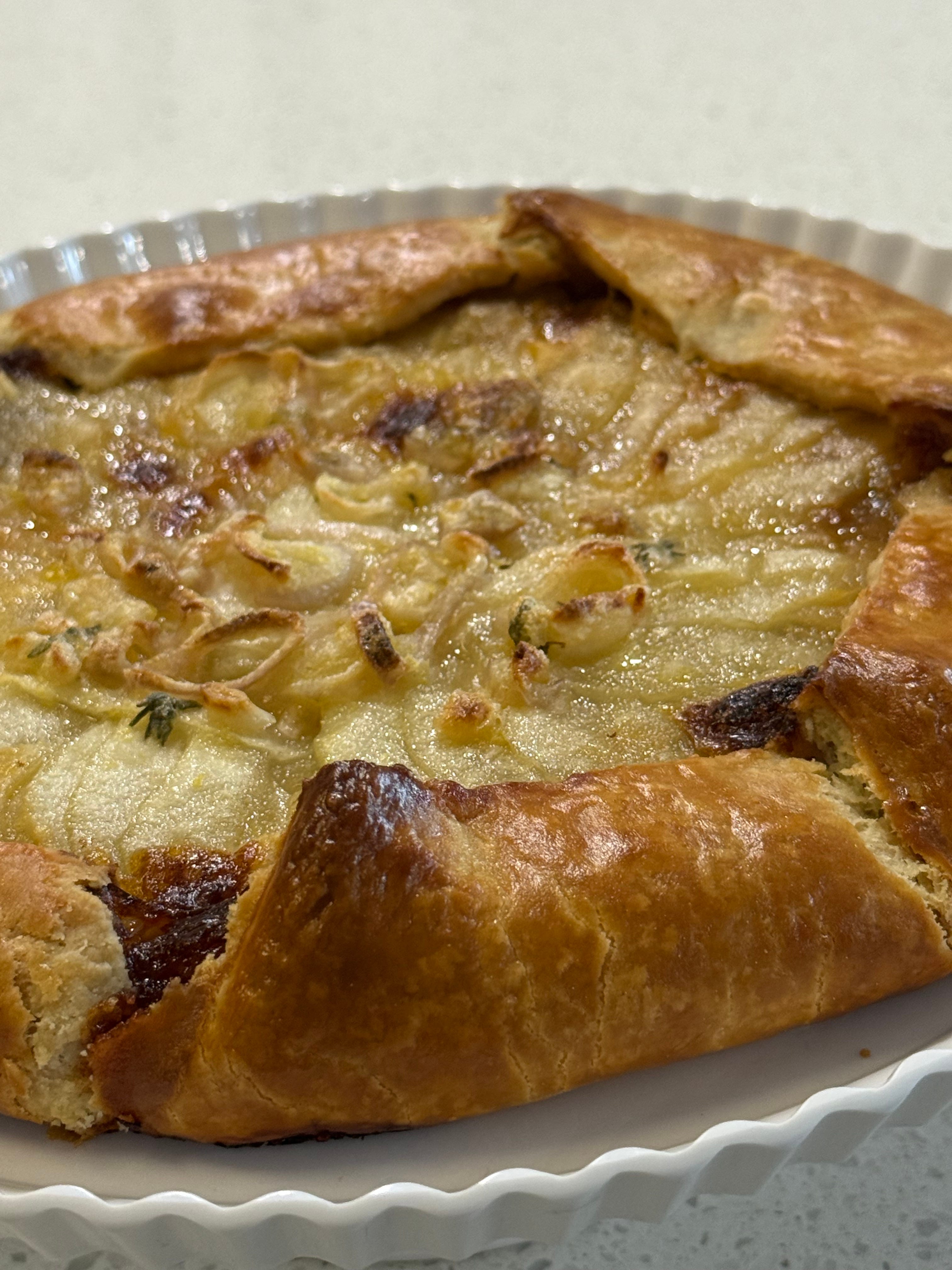
The soil of my early youth was rich in the safety of a Midwestern community that time forgot. A deep arboreal canopy safeguarded unlocked doors and small class sizes brimming in the arts. A home was forever known as belonging to your family ~ but only after you no longer owned it. “There’s heaven, then there’s Terrace Park,” my father would say.
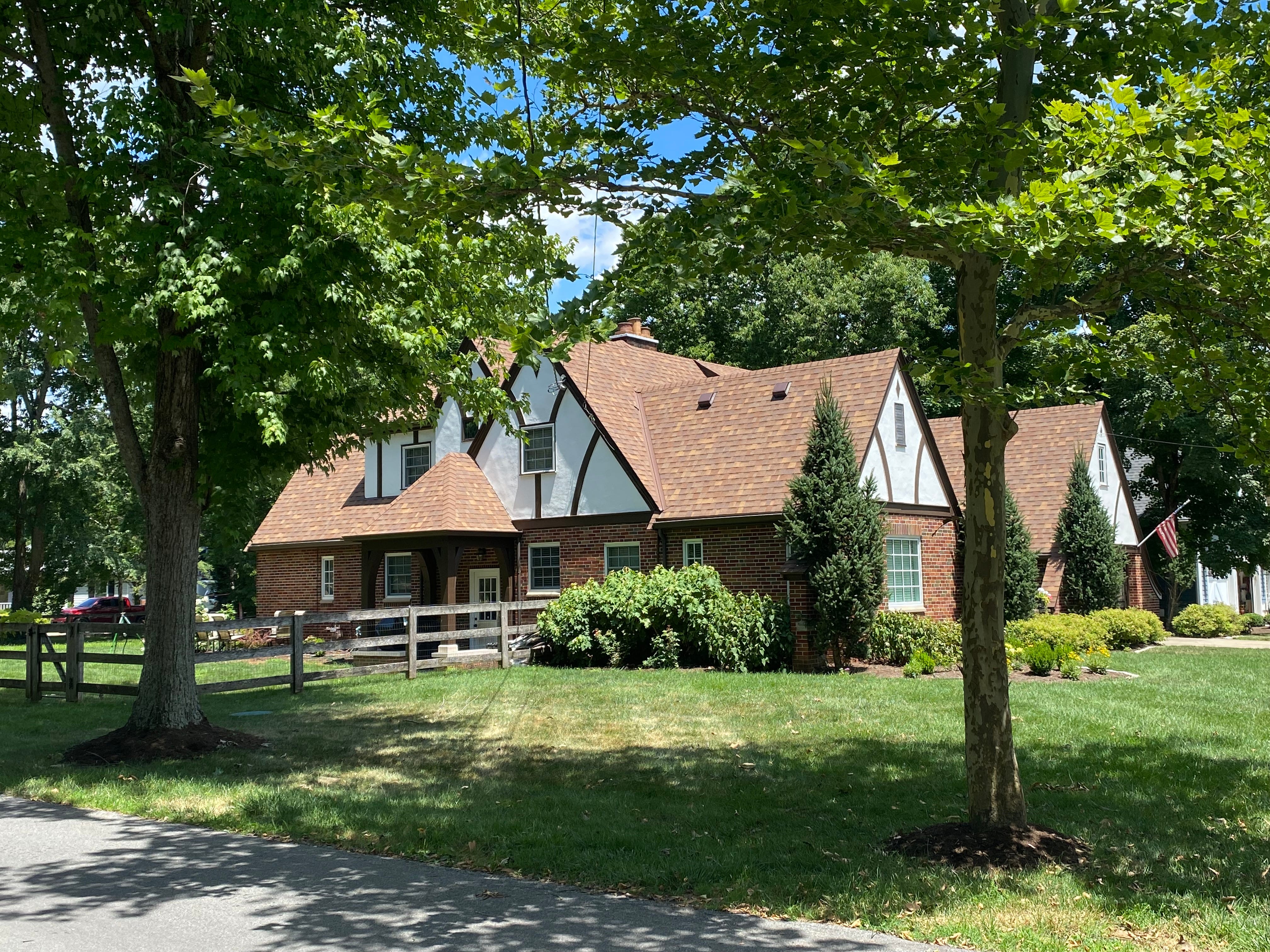
Our family’s estrangement from cooking would seed the quiet ache in me of not knowing what I wasn’t taught. More prominent to my brothers’ and my experience of the sixties was the upwardly mobile parental malaise of barbiturates and alcohol. I would later understand the cost of how a void of healthy modeling shapes one’s own capability beliefs.
Though both of my grandmothers were cooks ~ creative Depression-era masters of managing miniscule food provisions ~ the cooking gene leapt over my adoptive mother. Shiny portioned aluminum trays with peel-off covers steaming hot from the oven were her lifeline.
In the flash of a pan, I discovered the name of my birthmother, made all the more remarkable by my father’s offer to act as intermediary in meeting her ~ if she so desired. In less than a week, I sat across a restaurant table from the same blue eyes. “We have a large family of our blue eyes,” she said. And a large family of cooks.
There was emotional dissonance in belonging and not belonging to two families: my home family and my birth family. I was about to learn that food can, indeed, be an inheritance even when it arrives late.
What does it mean to inherit culture at age thirty? I fit in neither family; yet, I was the product of both. I wouldn’t know until decades later that I, indeed, had my own cooking style ~ a style I shared with Chef Edna Lewis, widely revered as the doyenne of American Southern foodways. At work had been an unseen creative partnership.
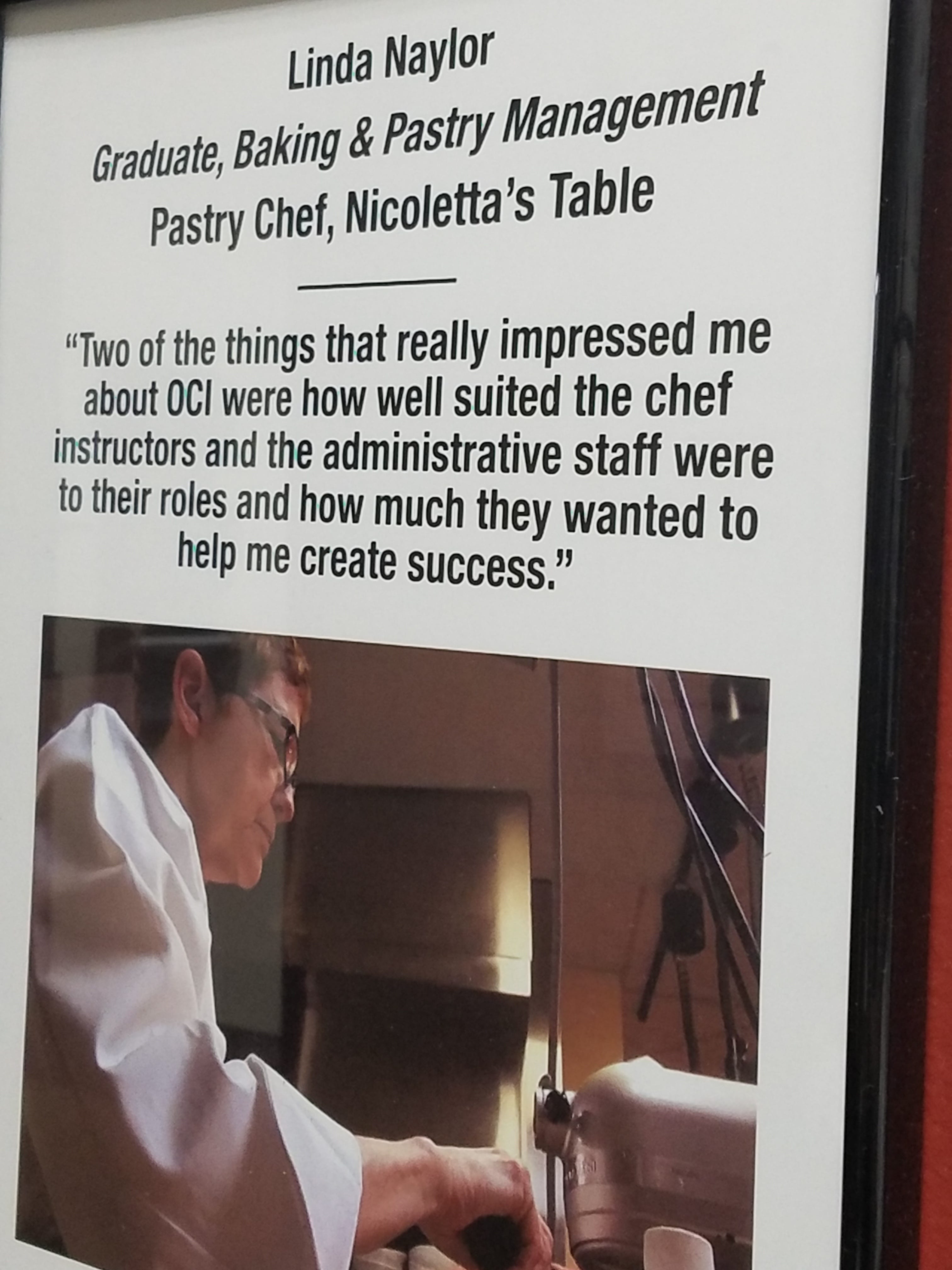
Fifty-seven years after my early elementary school days, the day-one impact of having exclusive responsibility for dining room and catered desserts, plus inventive specials and retail confections, had yet to land. Chef-coated in the early morning hours of the restaurant kitchen with a Baking & Pastry Management degree in my pocket, I was my own version of the fresh-faced eighteen year-olds polishing their shiny futures on day one of culinary school two years earlier.
I had not yet realized that lifting fifty pound bags of sugar and flour were about to relieve me of an entire clothing size.
In short order, I learned to value a pastry chef’s autonomy. My 24”x36” station was the culinary eye of the hurricane. Dedicated freezer and walk-in refrigerator space were highly prized. Savory kitchen staff buzzed everywhere. I had exclusive use of a high-end confection oven (which I had no idea how to operate) and shared use of a blast chiller, both of which I would come to love and hate (I hated the blast chiller only because I didn’t want to share it.). Front-of-house staff whipped by the pastry station like commuters running for a train.
The station was my own cloistered domain. In a previous life as an independent contractor, I hadn’t reported to anyone in twenty-five years so I gave silent thanks for Chef’s quiet personality as, can I say, not the industry standard. He had his own hands full fielding the owner’s menu, wine dinner and event ideas, and covering staff no-shows.
The six-week pastry internship I had earned and just completed at two of Vitaly (Vito) Paley’s restaurants, ~ the fine dining Paley’s Place, a James Beard Award winner; and Portland’s big downtown restaurant, Imperial ~ were my first tastes of restaurant world.
I recognized quickly that my natural ability to do three things at once was an exact fit for a professional kitchen.
Because my interest in flavor development is both savory and sweet, I’m always attracted to their convergence. Savory pastry recipes abound in every culture as both elegant and functionally simple.
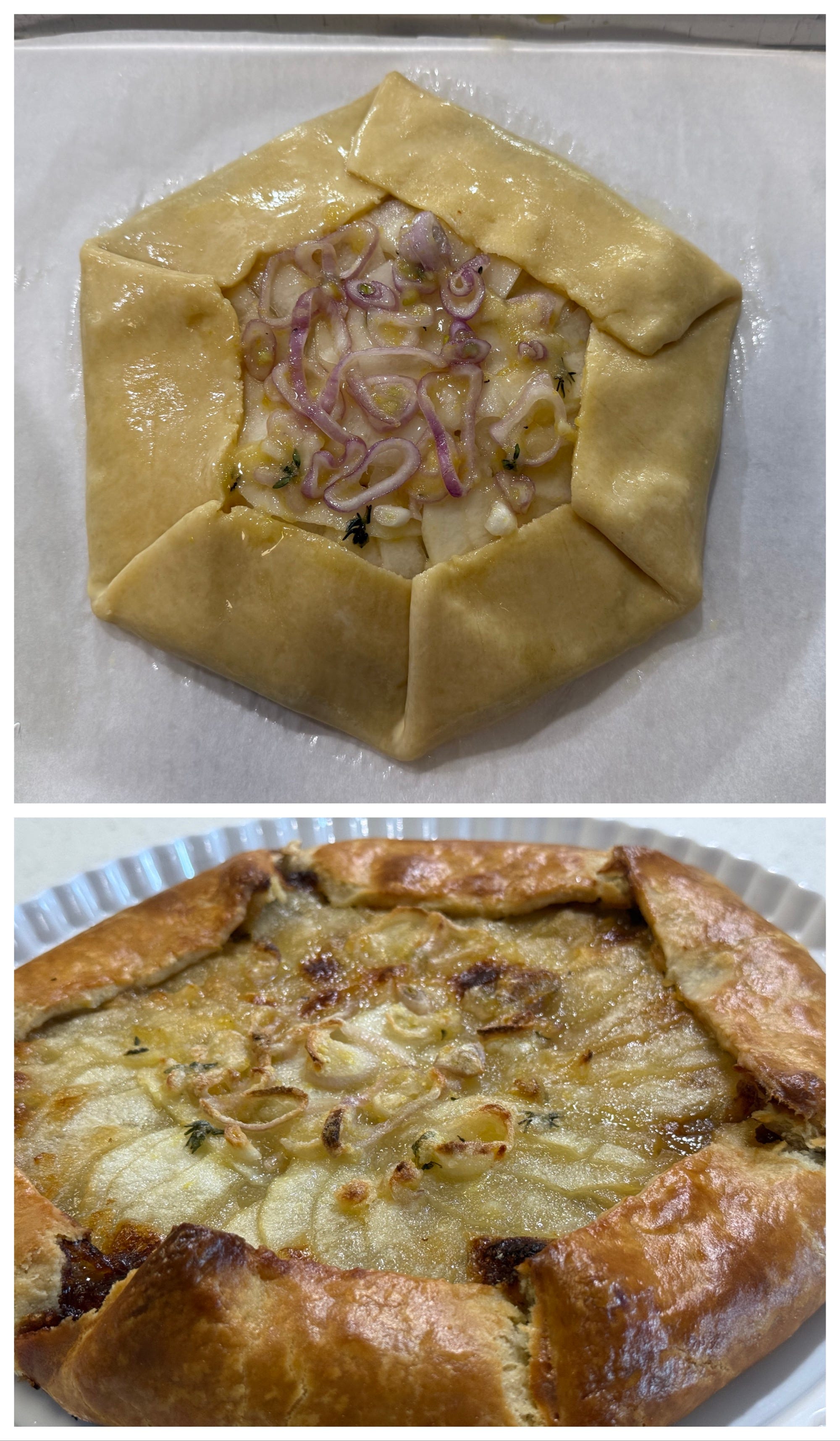
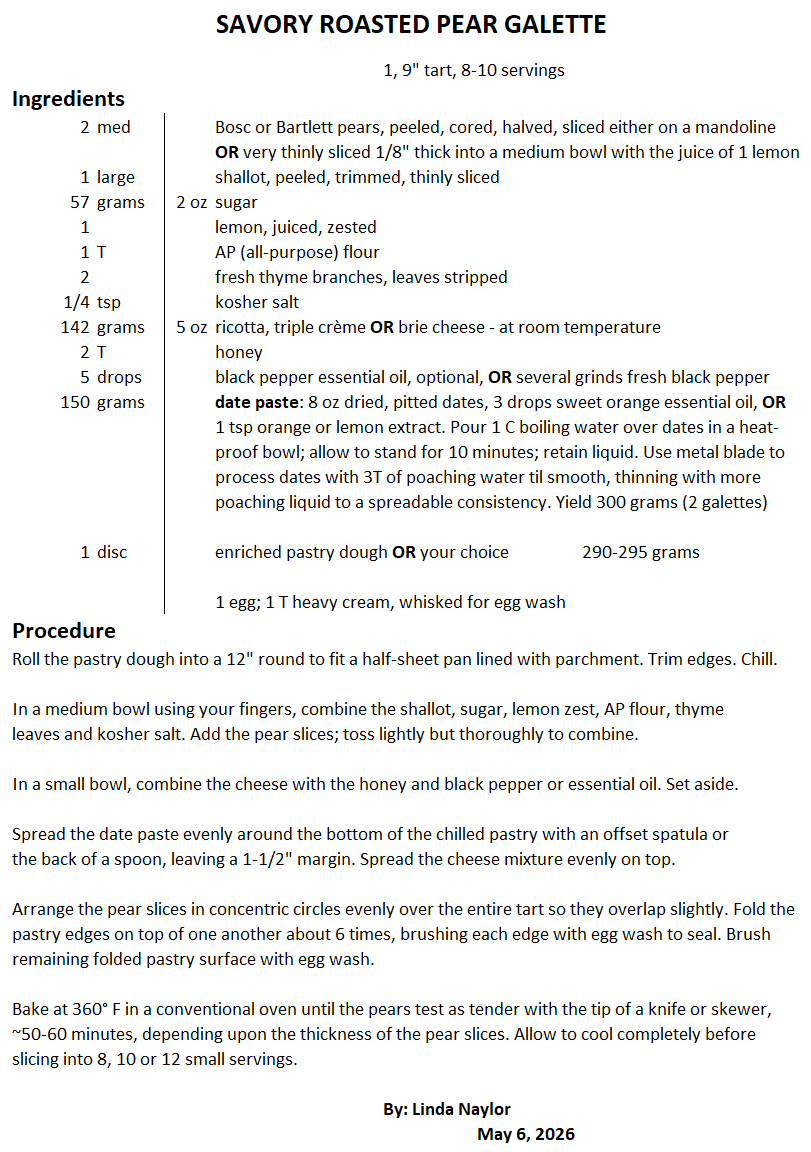
Meet Savory Roasted Pear Galette.
Headnotes
The berry and stone riches of the Pacific Northwest scream for the simplicity of galette. Yet, a savory fruit tart or galette is special, indeed.
You’ll notice a number of ORs in the ingredient list: “pears sliced on a mandoline OR very thinly sliced 1/8” thick; ricotta, triple creme OR brie cheese; black pepper essential oil OR freshly ground black pepper; sweet orange essential oil OR orange or lemon extract; 1 enriched pastry dough disc OR your pastry dough choice.” These are flexibility markers to encourage you to use what’s in your pantry or cheese drawer or spice cabinet.
The best indicator of how good this galette is was when I served it this past weekend to nine super-svelte women; I turned around moments later to see that each of the 12 skinny slices I had plated were gone.
Do embrace the intersection of savory and sweet. Please resist the temptation to glaze the baked galette with warm apricot jam. Too sweet. Let the savor shine!!
Thank you to every TASTE | Pacific Northwest reader.
If you enjoy learning how to coax out flavor; if you feel inspired to protect the beautiful food environment around you; if you enjoy more personal essay as I steady and steer my writing sea legs, you’re very welcome to push the Subscribe button.
Perhaps, even share with a friend. It’s nice to share.
TASTE | Pacific Northwest includes a voice for the land and the simple riches of our food system.
Linda Naylor is an encore-career chef with a passionate fire for helping others learn to love our food system and the land that supports it. She teaches simple techniques to enhance flavor, and to help readers enrich their own lives through food, wherever they live.
Your subscription today directly funds the research and advocacy needed to keep these scents and flavors, and the beauty of all our treasured environments, alive.
A note. Our use of a tilde in text is an homage to the brilliance of Judy Rodgers’ The Zuni Cafe Cookbook. Please never mistake it for AI.
Likes, Comments and Restacks are highly prized! Please click on the ❤️ icon to let the algorithm know our work is worth supporting.
Comments
Nothing yet. Say the first thing.
Sign in to join the conversation.