
Every TASTE | Pacific Northwest post is human-created: personally written, personally read to you… with every human flaw.
TASTE has gratitude for every subscriber. Our particular thanks to our paid subscribers, our TASTE Buds, whose generosity supports every reader.
Share TASTE | Pacific Northwest
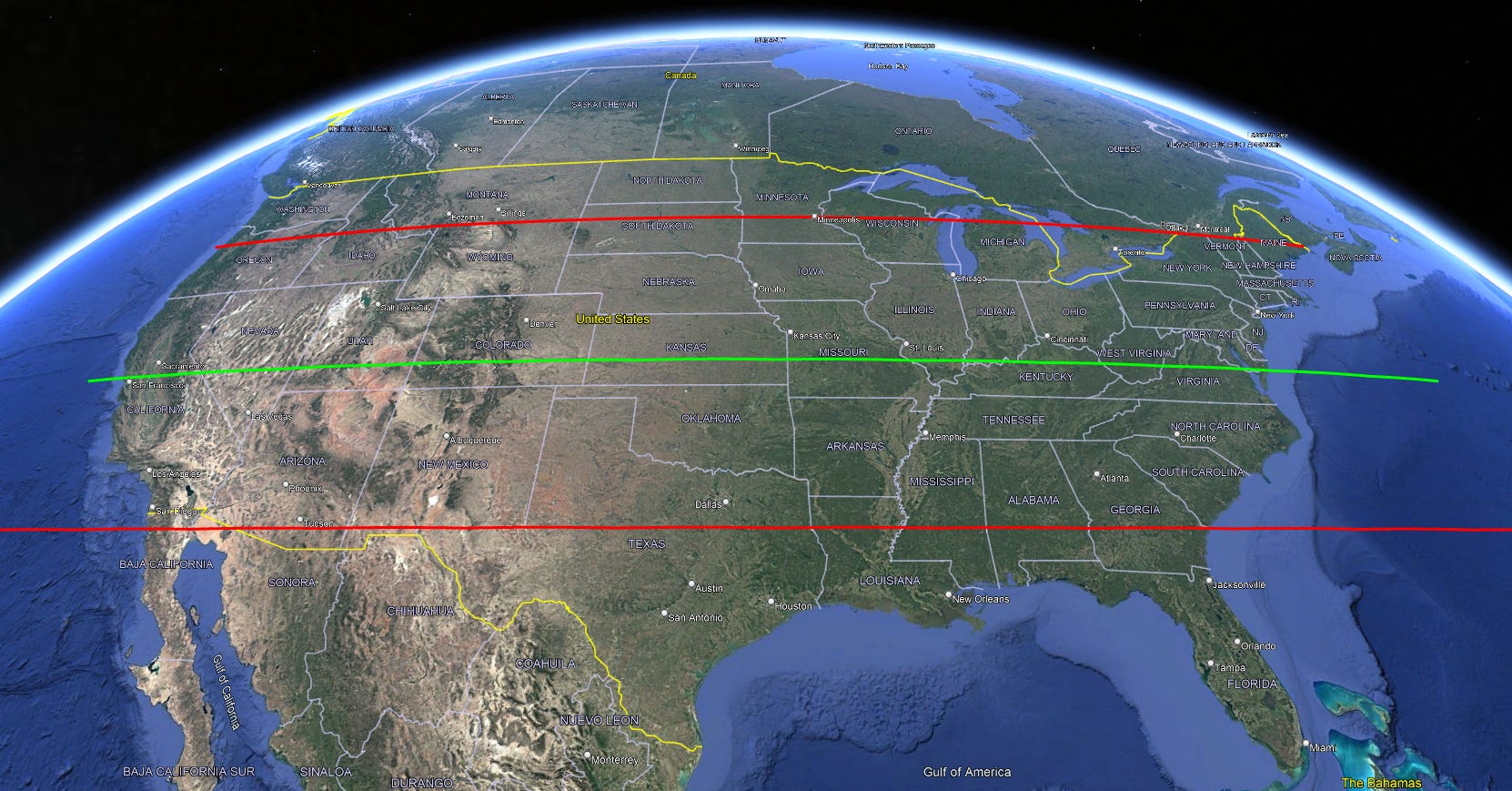
Regardless of your locale, there are fascinating similarities region to region that tie together on Earth’s latitudinal markers. In the United States, the 45th parallel north cuts through Oregon, Idaho, Montana, Wyoming, South Dakota, Minnesota, Wisconsin, Michigan, New York, Vermont, New Hampshire and Maine.
Though their weather patterns, elevations and topography are extraordinarily different, states on the same latitudinal lines possess some valuable similarities in how their crops proliferate.
My unwavering commitment to defending our democracy leads me to think of U.S. regional foodways more broadly than just state by state. Each state has its nuance, of course, via ancient rivers and oceans, ice ages and volcanic definition, but each is part of a larger regional foodway that should elicit mutual respect.
My perspective on regional foodways is that of a constantly curious chef and food writer.
My voice contributes to deepening our appreciation of food, and to improving how we eat, how we cook and whom we credit as models of American foodway insight and equanimity.
Like you, I depend upon others as experts in fields that support my interests.
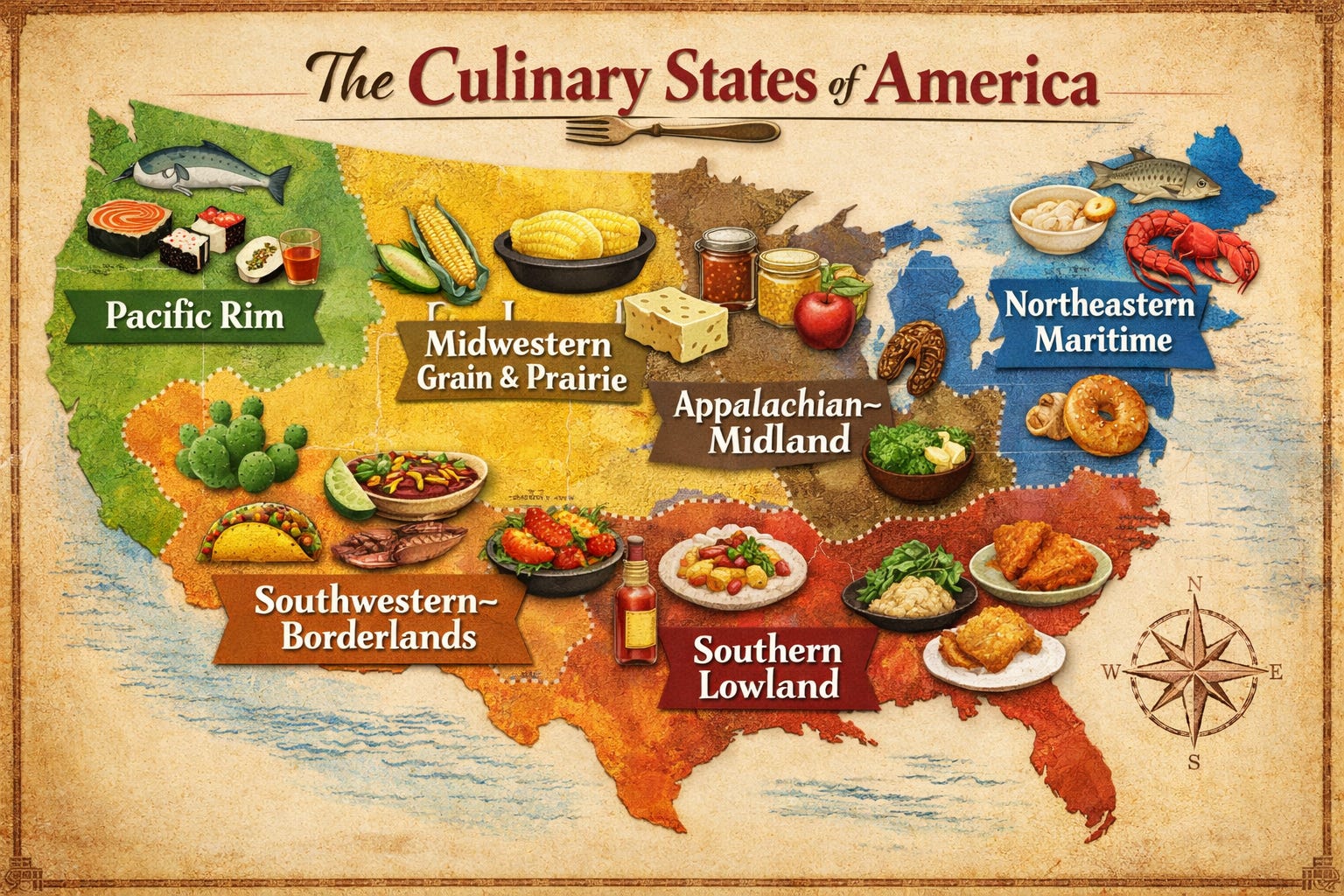
Based upon my own regional foodway research, I’ve asked AI to create an infographic of one very interesting interpretation of our national foodways, which you see above.
This is a view of six bioregional foodways, the major regional qualifiers of each are soil type, water and migration: what food the soil type will allow; the availability (or lack) of water to support that growth; and what the resident population desires to grow and eat.
This map reimagines the United States as a living mosaic of food ecologies. Food ecology is the study of food production processes and the impact those processes have on plants and animals. No matter where we live we are seeing loss of habitat; water shortages (disappearing lakes, dry river beds, lack of needed precipitation); and fewer species of animals we had grown accustomed to sharing our little world with.
The six bioregions are: Northeastern Maritime, Appalachian-Midland, Southern Lowland, Midwestern Grain & Prairie, Southwestern-Borderlands, and Pacific Rim.
We’ll be more closely revisiting these unique regions in an upcoming post. In each case, the regions are defined by type and temperature of available water (deep cold water, aquifer or well irrigation); early cultural food preferences (Indigenous, Italian, Jewish, Portuguese, African, French, German, Scandinavian, Polish, Mexican and Asian); and growing techniques they adapted based on soil quality.
What are you noticing in your changing environment? Changed or lost resources?
In your area, has it ever been possible to purchase close to the food chain?
Are your regional food preferences changing due to lack of systems to support them?
How are changes in water and fertilizer availability affecting your region?
What limitations (or eliminations) in access to your foodstuffs ~ at markets, retailers, distributors ~ are you seeing?
What do growers or retailers tell you about how their businesses are changing?
The irony of loss of food habitat is not poetic. Post WW I, California’s Santa Clara Valley is said to have been home to 79,000 acres of fruit orchards of apricots, prunes and cherries. Lovingly, it was known as The Valley of Heart’s Delight.
With the exception of three “heritage orchards” protected by communities such as Sunnyvale, Los Altos and San Jose, those orchards are gone.
What does this mean in the context of today’s orchardists, growers and farmers? Without the availability of cheap land and an already flourishing business environment, Santa Clara Valley would not have evolved into the world’s tech powerhouse it is today.
We know the Santa Clara Valley today as Silicon Valley.
Seizing land through speculation is a today problem.
Today, we cannot carve out our own food interests to the exclusion of the world around us. Many of us enjoy the luxury of specializing in certain regional cuisines, in other savory or sweet cooking, or even writing as food historians. It all has value. Yet, we need not look deeply to realize that the convergence of food and the environment is all one grand subject.
My Baking & Pastry Management degree included mixology, cost and labor management, food ethics, oenology, sustainable business practices, urban farming, restaurant management, and learning to partner with local farmers, ranchers and fishermen.
Conversation on these topics matters to us all. Our eating habits are shifting. Availability of once-plentiful basic ingredients is waning ~ while simultaneously becoming more expensive.
How can we better understand the challenges our entire country faces?
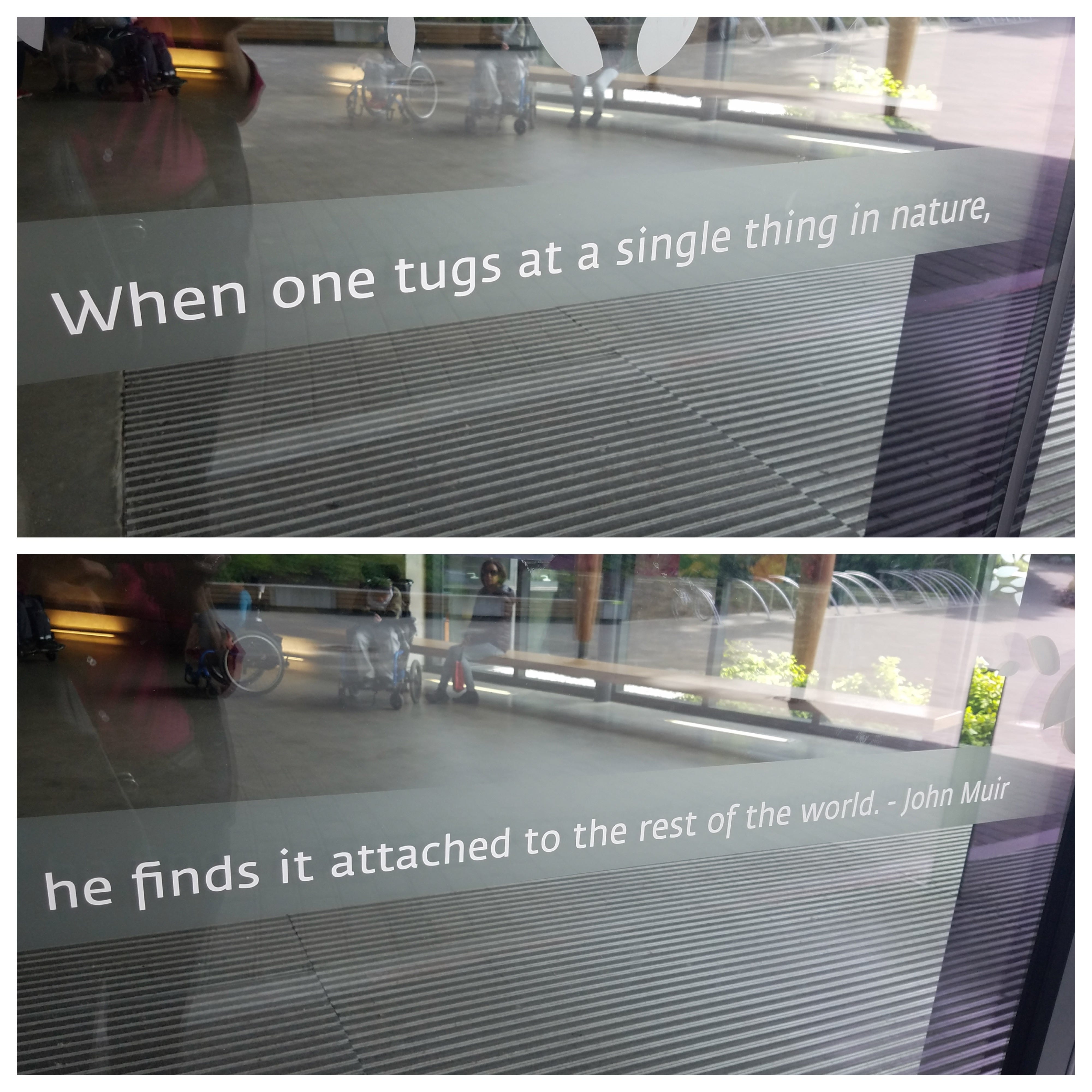
“They [We] need to establish a more relevant politics than the competitive politics of nation-states. And to found economies built not on profit but on conservation.” Barry Lopez, Horizon
Whom in your bioregion can you support to insist on solutions to the food challenges we face? Whom might you influence to do the same?
TASTE | Pacific Northwest includes a voice for the land and the simple riches of our food system.
Linda Naylor is an encore-career chef with a passionate fire for helping others learn to love our food system and the land that supports it. She teaches simple techniques to enhance flavor, and to help readers enrich their own lives through food, wherever they live.
Your subscription today directly funds the research and advocacy needed to keep these scents and flavors, and the beauty of all our treasured environments, alive.
A note. Our use of a tilde in text is an homage to the brilliance of Judy Rodgers’ The Zuni Cafe Cookbook. Please never mistake it for AI.
Likes, Comments and Restacks are highly prized! Please click on the ❤️ icon to let the algorithm know our work is worth supporting.
Comments
Nothing yet. Say the first thing.
Sign in to join the conversation.