
I’m an encore career chef living in a place I couldn’t imagine loving more. I use TASTE | Pacific Northwest to advocate for immersing ourselves fully in our own food locale, for using every cooking adventure as a learning-teaching experience, and for protecting the food and land resources that allow us all to thrive.
TASTE has gratitude for every subscriber. Our particular thanks to our paid subscribers, our TASTE Buds, whose generosity supports every reader.
Every TASTE | Pacific Northwest post is human-created: personally written, personally read to you… with every human flaw.
Send a Bit of Cascadian Gianduja Cake
Share TASTE | Pacific Northwest
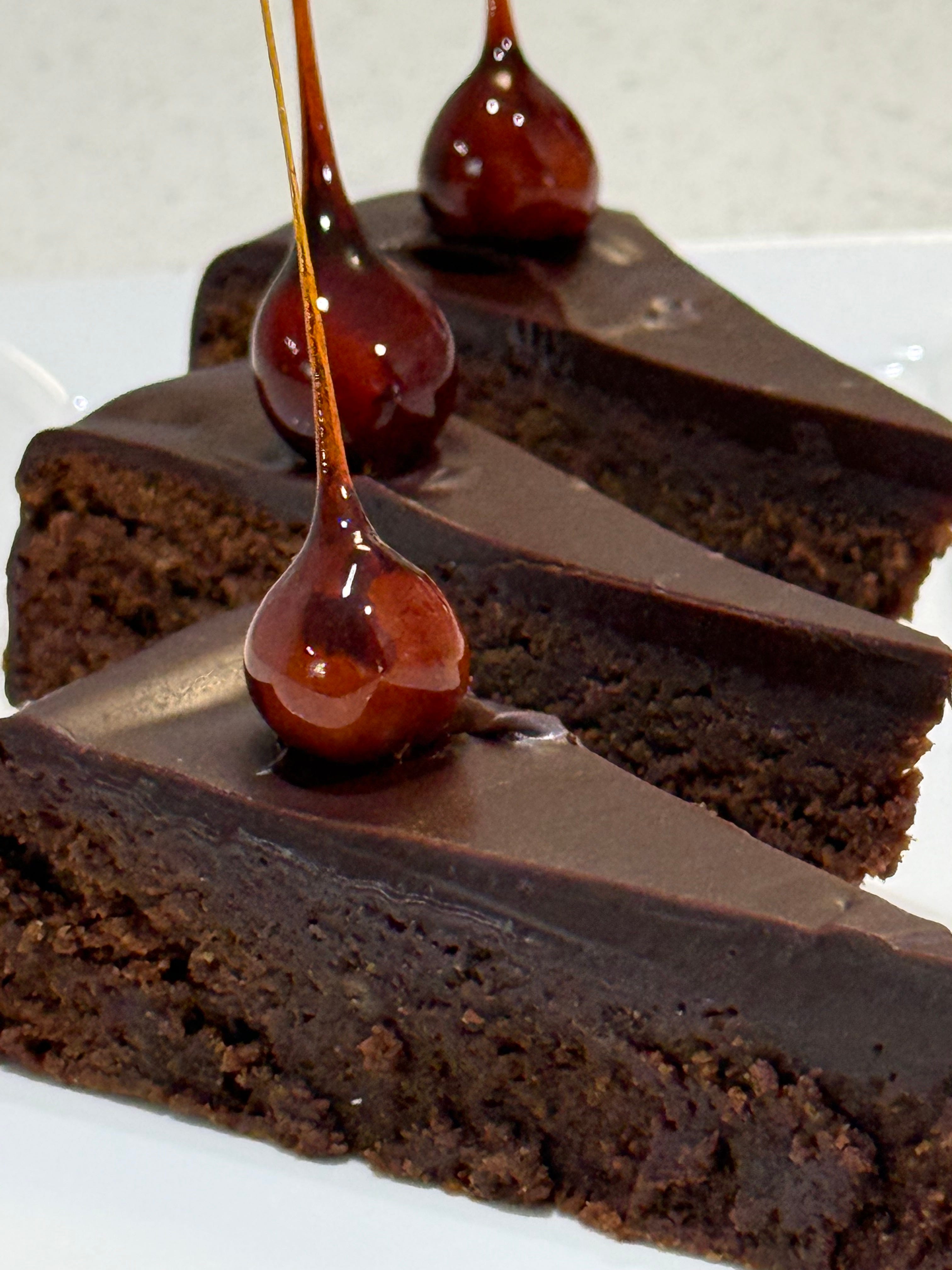
Ansel Adams used the analogy that the photographic negative is simply the foundation from which the print is the expressive, interpretive act.
There is no better way to express how a well written recipe acts as a foundation for our baking. Thoughtful edits make the recipe ours uniquely.
Let’s pause for a moment to demystify recipe creation. We all stand on one another’s shoulders when it comes to recipe development. What we learn from others we’re able to teach.
Anyone with a sincere interest in cooking is capable of creating unique, successful recipes.
One of the best ways of learning is understanding what makes others’ great recipes work.
My attraction to cookbooks goes beyond the benefit of having a special meal resource, or simply enjoying beautiful food photography.
Not every project can be said to be a success, nor need it be, but every project can be a learning experience ~ and fun ~ for home cooks and professionals alike.
Of the, say, 105-110 cookbooks / nutrition books / culinary textbooks I see on my shelves, three very prominent books are brand new to me.
How are they similar?
Jacques Pepin’s fiftieth anniversary edition of Jacques Pepin Complete Techniques, is a tour de force of Chef’s technical skill and a distillation of his years of practice at refining his (our) craft.
600 techniques | 1,000 photographs | 160 recipes
I bought the book for Paul Caloca and me as a true desk reference… because we’re still eager learners.
The second book was one I pre-ordered last fall for a very specific reason. The Noma Guide to Building Flavor by Chef Rene Redzepi and the Noma Test Kitchen, is a resource I’ll be using heavily over the next couple of years as I flesh out my own baking cookbook. The Noma Test Kitchen has revolutionized unique ways of developing flavor.
The book is the convergence of the efforts of many, many intuitive and research-driven cooks.
Pickling, Preserving, Salts, Spice Mixes, Oils, Butters, Broths, Reductions, Skins, Caramels, Fudges, Pastes, Sauces and Sweet Flavors
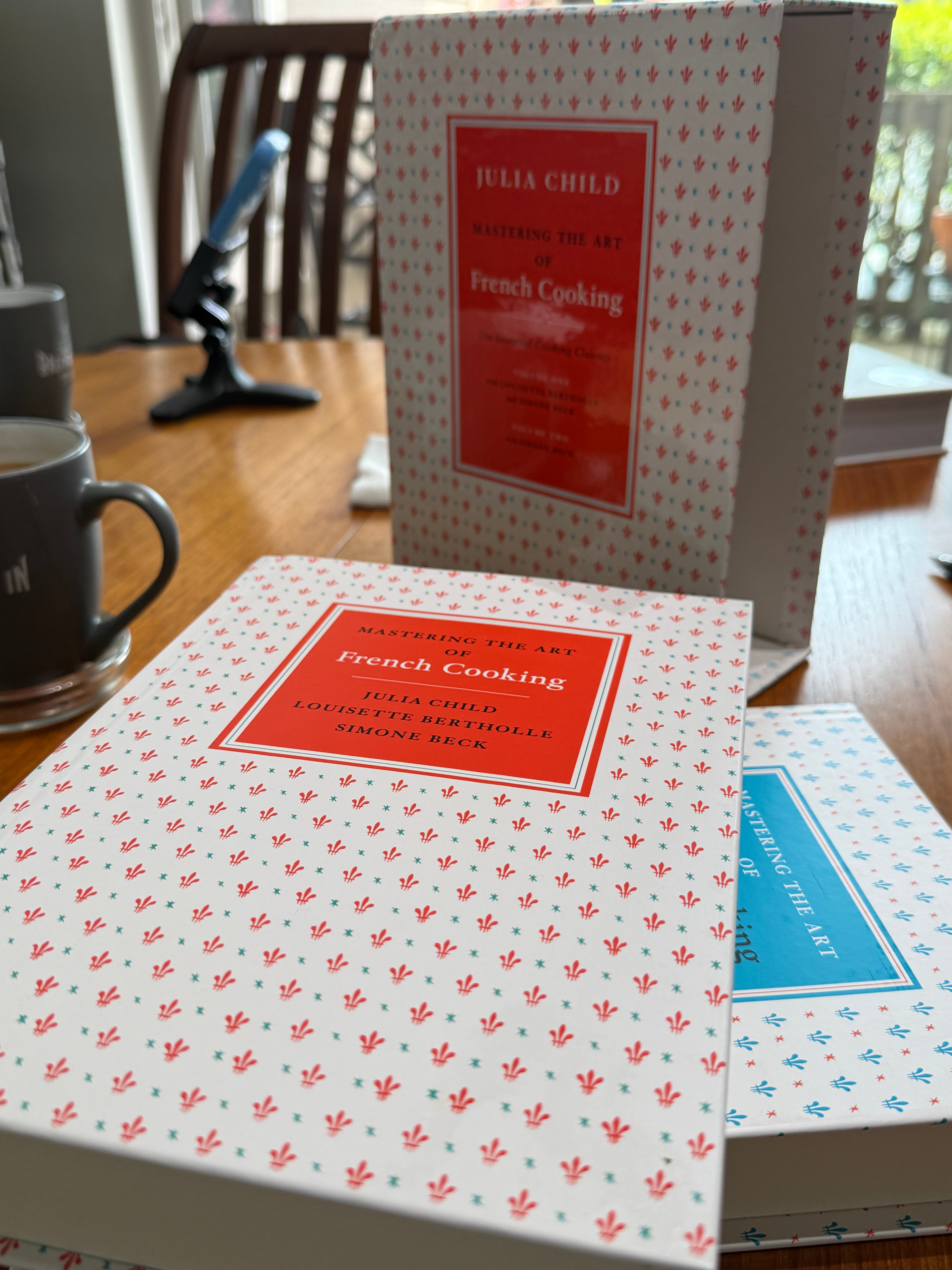
The two-volume set of Mastering the Art of French Cooking by Julia Child, Simone Beck and Louisette Bertholle ~ now in its thirty-ninth printing ~ was a recent, surprise gift from Paul when he realized that I didn’t already own them. My inventory of Julia’s books includes numerous other titles. She has her own space on my Metro rack bookshelf.
Note the similarity? They’re all true teaching books.
We’ll discuss the “Techniques” and “Noma” books in a different post.
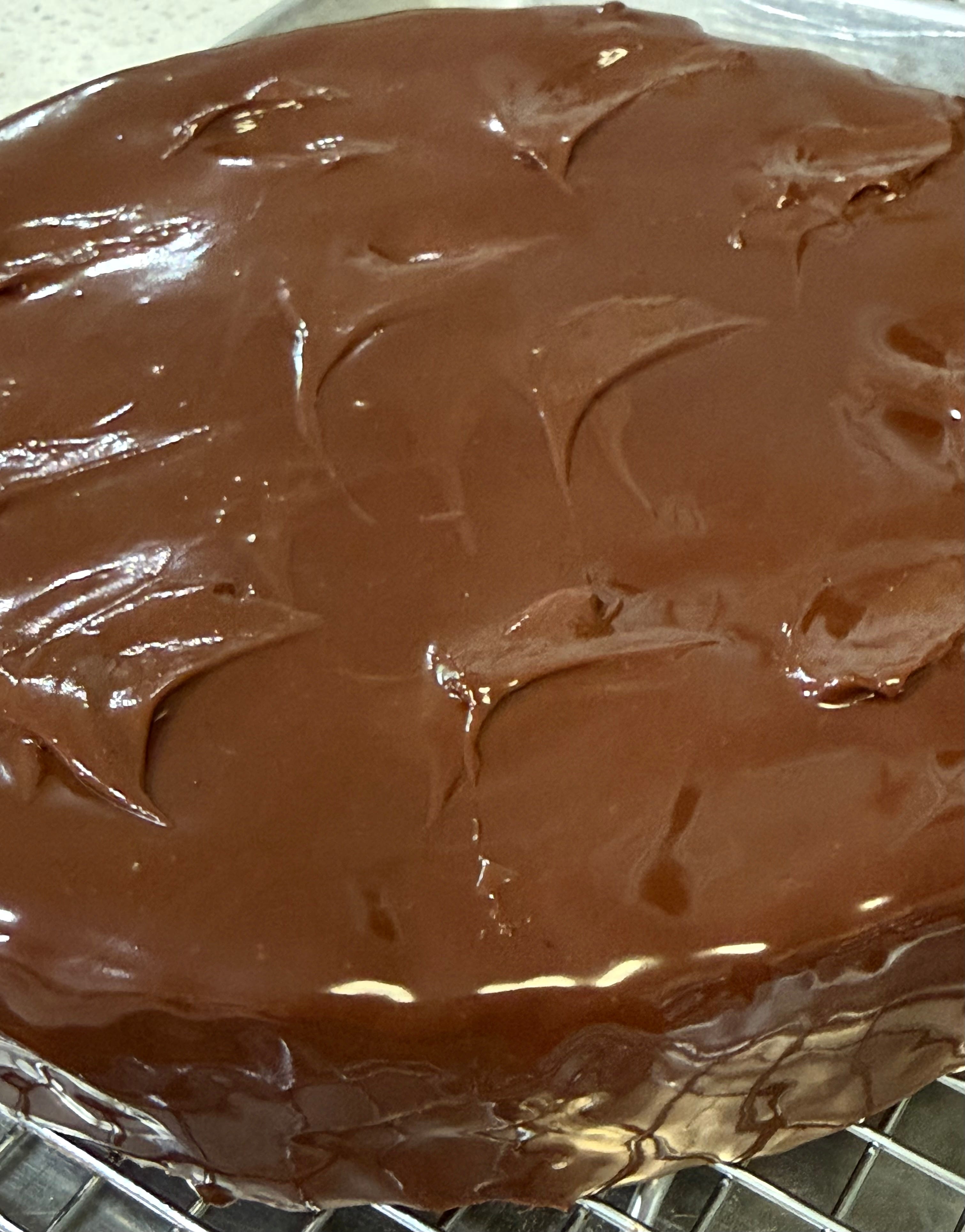
The best way to build baking knowledge and skill, particularly as a non-professional, is to use the examples others have given us. Recognizing how cake ingredients act with each other builds our system of understanding. Here’s a strategy I use to leaven my own thoughts on a new baking project.
First, follow bakers and pastry chefs whose recipes are consistently reliable. Do you have a couple of well-known, go-to baking books? If not, do some online research; better yet, ask people who are avid bakers for recommendations. One good book is a great resource; a second complementary book is even better.
Next, choose a baking project you have an interest in changing. Perhaps a cake by a known author, the flavor of which you’d like to edit to tastes you love ~ and you don’t know where to begin.
Finally, verify that you have everything the recipe calls for… exact ingredients, utensils, baking pans. When you’re learning, it’s unwise to make substitutions. Each of those ingredients has a role.
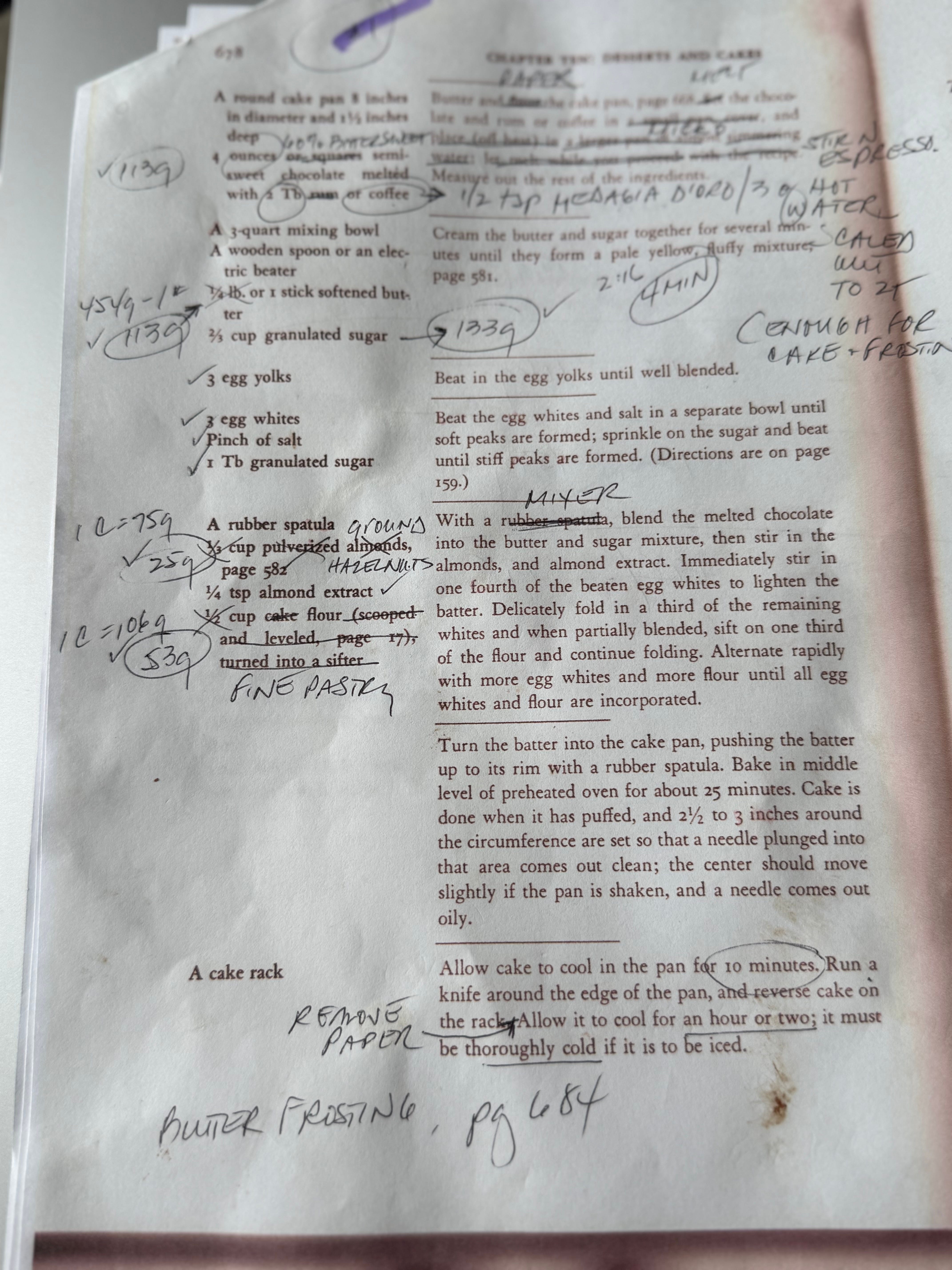
In Mastering the Art of French Cooking, (“Mastering”), Julia included a lovely, single-layer chocolate-almond cake. I love the partnering of chocolate and almond, though I was interested in changing the flavor profile to chocolate-hazelnut.
The hazelnut is known as the consummate dessert nut for its rich flavor. Oregon grows 99% of United States hazelnuts. I buy ten-pound boxes from a local grower.
Mastering recipes are exceptionally well tested. It was produced so that every American cook could bake or cook French recipes successfully.
I baked the cake three times.
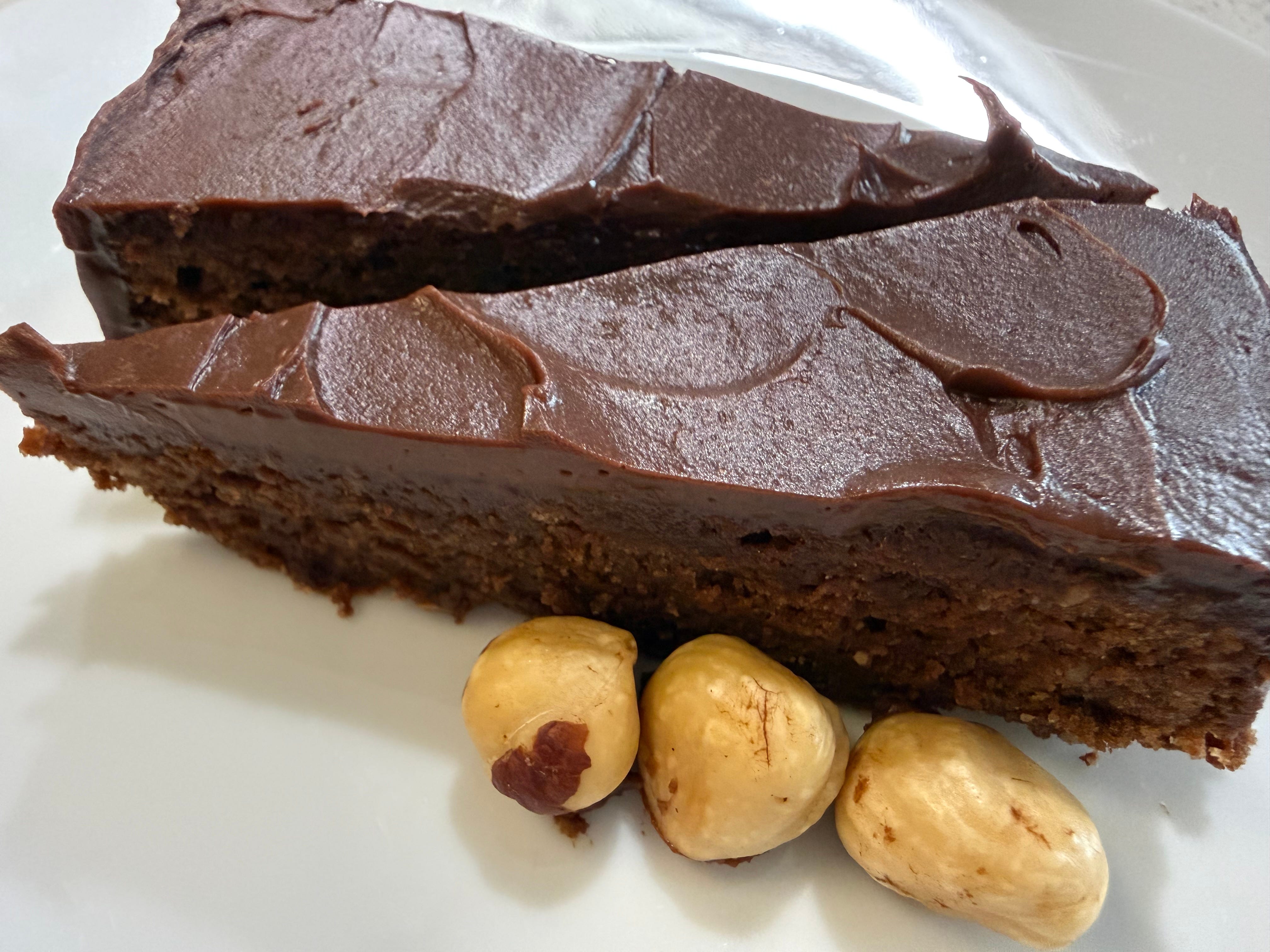
First bake. I baked it as written, using 60% bittersweet (also called semi-sweet) chocolate for both the cake and frosting to taste how sweet the cake actually was. Sixty-percent chocolate means that the chocolate’s cacao ingredients (cocoa solids, cocoa butter) are 60% of the total; the remaining 40% is largely sugar.
The question of retaining 60% chocolate would become a decision point.
I chose instant espresso instead of rum as a flavoring.
I chose finely ground hazelnuts instead of ground almonds.
Although the cake was lovely, the ground hazelnuts did not produce the luxurious texture I always expect in a cake crumb. I had to act quickly to spread the chocolate butter frosting as the spreadability changed within a few minutes because the instructions indicated the frosting ingredients had to be stirred over an ice bath to the desired consistency, which felt like unnecessary labor. It was composed only of chocolate, butter and a bit of espresso.
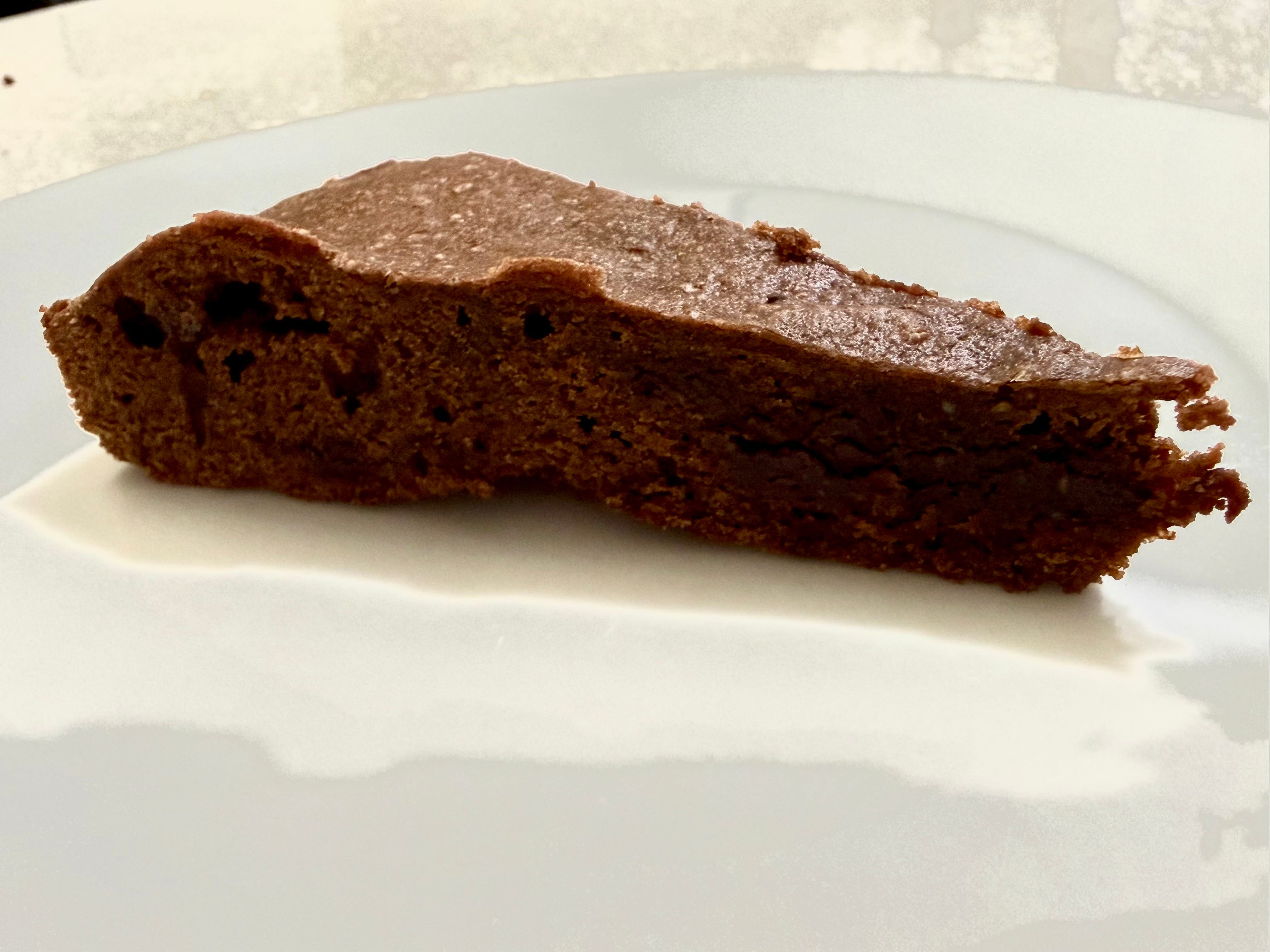
Second bake. I changed the chocolate to 72% and switched out the unsalted butter for hazelnut butter which is always on my pantry shelf. The goal was to see how using hazelnut butter affected the flavor and texture.
Hazelnut butter is easy to make. Roast whole raw hazelnuts for 10-15 minutes at 350°F (177°C). Process 280 grams / 10 oz roasted hazelnuts with 1 T sugar and 1/2 tsp kosher salt in a food processor for 3-5 minutes. My processor takes 3 minutes. Store in a sealed container at room temperature. You’ll love having it in your pantry.
It produced a cake with a dense, tight crumb and didn’t rise properly ~ even though the original recipe did not call for leavening (baking soda, baking powder). Nuts are solids. Hazelnut ‘butter’ is simply ground nuts processed to a spreadable consistency. High fat plus solids equals a tight crumb.
Unsalted butter ~ actually, all butter ~ is a certain percentage water which, when heated to steam, produces lift. The density of the cake batter also prohibited folding in whipped egg whites which was a requirement of the recipe.
No point in wasting the cost of ingredients frosting this one.
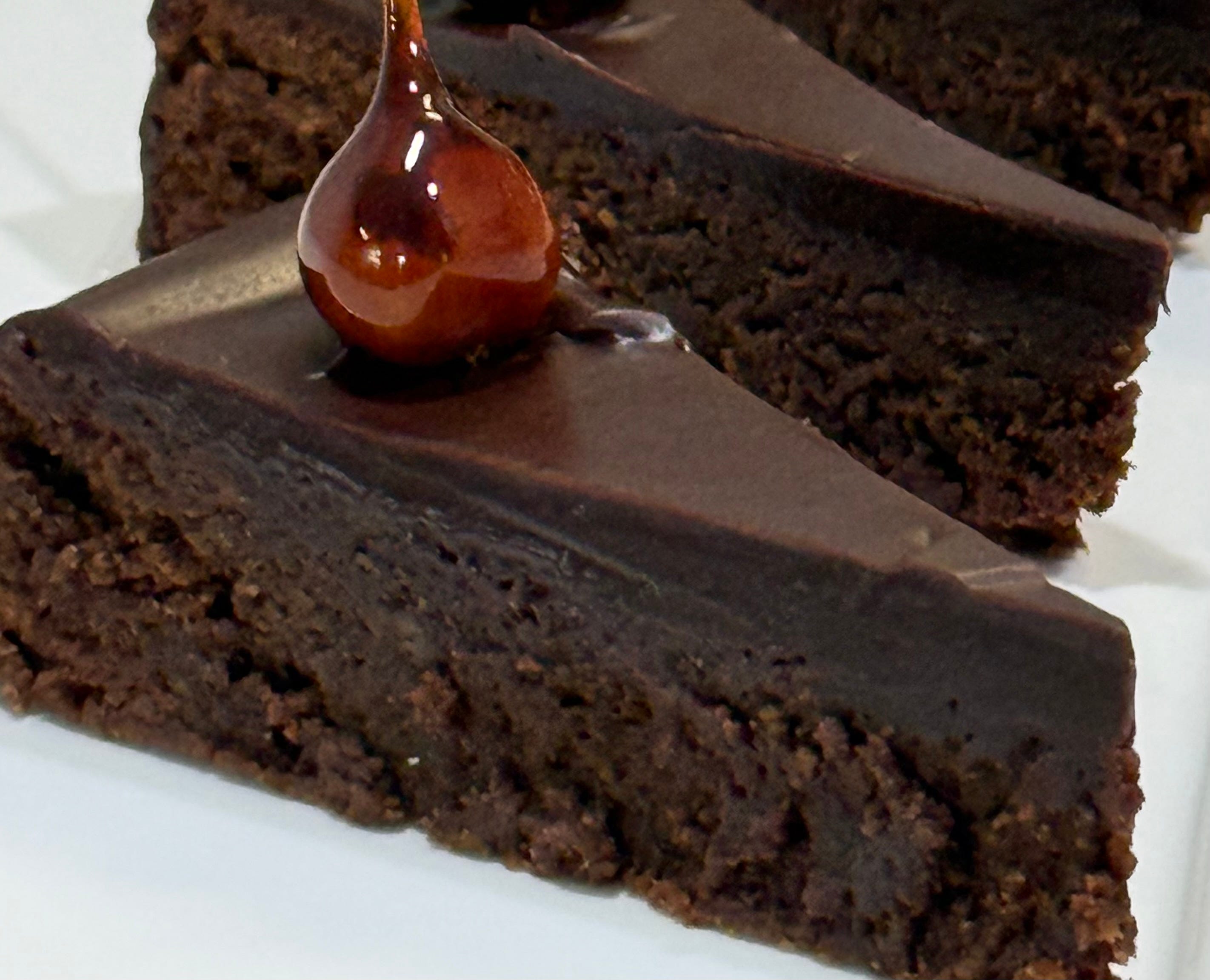
Third bake. Research told me there were several ways of increasing hazelnut flavor without creating a dense, unpleasant crumb. Here were the options and my decisions for or against:
Roasting hazelnuts to intensify their aroma and sweetness by driving Maillard reactions (the browning that occurs when amino acids react with reducing sugars under heat) and releasing oils. I wasn’t going to add ground nuts again, so what shape should the roasted nuts take?
Infuse the roasted nuts in either milk or cream, then strain for use in the cake. No, there was no benefit in adding any liquid to the recipe.
Replace part of the pastry flour with hazelnut flour. Hazelnut flour is expensive, and I certainly didn’t warrant risking even the perception of ground nuts in the batter.
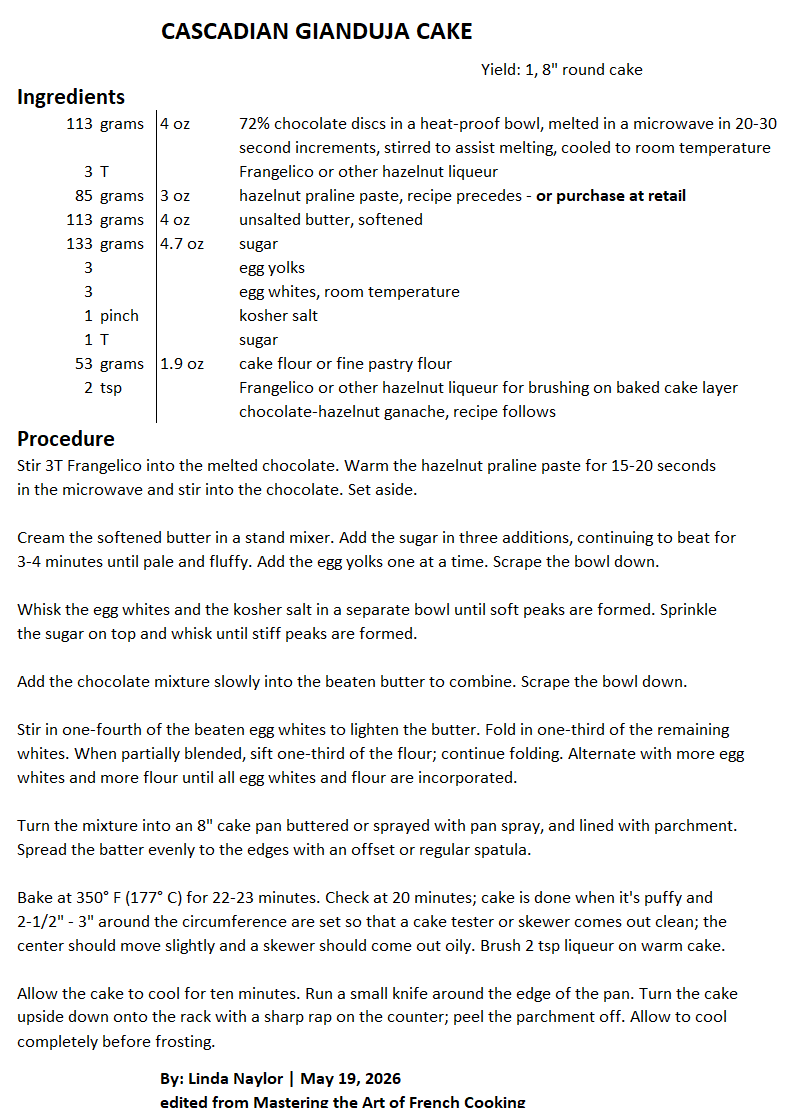
Create a hazelnut praline paste. Now we’re getting somewhere. Hazelnut paste (without sugar) was a possibility, but because I was switching from 60% chocolate (sweeter) to 72% chocolate (darker, less sweet) in the cake batter, I could afford the extra sugar in a praline paste. Sugar is the consummate flavor enhancer which is exactly what I wanted. Instinct said to add 10-15% of the total weight of the ingredients; I went with 15%.
Hazelnut extract or hazelnut liqueur. Each of these is considered a volatile aromatic compound, and I wouldn’t be adding bulk. Most people don’t have hazelnut extract in their pantries; neither did I. I did have Frangelico on our bar cart, which I never drink per se, but have it available for just this kind of use.
Hazelnut Praline Paste
Roast 200 grams (7 oz) of raw hazelnuts for 10-15 minutes in a 350° F (177° C) oven. Rub the skins off using a clean, dry towel. Group the roasted nuts in the center of a Silpat-lined half-sheet tray.
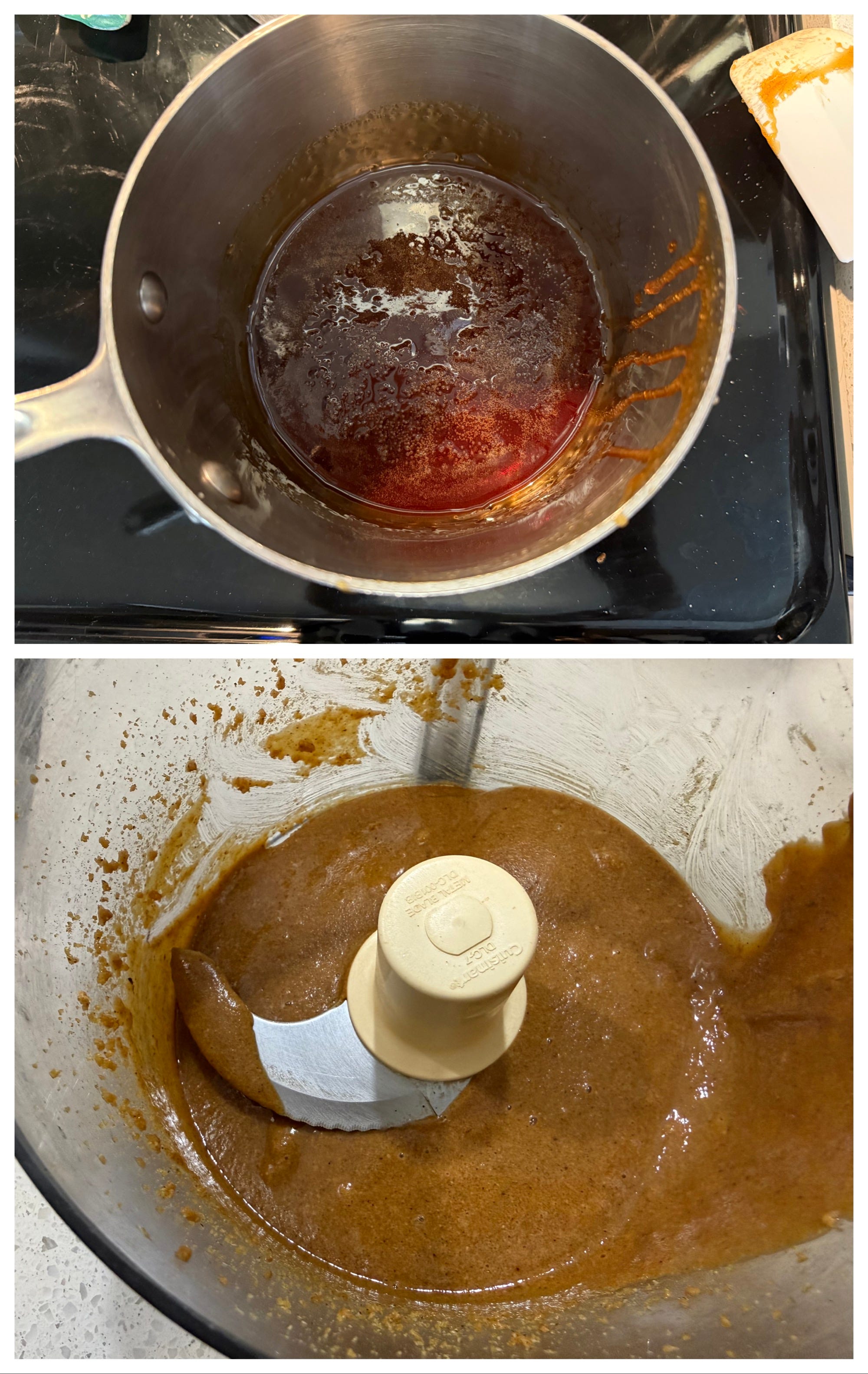
In a small, deep-sided pan over medium-high heat dissolve 200 grams of sugar. Begin stirring with a high-temperature spatula so the sugar melts evenly. Continue stirring; do not leave the hot sugar unattended. Watch carefully as the color deepens. When it’s a deep golden color, pour immediately around the edge and then over the center of the nuts. Use the spatula to move any remaining melted sugar from the pan onto the nuts. Allow the praline to cool completely.
Break into pieces by hand. Process the praline, pulsing first 5 or 6 times, for 6-8 minutes to a very smooth consistency. You’ll be using 85 grams in this recipe. Store the rest in a glass or plastic container with a lid at room temperature for up to 3 months.
Headnotes
This is an easy cake to bake.
Please, please… if you don’t already own a high-temperature spatula, purchase one. You’ll have years of sturdy service and total confidence that stirring high-temperature mixtures will always be safe. Yes, years ago, I melted a regular spatula.
The same is true for a Silpat silicone baking mat. Years of service.
Every time you bake, scale all the ingredients out in advance. An early master chef-teacher always said, "Mise en place (mez on plas), meaning everything in place, will save your ass.” Of course, he was right.
Purchasing the hazelnut praline paste at retail is totally an option.
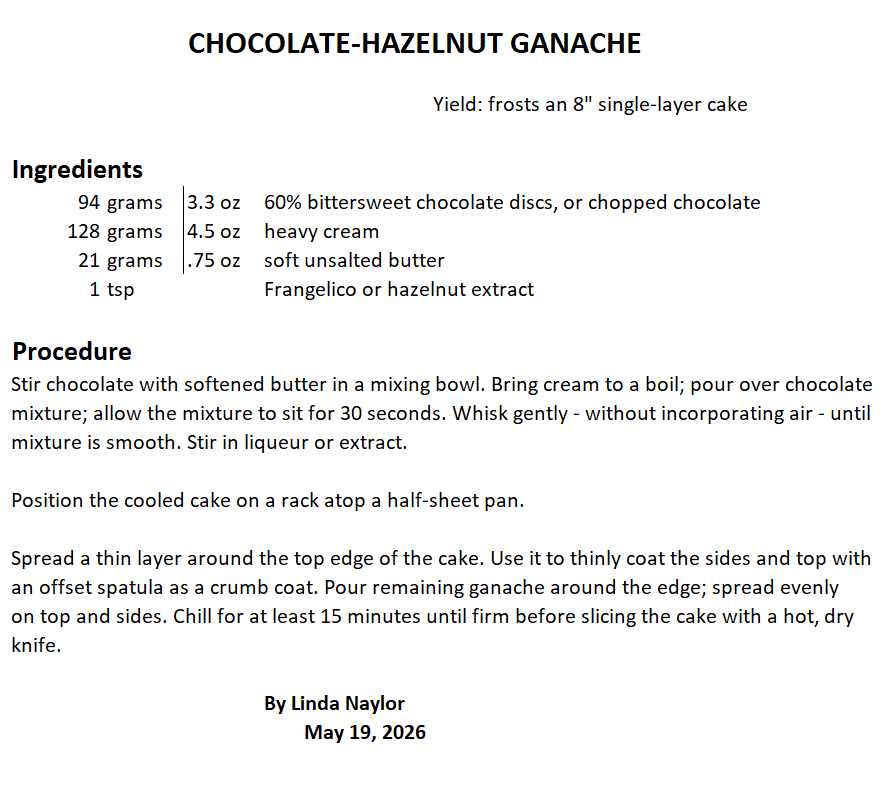
A frosting note. I mentioned that the Mastering chocolate butter frosting required quick work and unnecessary labor. In this recipe, I suggest using a simple, but glorious ganache of 60% chocolate, heavy cream, butter and yet another splash of Frangelico. Elegant, easy.
I offer another option. My all-time favorite restaurant yellow cake has a chocolate butter frosting ~ both unpublished as of yet ~ that may be your preference. If so, I’m happy to email that frosting recipe to you. You need only reply requesting it. The cake and frosting recipe will likely go out to paid subscribers during the current or upcoming quarter. A one-time offer. Also elegant and easy.
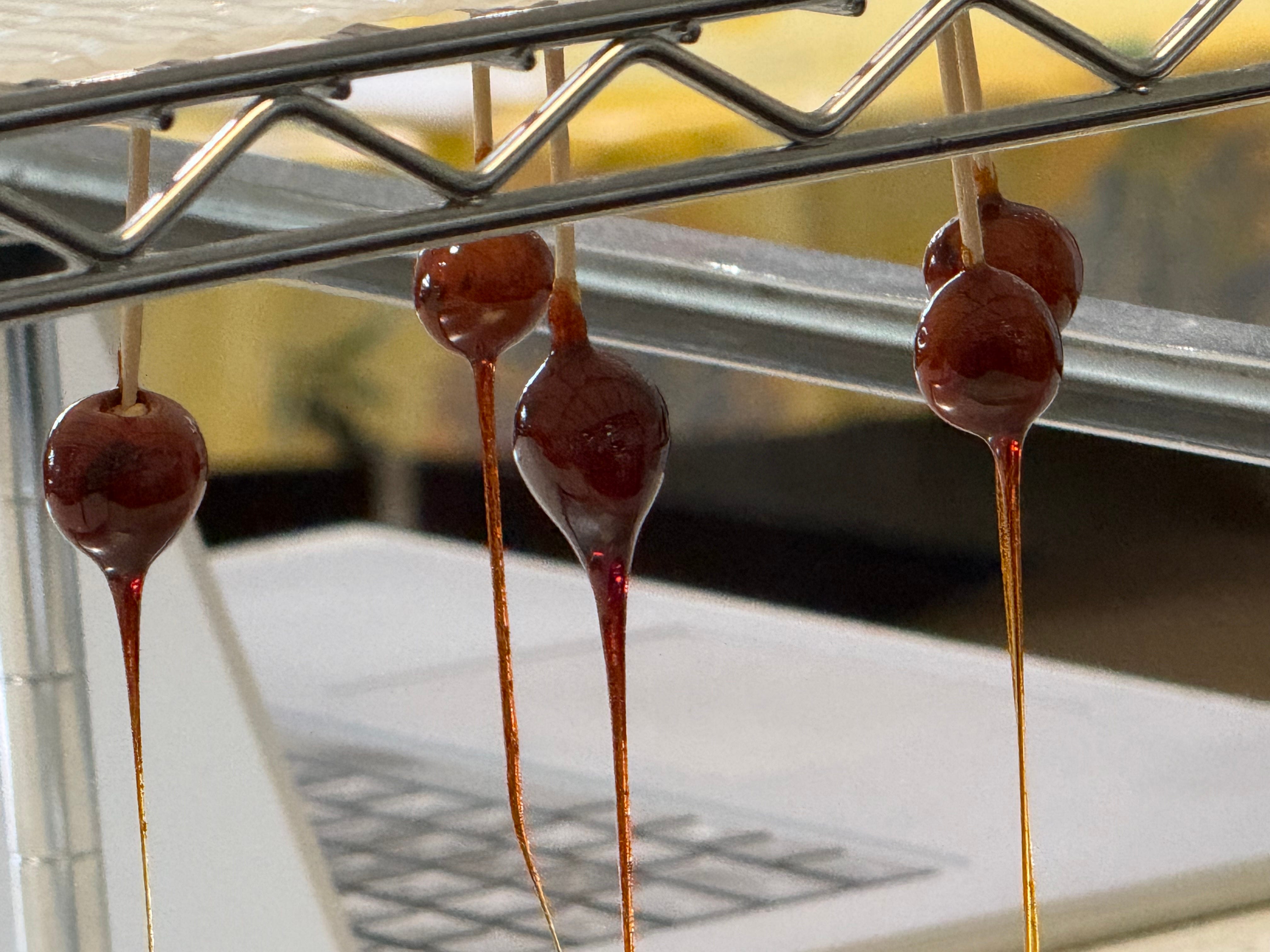
The candied hazelnut garnish was just a personal preference. A single piece of fruit ~ a raspberry, a young strawberry, a fresh cherry ~ is a perfect option.
If you enjoy learning how to coax out flavor; if you feel inspired to protect the beautiful food environment around you; if you enjoy more personal essay, you’re very welcome to push the Subscribe button.
Perhaps, even share with a friend. It’s nice to share.
TASTE | Pacific Northwest includes a voice for the land and the simple riches of our food system.
Linda Naylor is an encore-career chef with a passionate fire for helping others learn to love our food system and the land that supports it. She teaches simple techniques to enhance flavor, and to help readers enrich their own lives through food, wherever they live.
Your subscription today directly funds the research and advocacy needed to keep these scents and flavors, and the beauty of all our treasured environments, alive.
A note. Our use of a tilde in text is an homage to the brilliance of Judy Rodgers’ The Zuni Cafe Cookbook. Please never mistake it for AI.
Likes, Comments and Restacks are highly prized! Please click on the ❤️ icon to let the algorithm know our work is worth supporting.
Comments
Nothing yet. Say the first thing.
Sign in to join the conversation.