
I’m sure many of us hold wonderful childhood memories of snivelling at the dinner table while our disgruntled parents implored us to eat our vegetables — ‘they’re not going to kill you.’ Perhaps we should count ourselves lucky that we were only contending with a pile of soggy broccoli and not an ancient curse wielding, anthropomorphic root with a penchant for unleashing the din of a thousand damned souls. Small mercies, really.
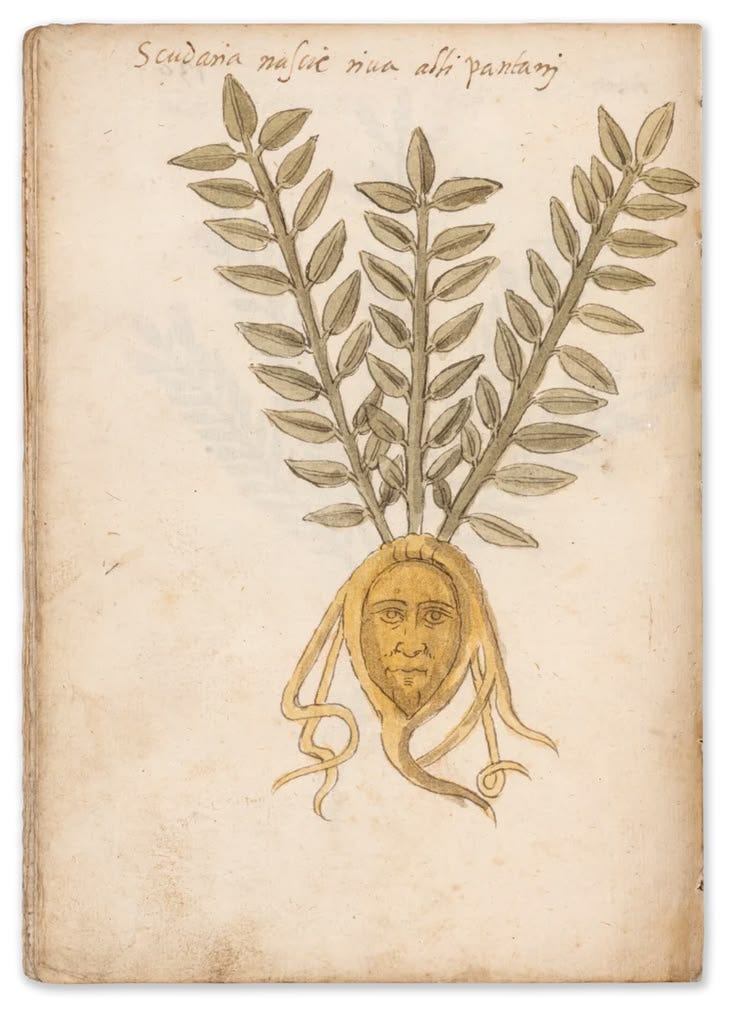
The mandrake is a common fixture of magical practice and esoteric lore. It has lived several lives throughout recorded and vernacular history, making it one of the most extensively storied plants in the European folk record.
To the casual etymologist it might appear that the word ‘mandrake’, is fairly straightforward, being a lexical collision of the Anglo-Saxon ‘man’ and ‘drake’, meaning dragon. However, dig a little deeper (haha) and it turns out that the actual roots (hahaha) of the word are more tangled. ‘Mandrake’ can be traced to the original Latin ‘mandragora’ which in fact does not have much at all to do with men or dragons. Given how frequently the root was used among the peasant classes of medieval Britain, it's little wonder the genus name fell victim to the usual bastardisations of vernacular English, especially for a plant whose shape left so little room for it to be regarded as anything else.
The anthropomorphic identification of the root can be seen further afield, popping up across Northern Europe under many names that insist on its resemblance to the human body. In France, the verbose vegetable is known as the ‘main-de-gloire,’ meaning ‘hand of glory.’ This naming is quite nuanced in that if you say ‘main-de-gloire’ three times quickly, you end up with something that sounds pretty similar to the Latinate parent ‘mandragora.’ This is an excellent phonetic corruption in itself, but the actual meaning of the main-de-gloire opens an entirely new can of worms.
Though the finger-shaped roots of the mandrake originally inspired this unusual name, over time, the plant's use to invite fortune and 'glory' became entangled with a separate, more gruesome folklore about the pickled hand of a hanged criminal. It's worth saying that this etymology is disputed rather than settled. Not every scholar accepts the ‘mandragora’ derivation, and the alternative reading (that ‘hand of glory’ is simply a literal, English-language description of the object, no corruption required) has its defenders too. But disputed etymologies are, if anything, more useful to the folklorist than settled ones, because the dispute itself tells you something: that two traditions this superficially different were close enough in function to become genuinely difficult to prise apart. Whether the confusion happened in the word or merely around it, the fact that anyone could confuse them at all is the more interesting inheritance.
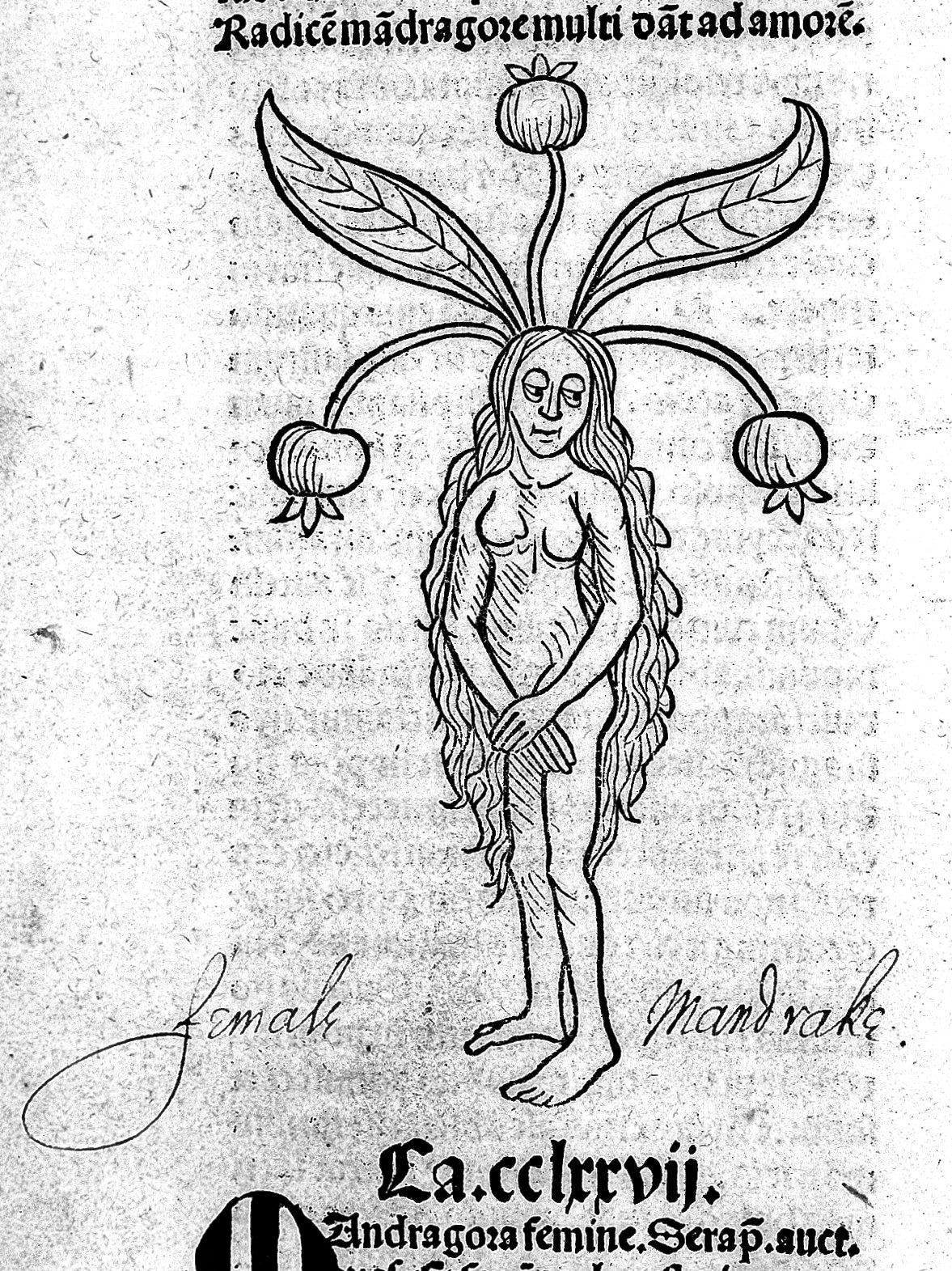
Germany also saw a proliferation of mandragora strains in its loamy soil and similarly reached the conclusion that the roots were less plant matter and more human, giving it the name ‘galgenmannlein’ — ‘little gallows man.’ As with much of the German language, the term is pretty to the point and tells you virtually everything you need to know about the folk provenance of the vegetable. This stems from the belief that the mandrake would only grow at the base of a gallows that had recently seen a hanging. The criminal’s blood and semen would drip down into the soil beneath, from which would spring a new root, bearing the soul and likeness of the dead man. An elaborate set of conditions had to be met by the hanged man to produce the magic herb, given by the Grimms' Deutsche Sagen:
If a hanged man was a hereditary thief (Erbdieb), his mother had either stolen or contemplated stealing while carrying him, and he died a virgin, then the fluids that dropped would cause a ‘Galgn-Mänl’ to grow there.
Hopping next door, the Dutch shared a similar belief that the mandrake grew from the urine of the hanging man, earning it the colloquial name ‘pisdiefje’ or ‘little urine thief.’ Delightful!
Some English texts also feature the simple ‘brain thief,’ which likely refers to the notion that the plant might grow from the brain matter of dead ne'er-do-wells. Further, the nickname also provides a great clue as to the adverse physical effects the mandrake enacts on its victims.
All species of Mandragora contain highly biologically active alkaloids, particularly tropane alkaloids. This is what makes the plant highly poisonous. Even the smallest of roots boasts strong hallucinogenic and hypnotic effects. Its reported anticholinergic nature also means efficient quantities can cause fairly swift asphyxiation. Light or accidental poisoning (which was weirdly quite common) can cause a very rough night of incessant vomiting and diarrhoea.
More commonly reported are the intense psychological effects such as delirium, terrifying hallucinations, and manic activity. In his New Herball of 1568, Dr William Turner, the clerical-medical Dean of Wells Cathedral and father of English botany, described the risks of administering the herb:
‘Of the apples of mandrake, if a man smell of them thei will make hym slepe and also if they be eaten. But they that smell to muche of the apples become dum . . . thys herbe diverse wayes taken is very jepardus for a man and may kill hym if he eat it or drynk it out of measure and have no remedy from it.... If mandragora be taken out of measure, by and by slepe ensueth and a great lousing of the streyngthe with a forgetfulness.’
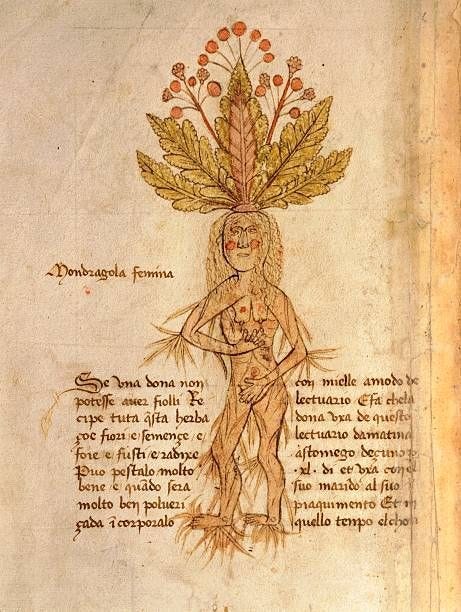
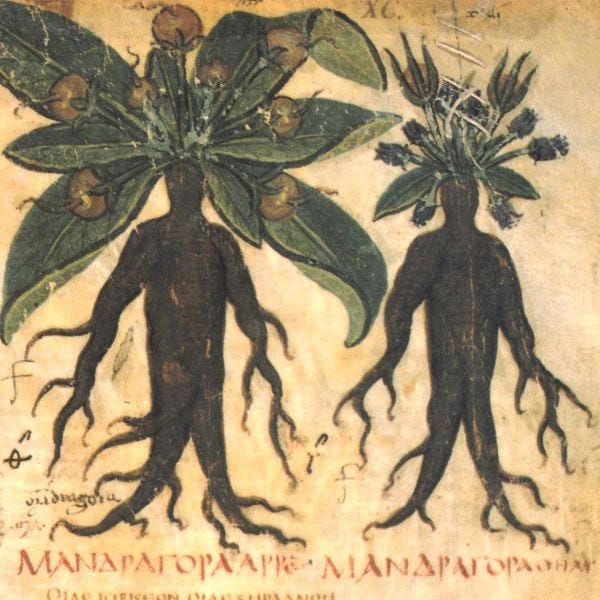
This anaesthetic affect, despite its dangers, was used frequently in classical medicine. Dioscorides, in De Materia Medica (1st century) writes that some in his profession may administer a ladle of mandrake reduction, made from the root boiled in wine until it shrivels to a third, before performing surgery. Pliny the Elder also repeats that a dose of mandragora potion is drunk by the patient before incisions or punctures are made on the body. Dioscorides was also one of the first authors to distinguish (mistakenly) between the male and female mandrake. Pliny claimed that mandrake roots could be identified through depiction of male or female genitalia and whether they were light (male) or dark (female) in colour. Ancient pharmacology if nothing else, was certainly creative.
If a man came into possession of a male or ‘phallic’ mandrake, this had the power to amplify sex appeal tenfold and would have you practically drowning in suitors in a matter of hours. Theophrastus in Historia Plantarum, wrote that the mandragora needed to be harvested by following a prescribed ritual for ultimate efficacy. One would ‘draw three circles around [the root] with a sword, and cut it facing west’; then in order to obtain a second piece, the harvester must dance around it while speaking as much lewd talk about sex as he possibly can.
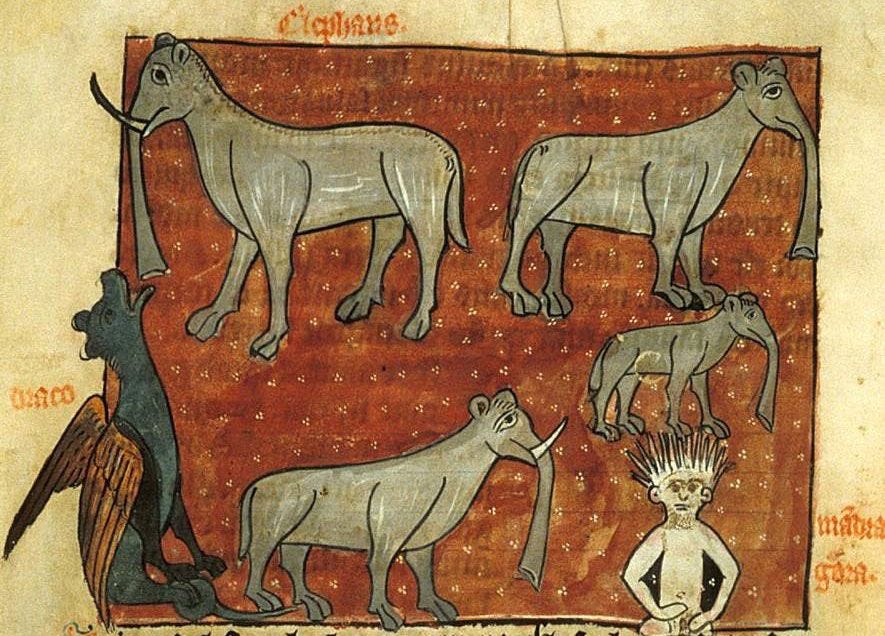
These potent roots were not just useful to humans alone, in the Christian allegorical bestiary Physiologus, the chapter on the elephant claims that when the male desires offspring, it leads its mate to the growing ground for the female to find the mandragora and come into estrous, the female then brings the root to the male which in turn become inflamed and they mate, making the female immediately pregnant. Yes those are in fact elephants below.
Perhaps the most famous belief is that once pulled up from the soil, the mandrake would scream and crying incessantly, killing its harvester. Some even believed these cries were devilish work and would instantly doom victims to hell. Shakespeare details this widely held belief in Henry VI stating that the cries:
‘Would curses kill, as doth the Mandrake’s groan,
I would invent as bitter-searching terms,
As curst, and harsh, and horrible to hear.’
And in Romeo & Juliet:
‘Shrieks like Mandrakes, torn out of the earth,
That living mortals, hearing them, ran mad.’
As is unfailingly human nature, the peril of the unearthing only made the reward more appealing. Naturally, harvesters devised some pretty gnarly methods to avoid falling victim to the mandrake’s wails.
One such method detailed by Joseph of Jerusalem goes like this:
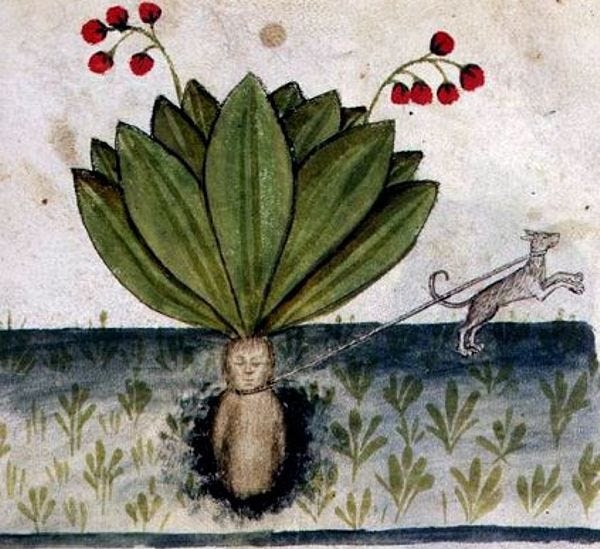
‘A furrow must be dug around the root until its lower part is exposed, then a dog is tied to it, after which the person tying the dog must get away. The dog then endeavours to follow him, and so easily pulls up the root, but dies suddenly instead of his master. After this, the root can be handled without fear.’
According to Josephus, it was no easy task for the harvester, because the root would move away from the handler, and though it can be stopped by pouring a woman’s urine or menstrual blood on it, touching it will cause certain death. Certain death, I believe, is the only suitable punishment for greedy dog murderers.
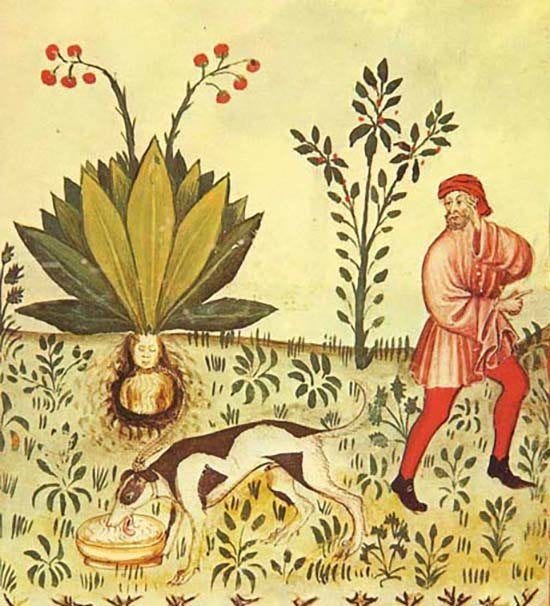
Like the notion that the plant grew from criminal death juice, the fear of the mandrake’s scream seems to be a purely medieval embellishment, with no record in classical texts. The practical function of this fearmongering, may well have been a tactic in creating imagined scarcity and driving sales of the plant for herbalists and merchants of the time.
Many believed the mandrake could 'leap about like a will-o'-the-wisp,' glowing in the dark as it went. Arabic sources reportedly translate loosely to 'devil's lantern,' and the Old English Herbarium describes the plant shining at night like a lamp. Josephus, states that mandrake is like a flame in colour, and in the evening appears like a glittering light, but the definitive origin of this belief has been lost to time.
Thomas Moore asserts this idea in Lalla Rookh:
‘Such rank and deadly lustre dwells,
As in those hellish fires that light
The Mandrake’s charnel leaves at night.’
Throughout the historic record, it seems no self-respecting witch’s cabinet was complete without a mandrake root or two. An alternative classical name for the plant ‘circeium’, derives from Circe, the celebrated ancient Greek enchantress, inferring its long history with witchery.
Its tropane alkaloids place mandrake in the same family as belladonna and henbane, the trio most commonly implicated in flying ointments. These were the hallucinogenic salves said to be rubbed onto skin, or onto broom handles and inserted somewhere considerably more (ahem) absorbent, to allow witch’s to fly to black sabbaths. Whether this allowed physical flight is debateable, though with the hallucinogenic effects of the concoction, they certainly would have been ‘flying’ in some respect.
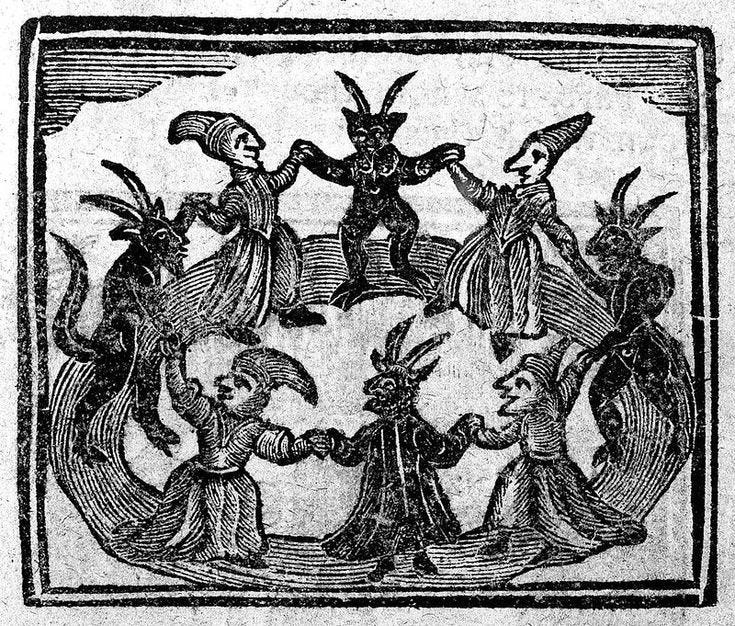
Ben Jonson, in his Masque of Queens, introduces a conventicle of witches, who, as part of the business which has brought them together, relate their deeds. One of the hags, who has been gathering mandragora, croaks:
‘I last night lay all alone
On the ground, to hear the Mandrake groan;
And plucked him up, though he grew full low;
And, as I had done, the cock did crow.’
By the time of the early modern witch trials, simply owning a mandrake root was itself grounds for suspicion — not because you'd necessarily done anything with it, but because the root's entire cultural history made it legible as a tool of maleficium by default. In some sources, the mandrake might even be used as a kind of familiar or ‘little genius’ by an enchanter. This vegetal assistant not only cures a host of maladies, but discovers hidden treasures; doubling the amount of money locked up in a box, keeping off evil spirits, or acting as a love charm if provided the right care by the possessor. It was fed, dressed, and consulted like a familiar, which meant a woman keeping one in a box lined with silk was, depending on who was doing the accusing, either a herbalist with an unusually devoted houseplant or a witch keeping a small imprisoned demon on retainer. You can probably guess which answer Medieval and Early Modern witch hunters went with.
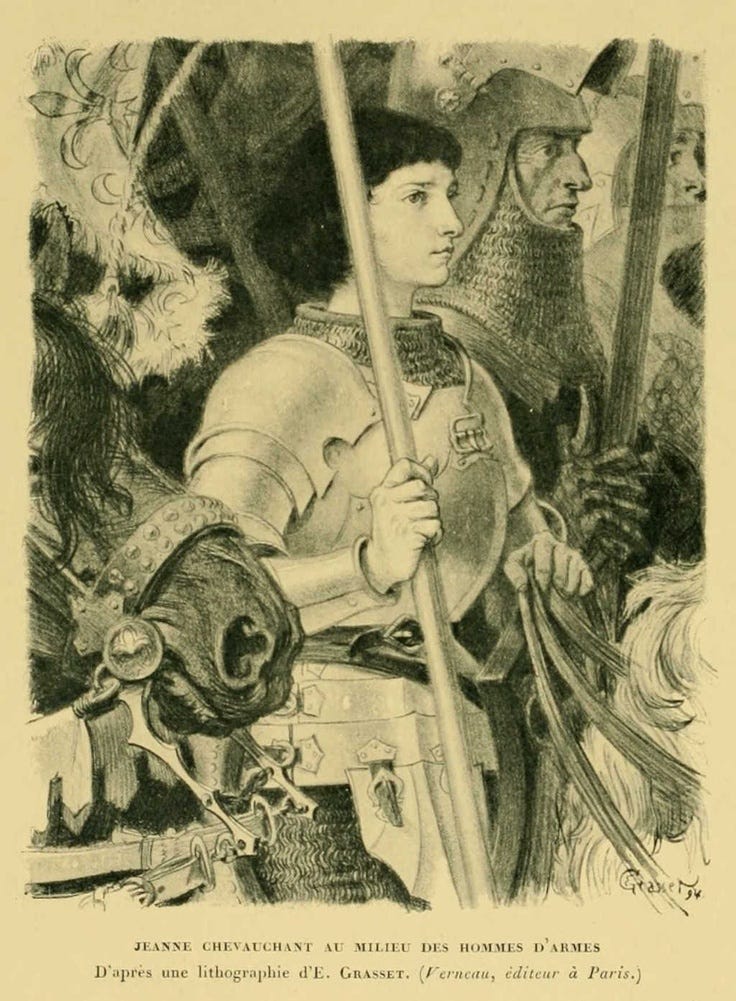
when, during her trial in 1431, Joan of Arc was accused of having a mandrake about her person, the suggestion helped send her to the stake. Among the many charges levelled at her trial was the accusation that she owned and consulted the plant regularly. She denied it flatly, admitting only to having heard the old belief that the mandrake brought luck. It was a minor charge against her, buried under far weightier ones but its presence certainly demonstrates how dangerous even the most simple inherited herbal beliefs could become in the wrong hands.
It's worth pausing, at the end of all this, on the strangeness of the impulse itself — the cross-cultural personification of the mandrake. Every culture that got its hands on this root arrived at the conclusion that a body-shaped thing must contain a body's worth of meaning. Resemblance was evidence, and arguably the best information available to anyone standing in a field without a microscope. But I don't think that's the whole of it, or even the more interesting part. The other reason we keep finding ourselves in nature is that an indifferent universe is close to unbearable, and a populated one isn't. Weather that simply happens to you is far more harrowing than weather that can be bargained with. A root that just sits in the ground is less use to a frightened, mortal species than a root that screams; that can be fed and dressed and consulted like a small difficult relative.

This kind of knowledge — knowledge that reads the nonhuman world through the shape of the human body — though different is a no less rigorous way of knowing. There's a reading of the scream that doesn't require you to believe in it at all, only to ask what it does. A root this potent, this widely wanted, needed some mechanism to keep it out of careless or unauthorised hands, and a scream loud enough to kill the unprepared is about as effective a deterrent as folklore ever produced. This specialised knowledge is precisely the thing that separates the folk who know the root’s importance from the opportunists who don’t.
A species that narrates constantly, compulsively, to itself, is not going to leave the rest of the world unnarrated. We leak personhood into whatever we spend enough time looking at. From the strange, unseen world underground, we unearth an attempt to explain the natural in terms most recognisable to us, and to guard that knowledge once it's been claimed. The result of this impulse may be a strange, knobbly, screeching vegetable, but this strangeness is deeply, unequivocally human.
Thanks for reading Lurker! This post is public so feel free to share it over a screaming salad.
No posts
Comments
Nothing yet. Say the first thing.
Sign in to join the conversation.