

I specialize in helping people heal from sexual trauma. It’s been my clinical focus for years. I know the statistics. I know the nervous system’s response to violation, the ways trauma lives in tissue long after the event has passed.
But I didn’t know how passionate I was about dismantling patriarchy until recently, when something cracked me open and shook my foundations.
Something is shifting. You can feel it if you’re paying attention.
Women are breaking the silence and speaking up in ways they haven’t before. Calling for accountability from a culture that has normalized oppression of, and brutality against feminine bodies, wisdom and strength.
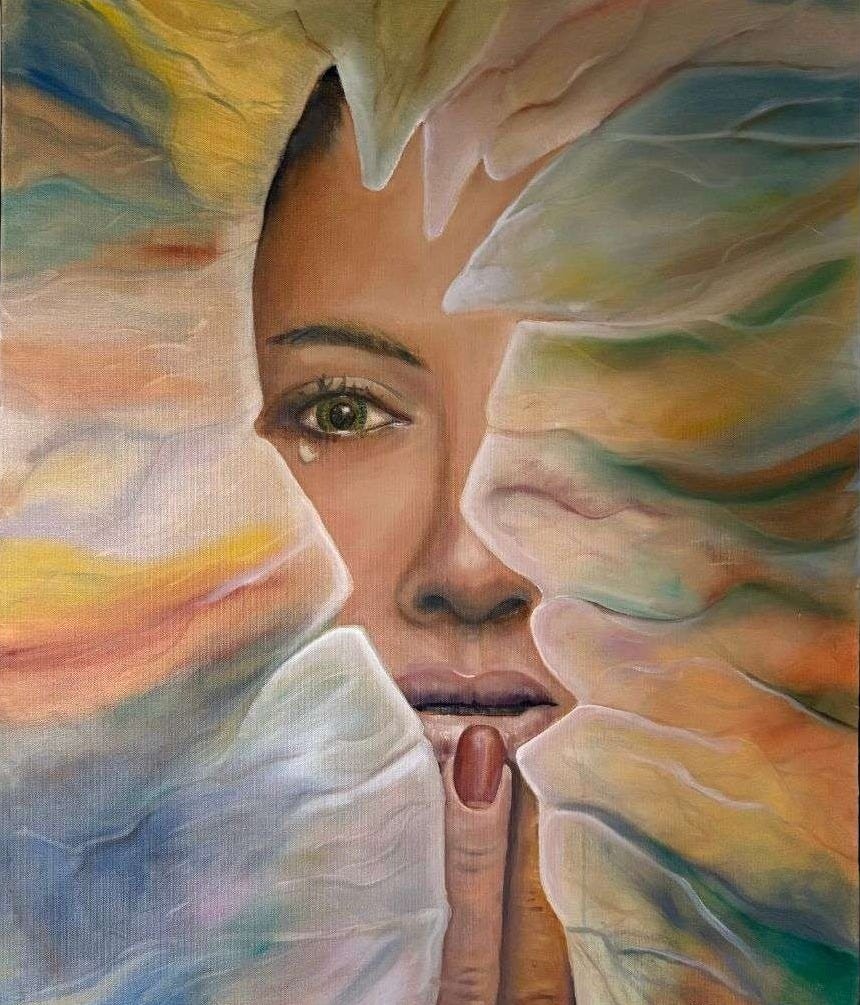
Thousands of us read the article “What Happens When the World is Motherless” that names the sacred rage that many of us feel but are afraid to speak.
The article catalyzed conversations in several communities I’m part of. Women began sharing their stories of violation, but also stories of the more subtle ways patriarchy harms. The dismissals. The silencing. The ways we’ve learned to make ourselves smaller to stay safe.
The preference for the bear over the man.
I thought of the line often attributed to Edmund Burke, “All that is needed for evil to prosper is for good [people] to do nothing.”
And I found myself writing something I don’t often share publicly:
“Each of us knows women who have been raped. Each of us knows men who have done the raping. If you think you don’t, I promise you, you’re wrong.
One of my specialties as a therapist is sexual violence and 50% of all women have experienced this.
Read that again.
If anything that number is low because it doesn’t count unreported instances.
I am one of the 50%. I no longer harbor anger, but I do hold deep grief for the continued silence of our culture. A culture where a rape academy can exist without meaningful consequence.”
Another woman responded with words of her own:
“The 50% you speak of is only those who have reported or expressed their abuse. Most women never speak up; they hold it in their cellular tissue, let it fester over the course of their lifetimes, and then pass it down through their DNA.”

What surprised me wasn’t the sharing. I’m a therapist who specializes in this work and I’ve held space for hundreds of these stories.
What surprised me was the intensity of my own response.
The passion that rose up in me and the recognition of how deeply this wound lives in my body, even after years of healing work.
I have a tendency to name what everyone knows is present but no one wants to look at. It doesn’t make me popular, and this time was no different. But I see it as door-opening work and that is sacred.
Because we cannot heal what we do not acknowledge.
And the harm of patriarchy, the violence it enables, the silence that perpetuates it needs to be acknowledged.
When women (and also men) speak about sexual violence and systemic harm, they are often met with silence or dismissal.
Some of that silence is shock. Some is not knowing what to say. Some is the discomfort of recognizing complicity, even passive complicity, in systems we benefit from or fail to challenge.
And some of it… the hardest part… is defensiveness.
A certain amount of defensiveness is to be expected when an aspect of one’s identity is challenged. It's a predictable nervous system response to identity threat, and the work is precisely to stay present with that physiological state without acting on it. Though every form of systemic injustice has its own shape, this mirrors the dynamics we see in anti-racism work, where white people must first grapple with their own privilege before they can proceed to deeper work.
The initial response is often some version of: “But I’m not like that. I’m one of the good ones. Don’t lump me in with those people.”
It’s what happens next, after the defensiveness, that really matters.
Before we go further, let’s be clear about something essential:
Patriarchy does not equate with men.
bell hooks wrote that “Patriarchy is the single most life-threatening social disease assaulting the male body and spirit in our nation.”
Life-threatening to men as well as to women.
Patriarchy is a system of control and domination that has harmed all of us for thousands of years. It’s a structure that limits what’s possible for everyone inside it.
Men are taught to disconnect from their emotions, to perform strength rather than feel it, to suppress tenderness and vulnerability. The terror of humiliation, the pressure, the addiction, and the overwhelming dissatisfaction most men feel in their lives are some of the costs.
And that means the solution isn’t about demonizing men or creating new hierarchies with different people at the top. We need to really examine, and then dismantle the entire structure.
Recognizing Patriarchal Wounds and Reclaiming Wholeness is the practice guide for taking this work into your own body.
I’ve been thinking a lot about what moves conversations forward when this topic arises. What allows people to stay present with discomfort rather than shut down the conversation, dismiss women’s voices or move to defend?
Acknowledging systemic benefit without personalizing it as individual guilt. There’s a difference between recognizing “I benefit from structures that harm others” and “I am a bad person.” The first invites accountability. The second invites shutdown.
Naming discomfort and staying present anyway. Rather than collapsing into self-flagellation or demanding reassurance, there’s something powerful about simply saying: “This is uncomfortable. I’m feeling defensive. And I’m choosing to stay here anyway.”
Making it about accountability, not performance. The goal isn’t to prove you’re “one of the good ones.” The goal is to see the system clearly and take responsibility for the ways you participate in it, actively or passively.
Understanding that this work is developmental. Just as with anti-racism work, dismantling internalized patriarchal conditioning is a process, not a single conversation. There will be missteps. There will be learning edges. The work is to keep returning to it with awareness and humility.
Making space for others’ pain without centering your own discomfort. When someone shares a story of violation or harm, the response isn’t “But I would never...” or “Help me feel better about this.” The response is: “I’m listening. Thank you for trusting me with this.”
One man, after reading the “Motherless” article, wrote something that captures this quality of response:
“If you haven’t read this you must. If you have read it, you need to do it again until you feel it. I caught myself. It landed like a bomb with me and I was then in a ‘what can I say about this’ mode...
I then remembered all the times I ‘explained this away’ in the past… The masculine has trouble getting into this space. Stop. Breathe. Recognize the pain implicit here. You don’t need to solve anything…
I would encourage men to PULL ON THIS THREAD. There is more there than we can begin to appreciate.”
Notice what he’s doing: He’s naming his own defensiveness. He’s owning past dismissals. He’s recognizing the masculine tendency to problem-solve rather than witness. And crucially, he’s calling other men to do the work, not asking women to make it easier.
This is what it looks like to embody divine masculine energy.
When I talk about dismantling patriarchy, I’m not talking about erasing masculine energy. I’m talking about calling forth its sacred expression.
This energy doesn’t get defensive when challenged. It listens, witnesses, and takes responsibility.
It doesn’t say “Not all men.” It says “What can I do differently?”
It doesn’t demand comfort. It offers presence.
It doesn’t center itself. It makes space.
This collective awakening and reckoning with patriarchy’s harms is calling all of us forward.
Women are being called to speak what has been silenced. To trust the wisdom of our bodies. To name what we know, even (or especially) when that makes others uncomfortable.
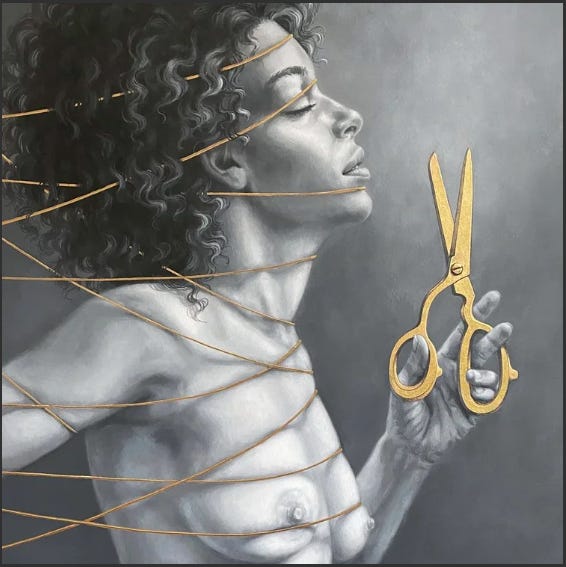
Men are being called to listen without defending. To examine their conditioning. To feel the grief of what patriarchy has cost them: their emotional wholeness, their capacity for authentic connection, their access to the full range of human experience.

All of us are being called to see the system clearly, recognize the ways we’ve been shaped by it and to choose something different.
I want to say one more thing, and it's the part that's hardest for me to say:
The patriarchy doesn’t just live “out there” in systems and structures and other people’s behaviors.
It lives in me too.
In my lineage and in the women who raised me. In the choices I made in my early careers, learning to move through male-dominated spaces, and internalizing patriarchal values. (I’ll go deeper into this in the next essay)
Patriarchal conditioning is insidious, and largely invisible to us. Like a fish trying to understand the nature of water.
For now, I’ll say this:
If you’re a woman reading this and feeling the weight of what hasn’t been named, you’re not alone.
And if you’re a man reading this and feeling the discomfort of complicity or the grief of recognizing harm, that discomfort is the doorway. Don’t turn away from it. There’s medicine on the other side.
We need the archetypal energy of both the divine feminine and the divine masculine for this healing.
The world we’re all longing for requires it.
From my heart to yours,

If this essay moved you, the work continues in the practice guide. Recognizing Patriarchal Wounds and Reclaiming Wholeness.
New here? Subscribe to get the next essay
I'm a licensed psychotherapist and psychospiritual coach. If you've been doing this work for years and something essential still isn't shifting, that gap is exactly where I work. Work with me →
June 11th - The Patriarchy Lives in Me Too
June 11th - Guide to Recognizing Patriarchal Wounds and Reclaiming Wholeness
June 25th - Beyond EMDR Guide: A Roadmap for Healing Complex Childhood Trauma
Subscribe to be notified when these become available
© Linnea Butler 2026
Comments
Nothing yet. Say the first thing.
Sign in to join the conversation.