
My grandmother flew planes in 1929. She was one of Amelia Earhart’s Ninety-Nines, a force of nature, doing what virtually no women did. I never met her. She died before I was born.
But she passed something down to me that goes beyond strength.
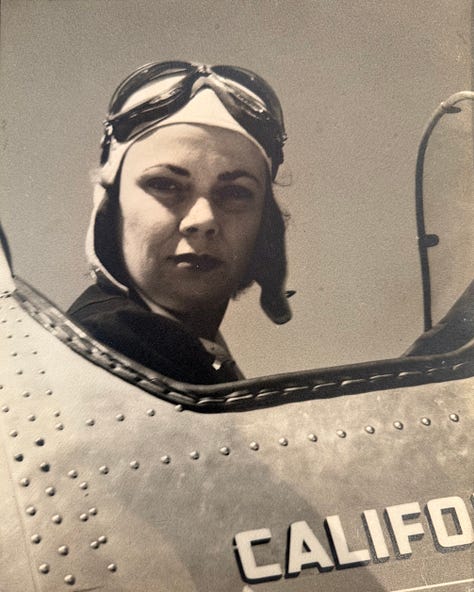
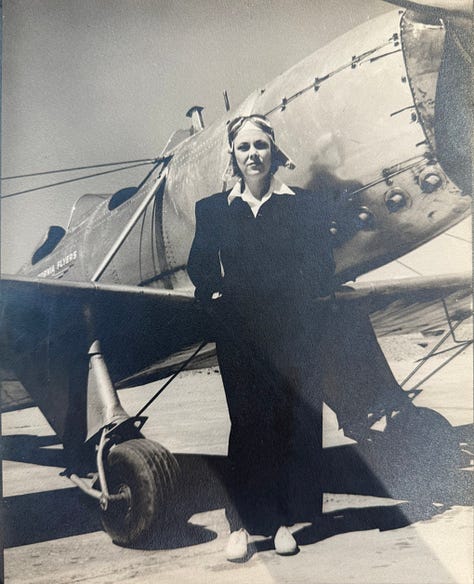

She flew planes. And she carried the patriarchy in her bones.

Two weeks ago, I wrote about the cultural awakening happening right now1: women breaking the silence, naming the harm of patriarchy, calling for the divine feminine and the noble masculine to come forward. I wrote about what’s happening out there.
This essay is about what’s happening in here.
In me and in circles of women sharing their deepest thoughts and fears. In the women I work with as a therapist. In the women I see at the grocery store.
The patriarchy doesn’t just live in systems and structures and other people’s behaviors.
It lives in us.
I’ve spent years helping women heal from sexual trauma. I know how violation gets passed down through generations.
But what I’m contemplating now is how patriarchy itself moves through lineages.
This is what I inherited from my grandmother, and from my mother who taught me to never be financially dependent on a man… from a lineage of strong, capable women who learned to survive by becoming what the system demanded.
My grandmother was a tiger AND lovely and feminine. She held both. But the masculine available to her was the only one her century offered: the one that required her to push through, perform strength, swallow tenderness. She did the best she could with what she had.
And she passed it down anyway.
As a child I was fascinated by mythology, particularly by Athena. I didn’t have words then for what drew me to her. Now I think I do.
Athena was the goddess of wisdom. She was also the goddess of weaving. The same figure held both the clarity of mind and the patience of the loom.
Athena’s origin story is complex and telling. Metis was Athena’s mother, and her name means wisdom, counsel, skill. Zeus swallowed Metis whole, absorbing her into himself, and later gave birth to Athena through his own head.
The story shows us that the feminine source of intelligence was not destroyed but absorbed… and reborn in a form that served masculine sovereignty.
Gabriella Gutierrez writes:
“Athena is the last feminine keeper of wisdom before wisdom becomes masculinised.”2
This is the mythological story of exactly what this essay is about. The feminine wasn’t stripped from rationality. It was its original ground.
And then it was swallowed.
This isn’t just my story. It’s the story of millions of women who don’t realize they’re carrying a system that wasn’t designed for them.
My first career was in research science. My second was in biotech marketing. Both intensely male-dominated. I did well in both because I was very good at pushing through, ignoring my own needs and dissociating from my body. I had learned, like my mother and my grandmother before me, how to survive in spaces that weren't designed for feminine ways of being.
I thought this made me strong. Capable. Successful.
My body eventually disagreed3. What it taught me was simple: my worth was never measured by what I could produce.
I’m still unlearning that.
The tricky thing about internalized patriarchy is that it doesn’t feel like patriarchy.
It feels like you. It feels like your personality, your drive, your identity. It feels like the way you are.
As I’ve previously written4:
I know the belief that lives in my bones, the one that says I must always be pushing, always striving, always earning my right to exist through achievement and productivity and being useful to others.
That’s a conditioned response.
The conditioning is so deep, so early, so reinforced by every external system that rewards us for it, that we can’t always see it. Like a fish trying to understand the nature of water.
The clearest place I see it in myself and in the women I work with is in the struggle to slow down.
Slowing down feels dangerous. It feels like falling behind. It feels like “who am I if I’m not doing”.
That feeling is the broken masculine running the show.
In Chinese philosophy, the yang principle is doing, action, structure, direction, light. The yin principle is being, receptivity, stillness, intuition, dark. Life requires both. The breath requires both the inhale and exhale5.
But patriarchy made an enemy of one and a corpse of the other. It valued the DO-ing and made the BE-ing invisible. It valued the light and made the dark dangerous.
And then it taught us, taught women, that to survive we had to become the doing too.
So we became excellent at producing; excellent at performing.
And we lost touch with the part of us that knows how to just be.
I wrote about this last winter6 from the seashore in France:
My head is my safe space. When things get uncomfortable in my body, when emotions start rising, when I don’t know what to do with what I’m feeling, I go hunting for new information. Another book. Another training. Another teacher who might have the answer I’m missing.
That’s the broken masculine looking for one more thing to do, to know, to control.
I catch myself measuring the day by what I accomplished in it.
I catch myself reaching for the laptop instead of rest.
I catch myself feeling guilty for taking a walk without an audiobook or a podcast, as if the walk only counts if I’m also learning something.
I sit down to meditate and catch myself feeling guilty for not being more “productive”.
I catch myself lying awake at night cataloging what I didn’t finish.
I catch myself feeling proud of how much I can hold, how much I can carry, how much I can produce while also caring for my clients, also moving across an ocean, also tending to my health, also writing, also tending relationships.
I hear my mother’s voice saying “you can play when the work is done” and I catch myself treating rest as a reward I haven’t earned.
I catch myself unable to be still without a small voice in the back of my mind asking what should I be doing right now?
This is the broken masculine, in me, today.
And if you’re reading this and you recognize yourself, please know that you’re not alone. This isn’t your personality. This isn’t who you are. This is patriarchy living in your nervous system. You can discover a different way to live, and to honor your own needs and your very presence.
Recognizing Patriarchal Wounds and Reclaiming Wholeness is a practice guide for sitting with this in your own body.
The work isn’t to stop doing.
The work is to root the doing in BEing.
The sacred masculine archetype isn’t dominating or controlling; it’s the protective energy in each of us. In our bodies, it’s the part that holds the boundary that protects the rest. It creates the structure inside which receptivity can happen. It’s purposeful action in service of life, not in service of proving worth.
The divine feminine archetype isn’t passive. It’s receptive. It’s the part of us that listens to what wants to emerge rather than forcing it. It trusts cycles and knows the field needs to lie fallow before the next harvest. It is creation from spaciousness, not from grinding.
Both are needed. Both are us.
Athena’s other domain was weaving, not as the lesser gift. To weave is to hold the whole design in mind while working with each individual thread. It is structural and relational all at once, allowing space for wisdom to emerge from the act of creation itself. This is the kind of intelligence we are reclaiming: not the swallowed kind, but the original kind that knows how to hold both.
This is the work we do together in The Weaving.
Information lives in the mind. Wisdom lives in the body.
The journey from internalized patriarchy to wholeness happens in the slowing down. Not in adding another framework, another teacher, another book. But in allowing, in being, in trusting that the doing will emerge the same way a plant rises from the soil that held it through winter.
This is the integration we’re called to. Not feminine ascending while masculine is demonized. Not masculine remaining dominant while feminine is decorative. Both, dancing together.
My grandmother flew planes. She was a force of nature. She was also lovely and feminine.
She held both.
But the masculine available to her was the only one her century offered. The one that required performance, that suppressed tenderness, that proved worth through achievement. She did the best she could with what she had.
What I want for her, now, across all these years and on the other side of the veil, is what I want for myself: the strength she had, in service of the feminine she also was. The sacred masculine that protects rather than performs. The sacred feminine that creates from rest rather than from exhaustion.
This is the inheritance I want to leave the next generation. Not stronger women breaking through harder.
Whole humans, holding both.
Maybe you have a grandmother like mine. Maybe you have a mother (or father) who taught you to push through. Maybe you’ve spent your life proving you can do it all, and somewhere underneath you know that you’re tired in a way sleep doesn’t touch.
Maybe you’ve been told you just need to manage your time better. But this isn’t a time-management problem or a self-care deficit.
It’s the patriarchy living in your body.
And you were never meant to carry it.
From my heart to yours,

If this essay moved you, the work continues in the practice guide. Recognizing Patriarchal Wounds and Reclaiming Wholeness is a workbook for sitting with these questions in your body: checklists, somatic inquiries, and practices you return to over time. Available to paid subscribers.

I’m a licensed psychotherapist and psychospiritual coach specializing in trauma and spiritual development. If this work is calling and you’re ready to go deeper 1:1, I offer psychospiritual coaching and energy healing sessions worldwide. Learn more →
Beyond EMDR Guide: A Roadmap for Healing Complex Childhood Trauma, a companion guide to my most read essay, Beyond EMDR: Why Chronic Trauma Requires a Different Approach Than We’ve Been Taught
When the Body Tells the Story: the 4th installment of Chloe’s journey to healing complex trauma
© Linnea Butler 2026
“Something is shifting. You can feel it if you’re paying attention. Women are breaking the silence and speaking up in ways they haven’t before. Calling for accountability from a culture that has normalized oppression of, and brutality against feminine bodies, wisdom and strength.”, from When Women Speak about Patriarchy
“Athena enters the world already severed from her maternal lineage, her origins recast to align with the authority of the father. She carries Metis within her—intelligence, strategy, craft—but stripped of its independent source, now contained and legitimised through the sky king, Zeus.” From Athena: A Wisdom that Weaves the World
“We pathologize the inward movement, the rest phase, the natural contraction that follows any expansion… But nature knows a different rhythm... The ocean moves in waves — each crest an outward expansion, each trough a settling inward to gather force for the next rise. The moon waxes full, then wanes dark. Plants rest in winter, focusing their energy on roots rather than leaves.” From Cycles of Expansion and Contraction: The Rhythm of Healing
Comments
Nothing yet. Say the first thing.
Sign in to join the conversation.