
I promise I’ll get back to earlier-stage companies, but a recent story in Fortune stopped me.
In my tracks.
Because of you all.
This might surprise you, but I don’t have an endless list of startup coverage that I want to reverse engineer. These posts happen serendipitously.
They are inspired by something I read: a line in an article, drama on X, a phrase in someone’s Substack that makes me nostalgic for something in my startup past…
And then the words pour out.
This is a stressful process for many people in my life. How can you operate like that? Aren’t you worried you’ll go months without something to write about?
No, because media never leaves me uninspired. At its core, it’s storytelling— characters, conflict, and resolution. And the best companies know how to tell their story—their company narrative—and have it show up in coverage. There’s always something to pick apart that helps founders.
Ok, back to Fortune.
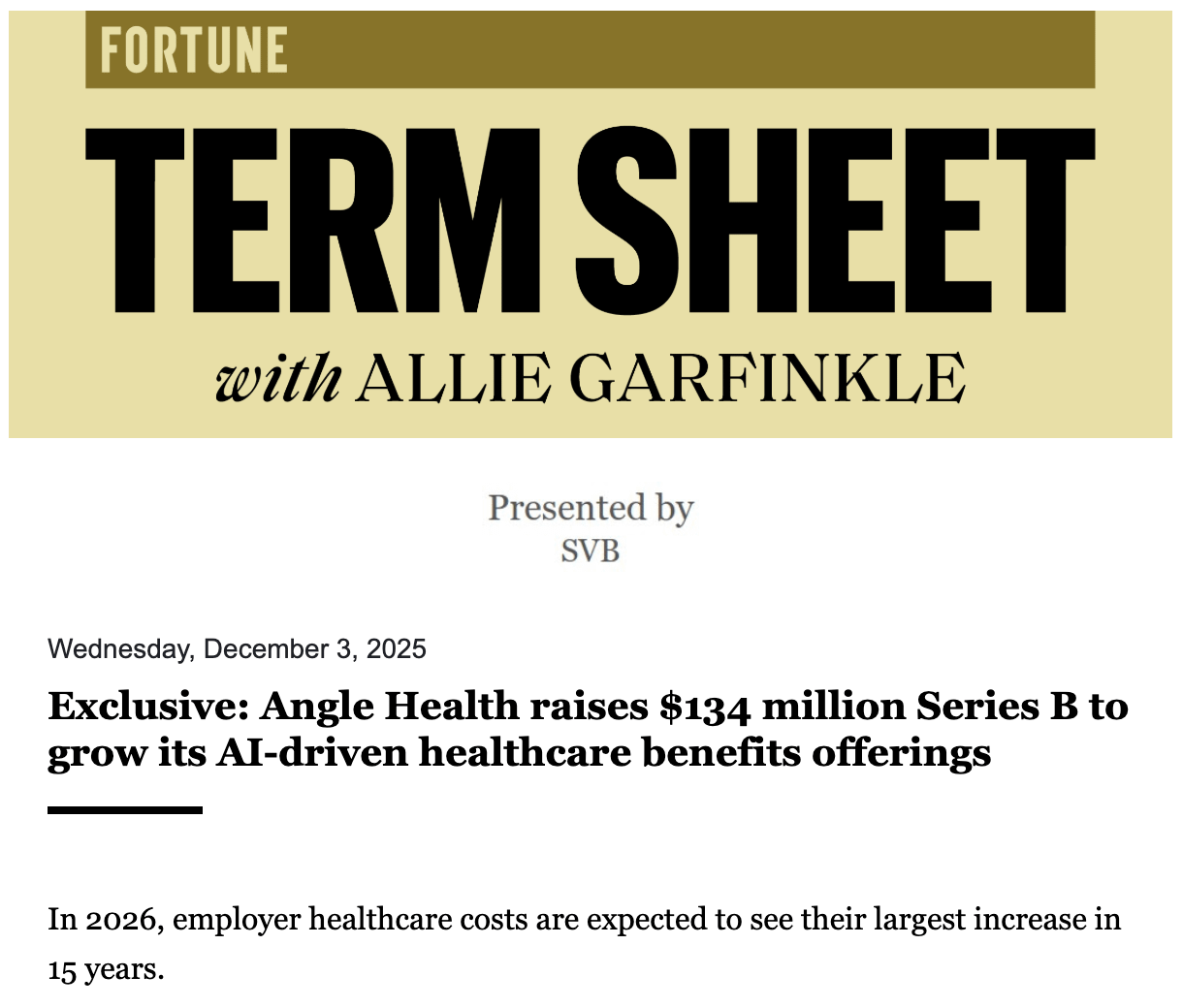
This is the line—and actually, it’s the first sentence of the article—that made me pause:
“In 2026, employer healthcare costs are expected to see their largest increase in 15 years.”
It opens the article on Angle Health’s Series B announcement. And you, early-stage founder, are probably rolling your eyes and thinking: It’s easy for a Series B company to land an exclusive in Fortune.
You’d be right—it is easier.
But you can still learn from this piece. Because the importance of having a strong company narrative is stage agnostic.
Your company narrative answers one question: Why does your company need to exist? And it should inform all of your communications: media interviews, website copy, social posts, even sales calls and investor meetings.
I draft narratives by breaking them into four parts:
The moment: What is happening now in the macro environment relevant to your company?
The problem: What pain are you fixing?
The solution: What did you build to fix it?
The stakes: What becomes possible if you succeed?
If you haven’t done this exercise—personally and/or with your cofounders—do it now so you’re aligned.
Angle Health—or maybe the reporter deserves all the credit—nails the moment:
“In 2026, employer healthcare costs are expected to see their largest increase in 15 years.”
It’s timely. It’s painful. I wish it were fiction, but it isn’t—and that’s why this moment works for Angle Health.1
Before we get into the Fortune piece, here’s my draft of what I imagine to be their company narrative—pulled from press releases, company blog posts, and Fortune:
In 2026, employer healthcare costs are projected to see their largest increase in 15 years, a spike that hits the 62 million SMB employees who depend on smaller companies for coverage especially hard. Traditional health insurance wasn’t built for these employers—plans are rigid, pricing is opaque, administrative work is overwhelming. Angle Health is rebuilding health benefits with an AI-native platform that automates administration, guides members to the right care, and delivers the level of service historically reserved for large enterprises. If successful, Angle will give every employer—not just the Fortune 500—access to high-quality, affordable benefits while unlocking a healthcare ecosystem that is responsive to the needs of tens of millions of workers.
Something like that.
Now, let’s reverse-engineer the coverage.
Allie Garfinkle—author of Fortune’s Term Sheet, host of the Term Sheet Podcast, and one of my favorite reporters—wrote this one.
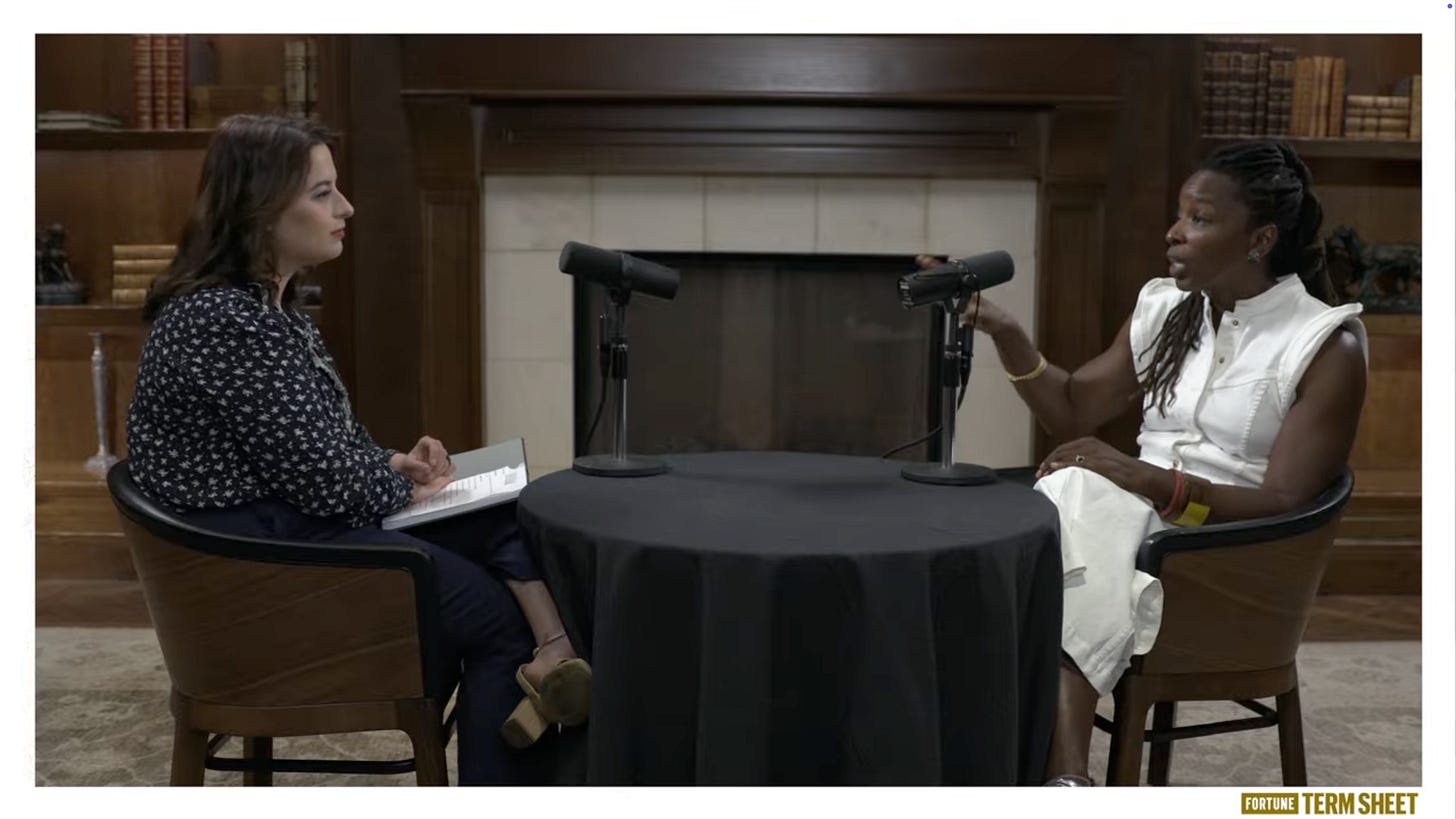
As someone obsessed with storytelling, she feels like my journalistic equivalent. Her passion shows up in the color she adds to her pieces—the small details she notices when she walks into the room, the throwaway lines spokespeople offer while filling silence, even the inclusion of her own lived experiences.
Because of this, I imagine Allie almost never agrees to an email Q&A.
Founders, take note: If you want to resonate with a reporter like Allie, you need to get comfortable with live interviews—phone or Zoom at minimum. Reporters like Allie pull meaning from the unscripted moments: the offhand remark, the laugh, the comment as the call is ending. Those moments don’t happen over email.
In 2024, I worked with Allie on a story about Y Combinator’s new Requests for Startups.
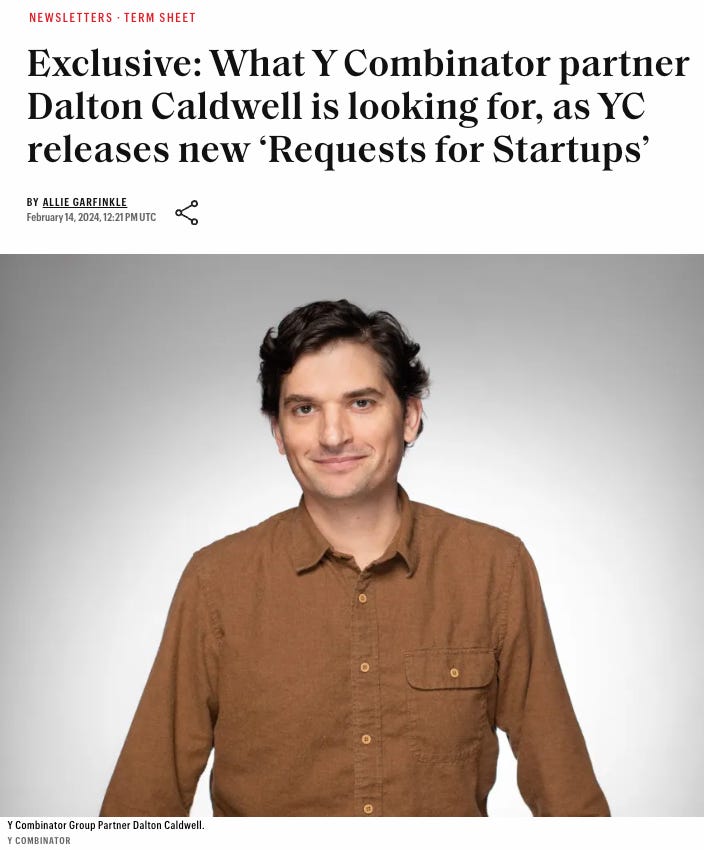
The interview would be with YC Partner Dalton Caldwell (now founder of Standard Capital). I always had insightful conversations with Dalton—but he is not one for small talk. For many comms people, putting someone who “doesn’t do small talk” in front of a reporter like Allie would be nerve-wracking.
But I wasn’t worried, because:
Dalton is sharp and thoughtful, even if he doesn’t riff.
Allie is the kind of reporter who can disarm anyone. She creates ease. She shows enough of her own personality that the person across from her relaxes.
A great storyteller isn’t trying to trip you up with small talk or by bringing atypical questions to an interview; they’re trying to understand you. That’s Allie. The more you show up as a real human—not a scripted spokesperson—the more likely your story will land as memorable.
That human element has to come across in your pitch. Allie’s coverage often centers on the people behind the news more than the funding numbers themselves. The funding makes it newsworthy, but the human stakes, perspective, or founder story is what makes it coverage-worthy.
A reminder of the questions to find your angle:
What’s the news hook?
What cultural shift does this reflect?
What trending story can you plug into?
What about your founder story or background is unique?
Do you have a partnership with a recognizable company?
Do you have surprising growth or customer data that gives a new perspective on the market?
Do you have investors with strong name recognition?
Here’s what likely made Angle Health’s story coverage-worthy to Fortune:
News hooks: $134M oversubscribed Series B round
Cultural shift: In 2026, employer healthcare costs are projected to see their largest increase in 15 years.
Trending story: Not “trending” in a viral sense, but highly relevant: Angle highlights its proprietary AI models trained on millions of de-identified patient records to predict healthcare risks and deliver personalized interventions. (An AI-native approach that aligns with one of the biggest narratives in healthcare and tech right now.)
Founder background: Founders Ty Wang and Anirban Gangopadhyay were both Palantir engineers. (Why this matters is outlined in a company blog: Palantir gave them a unique perspective into how the largest government and commercial organizations operate—experience that translates directly into building large-scale health infrastructure.)
Partnerships: N/A in this announcement
Data: (Outlined in a company press release.) Since announcing its last funding round in 2022:
Topline revenue grew 26x
More than 3,000 employers across 44 states served
Customer renewal rate of 80%+
Investors: Led by Portage, with participation from Blumberg Capital, Mighty Capital, PruVen Capital, SixThirty Ventures, TSVC, Wing VC, and Y Combinator
I started this post talking about the importance of a consistent company narrative—and you can see pieces of Angle Health’s appear in Fortune. But what about the founder narrative?
Your founder narrative explains why you are the right person to build this company. It includes the moment where the problem you’re solving became personal.
While the founder narrative didn’t make it into Fortune (beyond the Palantir reference), I expect it showed up in the pitch to Allie because it’s so powerful. From Angle Health’s blog post, here are the details of Ty Wang’s:
His parents were blue-collar workers juggling multiple jobs while managing chronic illness, unable to take time off to care for themselves.
Despite today’s proliferation of telehealth and digital health tools, those benefits remain out of reach for people without traditional insurance.
As a young engineer, he saw how dramatically employer-sponsored plans differed from the coverage available to SMB workers.
He began to understand how legacy infrastructure and misaligned incentives created a two-tier system—excellent care for some, limited access for most.
This is the “why me?” moment.
It’s concrete. It’s emotional. It’s relatable. And it ties directly to the 62 million SMB employees Angle aims to serve.
I imagine the pitch distilled it into something like:
“As a child of immigrants, I watched my blue-collar parents work multiple jobs while managing chronic illness—my first window into how complicated and unfair healthcare is for the 62 million SMB employees who depend on it.”
Speaking of the pitch, I’ll take a stab at drafting what this might have looked like:
Hi Allie,
Ty Wang here, founder of Angle Health. We’re rebuilding healthcare coverage for SMB employees—giving them the kind of benefits that, until now, only large enterprises could offer. We just raised an oversubscribed Series B, and I’d love to offer you the exclusive.
The timing is urgent: in 2026, employer healthcare costs are projected to see their largest increase in 15 years—greatly impacting the 62 million SMB employees who already operate at a disadvantage.
This problem has always been personal for me. I’m a child of immigrants; my blue-collar parents worked multiple jobs while managing chronic illness. Watching them navigate a system that felt unequal is what first opened my eyes to how deeply broken SMB healthcare really is.
Since our last round, we’ve seen the impact of fixing this: 26x topline revenue growth, more than 3,000 employers across 44 states now relying on Angle for benefits, and an 80%+ customer renewal rate.
If you’re interested in an exclusive, I’d be happy to meet for coffee and set up time with our lead investor at Portage.
Thanks,
Ty
Now that’s how you see a compelling company and founder narrative come together 🥂
If you’re a founder, take 20 minutes this week to write down your company narrative—and one sentence explaining why you had to build this. Your future coverage will be better for it.
Typical disclaimer: I’ve never worked with Angle Health, and everything here is a hypothesis based on public information. We may have crossed paths during the W20 batch, but that whole batch is a blur—because, well, the pandemic was a blur.
No posts
Comments
Nothing yet. Say the first thing.
Sign in to join the conversation.