
Chad IDE made it way too easy last week to distract yourself from your actual work.
The irony: Chad IDE is supposed to help developers stay focused by integrating your brainrot vices (TikTok, Tinder, X) directly into your agentic workflow—making it harder to lose track of time during the inference time gap.

The launch garnered 3M+ views and all types of attention. That’s the point though, right? To find a way—any way—to break through the noise and reach your target audience when you’re being labeled as “yet another vibe coding integrated development environment.”
But unintended, the launch also sparked questions about the supposed “vibe shift” happening inside Y Combinator and Andreessen Horowitz because of where they are investing—and sparked debates about rage baiting.
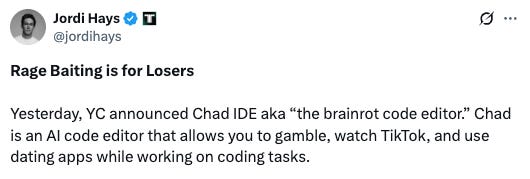
As a founder, it might be tempting to think that you need to create controversy or shock-value to gain the attention of VCs. And this instinct isn’t totally wrong—founder-led marketing has become a massive competitive gap. But here’s the part where founders are stumbling:
You don’t have to sacrifice your brand to get attention.
Even if your target audience on X are YC partners, you can see in real time that the vibe is shifting: they are trying to change the narrative that rage bate = signal and a positive signal for them to invest.1

While controversy can break through the noise, it can also alienate the very people you’re trying to reach.
Chad is now in closed beta, building a community of engineers excited about the idea. And they’ll find them—there’s a segment for this. But their launch ensures that segment is smaller than it needed to be. (Just look at the comments.)
So founders, what do you do with this insight?
Channel your target audience every time you create content. Aim to resonate—not spark debates about whether VCs are investing in the wrong ideas.
Very few founders know how to talk about what they’re building, position themselves in the market, and tie their work to macro trends.
But Melisa Tokmak the founder of Netic—a startup helping businesses and contractors like electricians, plumbers, HVAC technicians generate and handle demand with AI—nails her messaging every time. She resonates both with blue-collar workers and with VC Twitter.
Netic is the foil to Chad.
Netic speaks with optimistic, intentional messaging that’s aligned with a $500B industry that “keeps America running,” as well as candidates and VCs.
Chad speaks to a narrow set of developers and VCs with messaging that limits who the product can appeal to.
I first saw Netic on TBPN (2:26-2:40), a talk show embraced by the tech elite and exactly the kind of audience founders would kill for leading up to an investor demo day.
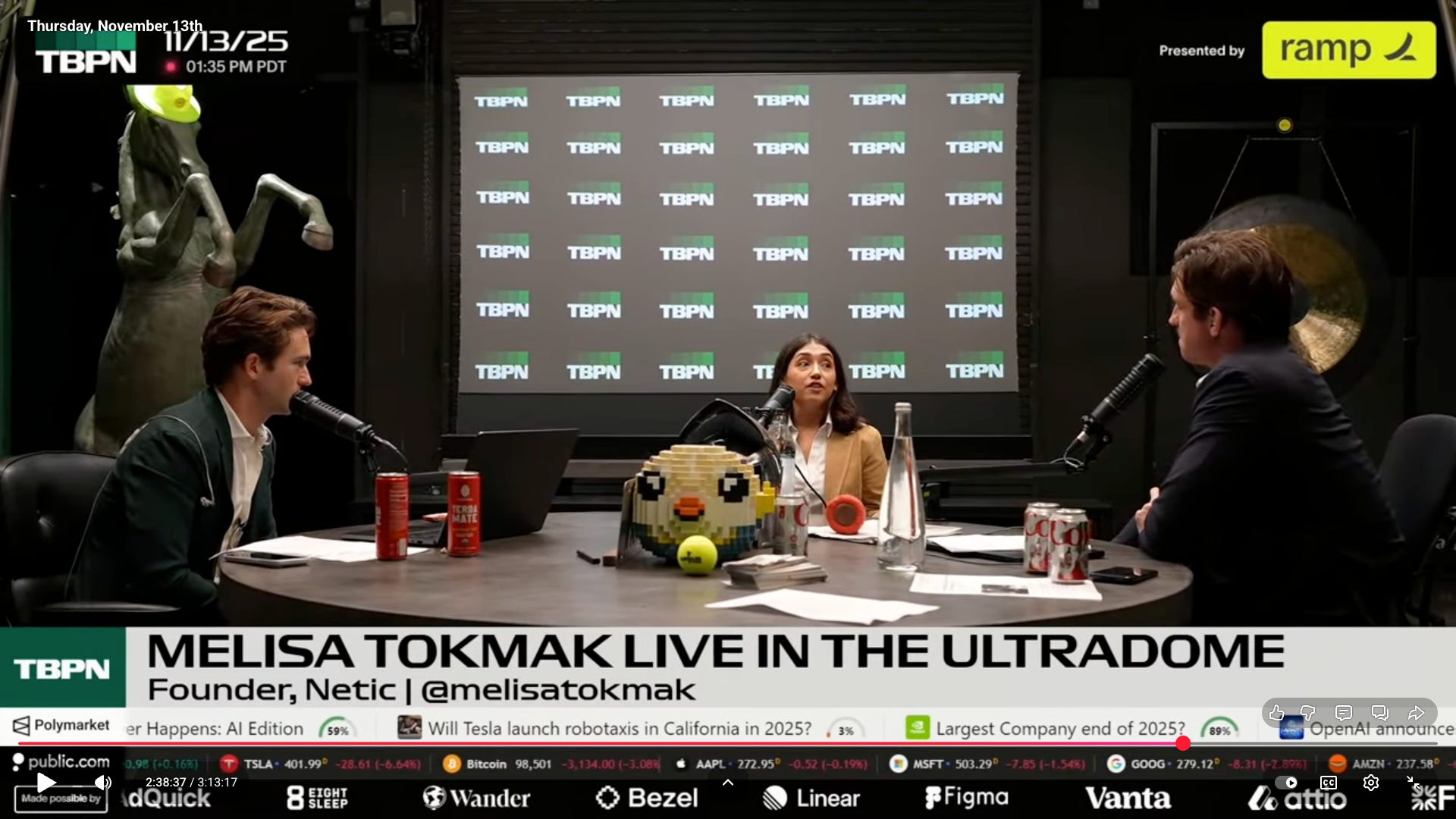
Melisa went live with the hosts to discuss Netic’s Series B.
And while blue-collar workers don’t watch TBPN, candidates do—which matters, because her messaging made it very clear: Netic is hiring.2.
(She also worked with Bloomberg on a story and broadcast opp, which is perfect for reaching her core audience of businesses owners and contractors.)
TBPN hosts John Coogan and Jordi Hays are a breath of fresh air. As someone who just introduced myself in a Discord as having “unabashed enthusiasm for tech/startups/building,” I want more coverage from tech optimists like them.
In their Information profile, they were also described as having an “unabashed, unapologetic enthusiasm for tech.”3 That makes founders like Melisa confident they’ll celebrate innovation—not drag them into gotcha traps that could alienate their core customers.
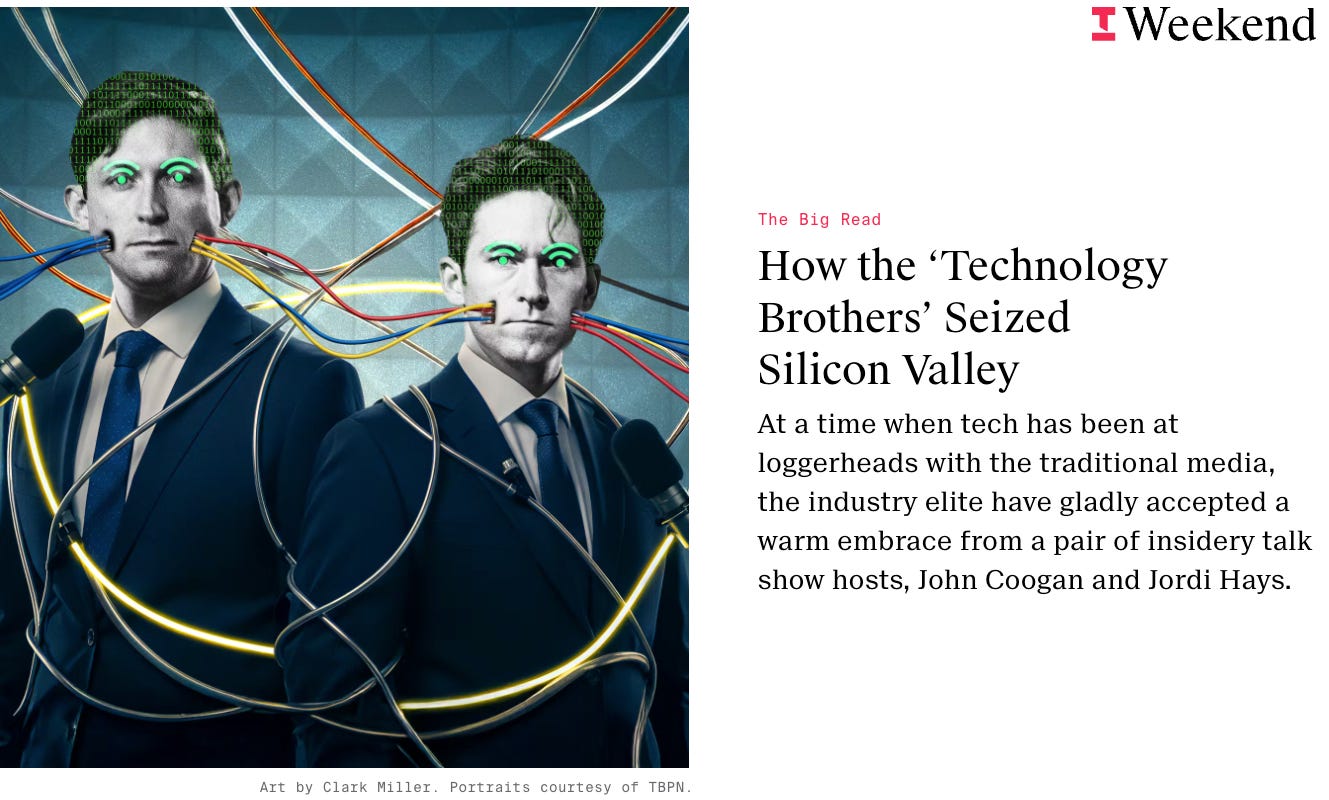
When determining who to bring on, John’s process is simple, according to The Information:
He goes to X and checks what they’ve shared recently, their number of followers and whether they follow the same people.
Founders: You must be active on social channels and speak to topics that resonate with your target audience.
Reporters, creators, hosts, and conference producers all check your social presence to gauge whether you matter in your community. This isn’t just a TBDN thing. It’s a media thing.
Melisa’s X account is a masterclass in clear founder narrative, consistent themes, and impactful storytelling about her users.
John and Jordi are also a great case study in how to build a brand without creating controversy. From The Information:
[Their] early gag that helped them gain attention: Print out posts from X from founders and investors, then dress up in suits and film themselves with top-end 4K cameras discussing the posts.
And their skill at brand building directly benefits the guests who come on the show. While their social channels don’t have a massive following yet (around 130,000 followers across their accounts), it’s not uncommon for one of their clips to go viral.
Back at YC, I often asked founders where they got their news. None pointed to the homepages of major outlets—they pointed to X. So even if John and Jordi’s following is on the smaller side, if a clip from your segment goes viral, the impact is huge.
A reminder of the questions to find your angle:
What’s the news hook?
What cultural shift does this reflect?
What trending story can you plug into?
What about your founder story or background is unique?
Do you have a partnership with a recognizable company?
Do you have surprising growth or customer data that gives a new perspective on the market?
Do you have investors with strong name recognition?
Here’s what likely made Netic’s story coverage-worthy to TBPN:
News hooks: $23 million Series B, valuing the company at $450 million—a 4x step up.
Cultural shift: The U.S. is facing a national shortage of skilled labor—the exact type of labor needed to build the explosion of data centers and handle post–extreme-weather demand. Netic sits at the center of this need, and Melisa repeats it everywhere: they’re building for “the backbone of the American economy: essential services businesses.”
Trending story: At GTC, Jensen Huang emphasized the industry’s need for “mountains” of mechanical engineers, electricians, plumbers, construction skills, and craft labor to support data center buildouts. TBDN even asked Melisa directly about this comment during the interview.
Founder background: From Bloomberg (and likely included in her original Series A pitch to TBDN): “Tokmak has a unique résumé for a Silicon Valley founder. Born in a small town in Turkey, she left home for a boarding school near Istanbul at 13, studied math and physics in India, and later went to Stanford University. After graduating, she worked on product and engineering teams at Facebook and at Scale AI, where she helped spearhead the company’s government and security focus.”
In the end though, just read her pinned post on X. She owns her founder narrative. It’s clear she’s worked incredibly hard to get where she is—and now works just as hard for her customers and team.
Partnerships: None shared.
Data: Netic didn’t provide growth or customer metrics, but Bloomberg included this notable data point from Founders Fund:
“Backing three early funding rounds in a row is something Founders Fund rarely does… the last companies they had enough conviction to back this way were Cognition AI and Anduril.”
A reminder that validating data doesn’t always have to come from inside the company.
And remember, for TBDN, X signal matters. Melisa has 30k+ followersInvestors: Founders Fund
On the day Melisa appeared on TBDN, the Bay Area was hit with a massive rainstorm. She mentioned on air that San Francisco was “a disaster because of the rain,” and that the Bay Area needed exactly the essential service providers Netic empowers—electricians, repair techs…
While this isn’t a “trending story” you’d pitch, it is a relatable detail that grounded the interview and helped viewers—especially potential candidates—better understand Netic’s value.
Through San Francisco story, she was saying: The work matters every single day. Come work for us.
She also stayed on message, making it clear she was speaking to potential candidates:
“When you have a business with strong margins and you’re scaling efficiently, you don’t want to raise more than you need. That would be a detractor to the type of talent we’re hiring—they want to work on nimble teams, run through walls, and build the future of essential services.”
In her pitch to TBDN, I’m sure she didn’t tell them she wanted to come on the show to reach candidates. But her preparation—the anecdotes she chose, the phrases she repeated—made that purpose obvious the moment the interview wrapped.
Great interviewees do two things extremely well:
They bring colorful stories or anecdotes.
They deliver clear key messages again and again.
Melisa is a repeat guest on TBPN. Back in June 2025, she came on the show to announce Netic’s $20M round—so she already had rapport with the hosts.
Because that first experience was positive, she (likely) kept the relationship warm. And because she gave TBPN exclusive news early in their run, the hosts likely view her as a high-trust guest.
Founders: build relationships with reporters and creators early in your career and in their career.
For her initial appearance, Melisa likely leaned on her partners at Founders Fund for a warm intro. (John was previously an entrepreneur-in-residence there.) Use your investors. Ask them for warm intros to TBPN, as they’ve likely appeared there. This tracks with what The Information reported:
Since “TBPN” debuted last October, Hays and Coogan have warmly welcomed investors from pretty much every major venture firm in existence, a marker of the podcast’s widening appeal.
So what does a second-time pitch look like when you already know the hosts? Casual. Direct. No need to explain the business again. Something like:
Hey guys,
Would love to come back on TBPN and share our $23M Series B: $450M valuation (4x step up), led by Founders Fund.
The timing is perfect: the U.S. skilled-labor shortage, the surge in data-center buildouts, and even Jensen’s “mountains of electricians” comment all tie directly into the problem we’re solving.
Founders Fund also mentioned this level of conviction (backing 3 rounds in a row) is rare for them. Last time was Cognition and Anduril.
If you’re up for another segment, we’d love to do it.
And that’s the lesson:
If you want to build a strong brand without relying on controversy, follow the people who are already doing it well. Study them. Borrow their frameworks. Translate their playbook to your own narrative, company, and target audience.
Another example of why you should never sacrifice your brand just to get attention.
Listen to the full interview and you’ll hear the same candidate-focused messaging throughout.
No posts
Comments
Nothing yet. Say the first thing.
Sign in to join the conversation.