
[Part 1; Part 2; Part 3; Part 4]
In late November 2024, species at risk scientists at Fisheries and Oceans Canada (DFO) convened a Teams meeting to discuss the “possible outcome scenarios” for an endangered leatherback sea turtle DFO had satellite-tagged that summer and named Dina. By then, you will recall, the 30-year-old reptile—identified as a valuable reproductive member of the beleaguered species—had attempted to exit the Gulf of St. Lawrence at St. Georges Bay nine times, but her passage to the Atlantic Ocean and her route back to her nesting beach in Trinidad was being blocked by the Canso Causeway.
Emails obtained through an Access to Information Request (ATIP) by Nova Scotia fisherman, Darren Porter, reveal that on that day, Colleen Smith, a senior fisheries protection biologist asked if the Canso Causeway had been identified in the species’ recovery strategy as a “threat” to the species. Mike James, head of the sea turtle unit replied, “pretty convinced it’s definitely an issue for turtle passage.”
As we now know, in addition to Dina, the causeway likely blocked and indirectly killed, at least three other leatherback turtles in late 2024 alone. One turtle, found on Port Hood beach and named Hoody, was necropsied and found to be emaciated and hypothermic, and suffering from skin lesions from prolonged frantic swimming. As well, leatherbacks were found dead at Pointe-Sapin and Long Pond. Their location, and time of year highly suggest the causeway was implicated in some way.
The causeway is also known to block passage for numerous other migratory species, including whales, sharks, and tuna.
We know that DFO is currently preparing an amended recovery strategy for leatherback sea turtles, and the document is supposed to provide updated information on the species, threats it faces, and identify critical habitat.
Earlier in the series I posed two key questions: 1) Will the causeway be included in the amended recovery strategy as a human-caused or anthropogenic threat? And 2) Will the amended strategy designate the Canso Strait—a traditional migratory route for this species—as critical habitat?
While DFO’s official messaging on all this is scant, at best, it should be acknowledged that DFO scientists themselves, who are most qualified to judge any of it—those who work inside the species at risk program—couldn’t be any more clear.
Fix the Canso Causeway problem.
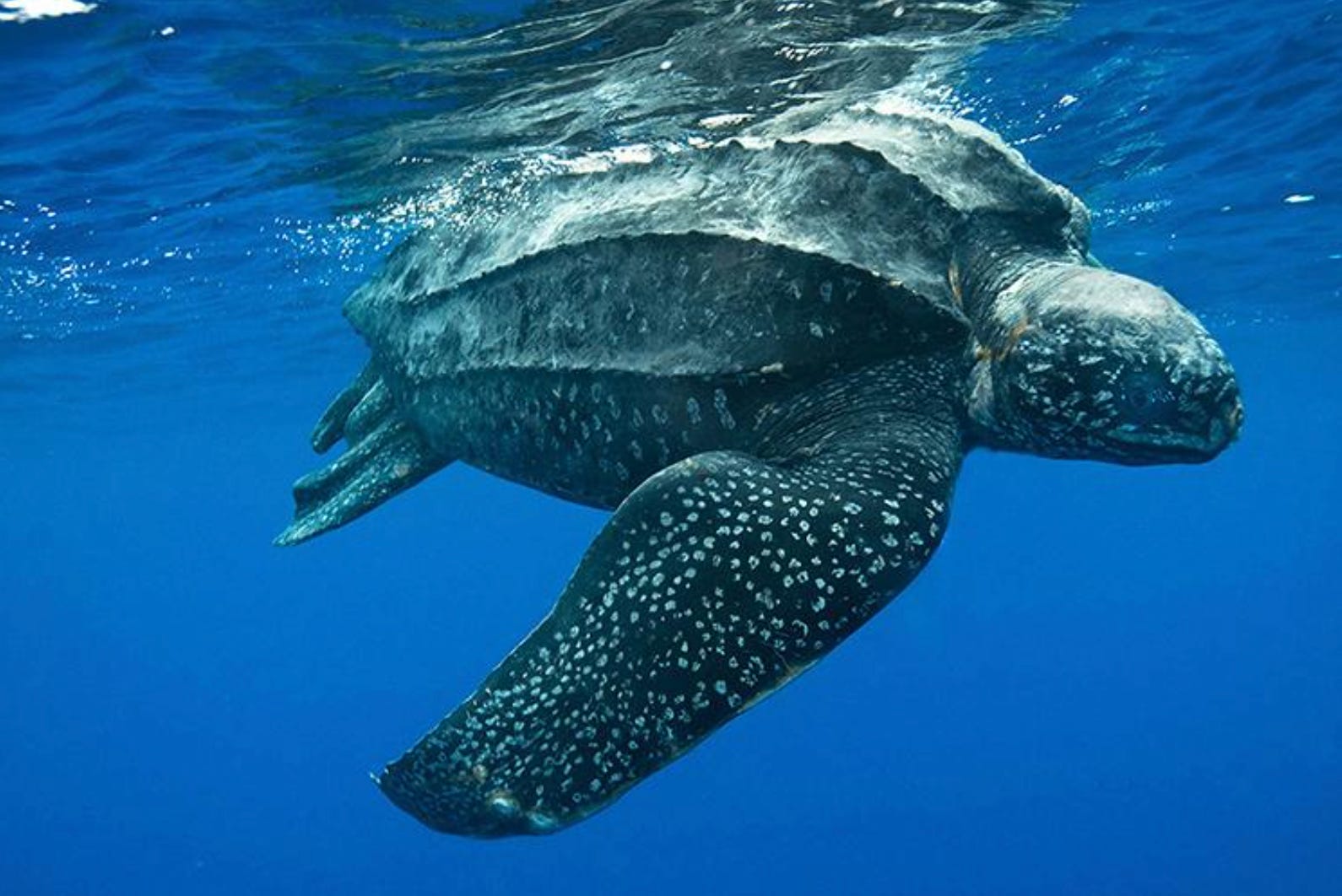
Leatherback sea turtle. Source
Mike Kofahl is the staff lawyer with East Coast Environmental Law (ECELAW). You were introduced to Kofahl earlier in this series. In an interview with The Quaking Swamp Journal, Kofahl lays out where legal obligations to protect species or habitat might get triggered or, how enlightened ministerial discretion could lead to a solution.
Kofahl explains that the federal Minister of Fisheries and Oceans—currently Joanne Thompson—could impose a condition of reporting requirements or order a study on the impacts of the causeway.
“That’s one practical solution the minister has available to them to use if they wanted to.”
Heck, they could even jump start the process of creating animal passage if they saw fit to do so.
For example, in 2000, DFO minister Herb Dhaliwal did just that. He appointed Eugene Niles, a former regional director for DFO’s Gulf region as a special advisor and tasked him with conducting a review of all the issues surrounding the Petitcodiac River causeway, which was built in 1968 across the tidal river to join the communities of Moncton and Riverview, and to provide some control over water levels on nearby agricultural land.
Dhaliwal asked Niles to come up with a range of options, including a final recommendation.
When the Petitcodiac River causeway was initially built, a fishway was incorporated into the structure but it was blocked by sediment build up and rendered useless. Controversy around fish passage dogged the structure for nearly 30 years, mainly a result of the observed ecological decline, and the collapse of fish populations.
Niles recommended that the province and the feds embark on a joint environmental assessment of constructing a partial bridge in the causeway. In 2010, the gates were opened to allow the movement of fish, and by 2021, the entire 240-metre causeway was removed and replaced with a $61.6 million bridge, allowing the restoration of the Petitcodiac River’s natural tidal flow.
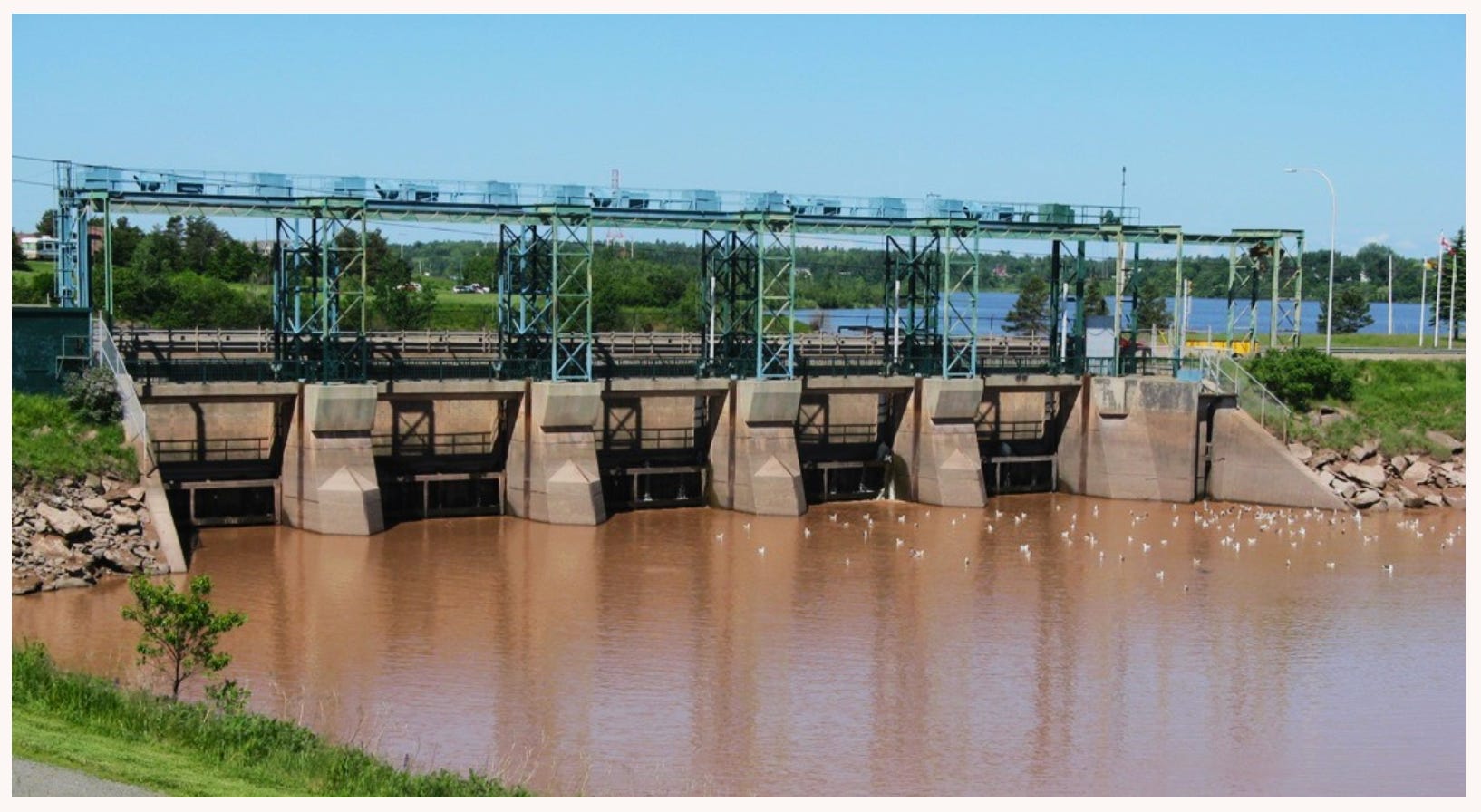
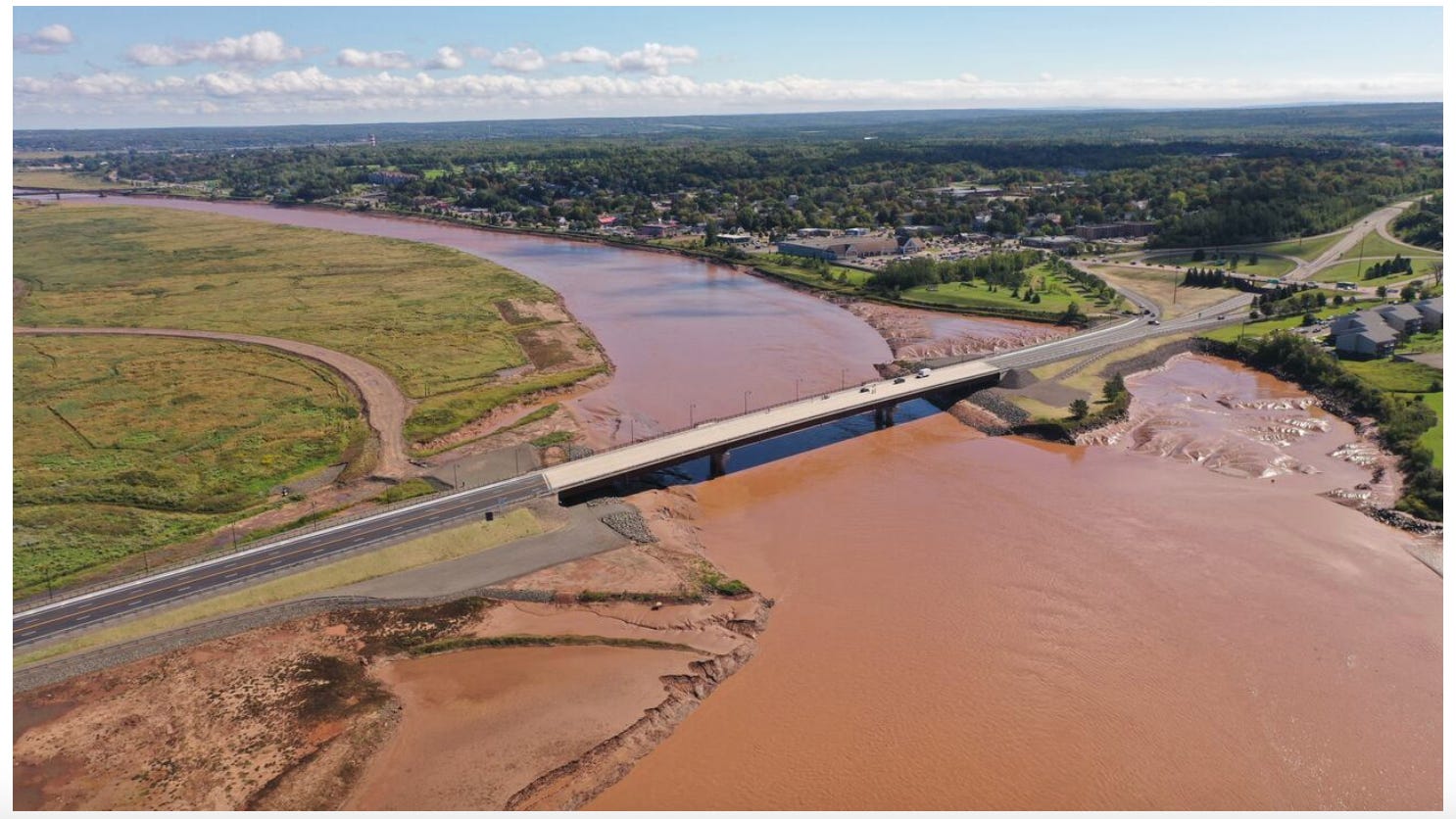
Petitcodiac River causeway (top) was built in 1968 connecting Moncton with Riverview, New Brunswick. By 2021, the entire 240-metre causeway was removed and replaced with a $61.6 million bridge, allowing the restoration of the Petitcodiac River’s natural tidal flow.
Another possible avenue arises when existing structures, like the Canso Causeway and ship lock, require approval to keep operating.
According to Kofahl, “The federal minister can impose conditions as part of that authorization. One of the things you can imagine is a reporting requirement that could feed into something like a recovery strategy or even the identification of critical habitat. That’s something that could easily be done in the Fisheries Act right now, as just an imposed condition on the operators of the causeway or the ship lock.”
Kofahl continues:
“If the causeway does get listed as a “threat” to the species, there could be a legal obligation to do something about it. It depends on what the critical habitat is and what the strategy is, what the plan parameters are, and what the ultimate obligations actually are.”
“The big thing would be monitoring and studies, and hopefully, designation of the [causeway as] critical habitat would be really helpful. But if the Canso Causeway or the Canso Strait are not identified as critical habitat, that can be limiting, unfortunately.”
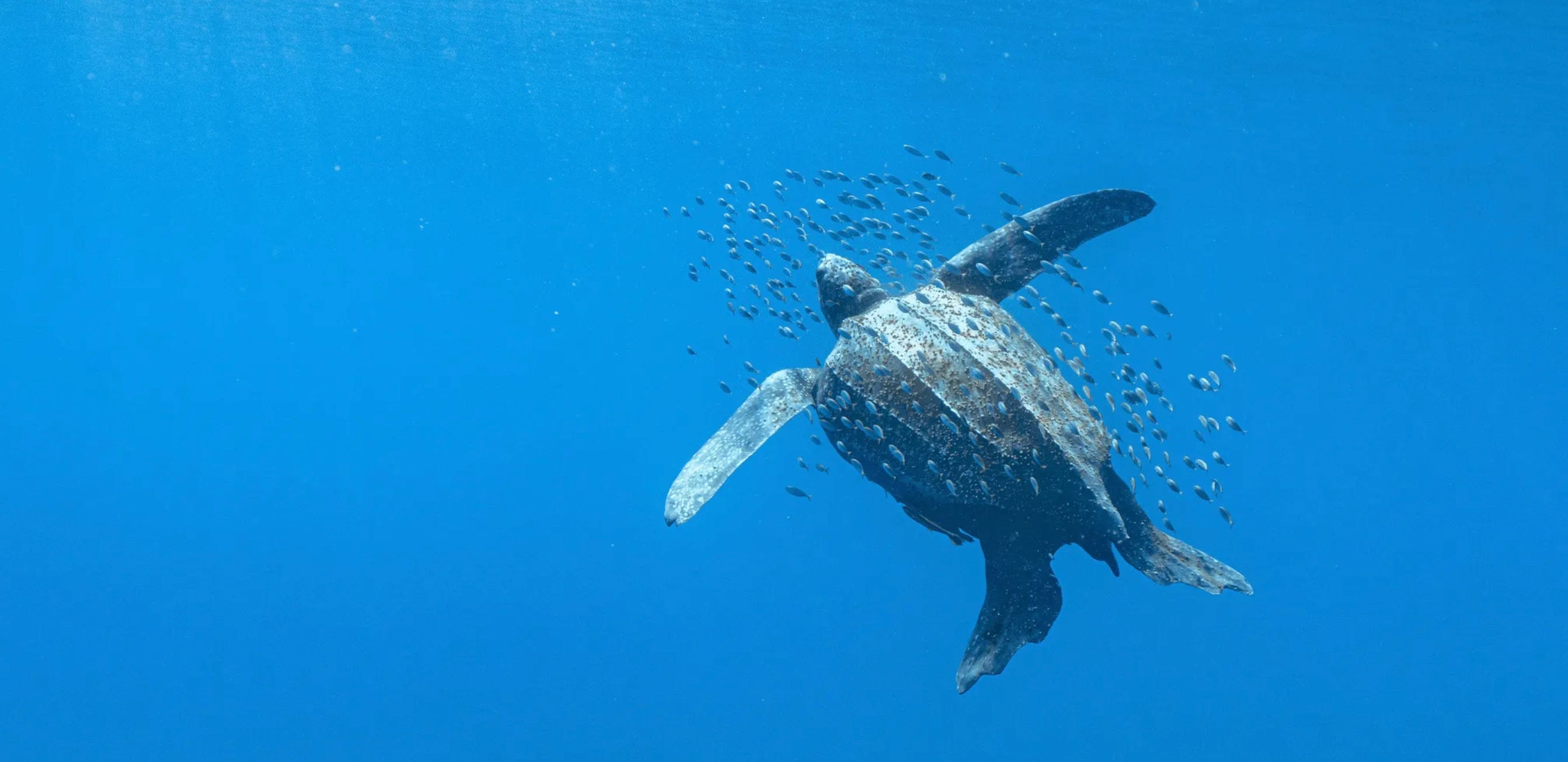
Leatherback sea turtle swimming with fish. Source: iNaturalist
On December 19, 2024, according to the ATIP, Wendy Williams wrote to her colleagues at DFO to discuss the Fisheries Act. Williams is the director of aquatic ecosystems and when she penned her email to the group, Dina was unfortunately swimming south again, down the west coast of Cape Breton Island, instead of up and around it. Mike James was providing the team with regular updates on her whereabouts.
“I expect she may appear back in St. Georges Bay – Canso Causeway area,” writes James. “Her tag is starting to log some time at 0-3 degrees C, and nothing above 6 degrees C. At this point I don’t think it’s likely she will exit the Gulf.”
Williams’ email focuses on the Fisheries Act, and notes that it “prohibits impacts to fish and fish habitat, including preventing fish passage, and provides the Minister with authorities to compel the owner/operator of an obstruction to undertake studies and implement measures to comply with the Act.”
Williams also notes that neither the causeway or the canal meet the current requirements of the Fisheries Act and that the DFO “has developed, and is implementing an existing facilities position statement that requires existing structures to comply with the Act. DFO is currently applying this statement to other existing facilities/structures, including hydroelectric facilities and the Avon River causeway, for example.”
Kofahl says DFO’s policy for “existing facilities” would mean that ongoing activities would be “captured” under the Fisheries Act and the Species at Risk Act.
“Some of the main provisions of the Fisheries Act include protections against blocking fish passage, but these provisions that deal with fish and fish habitats didn’t exist when the Canso Causeway was built. So, generally, in Canadian law, statutory provisions are very explicit that they don’t apply retroactively.”
Kofahl explains that while the Fisheries Act doesn’t apply to existing structures retroactively, the Canso Causeway does have “ongoing operations and potential maintenance activities that do apply under the current Act.
“There is a working bridge and ship lock, so there are potentially maintenance issues there,” and while “the structure itself is just an immobile structure, I know that occasionally they add new rock material or aggregate [to the causeway] and may fix parts of the causeway. Those sorts of activity would be captured as well under the Fisheries Act.”
“Getting out ahead of the causeway needing repairs” is one of Heather Penney’s research goals. Penney coordinates the Aquatic Resources Program at StFX, and is one of the researchers involved in the Canso Causeway study I discussed earlier in this series.
“The causeway is 70 years old, so eventually they will have to adjust/fix/repair. When this happens, I’d like to see openings for migration added,” says Penney.
When it comes to the Species at Risk Act, Kofahl says, “if a structure or an activity arose that harmed or killed a turtle directly,” that law would automatically be triggered. But he explains—and we have touched on this— that while the causeway blocked Dina’s passage, forcing her to swim around in search of an exit, which most likely resulted in depleted energy stores, hypothermia, and her ultimate death—“it’s an indirect consequence.”
However, if the Canso Strait was listed as part of the leatherback sea turtle’s critical habitat because it’s part of its migratory route, then the Species at Risk Act would come into play, he explains.
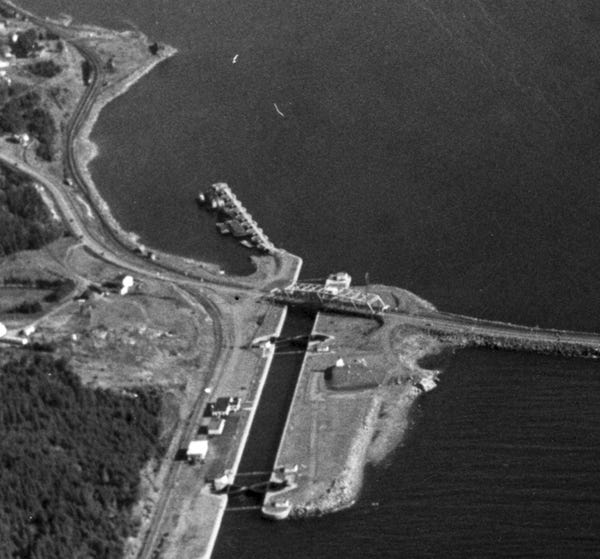
Canso Canal and navigational lock, with Cape Breton on the left.
As previously reported, in 2014, the causeway structure, including the swing bridge, were transferred to the province from the federal government. The feds maintain jurisdiction over the canal and navigational lock.
When it comes to the causeway structure itself, Gary Andrea, media advisor with the provincial department of Public Works, echoes what Kofahl says: “If in the future the causeway requires expansion or reconstruction, enhancements for fish and aquatic life and compliance with the federal Fisheries and Species at Risk Acts will be part of our design considerations.”
As for the canal and navigational lock, the Canadian Coast Guard (CCG) own, maintain, and operate it. Up until very recently, the CCG has been a special agency within DFO, but pursuant to an Order in Council made on September 2, 2025, it was transferred to the Department of National Defense (DND). This transfer was effective April 1, 2026.
I reached out to the DND to see what it had to say about the possibility of restoring marine life passage in the Canso Strait. Apart from providing a couple paragraphs about the history of the causeway and ship lock construction, there was little on offer:
“Questions related to the movement of marine life and compliance with the Fisheries Act and Species at Risk Act would be best addressed by DFO.”
We do know, based on the ATIP, that a few days after the Teams meeting, DFO scientists flagged the Canso canal as a potential exit route for Dina out of the Gulf.
The conservation and protection (C&P) Gulf area chief spoke with Canso canal staff to see if anything could be arranged. The Canada Coast Guard, now under the auspices of DND, operates the canal and locks from April 14 to December 23, on a 24/7 basis. If things had been operating normally in November 2024, the canal could potentially have been opened up to allow Dina’s passage when she was in the vicinity of the causeway — which seemed like a lot of the time, based on the satellite tracking data.
It wouldn’t have been the first time the canal was used in this way. We saw earlier in the series how in 2014 the canal was opened to allow the passage of a dead fin whale stuck outside the north gate, blocking vessel traffic. In that case, the north and south gates were opened, allowing the tide to move the whale carcass through the canal.
But apparently, in November 2024, the canal wasn’t an option for Dina. It had been closed for months. According to the ATIP, Canso canal operators said a private company was de-watering/ dredging the site.
“The canal is completely out of the question.”
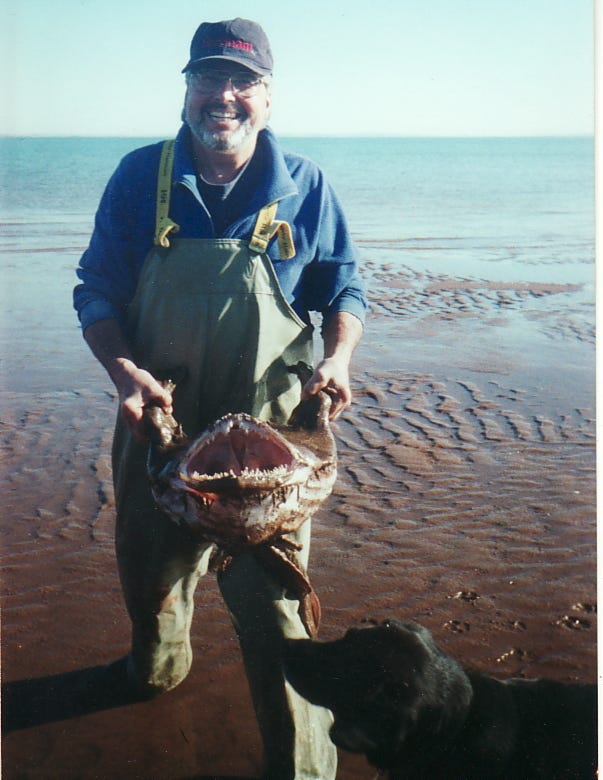
Mike Dadswell with a monkfish and Buddy. Dadswell is a retired Acadia University biology professor, and former DFO fisheries scientist. Photo contributed.
Mike Dadswell is a retired professor of biology at Acadia University in Wolfville, where he spent 30 years teaching, and before that, nine years as a fisheries scientist with the DFO. His research has focused on Atlantic salmon, sturgeon, lobster, scallop aquaculture, and the impact of tidal turbines on fishes, and freshwater ecology.
In an interview, Dadswell tells me that in the late 1970s, during his stint with the DFO, he was brought into “an exercise to look at the Canso Causeway and see whether it had done anything to the biology and fisheries of Nova Scotia or New Brunswick.”
At the time, there had been a precipitous decline in annual lobster landings in Chedabucto Bay. Between 1968 and 1977, landings had pretty much collapsed and were 95% lower than what they had been two decades earlier. Dadswell had a hypothesis, which he presented in a 1979 paper, published in DFO’s Fisheries and Marine Service Technical Reports.
Before the causeway construction, female lobsters would move upstream from eastern Nova Scotia into the Gulf of St. Lawrence to release their eggs. These hatched lobster eggs (larvae) would then drift downstream “in the powerful flow out of the Strait,” into Chedabucto Bay and down the eastern coast of Nova Scotia, where they would eventually mature, reaching marketable size after 5-7 years. But when the causeway was built, that all stopped. The lobster stock collapsed from normal fishing pressure.
“There just was no recruitment, so it was down in the stocks.”
Dadswell says there also used to be a million-tonne haddock fishery in the Strait of Canso. “Of course, that got wiped out too because the fish couldn’t go through anymore.”
Interestingly, in Dadswell’s 1979 paper he writes that the causeway “arrests the flow of the larval-bearing water.” It’s what he believed at the time: the causeway was an impermeable structure, stopping water flow completely. But about 20 years ago, that view changed.
I had a scallop farm back then, and [the causeway] was a good place to collect little baby scallops. It would take me a whole day to put the array in the water and then I’d come back a couple of months later when they were big enough to get off the mesh that they attached themselves to. While I was there in a boat—and I’ve got stuff in the water—all of a sudden, it all starts to move as the current flows and as the tide comes up. There’s still quite a current that goes through the big rocks of the causeway. It’s not sealed, so [marine] animals can still feel the current coming to them, and it draws them in, and they think that’s a way to go.
Dadswell says the Gulf of St. Lawrence attracts a lot of marine life in the summer “because it’s a very rich environment.”
“In the late fall, the Atlantic Ocean is four or five degrees warmer than the Gulf, so the cold water starts driving them out and then they feel the current so they follow it and bingo.”
Dadswell says there is also the hard-wired instinct to migrate south, but he says the current also plays a role.
I asked Dadswell if there was any talk at DFO back when he worked there about what could be done to the causeway to allow for marine life passage.
“Oh, lots of it,” he says.
Back in 1978 and 1979 there were “numerous meetings about the Strait and also with the fishermen,” says Dadswell, “at least three or four that I can remember—one at Bedford, a couple at St. Andrews. I don’t know if there were more later, probably. I left DFO in 1986. At every meeting, the idea came up about a passage and/or a bridge.”
Dadswell envisions a partial bridge over a free-flowing channel.
“They don’t need to take the causeway out…it [the opening] probably only has to be about 50 feet deep and 100 feet wide, just as long as the current goes through… the animals just need a path.”
But according to Dadswell, the DFO “didn’t want to change anything. They didn’t want to spend the money, is what it came right down to,” he says.
Darren Porter is a weir fisherman in the Bay of Fundy, and no stranger to taking on infrastructure that blocks fish passage. Porter has been advocating for proper fish passage at the Windsor aboiteau since 2009—an issue that was only very recently resolved—and roughly a decade ago he, along with others, including the aforementioned Dadswell, began raising awareness about how the spinning turbines at the Annapolis tidal generating station were killing migrating fish in violation of the Fisheries Act.1
As previously written, Porter is the one who submitted the Access to Information (ATIP) request about Dina, and then provided the results to journalists, including me.
In an interview I asked Porter what it was about Dina’s story that motivated him to find out more about what happened to her.
“I live on the water and I live within that resource and that environment. I have become very attached to it.”
I see massive harm to fish and fish habitat and massive harm to creatures and the fishery, as well as to indigenous groups. I’ve tried to figure out how to deal with it over the years, and it’s very complex because DFO does not protect fish and fish habitat. DFO protects the illusion that they protect fish-and-fish habitat. There hasn’t been a single conviction of a single barrier in the province of Nova Scotia ever, which means Sections 34 and 35 of the Fisheries Act, which are intended to protect fish and their habitats from harmful activities, are not being enforced.2
“We have beautiful laws, but we have zero enforcement for barriers.”
The Canso Causeway and canal have caused “the most ecological damage to the marine environment of any structure in the province of Nova Scotia and possibly the Maritimes region because that area was a productivity pump,” he says.
“It’s number one on the list. It’s just a big environmental disaster. If we can find a way to mitigate that disaster and make it better, why not?”
Porter says, the first step is to recognize that the Canso Strait is critical habitat for the endangered leatherback sea turtle.
The next step is to think big.
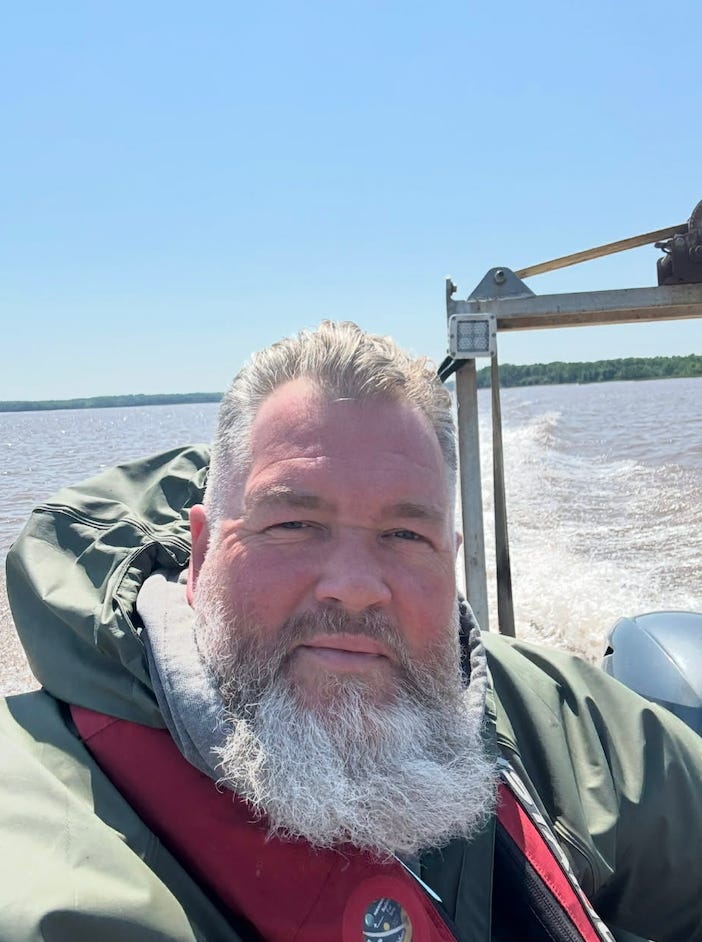
Darren Porter is a weir fisherman on the Minas Basin who has advocated for fish passage at the Annapolis tidal generating station, and at the Windor aboiteau where it crosses the Avon River. Porter filed the Access to Information request with the DFO about Dina, and shared his findings with journalists. Photo contributed.
Back at the DFO Teams meeting in November 2024, Colleen Smith, the senior fisheries protection biologist alludes to the cost involved in fixing the causeway, and says it could be the “offsetting project of the century – even removing a portion of it to a bridge.”
Offsetting, in this context, is when the activities of a proposed project or development that will have unavoidable harmful impacts on fish and fish habitat are counteracted by doing something beneficial. According to DFO policy, it’s something proponents have to consider, when their undertaking is anywhere on or near a water body, and the harmful impacts on fish and fish habitat cannot be avoided or mitigated.
Offsetting is something Darren Porter sees as a way to fund the creation of animal passage in the causeway.
“We know there are [mining] companies coming to the province that are going to cause damage, and they need offsets. There’s going to be a lot of offsets needed and they just don’t exist.”
Porter argues that the magnitude of the offsets that mining and other extractive companies will require can be satisfied by fixing the Canso Causeway and restoring the Canso Strait.
“Why don’t these companies partner with the province? It would be the biggest marine win for whales, turtles, sharks, and multiple species of fish. There’s no problem bigger and more important to fix.”
I reached out the DFO to find out if there is any way that restoring marine life passage in the Canso Causeway could be funded as an “offset project” — by combining offsets from government projects and/ or from proponents who are being required to offset due to unavoidable environmental impacts?
DFO’s response wasn’t exactly an encouraging one, but it did seem to put the ball entirely in the proponent’s court.
“DFO’s approach to offsetting is outlined in its Policy for Applying Measures to Offset Harmful Impacts to Fish and Fish Habitat. Offsetting is the responsibility of the proponent.”
I also contacted the Nova Scotia Department of Public Works, to find out more about the province’s “habitat banking” system, and whether it could be used to help fund the creation of passage in the causeway.
Gary Andrea replied:
As part of various projects, the province maintains credits for creating and preserving sensitive environmental habitat such as marshes and wetlands. Those credits can be used for future projects that will require altering other sensitive areas. The department’s habitat banks are continuously being depleted and replenished when we perform various types of construction and maintenance projects each year.
“Does this mean that if work needs to be done on the causeway in the future to comply with the Fisheries or SAR Acts, the credits in the “habitat bank” might be used, if there are any?” I ask.
Andrea replied: “It would depend on the nature of the project. We can’t speculate on a hypothetical project.”
Porter envisions a small bridge being built within the causeway. “That’s the minimum,” he says.
“We have a responsibility to try to find a solution to fix this.”
When you think about it, fixing it really is a no-brainer. It would be like paying for the damage the initial causeway construction project externalized, and even then, given the magnitude of the ecological devastation over a 70-year period, it would only be a fraction of the actual damage cost.
As Kathleen Martin, head of the Canadian Sea Turtle Network says, “We know it’s a problem. Let’s fix it. It’s a huge opportunity to do the right thing.”
If you look around, the tide is not only turning, it’s flowing again. The Petitcodiac River, Annapolis River, and Avon River — tidal rivers, restored or being restored.
Let’s add the Strait of Canso to that list.
Think of it as reparations.
[Right of Passage is an ongoing series, written in honour of Dina, and the countless other marine creatures that have met a similar fate in the Strait of Canso. Stay tuned for future updates on this story. Thank you for reading. If you value long-form journalism, please consider taking out a paid subscription.]
The Windsor aboiteau is essentially a small dam which was slated to be replaced as part of the highway 101 twinning project where it crosses the Avon River. Up until recently the twinning project has been held up over issues involving fish passage while also maintaining freshwater in the adjacent Lake Pisiquid, a man-made lake. The lake only exists when the sluice gates on the Avon River aboiteau are kept closed, but when the gates are closed and the tide drops, the migration route of fish including gaspereau and salmon is not only blocked, but the low water levels trap the fish in mud and shallow, high-temperature pools, often killing them. To add insult to injury, in 2023 the NS government imposed a state of emergency (under Section 12 of the Emergency Management Act) for the Windsor area and ordered that the aboiteau gates remain closed to refill Lake Pisiquid for fire control purposes, even though there were no wildfires anywhere in the vicinity of Windsor. Earlier this year, DFO approved a new aboiteau structure that will allow for fish passage while maintaining brackish water in the lake. For more on this controversial and complicated story go here, and here.
In 2019 the DFO ruled that the hydraulic lift propellor turbine at the Annapolis tidal generating station—the first of its kind in North America—was in fact killing fish that were returning to their natal river to spawn, including gaspereau, American shad, striped bass, an Atlantic sturgeon. It’s something the DFO had known about for years but did nothing about—and it meant that NS Power would need authorization under the Act to continue to operate. According to a CBC report at the time—quoting DFO—for the Fisheries Act authorization the proponent had to “develop and present ways the project could avoid, mitigate, or offset impacts to fish and fish habitat.” To mitigate the damage, the company found it might need to shut down the turbines for four months every year to allow for the passage of various migrating species of fish. According to Porter, the company could also choose to offset the damage done by the turbines, but he says that “was too expensive to solve.” In the end, NS Power did not apply for that authorization and instead applied to decommission the 37-year-old tidal generating station.
Section 34 provides definitions and the legislative framework for fish habitat protection, including the definition of “fish habitat” and “deleterious substance,” while Section 35 prohibits the “harmful alteration, disruption or destruction of fish habitat” (HADD), unless authorized by the Minister.
No posts
Comments
Nothing yet. Say the first thing.
Sign in to join the conversation.