
As I work on the next instalment of “Right of Passage,” an ongoing series about how the Canso Causeway blocks the natural migration of numerous species including the endangered leatherback sea turtle, there’s been a storm gathering in the province about the anti-democratic tendencies of Premier Tim Houston, whose recent budget-cuts have raised the ire of many a Nova Scotian, and rightly so.
That I haven’t weighed in here at the Quaking Swamp Journal about Houston’s most recent shenanigans hasn’t gone unnoticed by some of you. Without naming names, one paid subscriber recently wrote me to say that the “turtle endangerment story” was not their “focus,” and that they needed to “focus on the immediate threats” posed by the government “in its attempts to undercut the creative and progressive movements of our culture.”
“I am sure that you are aware of these threats since it limits the ability of independent artists, historians, and journalists to obtain funding support,” this reader wrote.
I’ve gotten a few other “unsubscribes” recently — maybe they are for similar reasons, maybe not. But I’d like to address this, even if it is only one reader’s sentiment. I think it raises some important issues.
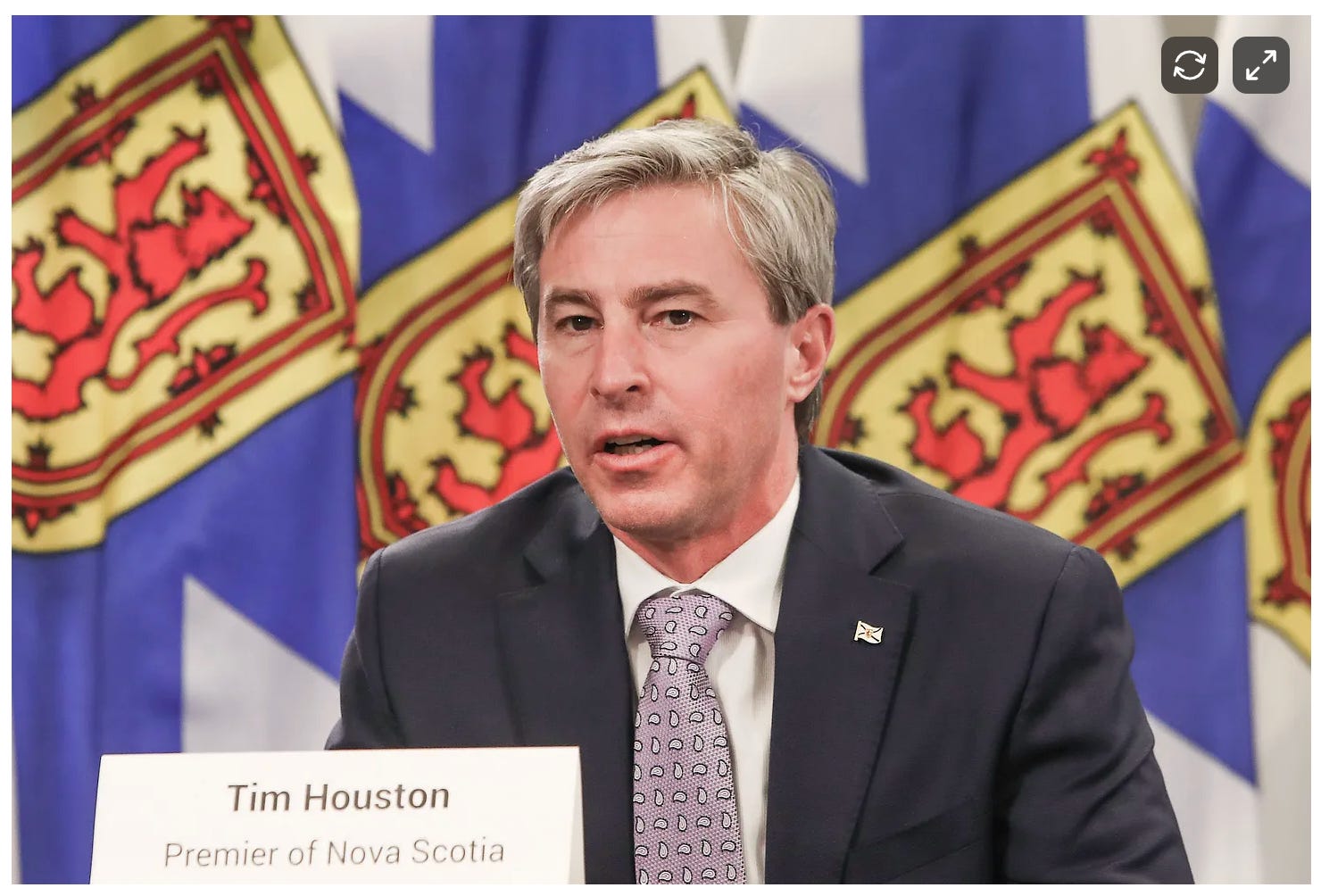
But first, while I personally have never been on the receiving end of any provincial government funding support, I wholeheartedly sympathize with anyone who does and has either lost their job or funding in this latest round of unjustifiable budget cuts.
I recently wrote on Facebook:
What a legacy Houston (BlackRock boy) is creating for himself and his government: a province that has been environmentally and culturally pillaged, not to mention the damage he’s doing to what’s left of our democratic processes. And for what? While he’s taking aim at so many of the things that make life worth living for most of us (and why people want to come to this province) -- he is enriching the 1%, who he has been shilling for all along.
It’s true that my energy and focus over the last few months has been elsewhere — namely working on a long-form series about the beleaguered leatherback sea turtle— but if anyone is late to the game on Houston’s contempt for democracy, it’s not me.
I’ve been writing about this very subject matter for years. Houston’s authoritarian tendencies were in full display during the pandemic, but back then, his over-reach was either largely ignored, cheered on, or seen as a necessary evil, by much of this province’s media and public. My list of articles on this subject is long, and I suggest you peruse the archive if you’re interested in revisiting that time period.
Since then, I’ve written about his contempt for democracy on a number of other fronts: betraying promises about protected areas (here and here), scrapping legislation on coastal protection (here), showing disingenuous concern about forest fires (here), secretly changing wetland policies (here and here), and passing a raft of new laws that will no doubt have negative environmental and societal ramifications for this province well into the future (here and here). Even before Houston moved to open up the province to uranium mining, I began a 7-part series on Rosalie Bertell – who devoted much of her working life to exposing the dangers of low-level radiation.
Bertell was so prescient – it’s astonishing how much so – when she delivered the following in a 1986 acceptance speech for the Right Livelihood award she said:
This [award] is a much-valued service to the forming global village. In the long run it will, I think, be more humanly productive than increased airport security, military exercises, nuclear threats, and development of crowd-control technology. This contrast between a system of encouragement and cooperation, on the one hand, and a system of threats and forceable control, on the other, lies at the centre of the global crisis. It poses a clear choice for the future, on which will depend the survival or disintegration of civilization.
Houston (like many other politicians in Canada and around the world) has opted for capitalizing on crisis, when it legitimately exists, or manufacturing it when it doesn’t. Either way, they can justify that “system of threats” and “forceable control,” that Bertell was referring to.
Just look at what recently happened in Province House: the government brought forth a budget that they had to know would be wildly unpopular, which led to a protest inside the legislature (ie. the singing protestors), and the government reaction was to close Province House for a week, citing safety concerns, and a need for facial recognition technology and better surveillance.
It’s truly astonishing. In Canada, freedom of expression and assembly are part of our Charter rights and freedoms. Protest is supposed to be disruptive — that’s entirely the point of it. But here the government has managed to take something entirely lawful and make it problematic.
But what’s more astonishing to me is that this was the same playbook used during the pandemic against protest. But many of the same people angry about Houston’s shenanigans today, accepted this authoritarian approach back then.
It’s a slippery slope, folks.
Keeping people safe can take many permutations. Be wary of laws that are being justified on those grounds, and of governments that trot out the “keeping people safe” card whenever they want more control.
Thanks for reading and supporting my writing in whatever way you can.
No posts
Comments
Nothing yet. Say the first thing.
Sign in to join the conversation.